Bar Knife
A bar knife is a small paring knife with a straight blade, about 8 to 10cm in the ones we use (Urban Bar’s own Coley bar knife has an 11.5cm blade), kept for fruit and garnishes and nothing else. It cuts citrus wedges, wheels and slices, squares off twists and halves limes for the press. Any drink with a cut garnish, from a Tom Collins to a Campari and Soda, starts with one.
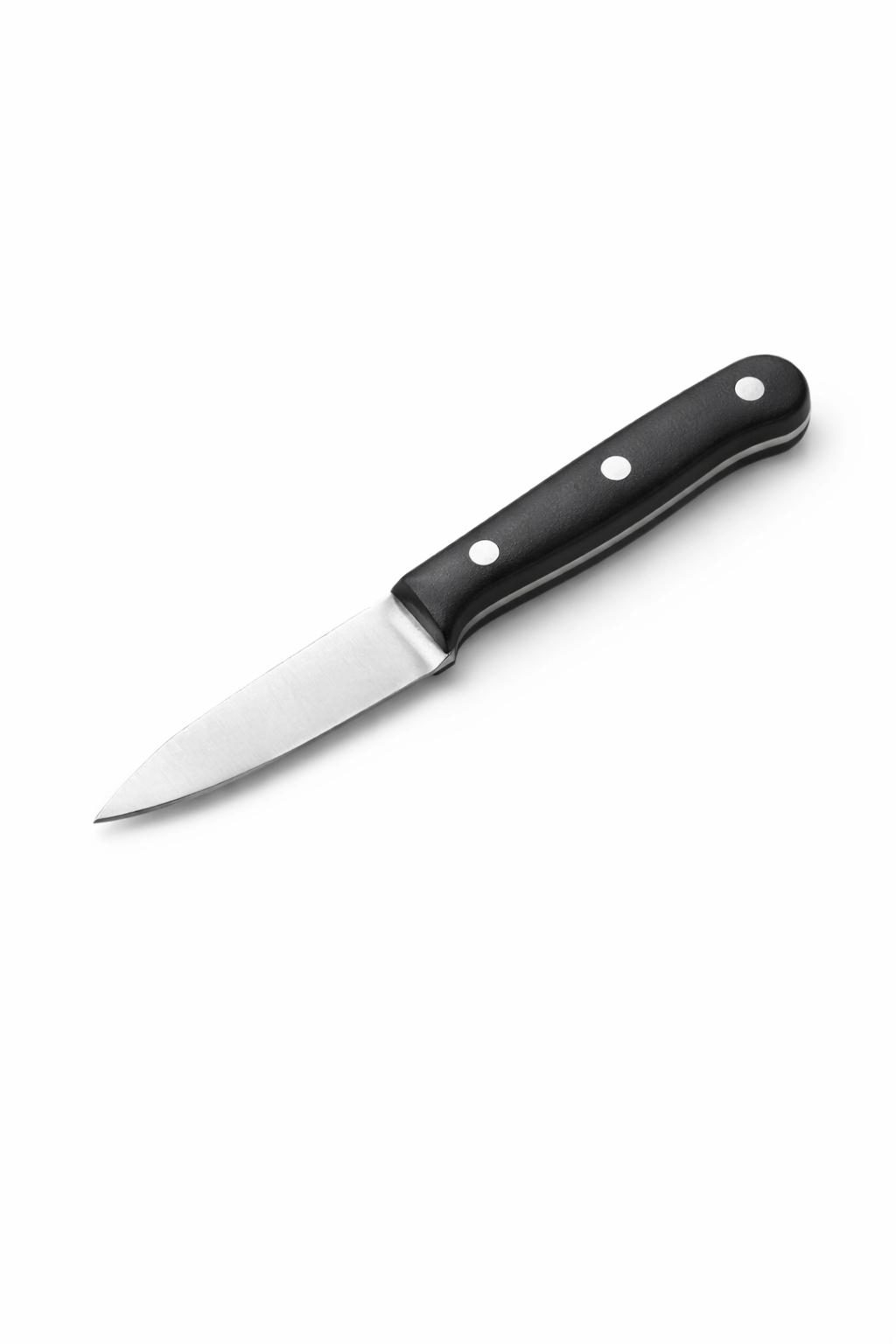
About the Bar Knife
Eight to Ten Centimetres, Straight-Edged
A paring knife of 8 to 10cm with a straight edge and a fine point. A chef's knife is too long to control over a small board, and a serrated blade tears citrus skin rather than parting it.
The point does more work than people expect. It lifts a pip out of a lemon half, frees the end of a twist from the pith, and trims a peel square.
Thin beats thick. A heavy blade wedges the fruit apart as it goes and crushes the cells at the cut, so the juice ends up on the board instead of in the wedge.
A Sharp Blade Is the Safer Blade
A sharp edge bites the skin where you place it and goes where you push it. A blunt one skates across the curved, waxy surface of a lime, and when it finally catches, it does so with all the force you have been adding.
Most garnish cuts happen that way: on a blunt edge, at speed, with the holding hand in the wrong place. Curl that hand's fingertips under, so the knuckles face the blade, and set the board on a damp cloth so it cannot slide.
Sharpness also protects the garnish. A clean cut through citrus leaves the cells intact and the wedge holding its juice; a blunt one bruises the flesh and leaves a ragged, weeping edge.
Bar knife against the other cutting tools
Bar knife
- Blade
- Straight, about 8 to 10cm (ours); 11.5cm (Urban Bar)
- Good for
- Wedges, wheels, halves, trimming peel
- Problem behind a bar
- Needs regular honing
Chef's knife
- Blade
- Straight, 20cm or more (our guidance)
- Good for
- Large fruit such as pineapple
- Problem behind a bar
- Hard to control on a small board
Serrated knife
- Blade
- Toothed
- Good for
- Bread, not garnish
- Problem behind a bar
- Tears citrus skin
Y-peeler
- Blade
- Short, slotted
- Good for
- Wide strips of peel
- Problem behind a bar
- Cannot cut wedges or wheels
Channel knife
- Blade
- Notched
- Good for
- Long, thin twists
- Problem behind a bar
- Peel only
| Tool | Blade | Good for | Problem behind a bar |
|---|---|---|---|
| Bar knife | Straight, about 8 to 10cm (ours); 11.5cm (Urban Bar) | Wedges, wheels, halves, trimming peel | Needs regular honing |
| Chef's knife | Straight, 20cm or more (our guidance) | Large fruit such as pineapple | Hard to control on a small board |
| Serrated knife | Toothed | Bread, not garnish | Tears citrus skin |
| Y-peeler | Short, slotted | Wide strips of peel | Cannot cut wedges or wheels |
| Channel knife | Notched | Long, thin twists | Peel only |
A Kitchen Knife Works, at a Cost
It will cut a lime. What you lose is edge life and a clean taste.
Citrus acid is hard on steel, etching carbon blades and dulling anything left wet. A knife that spends its evenings in lemon juice and its days on onions needs sharpening more often and carries both flavours.
Garnishes go into drinks raw, so the blade that cuts them should not have touched raw meat, garlic or anything strongly flavoured. Keeping one small knife for fruit settles that.
Honing Keeps the Edge Between Sharpenings
Hone before each session with a few light passes on a steel or ceramic rod. That does not sharpen; it straightens an edge that has rolled over, which keeps the knife usable between sharpenings.
Sharpen on a whetstone every month or two, or take it somewhere that does. A 1000-grit stone followed by a 6000 is plenty for a paring knife.
Wash and dry it by hand straight after use, never in a dishwasher, where detergent and the rack both blunt it. Store it in a block, a sheath or on a magnetic strip, never loose in a drawer or under water in the sink.
Using the Bar Knife
Usage
Cutting citrus wedges and wheels, halving fruit for juicing, trimming peels square and slicing garnishes. A straight blade of 8 to 10cm covers all of it on a small board.
Pro Tip
If you have to push hard to cut a lime, stop. Either the knife is blunt or it is the wrong knife, and both end in a slip.
Professional Tips
- Sharp is safer. A blunt blade slips off the peel.
- Cut on a board, never on glass, steel or the bar top.
- Curl the fingers of your holding hand under, knuckles towards the blade.
- Never leave it in a sink of water, where nobody can see it.
Alternatives
Budget Alternative
An inexpensive stainless paring knife does the job, provided it is kept sharp and kept for fruit.
Premium Option
A paring knife in harder stainless steel holds its edge longer between sharpenings. That is what the extra money buys; a cheaper knife cuts as cleanly on the day it is sharpened.
Specifications
Material
Stainless steel blade; plastic, composite or wooden handle
Capacity
Not applicable
Details
Straight, non-serrated blade of about 8 to 10cm with a fine point in the ones we use; Urban Bar’s own Coley bar knife has an 11.5cm part-serrated blade
More to explore
Common Questions
What knife should I use for cocktail garnishes?
Why is a sharp knife safer?
Can I just use a kitchen knife?
How do you keep a bar knife sharp?
How do you cut a lime wedge?
How do you cut a citrus wheel?
Is a bar knife dishwasher-safe?
Sources.
Correct as of 18 October 2026.
- Urban Bar, “Coley Premium Stainless Steel Cocktail Bar Knife 11.5cm Blade” (4.5 inch blade, part serrated).
Made with the Bar Knife
Used In These Cocktails
Related Equipment
Updated 18 October 2026