Bar Spoon
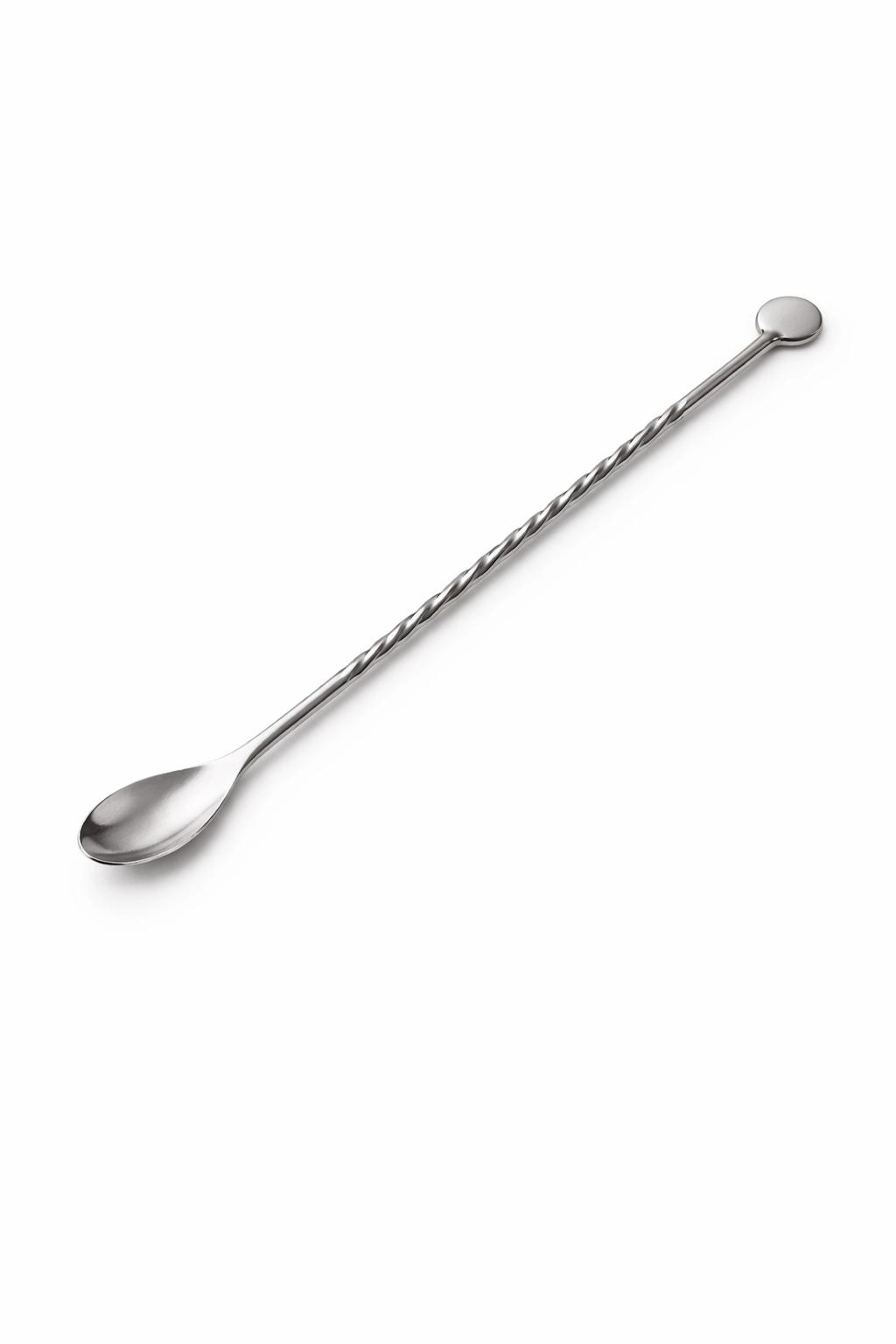
A bar spoon is a long spoon, 30 or 40cm in Urban Bar’s own Drop spoons, with a small bowl that holds roughly 5ml and a shaft that is often twisted. It stirs drinks in a mixing glass or a tall glass, floats one liquid on top of another, and measures small amounts such as a spoon of maraschino. Our Manhattan and Martini are stirred with one in the mixing glass, and a Tom Collins finishes with a single lift of it.
Essential Equipment
Recommended for every home bar
About the Bar Spoon
A Barspoon Is About a Teaspoon
The bowl holds roughly 5ml, close to a kitchen teaspoon. Our recipes use it for small, strong amounts: a spoon of crème de violette in the Aviation, maraschino in the Illegal, absinthe to rinse the coupe for a Corpse Reviver No. 2.
Bowls vary from maker to maker, so a barspoon is a seasoning rather than a precise measure. Where a recipe needs exactly 5ml or 10ml, a measuring spoon is the surer tool.
Stir Against the Glass
Rest the back of the bowl on the inside of the mixing glass and spin the shaft between thumb and two fingers. The ice turns as one block, chilling and diluting the drink without breaking up.
In a mixing glass full of cubed ice, stir for 20 to 30 seconds: that is how our Manhattan and Martini are made. A drink built over one large cube in its own glass gets 15 to 20 seconds.
What the bar spoon does in our recipes
Stir in a mixing glass
- How
- 20 to 30 seconds against the glass wall
- Example
- Manhattan, Martini, Negroni
Stir over one large cube
- How
- 15 to 20 seconds in the serving glass
- Example
- Drinks built over a single cube
Lift a long drink
- How
- One slow lift from the bottom after the soda
- Example
- Tom Collins, Americano
Float a layer
- How
- Pour slowly onto the back of the upturned bowl
- Example
- Penicillin, White Russian
Measure
- How
- Roughly 5ml
- Example
- Aviation, Illegal
| Job | How | Example |
|---|---|---|
| Stir in a mixing glass | 20 to 30 seconds against the glass wall | Manhattan, Martini, Negroni |
| Stir over one large cube | 15 to 20 seconds in the serving glass | Drinks built over a single cube |
| Lift a long drink | One slow lift from the bottom after the soda | Tom Collins, Americano |
| Float a layer | Pour slowly onto the back of the upturned bowl | Penicillin, White Russian |
| Measure | Roughly 5ml | Aviation, Illegal |
Soda Gets One Lift
A drink topped with soda or sparkling wine loses its bubbles to a full stir. Our Tom Collins and Americano get a single slow lift from the bottom of the glass, which carries the base up through the soda and stops there.
Floats Land on the Back of the Bowl
Turn the spoon over, hold the bowl just over the drink against the inside of the glass, and pour slowly onto it. The liquid fans out across the surface instead of diving in.
A float holds only if the top layer is lighter than the drink beneath it, which usually means less sugar. A smoky Scotch rides on a sweet, sour Penicillin for that reason.
Using the Bar Spoon
Usage
Stirring spirit-led drinks in a mixing glass for 20 to 30 seconds, or 15 to 20 over one large cube in the serving glass; lifting a long drink once after the soda goes in; floating a spirit or cream over the back of the bowl; and measuring a barspoon, roughly 5ml.
Pro Tip
Count the stir. Twenty seconds feels long the first time, and a Manhattan stirred for half that comes out warm and too strong.
Professional Tips
- Keep the back of the bowl against the glass and let the ice turn as one.
- Spin the shaft between thumb and two fingers; the wrist hardly moves.
- For a float, turn the spoon over and pour slowly onto the back of the bowl.
- Give a soda-topped drink one slow lift from the bottom, not a stir.
Alternatives
Budget Alternative
A plain stainless spoon with a twisted shaft and a disc end. If the length is right, it stirs as well as an expensive one.
Premium Option
A Japanese-style spoon with a long, finely twisted shaft and a teardrop weight. The balance makes a long stir easier on the hand; the stir itself does not change.
Specifications
Material
Stainless steel, sometimes plated
Capacity
Bowl roughly 5ml (Urban Bar gives its Drop spoon’s head as an approximate 5ml measure); not a precise measure
Details
Shaft 30 or 40cm in Urban Bar’s own Drop spoons, often twisted, with a disc, fork or teardrop weight at the far end
More to explore
Common Questions
How much is a barspoon?
Why are bar spoons twisted?
How long should you stir a cocktail?
How do you float a layer with a bar spoon?
What length of bar spoon should I buy?
Can I use a teaspoon instead?
Why stir a Collins only once?
Sources.
Correct as of 18 October 2026.
- Urban Bar, “Drop Stainless Steel Bar Spoon 30cm” (head gives approximate 5ml measure).
- Urban Bar, “Drop Stainless Steel Bar Spoon 40cm”.
Master the Technique
Made with the Bar Spoon
Used In These Cocktails
Related Equipment
Updated 18 October 2026