Copper Mug
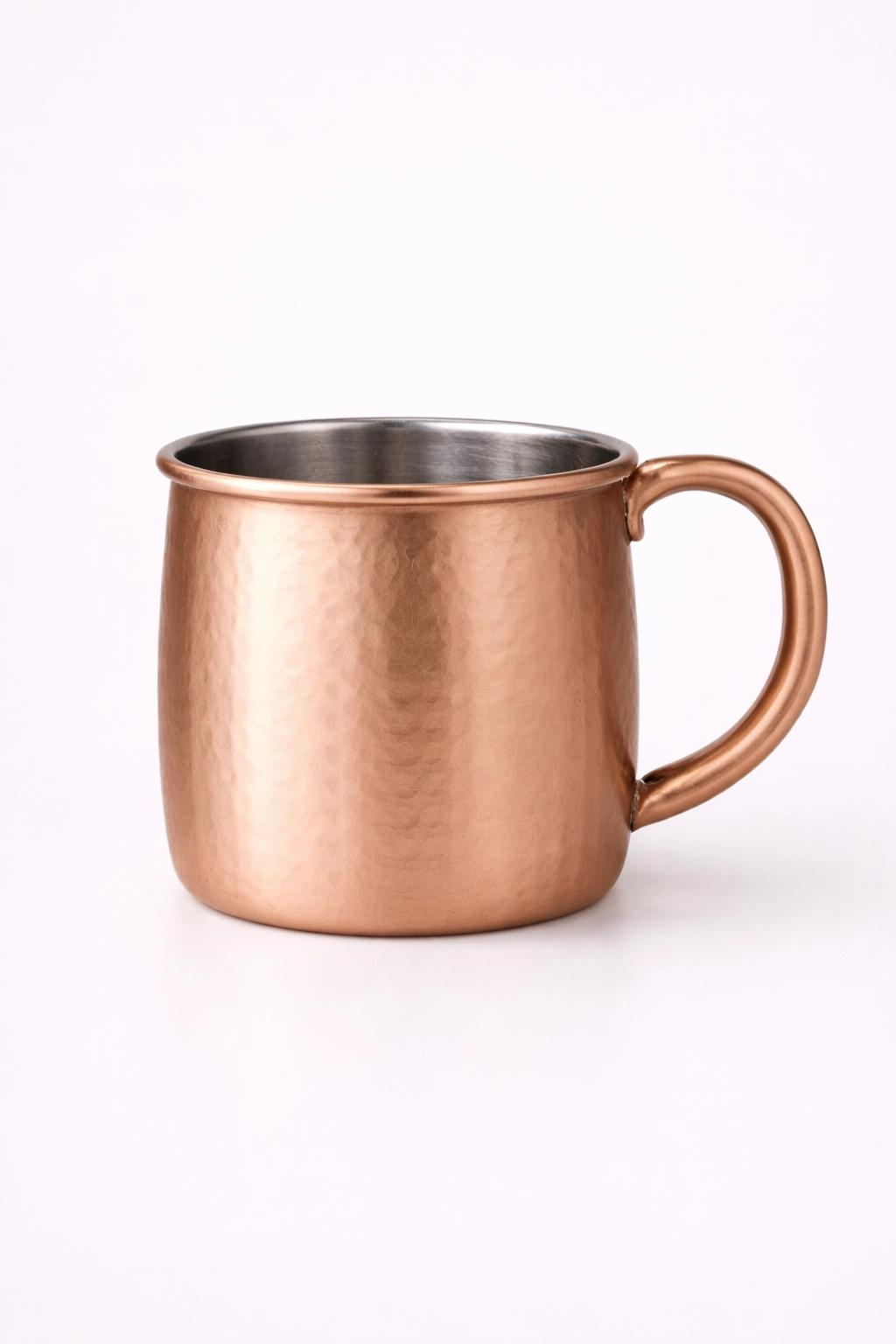
A copper mug is a handled metal mug, 57cl in Urban Bar’s own Ginza cup, lined inside with stainless steel or nickel. Packed with cubed ice, it holds a mule of spirit, lime and ginger beer, and the metal frosts quickly, so the rim feels cold against the lip. Our Moscow, Dublin and Mexican Mules all go in one.
About the Copper Mug
The Mule Made the Mug
The copper mug arrived with the Moscow Mule, which the Oxford Companion says purportedly originated in 1941 at the Cock ’n Bull pub in Los Angeles. John G. Martin, president of Heublein, was promoting Smirnoff vodka in the United States, and the pub’s owner, Jack Morgan, was hoping to improve sales of his ginger beer.
VinePair’s Osalene Schmitt reports that Martin went from bar to bar taking Polaroids of bartenders posing with a copper mug and a bottle of Smirnoff, sparking sales of both.
Copper Passes Cold and Warmth Quickly
Copper carries heat hundreds of times faster than glass. A mug full of ice takes on its temperature almost at once and frosts on the outside, and the rim is cold against the lip.
That speed works both ways. A hand round the body warms the metal just as fast, which is what the handle is for. Ice cools the drink; copper changes how cold it feels.
Buy It Lined
Lime juice and ginger beer are both acidic, and copper can pass into acidic drinks. The US Food Code bars bare copper from contact with foods more acidic than pH 6.0.
The US FDA Food Code bars copper and copper alloys from contact with food below pH 6, such as vinegar, fruit juice or wine, so a lime-sharp mule belongs in a lined mug; the lining is what keeps the drink off the copper. Buy a lined mug, and retire it if the lining wears through.
Copper mug against other vessels for a mule (the Ginza cup from Urban Bar’s listing; highball from our shop; the rest our guidance)
Lined copper mug
- Usual size
- 57cl (Urban Bar’s Ginza cup); our guidance 40cl or more
- In the hand
- Frosts fast; cold rim
- Notes
- Hand wash only
Unlined copper mug
- Usual size
- Our guidance 40cl or more
- In the hand
- The same
- Notes
- Not for acidic drinks
Highball glass
- Usual size
- 38 or 42cl (our shop)
- In the hand
- Cool, not frosted
- Notes
- Shows the drink; dishwasher-safe
Stainless steel mug
- Usual size
- Our guidance 40cl or more
- In the hand
- Cold, slower to frost
- Notes
- Hard-wearing; no polishing
| Vessel | Usual size | In the hand | Notes |
|---|---|---|---|
| Lined copper mug | 57cl (Urban Bar’s Ginza cup); our guidance 40cl or more | Frosts fast; cold rim | Hand wash only |
| Unlined copper mug | Our guidance 40cl or more | The same | Not for acidic drinks |
| Highball glass | 38 or 42cl (our shop) | Cool, not frosted | Shows the drink; dishwasher-safe |
| Stainless steel mug | Our guidance 40cl or more | Cold, slower to frost | Hard-wearing; no polishing |
Ice to the Top, Then the Drink
Pack the mug to the brim with cubed ice, pour in the spirit and lime, top with ginger beer and stir once. Our Moscow Mule is 45ml vodka, 10ml lime and 120ml ginger beer; the Dublin Mule uses Irish whiskey with a little sugar syrup and 90ml of ginger beer.
Using the Copper Mug
Usage
Mules built over cubed ice: the Moscow Mule, the Dublin Mule, the Mexican Mule, the Jamaican Mule and the Pack Mule, each about 145 to 200ml of spirit, lime and ginger beer. Pack the mug with ice to the brim, build the drink in it and stir once.
Pro Tip
Pack the mug with ice and give it a minute before building the drink. The metal takes on the cold almost at once, and the frost on the outside is the sign it is ready for the spirit.
Professional Tips
- Check the inside is lined before the first drink goes in.
- Pack it to the brim with cubed ice, then build the drink.
- Hold it by the handle; a hand round the body warms the metal fast.
- Chill it in the fridge first if there is room.
Alternatives
Budget Alternative
A highball glass. It holds the same mule over a tall stack of cubes, and most of our mule recipes give it as the alternative.
Premium Option
A heavier mug with a thick copper body and a stainless lining. It frosts well and lasts; the mule in it tastes no different.
Specifications
Material
Copper outside; lined inside with stainless steel or nickel
Capacity
57cl in Urban Bar’s own Ginza cup; our guidance is 40cl or more
Details
A straight-sided or barrel-shaped mug with a riveted or welded handle, often hammered on the outside
More to explore
Common Questions
Are copper mugs safe to drink from?
Why are Moscow Mules served in copper mugs?
Do copper mugs keep drinks colder?
How do you clean a copper mug?
What size is a copper mug?
Can I make a Moscow Mule without a copper mug?
What is the lining in a copper mug?
Can you put a hot drink in a copper mug?
Sources.
Checked between 18 October and 20 October 2026.
- US Food and Drug Administration, “FDA Food Code 2022, section 4-101.14 Copper, Use Limitation” (“copper and copper alloys such as brass may not be used in contact with a FOOD that has a pH below 6 such as vinegar, fruit JUICE, or wine”).
- The Oxford Companion to Spirits and Cocktails (Paul Clarke), “The Moscow Mule” (secondary source: purportedly 1941 at the Cock ’n Bull, Los Angeles; Martin and Morgan; a competing New York history; Wes Price’s claim; the copper-mug story possibly apocryphal).
- Urban Bar, “Black Ginza Cup 57cl” (reference maker’s own copper cup; the Moscow Mule mug it sells is Cocktail Kingdom’s and is not cited).
- Jerry Can Spirits shop, “Crystal ICE Hiball, 42cl”.
- VinePair, “The Moscow Mule Recipe (Osalene Schmitt)” (named-author trade press: three accounts of the drink’s start, the New York Herald Tribune of 1948 naming Rudolph Kunett, the Moscow Copper Co. story, and Martin’s Polaroids).
Master the Technique
Made with the Copper Mug
Used In These Cocktails
Show all 7 cocktailsShow fewer
Related Equipment
Updated 20 October 2026