Irish Coffee Mug
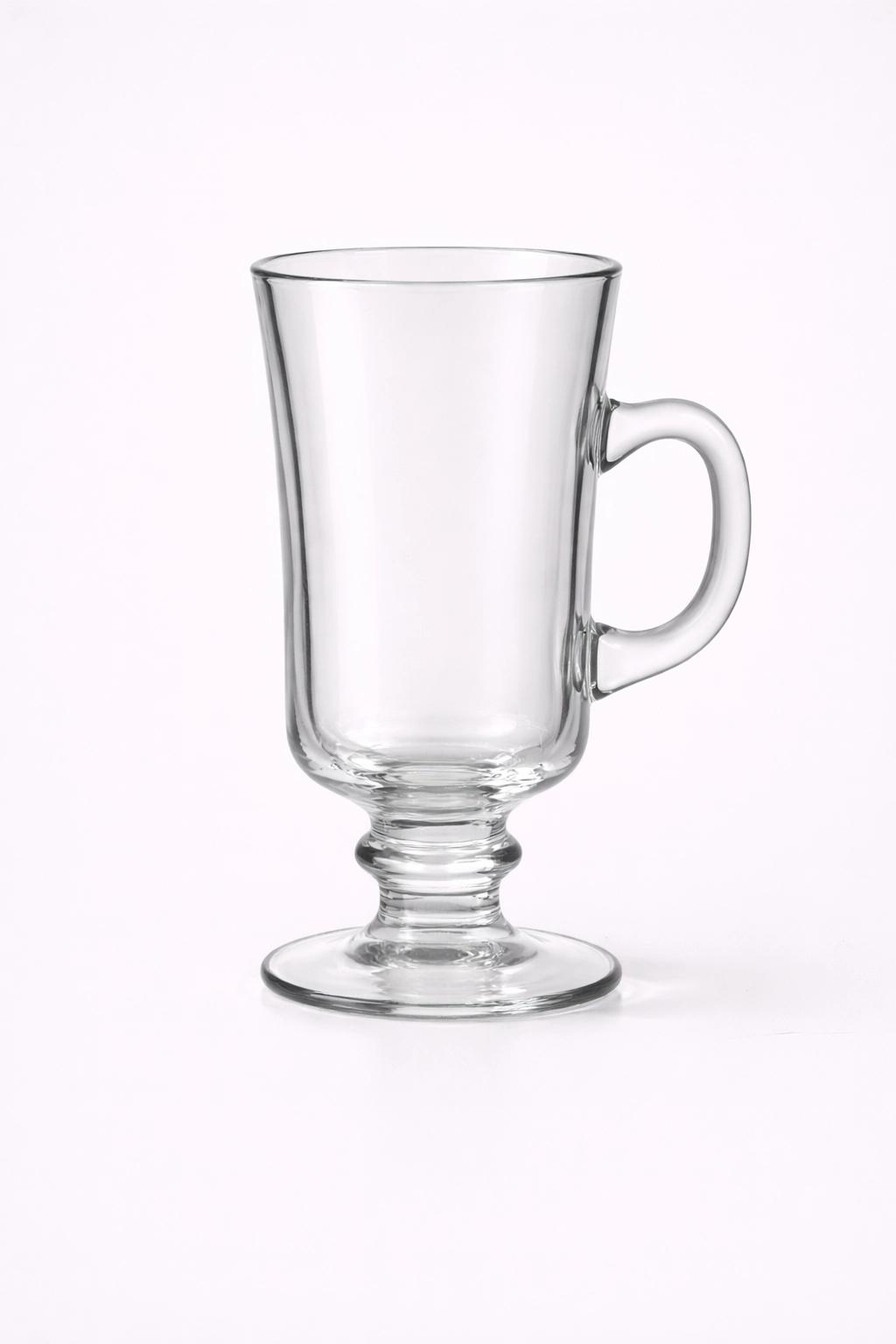
An Irish coffee mug is a heat-resistant glass with a handle and a short stem or foot, about 200 to 250ml by our guidance. The clear glass shows the band of cream over dark coffee, and the handle keeps your fingers off the hot bowl. It serves our Irish Coffee and other hot drinks, among them the Hot Toddy, the hot Brandy Sling and the Hot Toffee Apple.
About the Irish Coffee Mug
Clear Glass, a Handle and a Foot
The bowl is clear so the layers show: dark coffee underneath, a centimetre of pale cream on top. The handle sits clear of the bowl, so your fingers stay off the hot glass, and the foot lifts it from the table.
Our guidance is 200 to 250ml. That matters more than the shape, because an Irish Coffee is built to the rim.
Irish coffee mug, heatproof tumbler and china mug compared (sizes are our guidance)
Irish coffee mug
- Typical size
- Around 200 to 250ml
- Shows the layers
- Yes
- Use it for
- Irish Coffee and other hot cocktails
Heatproof tumbler
- Typical size
- Varies
- Shows the layers
- Yes
- Use it for
- A Hot Toddy, where the lemon and cloves show
China mug
- Typical size
- Often 250 to 350ml
- Shows the layers
- No
- Use it for
- Fuller hot drinks such as Hot Buttered Rum
| Vessel | Typical size | Shows the layers | Use it for |
|---|---|---|---|
| Irish coffee mug | Around 200 to 250ml | Yes | Irish Coffee and other hot cocktails |
| Heatproof tumbler | Varies | Yes | A Hot Toddy, where the lemon and cloves show |
| China mug | Often 250 to 350ml | No | Fuller hot drinks such as Hot Buttered Rum |
Sized for the Irish Coffee
Our Irish Coffee takes 120ml of coffee, a teaspoon of demerara and 50ml of whiskey, and 50ml of cream is floated on top. That comes to about 225ml, so a glass of 230ml or more holds it with the cream at the rim.
In a 200ml glass the coffee and whiskey reach the top before the cream goes on. Measure your glass with water once and you will know.
Warm the Glass, Never Boil the Drink
Fill the glass with hot water, leave it a minute while you make the coffee, and tip it out. A warmed glass will not crack when the drink goes in, and it keeps the drink hot.
Our hot drinks use water just off the boil, as in the Hot Toddy, or juice warmed until it steams and never boiled, as in the Hot Toffee Apple. Boiling drives off aroma, and with the spirit in, alcohol too.
Washing and Wear
Let the glass cool before it goes into water or the dishwasher; a hot glass meeting cold water can crack.
Look it over now and then. A chip on the rim or a fine crack in the bowl means it should not hold a hot drink again.
Using the Irish Coffee Mug
Usage
The Irish Coffee, and hot drinks such as the Hot Toddy, the hot Brandy Sling and the Hot Toffee Apple. Warm it with hot water first, build the drink with water just off the boil or liquid warmed until it steams, and leave room at the top for the cream or the garnish.
Pro Tip
Fill the coffee and whiskey to about a centimetre short of the rim before the cream. That leaves the layer the cream needs, and the cold band sits at the lip, where you drink through it.
Professional Tips
- Fill the glass with hot water for a minute, then empty it.
- Use water just off the boil, not at a rolling boil, and never boil the drink itself.
- Dissolve the sugar in the coffee first; the whiskey follows.
- Float the cream over the back of a warm spoon and serve it unstirred.
Alternatives
Budget Alternative
A heatproof tumbler or a plain china mug. It makes the same drink; in china you lose sight of the cream.
Premium Option
A heavier toughened glass with a thicker base and a sturdier handle. It stands up to more knocks; the drink is the same.
Specifications
Material
Heat-resistant glass, usually toughened
Capacity
About 200 to 250ml, our guidance; choose 230ml or more for our Irish Coffee
Details
Clear bowl with a handle, on a short stem or foot, with a thick base
More to explore
Common Questions
What size is an Irish coffee glass?
Can you pour boiling water into an Irish coffee glass?
Why is Irish Coffee served in a glass?
Why does the cream sink in my Irish Coffee?
What other drinks go in an Irish coffee mug?
Can an Irish coffee glass go in the dishwasher?
Should you stir an Irish Coffee?
Sources.
Correct as of 20 October 2026.
- The Oxford Companion to Spirits and Cocktails (Robert Simonson and David Wondrich), “Irish Coffee” (secondary source: created in late 1944 or early 1945 at Foynes by Joe Sheridan; the Buena Vista, 1953, through Stanton Delaplane and Jack Koeppler; the original footed goblet 180ml).
- KQED, “The true history of Irish coffee and its San Francisco origins (Kelly O’Mara)” (public broadcaster, named author: the Foynes Flying Boat Museum’s account of 1943; the Buena Vista’s 10 November 1952).
- Difford’s Guide, “Irish Coffee” (secondary source: created in late 1944 to early 1945 by Joe Sheridan at Foynes; the Buena Vista purportedly late on 10 November 1952).
Made with the Irish Coffee Mug
Used In These Cocktails
Related Equipment
Updated 20 October 2026