Muddler
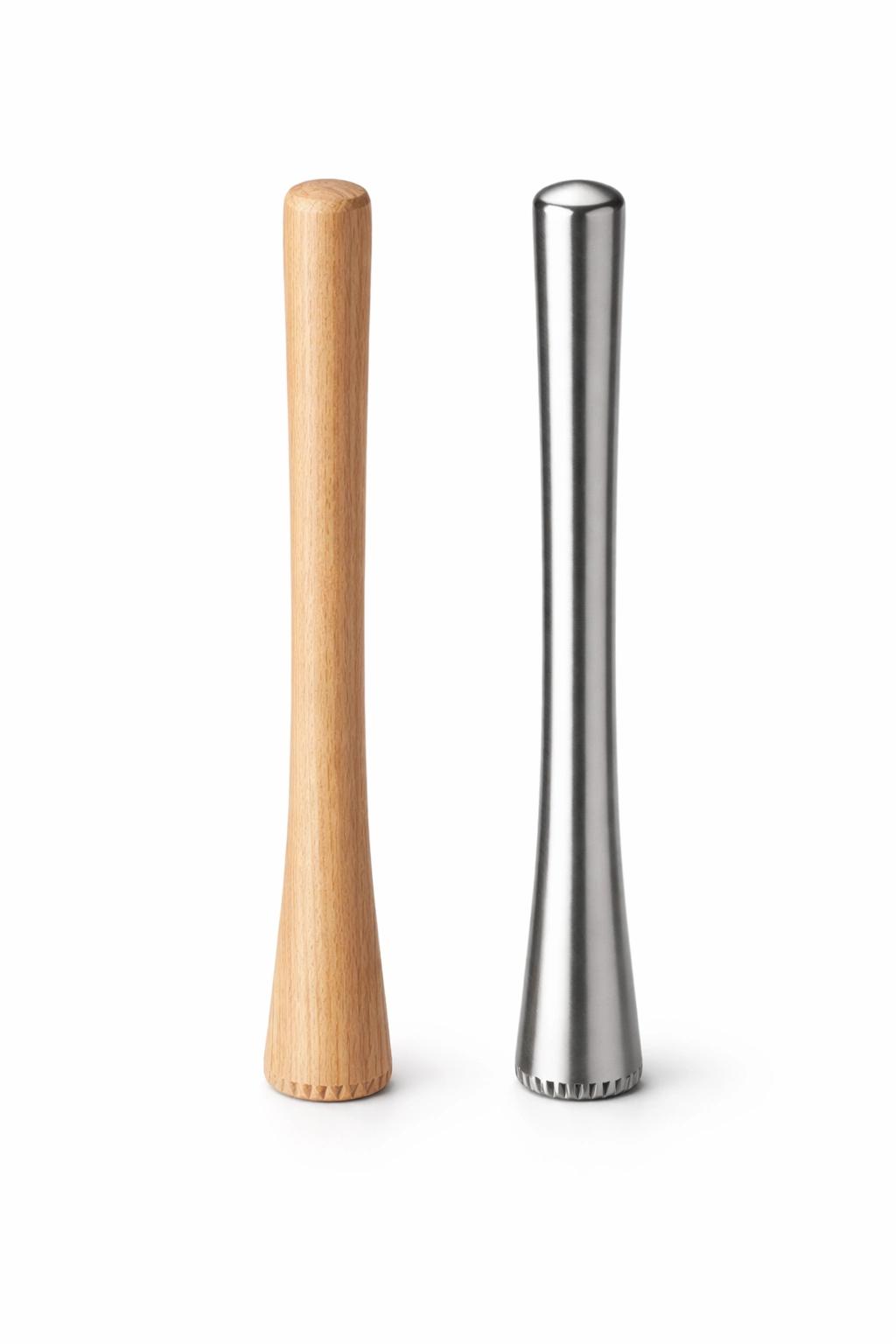
A muddler is a blunt pestle, about 20 to 25cm long in the ones we use (Urban Bar’s own 360 muddlers are 24 and 24.5cm), for pressing herbs, fruit and sugar in the base of a glass or shaker to release juice and oils. Mint wants a few gentle presses; limes and sugar cubes want firm ones. It is the tool for the Mojito, the Caipirinha, an Old Fashioned built on a sugar cube, and smashes.
Essential Equipment
Recommended for every home bar
About the Muddler
Press Leaves Gently
Mint stores much of its aroma in tiny oil glands on the leaf’s skin. A few gentle presses open them. Grinding or twisting tears the leaf apart and brings out grassy, bitter flavours along with the oil.
For a Mojito, one or two straight presses on the mint, no twisting. Shredded leaves and a dark green drink mean it went too far.
Basil in the Gin Basil Smash is handled differently: it is muddled firmly with the lemon and syrup for about 20 seconds, then double strained, so the drink takes the colour and flavour of the leaf and leaves the pieces behind.
Lime and Sugar Need Force
Hard ingredients reverse the rule.
A sugar cube in an Old Fashioned is crushed with a splash of water until it dissolves. Lime in a Caipirinha is pressed and twisted for 20 to 30 seconds, until the juice runs and the sugar starts to dissolve, and the sugar’s grain works against the peel to lift its oil.
Juicy fruit and vegetables sit at the hard end too. Cucumber, watermelon and cherry tomatoes are muddled hard in the shaker, as in the Eastern Standard and the Tomatini, because they are there for their juice.
How hard to muddle, by ingredient
Mint
- Pressure
- A few gentle presses
- Stop when
- The mint smells strongly but the leaves are whole
- Example
- Mojito
Basil
- Pressure
- Firm, in the shaker
- Stop when
- After about 20 seconds; double strain
- Example
- Gin Basil Smash
Lime wedges with sugar
- Pressure
- Firm, pressing and twisting
- Stop when
- The juice runs and the sugar dissolves
- Example
- Caipirinha
Sugar cube
- Pressure
- Firm, with a little water
- Stop when
- The sugar has dissolved
- Example
- Old Fashioned
Cucumber, tomato, watermelon
- Pressure
- Hard
- Stop when
- The fruit is fully juiced
- Example
- Tomatini
| Ingredient | Pressure | Stop when | Example |
|---|---|---|---|
| Mint | A few gentle presses | The mint smells strongly but the leaves are whole | Mojito |
| Basil | Firm, in the shaker | After about 20 seconds; double strain | Gin Basil Smash |
| Lime wedges with sugar | Firm, pressing and twisting | The juice runs and the sugar dissolves | Caipirinha |
| Sugar cube | Firm, with a little water | The sugar has dissolved | Old Fashioned |
| Cucumber, tomato, watermelon | Hard | The fruit is fully juiced | Tomatini |
Wood or Steel
Unvarnished hardwood is traditional. It is slightly kinder to leaves, absorbs smells over time, and should never go in a dishwasher, where heat and water split it.
Stainless steel, often with a toothed nylon or steel head, cleans completely and lasts. The teeth grip lime skin and fruit well; ease off with mint, because they tear leaves faster than a flat head does.
Avoid varnished or painted wood. The coating chips with use and ends up in the drink.
If You Do Not Own One
The end of a wooden rolling pin or the handle of a wooden spoon will do, provided it reaches the base of the glass or tin.
Avoid anything narrow or sharp, such as a knife handle or a fork. The force concentrates on a small point and shreds rather than presses.
Length matters in a shaker: at about 20 to 25cm, a muddler reaches the bottom of a tall tin with your knuckles clear of the rim.
Using the Muddler
Usage
Mojitos, Caipirinhas, smashes, an Old Fashioned built on a sugar cube, and drinks muddled with fruit or vegetables in the shaker, such as the Tomatini. Used in the glass or the tin, so nothing is lost in a transfer.
Pro Tip
Match the pressure to the ingredient: leaves get pressed, sugar gets crushed, and lime and juicy fruit get pushed until the juice runs.
Professional Tips
- Leaves: a few gentle presses, never a twist.
- Lime and sugar: press firmly, and twist if the recipe says so.
- Muddle in the tin if the drink is double strained.
- Rinse it straight away, especially wood.
Alternatives
Budget Alternative
The end of a wooden rolling pin or the handle of a wooden spoon, if it reaches the base of the glass.
Premium Option
A one-piece stainless steel muddler with a ridged head and some weight. The money buys a tool with no join to loosen and nothing to absorb smells.
Specifications
Material
Stainless steel with a nylon or steel head, or unvarnished hardwood
Capacity
Not applicable
Details
About 20 to 25cm long in the ones we use (Urban Bar’s own 360 muddlers are 24 and 24.5cm), with a flat, ridged or toothed head
More to explore
Common Questions
What is a muddler used for?
How do you muddle mint without making it bitter?
Wood or steel muddler?
Toothed or flat muddler head?
What can I use instead of a muddler?
How long should a muddler be?
Can a muddler go in the dishwasher?
Do you muddle in the glass or the shaker?
Sources.
Correct as of 18 October 2026.
- Urban Bar, “360 Stainless Steel Muddler (Shaped Handle) 24.5cm”.
- Urban Bar, “360 Stainless Steel Muddler (Straight Handle) 24cm”.
Master the Technique
Made with the Muddler
Used In These Cocktails
Related Equipment
Updated 18 October 2026