Start here.
The Core Principle
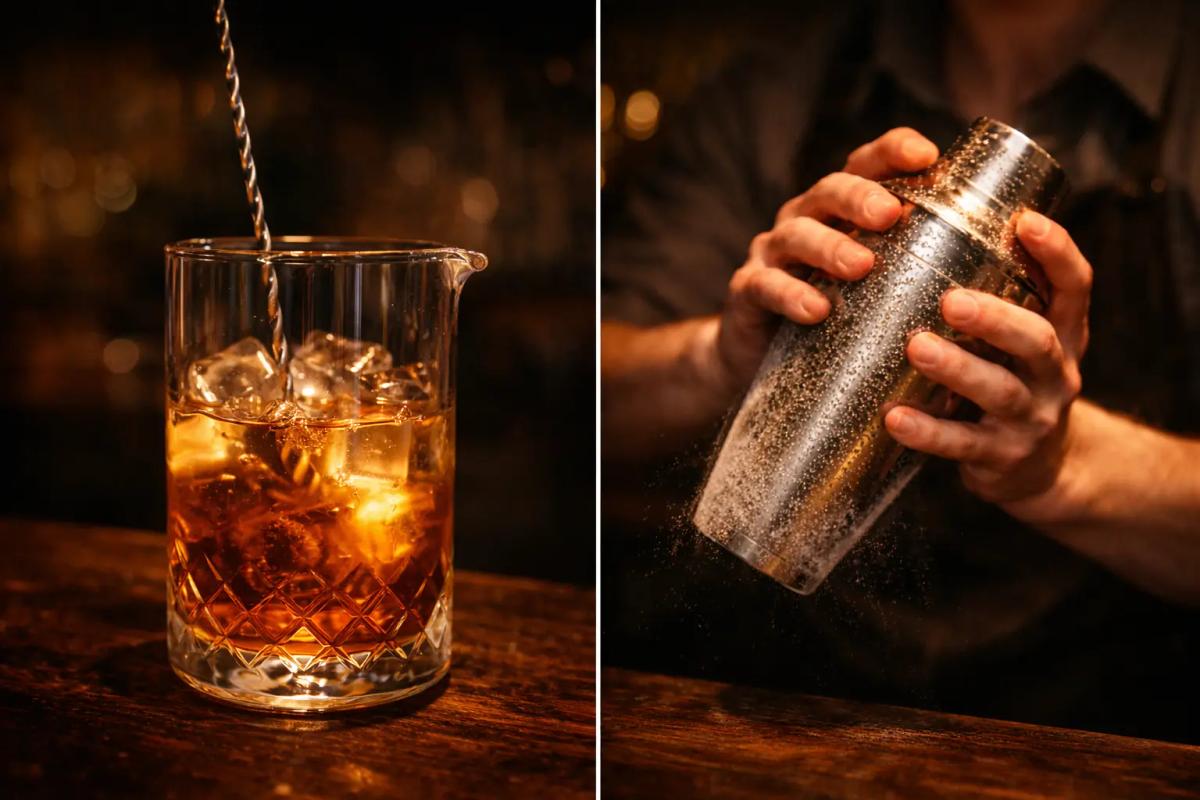
The decision comes down to ingredients. Spirit-only cocktails get stirred. Drinks containing juice, cream, eggs, or other opaque ingredients get shaken. That settles most drinks; the cases that break the rule are set out below.
Why does this matter? Stirring chills gently and dilutes a drink while preserving its clarity and silky texture. Shaking aggressively aerates, emulsifies, and integrates ingredients that would otherwise separate.
The Clarity Rule
If you want to see through your finished drink, stir it. Shaking introduces thousands of tiny air bubbles, which cloud the liquid and alter its mouthfeel. For spirit-forward classics like the Martini, Manhattan, or Negroni, that cloudiness would be considered a flaw.
The Integration Rule
If your ingredients naturally resist combining, shake them. Citrus juice, egg whites, cream, and fruit purees need aggressive agitation to form a cohesive drink. Stirring would leave them separated and unbalanced.
When to Stir
Stirring suits cocktails built entirely from spirits, liqueurs, fortified wines, and bitters. These ingredients share similar densities and mix easily with gentle motion.
Classic stirred cocktails include the Martini, Manhattan, Negroni, Old Fashioned, Vieux Carré, and Boulevardier. Notice the pattern: all feature base spirits with modifiers like vermouth, amaro, or liqueurs.
What Stirring Achieves
Dave Arnold’s measurements on Cooking Issues show what stirring does. It chills more slowly than shaking and never reaches a steady state, so a stirred drink comes off the ice warmer and less diluted than a shaken one. He pulled his stirred test drinks at minus 0.6°C, which he calls realistic, while shaking took the same drink to about minus 7°C in under 17 seconds. In his follow-up, a stirred Manhattan was strained at minus 1.2°C. Stirring adds no air, so the drink stays clear, with a silky texture.
Stirring Technique
Fill your mixing glass two-thirds with ice. Add ingredients, then insert your bar spoon between the ice and the glass wall. Using your fingers to rotate the spoon shaft, move the ice in a smooth circular motion. The ice should orbit the glass quietly without clinking. Stir for 20 to 30 seconds, then taste before you strain. The time is a guide rather than a rule. Dave Arnold’s measurements found that a stirred drink never settles at a fixed temperature the way a shaken one does, so how cold and how diluted it ends up depends on the ice and on how briskly you stir. In his tests, small ice chilled a drink fastest and large cubes slowest, so large cubes need the top of the range. A mixing glass straight from the shelf takes some of the cold for itself, so chill it with ice first. A drink built over ice in its own glass needs only about 15 seconds, because it carries on chilling as it sits. The numbered steps are under How to stir a cocktail.
When to Shake
Shaking suits cocktails containing citrus juice, egg, cream, or other ingredients that need physical force to integrate. The technique also chills drinks faster and more aggressively than stirring.
Classic shaken cocktails include the Daiquiri, Margarita, Whiskey Sour, Cosmopolitan, Pisco Sour, and Espresso Martini. Each has an ingredient that stirring will not fully mix in, and the coffee in an Espresso Martini needs the shake for its crema.
What Shaking Achieves
Dave Arnold found that hard shaking chills, dilutes and aerates a drink in about 15 seconds and levels off near minus 7°C, whatever the ice or the style of shake. His earlier trials showed that after 10 to 12 seconds, more shaking bought less than two degrees of extra chill. Under a microscope, his shaken drinks were full of tiny air bubbles that straining did not remove, and in blind tastings the difference from a stirred drink lasted at least five minutes. That air gives the lighter, frothier texture and the slight cloudiness.
Dry Shaking for Egg Drinks
Cocktails containing egg white benefit from a dry shake before adding ice. Shake the ingredients hard without ice for 10 to 15 seconds. With no ice to chill and thin it, egg white foams quickly, so a longer dry shake adds little. Then add ice and shake again to chill. This two-stage process creates the thick, stable foam that crowns drinks like the Whiskey Sour or Clover Club. Steps for both orders are under How to dry shake and reverse dry shake.
Which drinks to stir and which to shake.
Our rule: shake anything with citrus or other fruit juice, egg, cream or milk, and stir anything made only of spirits, liqueurs, fortified wines and bitters. The IBA’s specifications draw the same line. The Dry Martini and the Manhattan are stirred in a mixing glass, while the Whiskey Sour, the Espresso Martini and the French Martini are shaken. The IBA’s Negroni is stirred too, built over ice in its own glass.
Citrus does not always mean a shake. A long drink over ice is mixed in its glass, and the IBA builds the John Collins, lemon juice and all, in a highball full of ice and stirs it gently. It gives the Mojito a light stir after the soda goes in. The IBA stirs the Bloody Mary gently in a mixing glass, too. We find hard shaking leaves tomato juice thin and frothy, so we roll ours, as described below.
Never shake anything fizzy. Soda, tonic, ginger beer and sparkling wine go into the glass after the shake, or their gas escapes in the tin.
The rule bends the other way too. The Vesper holds no juice at all, yet the IBA shakes it. Casino Royale, Ian Fleming’s first Bond novel (1953), has Bond ordering one: “Shake it very well until it’s ice-cold.” The Ian Fleming website says the line “shaken and not stirred” first appears in print in Diamonds Are Forever.
A shaken Martini is colder, more diluted and slightly cloudy, because the tiny bubbles a shake leaves survive straining, by Dave Arnold’s microscope tests. In our view nothing is “bruised”: the gin is unharmed, and the bruising people taste is that extra water and air. When Arnold’s panel blind-tasted Manhattans and Negronis made both ways, it preferred them stirred. Make whichever you prefer.
Shaking and stirring are two of the methods. The third, and the most common for long drinks, is building the drink in its own glass. Bartenders also throw drinks between two tins, which sits between stirring and shaking, and blend frozen drinks. Each method has its own section below.
How to stir a cocktail.
Stir in a mixing glass, or the large tin of a shaker, with a long bar spoon. Our method:
- Chill the serving glass, and the mixing glass too, with ice and water. A warm mixing glass takes some of the cold for itself.
- Measure the ingredients into the mixing glass.
- Fill it two-thirds or more with hard, dry cubed ice, so the ice stands above the liquid.
- Slide the back of the bar spoon down the inside of the glass and turn it with your fingertips, so the ice travels round the glass as one mass. It should be nearly silent. Stir hard enough to clatter and the drink clouds with air.
- Stir for 20 to 30 seconds with ordinary cubes, longer with large cubes and less with small ones.
- Taste from the spoon. Stop when the drink is cold, the outside of the glass has frosted and the alcohol no longer burns.
- Strain through a julep or Hawthorne strainer into the chilled glass, or over fresh ice.
How long to stir has no exact answer. Dave Arnold’s measurements show a stirred drink never settles at a fixed temperature the way a shaken one does, so the ice and your pace decide. Water is part of the drink: in one of his tests a Manhattan went into the glass at 113g from 77g of mix.
Swirling is not stirring. Turning or rocking a glass to move the drink round it, which is what swirling means, mixes a little but barely chills, because the ice hardly moves against the liquid. It suits a spirit already poured over a large cube, not a cocktail that needs its water.
How to shake a cocktail.
Shaking is quick, and each step matters. Our method, with a Boston shaker, a Cobbler shaker or a Parisian shaker:
- Chill the serving glass first, with ice and water or in the freezer.
- Pour the ingredients into the small tin, or the base of a Cobbler.
- Fill it two-thirds or more with hard cubed ice. More ice chills faster and dilutes less.
- Seal it. Set the large tin over the small one at a slight angle and tap it once with the heel of your hand; on a Cobbler, press the strainer and cap firmly home. Lift a Boston shaker by the large tin alone: if the small tin stays put, the seal is good.
- Hold it with a hand on each end, pointed away from you and anyone near, and shake hard from the shoulders so the ice travels the full length of the tin.
- Shake for 10 to 12 seconds. Stop when the tin frosts and is almost too cold to hold, and the rattle softens as the ice breaks down.
- Break the seal and strain into the chilled glass at once.
Why 10 to 12 seconds is under When to Shake, and the detail of ice, grip and rhythm under A good shake is hard, short and full of ice.
To shake without spilling, check the seal before you start and hold a hand on each end throughout. If liquid weeps from the join, stop, open and re-seal rather than gripping harder. Dented tins, or two that were not made to fit together, will not hold a seal.
Shaking is easy to learn. A single drink needs a good seal and a full tin of ice more than strength; it is a night of them that tires the arms.
Some drinks foam without egg. Pineapple juice froths when shaken hard, so the French Martini, shaken in the IBA’s specification with vodka, raspberry liqueur and pineapple juice, gets a pale head from the shake alone. We shake it hard and double strain it.
A good shake is hard, short and full of ice
Shaking does its work through the ice, not through effort. Fill the tin, seal it, drive the ice from end to end and stop as soon as the tin is painfully cold.
Fill the tin two-thirds with ice
More ice means less dilution, not more. A full tin chills the drink quickly and the ice has little time to melt. A few cubes melt before the drink is cold and leave it thin.
Use hard, dry ice straight from the freezer, and start with cold tins. Wet or cracked ice and warm metal both add water before the drink has chilled.
Seal it, hold both ends and drive from the shoulders
Seal a Boston shaker by setting the smaller tin into the larger at a slight angle and giving it one firm tap with the heel of your hand. A Cobbler shaker is ready once its strainer and cap are on.
Hold the shaker with one hand on each end, so a seal that slips stays in your hands. Point it away from yourself and anyone near you. Move from the shoulders, not the wrists, so the ice travels the full length of the tin on every stroke. About two strokes a second, in a steady rhythm, is right. Short, frantic shaking looks busy and moves very little ice.
Stop when the tin is painfully cold
Ten to twelve seconds of hard shaking is enough for most drinks. The tin frosts on the outside and becomes almost too cold to hold, and the sound changes as the ice breaks down. Stop short and the drink is warm and harsh. Carry on long past that and it slowly thins.
Break the seal, then strain twice for a clean glass
Open a Boston shaker by striking the side of the larger tin where the two tins meet. A Cobbler cap can stick when the metal contracts with the cold: run it briefly under warm water or wrap it in a warm cloth rather than forcing it.
Strain through a Hawthorne strainer to hold back the ice. For drinks with citrus or muddled fruit and herbs, hold a fine strainer over the glass as well. It catches the ice chips and pulp that slip past the Hawthorne. More under How to strain a shaken or stirred drink.
The reverse dry shake is the other route to a foam
For egg white drinks, some bartenders shake with ice first, strain the ice out, then shake again without it. Many find this gives a firmer foam that lasts longer. Both orders work, so try each and keep the one you prefer. The steps are under How to dry shake and reverse dry shake.
A whip shake is for drinks served over crushed ice
When a drink is poured over crushed ice, it needs mixing more than chilling, because the ice in the glass will chill and dilute it. Shake it briefly with a small handful of crushed ice until the tin turns cold, then pour the whole thing, unstrained, into the glass and top with more crushed ice. The steps are under How to whip shake a drink over crushed ice.
Practise with ice and water
Fill the tin with ice and water, seal it and shake for twelve seconds. The ice should come out visibly smaller and the water very cold. If it tastes barely chilled, shake harder next time. Practise sealing and breaking a Boston shaker the same way until neither needs thought.
How to dry shake and reverse dry shake.
Egg white needs a shake without ice to whip into a foam. With no ice to chill and thin it, the white foams fast, and the ice shake that follows chills the drink. For a dry shake:
- Put every ingredient, the egg white included, into the small tin, with no ice.
- Seal and shake hard for 10 to 15 seconds. A dry shake seals less firmly, because there is no cold to pull the tins together, so hold a hand pressed on the join.
- Open the tin, fill it with cubed ice, re-seal and shake hard for 10 to 12 seconds.
- Double strain into a chilled glass, and let the foam settle for a few seconds before you garnish.
For a reverse dry shake, the order turns round:
- Shake everything hard with ice for 10 to 12 seconds.
- Strain the drink into the empty small tin and discard the ice.
- Seal and shake again, without ice, for 10 to 15 seconds.
- Pour into the glass. There is no ice left to strain.
Many bartenders find the reverse order gives a firmer foam that lasts longer, and both work. The IBA’s Ramos Fizz takes the reverse route at length: two minutes of shaking with ice, a double strain, then a minute of hard shaking without ice before the soda goes in.
How to whip shake a drink over crushed ice.
A whip shake mixes a drink without chilling it much. It is for drinks served over crushed ice, which does the chilling and diluting in the glass.
- Fill the serving glass with crushed ice.
- Add the ingredients to the tin with a small handful of crushed ice, or two or three cubes.
- Shake hard for about five seconds, until the tin turns cold.
- Pour the whole lot, unstrained, into the glass and top with more crushed ice.
Many tiki drinks are built this way, and it suits any drink that would otherwise be diluted twice, once in the tin and again on the crushed ice.
How to strain a shaken or stirred drink.
Straining keeps the ice in the tin. A Hawthorne strainer, flat with a coiled spring, fits a shaker tin. A julep strainer, a perforated bowl, sits inside a mixing glass and is our choice for stirred drinks. A fine-mesh strainer held under either catches ice chips, pulp and herbs: that is a double strain.
- Fit the strainer in the tin or glass and hold it in place with your index finger.
- For a shaken drink with citrus, fruit, herbs or egg, hold a fine strainer over the glass as well.
- Pour in one steady movement, tipping the tin right over at the end so the last of the drink drains through.
- Leave the fine strainer out for stirred drinks; there are no chips or pulp to catch.
We double strain anything served without ice that holds citrus, fruit, herbs or egg. Ice chips float on a drink served up and melt into it; on a drink served over ice they do no harm.
How to build a drink in the glass.
Building is the third method: the drink is mixed in the glass it is served in. Highballs, the Collins family, spritzes, the Old Fashioned and most hot drinks are built. Our method:
- Chill the glass, or warm it with hot water for a hot drink.
- Fill it to the top with cubed ice, so the drink stays cold and dilutes slowly.
- Add the spirit, then any syrup, juice or bitters.
- Top with the mixer last, poured gently down the side of the glass or down a bar spoon, so it holds its gas.
- Stir once or twice, lifting from the bottom, just enough to mix. A built spirit drink with no mixer, such as an Old Fashioned, takes about 15 seconds of stirring instead, because it carries on chilling as it sits.
A swizzle is built on crushed ice and mixed with a swizzle stick spun between the palms, until the outside of the glass frosts.
A fizzy canned cocktail is served the same way: pour it gently over fresh ice, and do not shake the can.
How to throw or roll a cocktail.
Throwing pours a drink from one tin to another through the air, so it takes in fine bubbles without the froth of a shake. Difford’s Guide, a secondary source, traces the cocktail method through El Floridita in Cuba to Miguel Boadas, who trained there and opened his Barcelona bar in 1933. Its review of Boadas records that the bar has since stopped throwing Dry Martinis, and points to a wine-based drink such as an Adonis for the throw.
- Put the ingredients and a few cubes of ice in one tin, and hold a Hawthorne strainer over it.
- Hold the full tin and the empty one together, high, one in each hand.
- Start pouring, then let the empty tin drop away below, so the stream stretches out as it falls.
- Bring the tins back together to finish the pour, tip the drink back over the ice and repeat.
- Strain into the glass.
Difford’s suggests four to five throws, and says the method suits drinks built on vermouth and sherry. Try a thrown and a stirred Bamboo side by side.
Rolling is the gentle version. Pour the drink and its ice from one tin into the other, close together and without height, five or six times. It mixes without frothing, which is how we mix a Bloody Mary.
The Grey Areas
Some cocktails break the rules deliberately. Understanding the exceptions helps you make informed choices.
The Shaken Martini Debate
In Casino Royale, Ian Fleming’s first Bond novel, James Bond orders his dry martini shaken. Shaking a Martini makes it colder, more diluted and slightly cloudy, with a lighter texture. Some people prefer it that way, and neither is wrong. The reasons are under Which drinks to stir and which to shake.
Throwing
Some bartenders throw cocktails, pouring them back and forth between two tins held far apart. It mixes more than stirring and aerates less than shaking. The steps, and rolling, its gentler cousin, are under How to throw or roll a cocktail.
Swizzling
Caribbean drinks sometimes call for swizzling, where a multi-pronged stick spins rapidly between the palms. This creates gentle aeration and crushed ice integration. It produces a drink somewhere between stirred and shaken in character.
Equipment Matters
The tools you use affect your results. Choose equipment suited to your preferred technique.
For Stirring
A proper mixing glass with a weighted base provides stability. Thin bar spoons with twisted shafts turn smoothly between the fingers. Japanese-style spoons work particularly well. The glass should hold enough ice to chill effectively without overflowing.
For Shaking
Boston shakers offer more capacity and a better seal than cobbler shakers. The two-piece design also easily separates ice from liquid during straining. Weighted shaker tins help you find the rhythm of a proper shake.
Common Mistakes
Even experienced home bartenders make avoidable errors. Watch for these patterns.
Under-Stirring
Impatient stirring produces warm, under-diluted drinks. Give stirred cocktails 20 seconds or more, and taste before you strain. The glass should frost visibly before you stop.
Over-Shaking
More is not better, though it does less harm than people think. Dave Arnold’s shaking trials melted only 20g more ice between 20 and 40 seconds of shaking. Stop at 10 to 12 seconds: past that the drink barely changes, and the tin grows painful to hold.
Using Wet Ice
Ice that has started melting dilutes drinks before you even begin. Keep ice frozen until the moment you need it. Dump any meltwater from your ice bucket.
A Decision Framework
When facing an unfamiliar cocktail, ask these questions in order:
Does it contain citrus juice? Shake it.
Does it contain egg, cream, or puree? Shake it (dry-shake first for egg).
Is it made entirely from spirits and liqueurs? Stir it.
Do you want it crystal clear? Stir it.
Is it a long drink topped with soda, tonic or another mixer? Build it in the glass.
Do you prefer a lighter, colder texture? Consider shaking.
These guidelines handle the vast majority of situations. For everything else, taste both versions and decide which you prefer.
Stirring vs Shaking: Key Differences (temperature and dilution from Dave Arnold’s Cooking Issues tests)
Temperature
- Stirring
- About -1°C (Arnold: -0.6 to -1.2°C)
- Shaking
- About -7°C
Dilution
- Stirring
- Less (Arnold’s batched Manhattan: water at 50% of the mix)
- Shaking
- More (his batched whiskey sour: 63%)
Texture
- Stirring
- Silky, viscous
- Shaking
- Light, frothy
Appearance
- Stirring
- Crystal clear
- Shaking
- Slightly cloudy
Time
- Stirring
- 20-30 seconds
- Shaking
- 10-12 seconds
Best for
- Stirring
- Spirit-only drinks
- Shaking
- Drinks with juice, cream, egg
| Characteristics | Stirring | Shaking |
|---|---|---|
| Temperature | About -1°C (Arnold: -0.6 to -1.2°C) | About -7°C |
| Dilution | Less (Arnold’s batched Manhattan: water at 50% of the mix) | More (his batched whiskey sour: 63%) |
| Texture | Silky, viscous | Light, frothy |
| Appearance | Crystal clear | Slightly cloudy |
| Time | 20-30 seconds | 10-12 seconds |
| Best for | Spirit-only drinks | Drinks with juice, cream, egg |