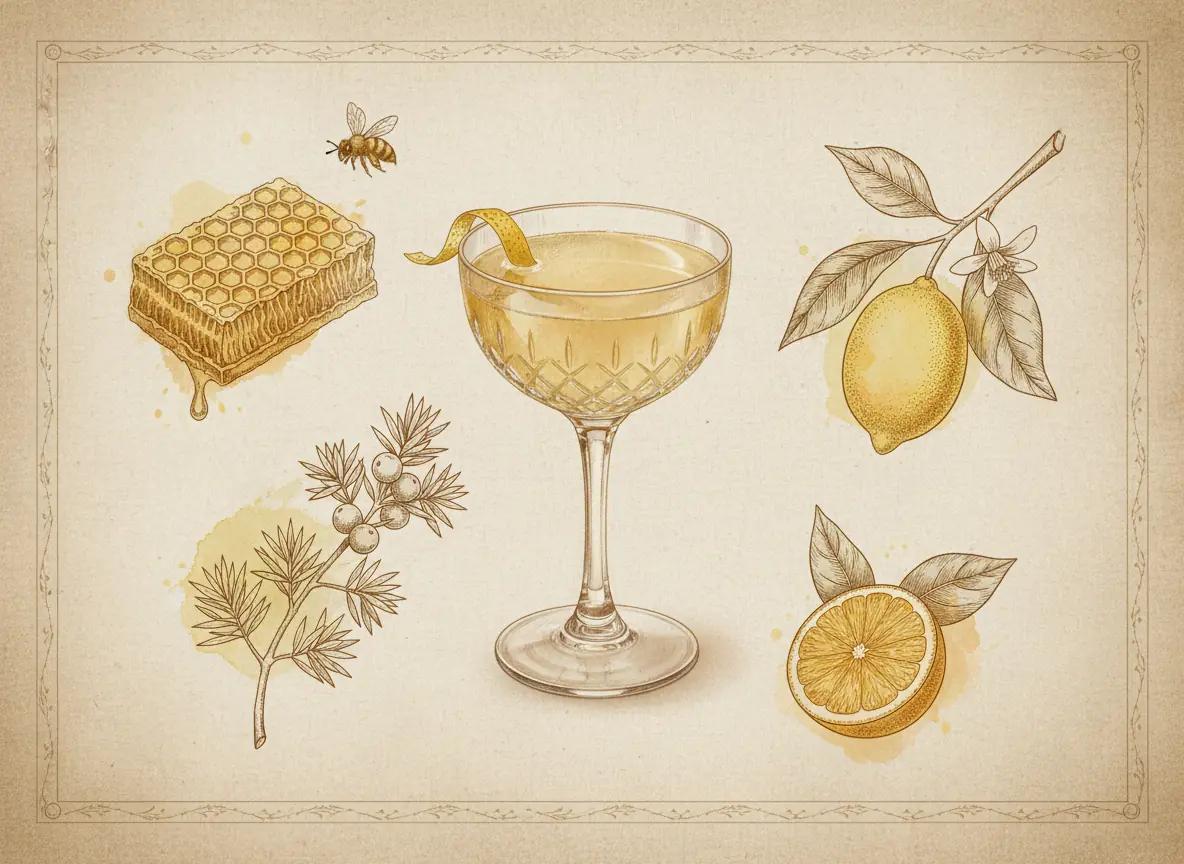
Bee’s Knees
A Bee’s Knees is 52.5ml of London Dry gin, 22.5ml each of fresh lemon and orange juice and two teaspoons (10ml) of honey syrup, made with two parts honey to one of warm water. Shake it hard for 10 to 12 seconds and double strain it into a chilled coupe, with a strip of lemon peel. About 2.1 UK units. The measures are the IBA’s. The orange is the part most recipes leave out. The oldest printings are gin, lemon and honey alone; David Embury suggested a little orange juice as a variation in 1948, and the IBA built it in. Orange softens the lemon, which is why two teaspoons of honey syrup are enough. The drink is often filed under American Prohibition, with honey and lemon covering for bathtub gin. Difford’s Guide, a secondary source, says the earliest printing tells a different story: Cocktails de Paris, published in 1929, credits it to Frank Meier of the Ritz in Paris, and Meier claimed it again in his own book in 1936.
Glassware: Coupe Glass
Garnish: Lemon peel
Ingredients
52.5ml
A London Dry at 40% ABV with clear juniper. At 52.5ml it is half the drink, and the honey and juices sit around it rather than over it.
22.5ml
Squeezed the same day. Matched measure for measure with the orange, it supplies most of the acid.
22.5ml
Squeezed the same day. The IBA’s addition to the old gin, lemon and honey drink; it rounds the lemon and lets a small amount of honey balance it.
2 teaspoons (10ml)
Two parts runny honey to one part warm water, stirred until it pours, then cooled. A mild wildflower honey lets the gin lead; heather or chestnut honey makes itself known.
Instructions
Squeeze the lemon and orange juice the same day and chill a coupe.
For the honey syrup, stir two parts runny honey into one part warm water until it pours, then let it cool.
Add the gin, lemon juice, orange juice and honey syrup to a shaker.
Fill with cubed ice and shake hard for 10 to 12 seconds.
Double strain into the chilled coupe.
Express a strip of lemon peel over the surface and rest it on the rim.
Source: the IBA (Official IBA specification, with the honey made up as a two-to-one syrup; method and lemon peel garnish ours). Last checked 10 October 2026.
Expert Tip
Use honey syrup, not neat honey. Honey stiffens when it meets cold gin and ice, and ends up as a lump in the shaker. Two parts runny honey stirred into one part warm water pours easily and in our experience keeps for a few weeks in the fridge. If you only have neat honey, do what the IBA says: stir it into the lemon and orange juice in the shaker until it dissolves, then add the gin and ice. Adjust with the honey. Too sharp, add a little more syrup; too sweet, take it back. The two juices are matched on purpose, and moving either changes the drink more than a few millilitres of honey does.
Behind the Bee’s Knees
Flavour Profile
Paris, Not Prohibition
Difford’s Guide gives the earliest printed Bee’s Knees as Cocktails de Paris, published in 1929, which prints it as a sixth lemon juice, a sixth honey and two thirds Gordon’s dry gin, shaken, and credits it to Frank Meier of the Hôtel Ritz. Meier repeated it in The Artistry of Mixing Drinks in 1936, where, Difford’s says, a design marks it as one of his own recipes.
The story most people know puts it in an American speakeasy, honey and lemon disguising rough bathtub gin. It is plausible and unsupported. The Brooklyn Standard Union of April 1929, which Difford’s Guide dates to the 22nd, did credit an American, Mrs J. J. Brown of Denver and Paris, the socialite Margaret Brown, and the Oxford Companion, in an entry by Eric Felten, also records the attribution, citing the paper of 23 April. Meier may have made it for her at the Ritz.
The Orange in the IBA Recipe
Meier’s drink has no orange. David Embury, writing in 1948, said a small amount of orange juice made an interesting variation, and the IBA spec goes further, giving orange the same 22.5ml as the lemon.
That changes the arithmetic. Orange juice is sweeter and less acidic than lemon, so the pair together are softer than lemon alone, and two teaspoons of honey syrup are enough to balance them. Leave the orange out and the same honey leaves the drink tart, which is why Meier’s version gives the honey as much room as the lemon.
Honey Syrup, and Which Honey
Neat honey and cold gin do not mix: the honey thickens and sticks to the ice. The IBA’s answer is to stir the honey into the juices first. Ours is a syrup of two parts honey to one of warm water, the same one our Gold Rush uses, which pours straight from the bottle.
The honey itself is a choice. Mild wildflower or acacia honey adds sweetness and a light floral note and leaves the gin in front. Heather or chestnut honey is darker and more bitter, and with a strongly juniper-led gin it makes a deeper drink. At two teaspoons the difference is noticeable without taking over.
Meier’s Version, the IBA’s and the Gold Rush
The Bee’s Knees in 1929, the IBA spec we pour, and our Gold Rush
Spirit
- Cocktails de Paris, 1929
- Two thirds gin
- Bee’s Knees (IBA)
- 52.5ml London Dry gin
- Gold Rush
- 60ml bourbon
Lemon juice
- Cocktails de Paris, 1929
- One sixth
- Bee’s Knees (IBA)
- 22.5ml
- Gold Rush
- 22.5ml
Orange juice
- Cocktails de Paris, 1929
- None
- Bee’s Knees (IBA)
- 22.5ml
- Gold Rush
- None
Honey
- Cocktails de Paris, 1929
- One sixth, neat
- Bee’s Knees (IBA)
- 10ml honey syrup
- Gold Rush
- 22.5ml honey syrup
Serve
- Cocktails de Paris, 1929
- Shaken, up
- Bee’s Knees (IBA)
- Up, in a chilled coupe
- Gold Rush
- On one large cube
UK units
- Cocktails de Paris, 1929
- Not fixed by the recipe
- Bee’s Knees (IBA)
- About 2.1
- Gold Rush
- About 2.4
| Element | Cocktails de Paris, 1929 | Bee’s Knees (IBA) | Gold Rush |
|---|---|---|---|
| Spirit | Two thirds gin | 52.5ml London Dry gin | 60ml bourbon |
| Lemon juice | One sixth | 22.5ml | 22.5ml |
| Orange juice | None | 22.5ml | None |
| Honey | One sixth, neat | 10ml honey syrup | 22.5ml honey syrup |
| Serve | Shaken, up | Up, in a chilled coupe | On one large cube |
| UK units | Not fixed by the recipe | About 2.1 | About 2.4 |
How to Serve It
Serve it up, in a coupe taken from the freezer. The double strain catches the orange pulp and the ice. Express the lemon peel over the top and rest it on the rim. The IBA allows orange zest instead; lemon keeps the nose sharper against the honey.
For honey with bourbon, make a Gold Rush; for the plain sugar sour on gin, a Gin Sour.
Make it at home
The Spirit
GinGin is a spirit flavoured with juniper berries. Under the retained Regulation (EC) 110/2008, juniper must lead the taste, the floor is 37.5% ABV, and the route the flavour takes sets the grade: plain gin, distilled gin or London gin. Our recipes count it at 40%, and it carries the Martini, the Negroni and the Gin and Tonic.
Master the Techniques
More to explore
Frequently Asked Questions
What is in a Bee’s Knees?
Is the Bee’s Knees a Prohibition cocktail?
Why does the IBA recipe include orange juice?
How do I make honey syrup?
Who was the drink made for?
How does it differ from a Gold Rush?
What does the name mean?
How strong is a Bee’s Knees?
Sources.
Checked between 18 October and 19 October 2026.
- Difford’s Guide, “Bee’s Knees” (secondary source: Cocktails de Paris (1929) credits Frank Meier of the Hôtel Ritz Paris: 1/6 lemon, 1/6 honey, 2/3 Gordon’s dry gin; Standard Union (Brooklyn), 22 April 1929, credits Mrs J. J. Brown of Denver and Paris; Meier’s The Artistry of Mixing Drinks (1936); Embury (1948) on orange juice).
- The Oxford Companion to Spirits and Cocktails (Eric Felten), “Bee’s Knees” (secondary source: first appears in print during Prohibition, ascribed to Margaret “The Unsinkable Molly” Brown (Brooklyn Standard Union, 23 April 1929 in its references); Embury on the drink).
- IBA, “Bee’s Knees” (official specification: 52.5ml dry gin, 2 teaspoons honey syrup, 22.5ml fresh lemon juice, 22.5ml fresh orange juice; stir the honey with the juices until it dissolves, add the gin and shake).
You Might Also Like
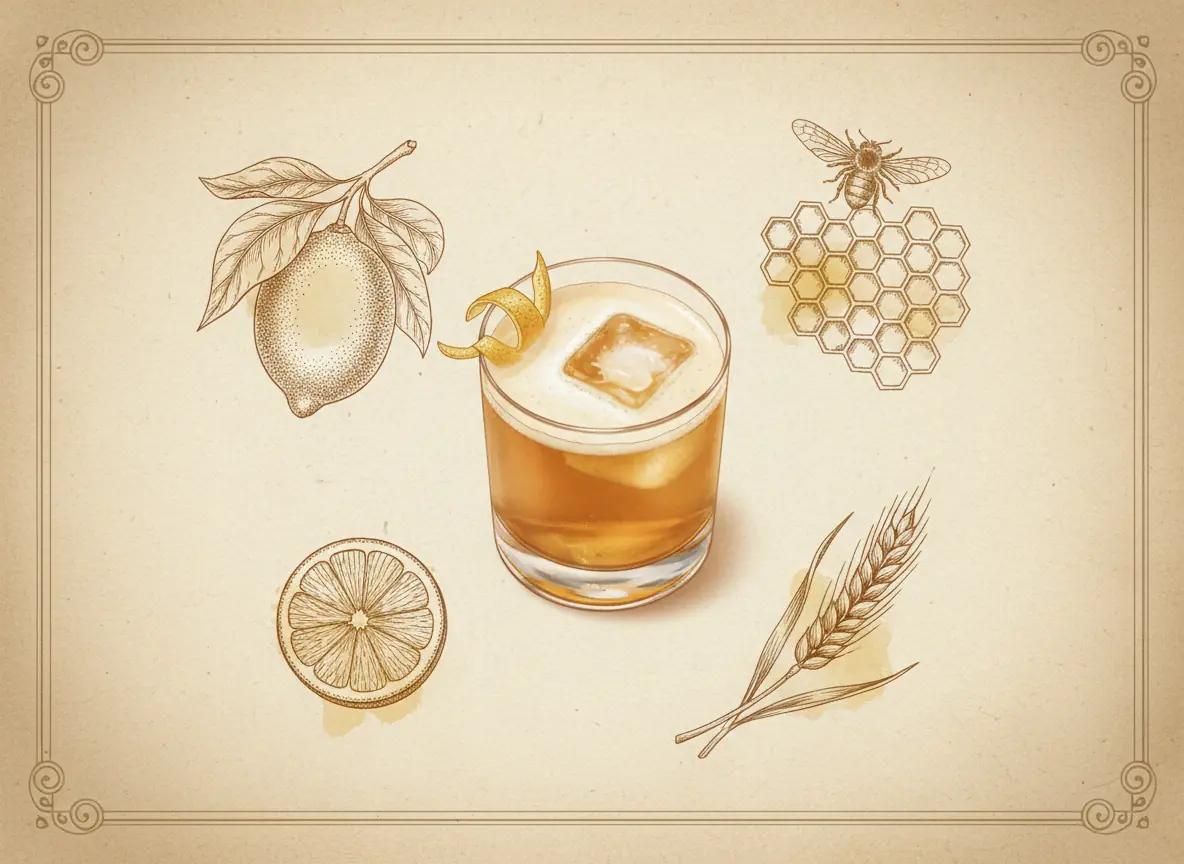
Honey Sour
A Honey Sour is a Whiskey Sour sweetened with honey: 60ml bourbon, 25ml fresh lemon juice and 15ml honey syrup mixed at two parts honey to one of warm water, shaken hard and double strained over a large cube in a rocks glass. A 15ml egg white is optional and gives it a soft foam, with three drops of Angostura on top. Honey changes more than the sweetness. It adds a floral, waxy note on top of the bourbon’s vanilla and caramel, and more body than sugar syrup. The drink sits between the Whiskey Sour and the Gold Rush, the bourbon, lemon and honey drink that Punch credits to T. J. Siegal at Milk & Honey in New York, in 2000 by its account and 2001 by VinePair’s. The Honey Sour adds back the egg white and the bitters, with a little less syrup. No one is recorded as its inventor. It is a sweetener swap on a sour. Difford’s Guide dates the first written sour recipes to Jerry Thomas’s 1862 guide and the oldest known whiskey sour mention to a Wisconsin newspaper of 1870. A glass holds about 2.4 UK units.
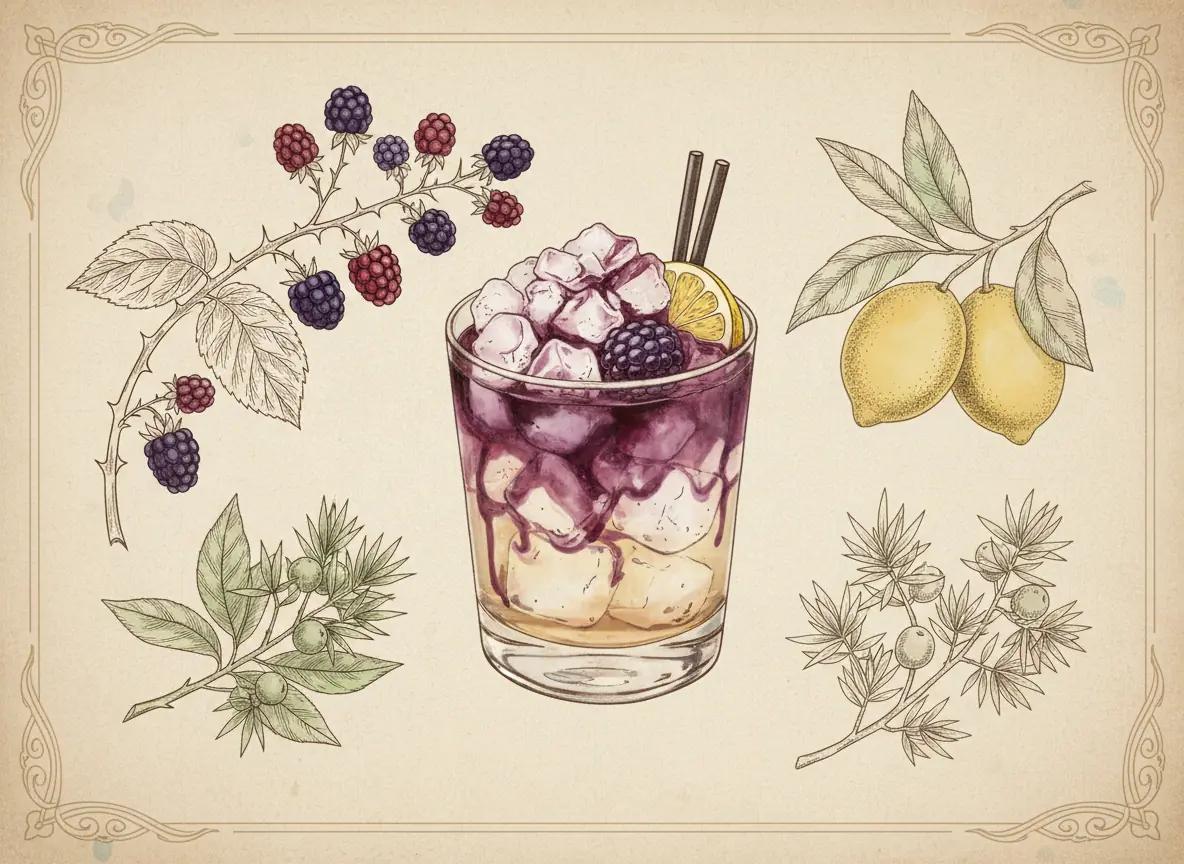
Bramble
A Bramble is 50ml London Dry gin, 25ml fresh lemon juice and 12.5ml sugar syrup, shaken hard and strained over crushed ice in a rocks glass, with 15ml of crème de mûre poured over the top so it bleeds down through the ice. A lemon slice and blackberries finish it. About 2.2 UK units. These are the IBA’s measures. Dick Bradsell created it at Fred’s Club in Soho: Punch dates it to 1984, Bradsell’s own account in Difford’s Guide says the mid-eighties or thereabouts, and the Oxford Companion says 1989. He wanted a British cocktail, and he took the idea from going blackberrying as a child on the Isle of Wight. Bramble is the everyday name for the blackberry bush. Underneath, it is a gin sour. The liqueur on top makes it change as you drink: tart and sharp at first, darker and fruitier towards the bottom of the glass.
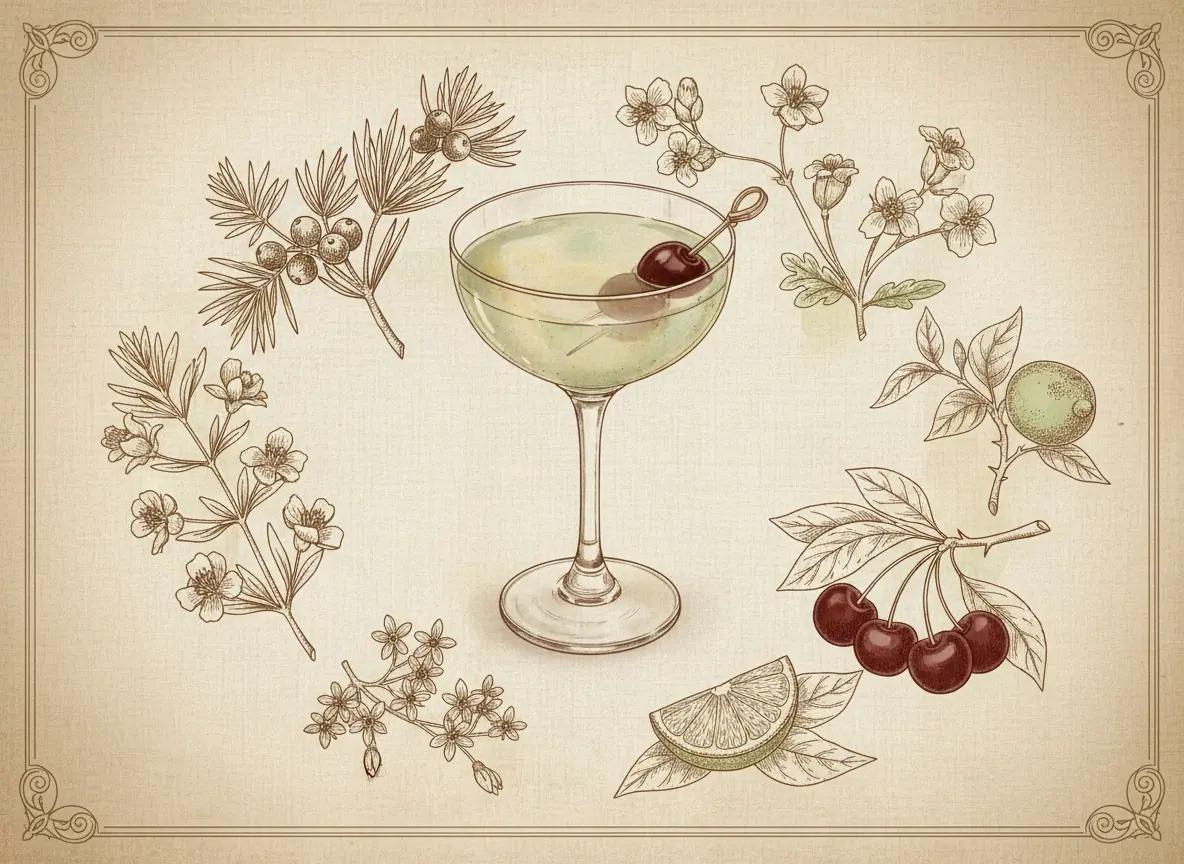
Last Word
A Last Word is 22.5ml each of gin, green Chartreuse, maraschino liqueur and fresh lime juice, shaken hard for 10 to 12 seconds and double strained into a chilled Nick & Nora or coupe. About 2.9 UK units. The measures are the IBA’s; the cherry or lime twist is ours. The Oxford Companion says the drink first appears in print in the Detroit Athletic Club News in 1916, on a menu at 35 cents, a high price then. Ted Saucier’s Bottoms Up of 1951 prints the recipe, quoting a club source who says Frank Fogarty, a vaudeville monologist, introduced it there about thirty years earlier. In 2003 Murray Stenson put it on the menu at the Zig Zag Café in Seattle, from where it spread, the Companion says. Four strong flavours at equal volume, and none takes over. Chartreuse brings herbs and heat, maraschino cherry and a bitter almond edge, lime the acid, and gin holds them together.
Where this one sits
Recipe by Jerry Can Spirits · Updated 19 October 2026