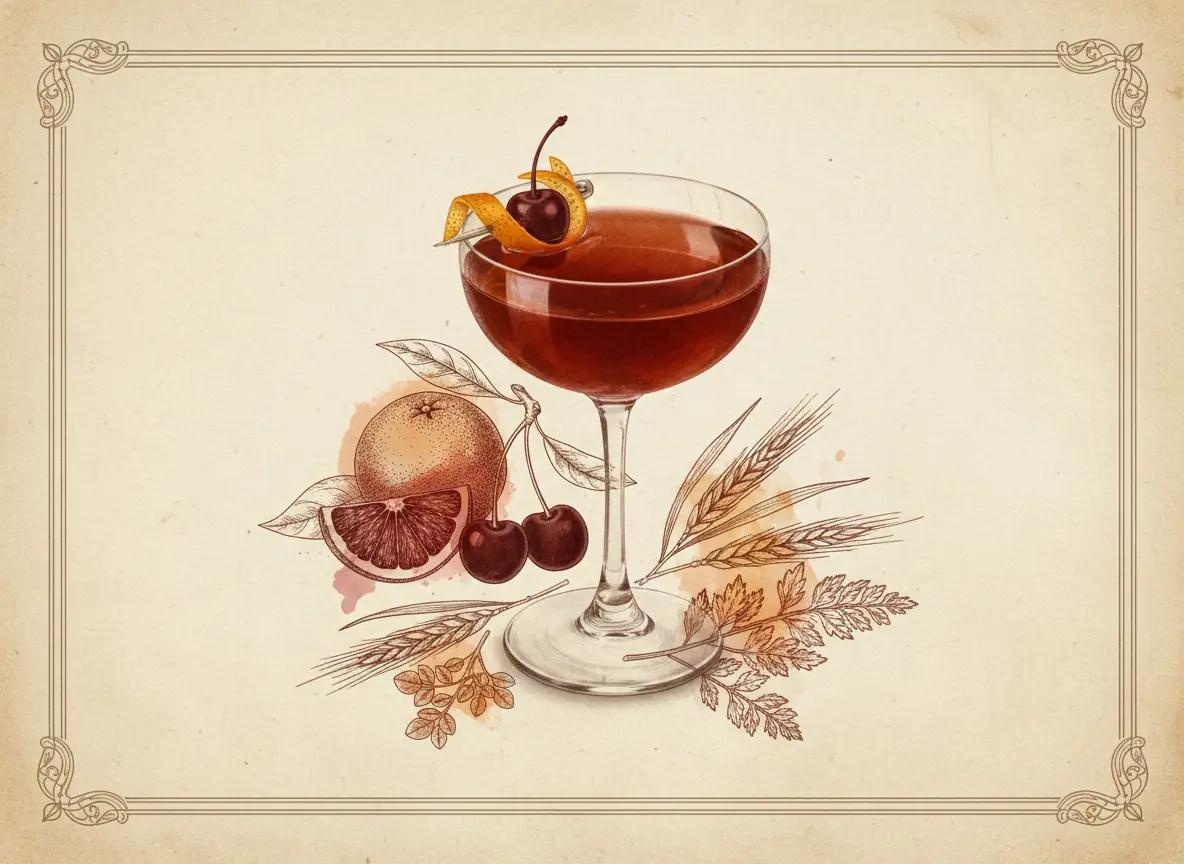
Blood & Sand
A Blood & Sand is equal parts Scotch whisky, sweet vermouth, Cherry Heering and fresh orange juice, 25ml of each, shaken hard and double strained into a chilled coupe. An expressed orange peel goes on top. No syrup goes in: the cherry liqueur and the vermouth do all the sweetening, and the glass holds about 2.0 UK units. It shares its name with Blood and Sand, the film that cast Rudolph Valentino as a bullfighter, first screened in 1922, and the Oxford Companion to Spirits and Cocktails says it first appears in Harry Craddock’s Savoy Cocktail Book of 1930. Nobody can be shown to have mixed it first. Scotch and orange juice sound like an odd pair. The vermouth and cherry join them, bridging malt and citrus with wine and dark fruit, so that no single ingredient leads.
Glassware: Coupe Glass
Garnish: Orange peel expressed and Maraschino cherry (optional)
Ingredients
25ml
A blended Scotch with some body, or a blended malt such as Monkey Shoulder, at 40% ABV. Its malt and light smoke have to show through three other full measures; an Islay malt pushes the drink towards smoke.
25ml
A rich Italian-style sweet vermouth, around 16% ABV at our working figure. We keep it in the fridge once opened and finish it within a month; stale vermouth is the usual reason the drink falls flat.
25ml
Cherry Heering, at 24% ABV on Fareham Wine Cellar’s listing, is the reference bottle: dark cherry with a dry, spiced edge. Cheaper cherry liqueurs are sweeter and thinner, and in an equal-parts drink that shows.
25ml
Squeezed the same day. Ordinary oranges work; a blood orange in season darkens the glass and adds a sharper fruit.
Instructions
Squeeze the orange juice the same day, ideally just before you build.
Chill a coupe in the freezer or with ice water.
Add the Scotch, sweet vermouth, Cherry Heering and orange juice to a shaker.
Fill the shaker with cubed ice and shake hard for 10 to 12 seconds.
Double strain into the chilled coupe.
Express an orange peel over the drink and rest it on the rim, adding a cherry if you like.
Expert Tip
Diagnose a dull one in order. Check the vermouth first. It is one of four equal measures, and in our experience a bottle left open out of the fridge for more than a month tastes flat and stale. If the vermouth is fresh and the drink still tastes thin, the Scotch is too light. A blend with some body and a little smoke holds its own against three full measures; a soft, grain-led blend vanishes behind the cherry. Squeeze the orange the same day, ideally just before you shake. It is the drink’s main acid, and carton juice leaves it sweet and dull.
Behind the Blood & Sand
Flavour Profile
The Origin
The Oxford Companion says the drink was apparently named after Blood and Sand, the silent film that cast Rudolph Valentino as a bullfighter, first screened in 1922, and that it first appears in Harry Craddock’s Savoy Cocktail Book of 1930. Difford’s Guide dates the drink to 1922, the year of the film, and says who was inspired by the film to make it is unknown.
Whether Craddock created it or recorded a drink already in circulation is not known, and nobody else has a documented claim. The usual reading of the name is the colour in the glass: dark cherry red for the blood, orange-gold for the sand.
How Four Equal Parts Balance
Four ingredients at 25ml each means none can hide behind another. The Scotch brings malt, dried fruit and some smoke. The vermouth brings body and a wine bitterness. The cherry liqueur brings dark fruit and most of the sugar. The orange brings the acid that stops it turning heavy.
Blood & Sand: what each ingredient does
Scotch whisky
- Measure
- 25ml
- Its job
- Malt, dried fruit and light smoke
Sweet vermouth
- Measure
- 25ml
- Its job
- Body, wine and a bitter edge
Cherry Heering
- Measure
- 25ml
- Its job
- Dark cherry and most of the sweetness
Fresh orange juice
- Measure
- 25ml
- Its job
- Acid and brightness
| Ingredient | Measure | Its job |
|---|---|---|
| Scotch whisky | 25ml | Malt, dried fruit and light smoke |
| Sweet vermouth | 25ml | Body, wine and a bitter edge |
| Cherry Heering | 25ml | Dark cherry and most of the sweetness |
| Fresh orange juice | 25ml | Acid and brightness |
Orange is a softer acid than lemon, which is why the drink needs no syrup. The cherry and vermouth sweeten it and the orange only has to keep them in check. Swap in lemon and the balance tips sour.
The Scotch Question
Scotch is an unusual base for a shaken drink with juice. Most whisky sours lean on bourbon, whose vanilla sits easily with citrus; Scotch brings malt and smoke instead, and the cherry is what makes that pairing work.
A blend with some body suits it best. Light, grain-led blends disappear behind the cherry and orange, and a smoky Islay single malt pulls the whole drink that way.
For Scotch and sweet vermouth with no juice, the Rob Roy is the stirred relative.
How to Serve It
Shaken hard for 10 to 12 seconds, double strained into a chilled coupe, with the oil of an orange peel twisted over it and a cherry if you like. Serve it straight away; as it warms, the sweetness comes forward.
It carries about 2.0 UK units, a full cocktail’s worth, though the juice makes it read lighter. It suits either end of a meal.
Make it at home
The Spirit
Whisky (Scotch)Scotch is whisky distilled and matured in Scotland, kept in oak for three years at the least, and bottled no weaker than 40% ABV. The Scotch Whisky Regulations 2009 allow only three ingredients, water, malted barley and whole grains of other cereals, and only water and plain caramel colouring may be added later. Fifteen recipes in our library call for it, from the Penicillin and Hot Toddy to the Rob Roy.
Master the Techniques
More to explore
Frequently Asked Questions
What is in a Blood & Sand?
Why is it called Blood & Sand?
Who invented the Blood & Sand?
What Scotch should I use?
Mine tastes flat. What went wrong?
How strong is a Blood & Sand?
Can I use blood orange juice?
Sources.
Checked between 18 October and 19 October 2026.
- The Oxford Companion to Spirits and Cocktails (Fernando Castellon and David Wondrich), “The Blood and Sand” (secondary source: a drink of unknown parentage, first in the Savoy Cocktail Book in 1930; apparently named after the Valentino film first screened in 1922; equal parts blended scotch, cherry brandy, Italian vermouth and orange juice).
- Fareham Wine Cellar, “Cherry Heering Liqueur (Cherry Liqueur) 24%” (UK retailer listing: 24%).
- Internet Archive, “The Savoy Cocktail Book (1930), scan” (primary source, read as text: Blood and Sand Cocktail in the 1930 book with Scotch whisky, cherry brandy, Italian vermouth and orange juice).
- Difford’s Guide, “Blood and Sand (Difford’s Recipe)” (secondary source: created in 1922 and named after Valentino’s film released that year; who was inspired by the film is unknown; first appears in the 1930 Savoy; cherry brandy said to represent blood, orange juice the sand of the arena).
You Might Also Like
La Louisiane
La Louisiane is 30ml each of rye whiskey, sweet vermouth and Bénédictine, with two dashes of absinthe and three of Peychaud’s bitters, stirred for 20 to 30 seconds and strained into a chilled Nick & Nora, with a maraschino cherry on a pick. About 3.1 UK units. Stanley Clisby Arthur printed it in 1937, in Famous New Orleans Drinks and How to Mix ’Em, as the special cocktail served at Restaurant de la Louisiane, “one of the famous French restaurants of New Orleans”, in Difford’s Guide’s reproduction of the book. His recipe, as Difford’s Guide reproduces it, pours a third of a jigger of each of the three, with three or four dashes each of absinthe substitute and Peychaud’s; ours keeps the thirds and trims the absinthe to two dashes. It sits on the Manhattan’s frame of rye and sweet vermouth, with Bénédictine poured at the same measure as both. In our view that makes it richer and more herbal than its parent, and the anise of the absinthe and the Peychaud’s places it in New Orleans.
Bijou
A Bijou is 40ml of London Dry gin, 20ml of green Chartreuse, 20ml of sweet vermouth and two dashes of orange bitters, stirred over cubed ice for 30 seconds and strained into a chilled Nick and Nora glass, with a lemon twist expressed over it and a cherry. About 3.0 UK units. The Oxford Companion says the drink appears to be Harry Johnson’s adaptation of a cocktail first recorded in St. Louis and Cincinnati in the spring of 1895, and that his version appeared in the 1900 edition of his Bartenders’ Manual. Bijou is French for jewel, and Difford’s Guide gives the explanation that each bottle stands for a stone by its colour: gin for diamond, vermouth for ruby, Chartreuse for emerald. At 55% ABV on Chartreuse’s own page, green Chartreuse is the force to manage. Many recipes pour the three in equal measures; ours doubles the gin so its juniper holds against the Chartreuse, with the vermouth giving body and the bitters tying the herbs together.
Last Word
A Last Word is 22.5ml each of gin, green Chartreuse, maraschino liqueur and fresh lime juice, shaken hard for 10 to 12 seconds and double strained into a chilled Nick & Nora or coupe. About 2.9 UK units. The measures are the IBA’s; the cherry or lime twist is ours. The Oxford Companion says the drink first appears in print in the Detroit Athletic Club News in 1916, on a menu at 35 cents, a high price then. Ted Saucier’s Bottoms Up of 1951 prints the recipe, quoting a club source who says Frank Fogarty, a vaudeville monologist, introduced it there about thirty years earlier. In 2003 Murray Stenson put it on the menu at the Zig Zag Café in Seattle, from where it spread, the Companion says. Four strong flavours at equal volume, and none takes over. Chartreuse brings herbs and heat, maraschino cherry and a bitter almond edge, lime the acid, and gin holds them together.
Where this one sits
Recipe by Jerry Can Spirits · Updated 19 October 2026