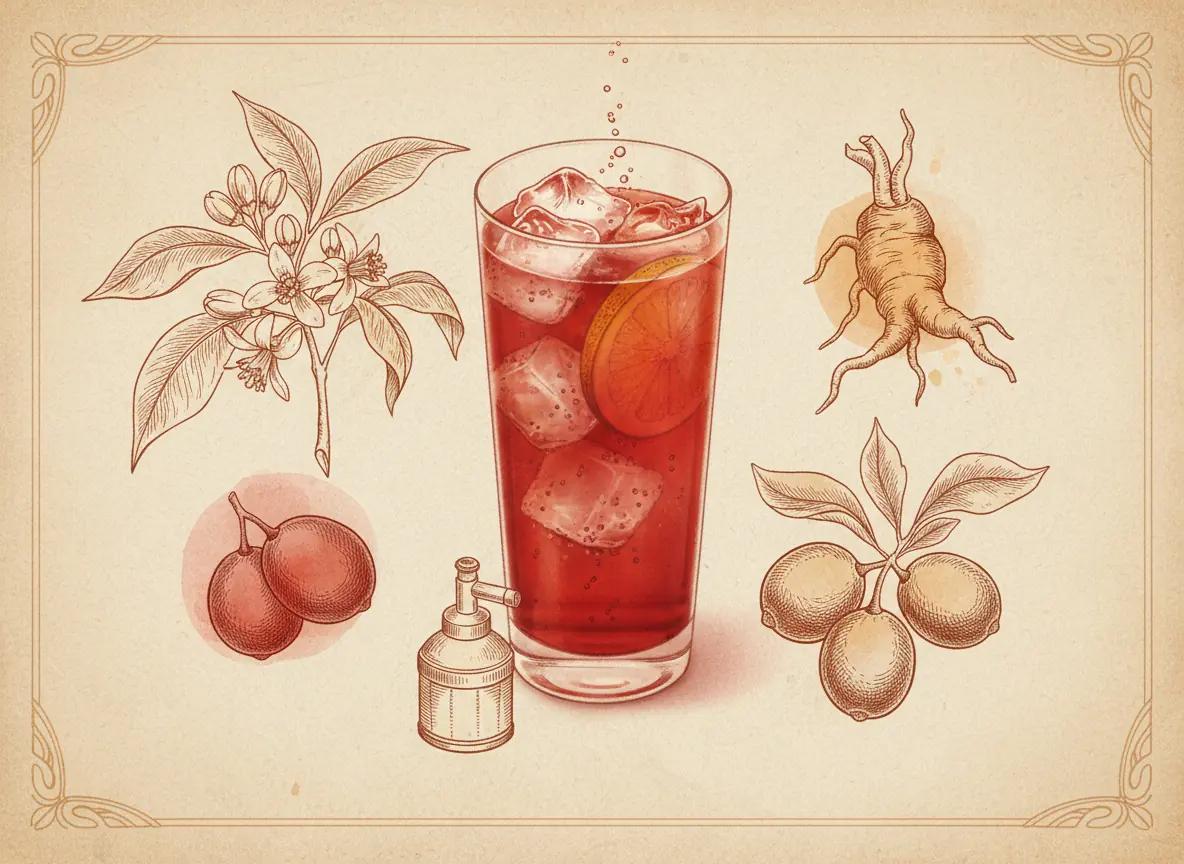
Campari & Soda
A Campari and soda is 45ml of Campari and 90ml of cold soda water, built over a highball full of ice, stirred once and finished with an orange slice. One part Campari to two of soda: bitter, orange-edged and long, and at about 1.1 UK units a light drink to have before a meal. Gaspare Campari created his bitter in 1860, by Campari’s own account. In 1932, by Campari’s own account, the company put it and soda together in a single-serve bottle designed by the Futurist artist Fortunato Depero, and Difford’s Guide, a secondary source, lists Campari Soda, as that bottle is called, at 10% ABV. The ratio is the only real decision. More soda and the bitterness thins out; less and the drink turns heavy. Start at one to two and adjust by 15ml either way.
Glassware: Highball Glass
Garnish: Orange slice
Ingredients
45ml
Bitter, orange and herbal, and 25% ABV in the UK. It is the whole flavour of the drink, so there is nothing to substitute; another red bitter makes a different drink.
90ml
Well chilled before pouring. Add it last, pour gently down the side of the glass and stir once. Poured hard, it flattens before the first sip.
Instructions
Fill a highball glass to the top with large cubed ice.
Pour the Campari over the ice.
Pour the chilled soda water gently down the inside of the glass.
Stir once with a single upward lift of the bar spoon.
Add the orange slice and serve.
Expert Tip
Pour the soda down the inside wall of the glass rather than straight over the ice. It loses less carbonation that way and arrives at the first sip with the bubbles intact. One slow lift of the spoon is enough; a second stir only costs fizz. Fill the glass properly with large cubes before anything else goes in. A half-filled glass warms fast, and a warm Campari and soda turns heavy and syrupy as the bubbles go, which is the usual way a two-ingredient drink goes wrong. Chill the soda before you open it. Cold soda holds its carbonation far better than room-temperature soda poured over ice, and in a drink where the fizz is one of two ingredients that difference shows.
Behind the Campari & Soda
Flavour Profile
The Origin
Gaspare Campari created the bitter that carries his name in 1860, by Campari’s own account, and in 1904 the company moved to a plant at Sesto San Giovanni, near Milan. The recipe is a closely held secret: bitter herbs, aromatic plants and fruit infused in alcohol and water. Soda is the simplest thing to add to it, and Campari and soda is the plainest form the drink takes.
The combination got its own bottle in 1932, when Campari launched Campari Soda, pre-mixed, in a single-serve bottle designed by Fortunato Depero, an artist of the Italian Futurist movement, by Campari’s own account. The small inverted cone put the drink on café tables without a bartender, and it is still sold in Italy at 10% ABV.
Campari and Soda, Americano or Negroni
Three Campari drinks sit one step apart, and the step tells you what each is for. Vermouth adds sweetness and body; gin in place of the soda makes a short, strong drink.
Campari and soda, Americano and Negroni compared; units take Campari at the 25% ABV on LWC’s UK listing, gin at 40% and sweet vermouth at 16%, our working figure
Campari and soda
- Spec
- 45ml Campari, 90ml soda
- Build
- Built over ice, one stir
- Glass
- Highball
- Strength
- About 1.1 UK units
Americano
- Spec
- 30ml Campari, 30ml sweet vermouth, 75ml soda
- Build
- Built over ice, one stir
- Glass
- Highball
- Strength
- About 1.2 UK units
Negroni
- Spec
- 30ml gin, 30ml Campari, 30ml sweet vermouth
- Build
- Stirred, strained over fresh ice
- Glass
- Rocks glass
- Strength
- About 2.4 UK units
| Drink | Spec | Build | Glass | Strength |
|---|---|---|---|---|
| Campari and soda | 45ml Campari, 90ml soda | Built over ice, one stir | Highball | About 1.1 UK units |
| Americano | 30ml Campari, 30ml sweet vermouth, 75ml soda | Built over ice, one stir | Highball | About 1.2 UK units |
| Negroni | 30ml gin, 30ml Campari, 30ml sweet vermouth | Stirred, strained over fresh ice | Rocks glass | About 2.4 UK units |
The Case for Simplicity
Bars sometimes dress the drink up with a dash of orange bitters, a squeeze of orange or a slice of grapefruit. None of it is wrong, and none of it is needed. Campari already brings bitterness, orange and a herbal finish; what it lacks on its own is length and lift, and soda gives exactly that. Additions mostly cover the thing you ordered the drink for.
The Ratio
One part Campari to two of soda is a common starting point, and it is the ratio used here. Built over a full glass of ice, the drink takes on melt water as it stands, so it starts a little more bitter and finishes softer.
If the drink tastes thin, cut the soda by 15ml next time. If the bitterness is too forward, add 15ml. Those two adjustments cover nearly every version that falls short.
How to Serve It
Built over ice in a highball, one gentle stir, an orange slice on the rim. Serve it cold and before food, with something salty alongside. At about 1.1 UK units it suits the aperitivo hour: a drink to open the appetite rather than end the evening.
Make it at home
The Spirit
CampariCampari is a red Italian bitter liqueur, 25% ABV in the UK on a wholesaler’s listing, made in the style Difford’s Guide describes: an infusion of herbs and fruit in alcohol and water. Campari dates it to 1860 and Gaspare Campari; the Oxford Companion has Gaspare setting up in Novara in 1856 and moving to Milan in 1862. Its bitterness anchors the Negroni and the Americano, and lengthened with soda over ice it needs nothing else.
Master the Techniques
More to explore
Frequently Asked Questions
What is a Campari soda?
What is the right Campari to soda ratio?
Is Campari soda alcoholic?
What do you eat with a Campari soda before dinner?
What is the Depero bottle?
What is the difference between a Campari soda, an Americano and a Negroni?
Should it go in a highball or a rocks glass?
How much Campari is in a pub measure?
Sources.
Checked between 18 October and 19 October 2026.
- Campari, “Our history” (1860 Gaspare Campari; 1904 the plant at Sesto San Giovanni).
- Campari, “Campari Soda” (1932, Fortunato Depero’s bottle for the first ready-to-drink version).
- Difford’s Guide, “Campari Soda” (secondary source: alc./vol 10%; launched in 1932; one part Campari to two parts soda; 10cl cone-shaped bottle).
- LWC, “Campari 70cl” (UK trade listing: 25%).
- legislation.gov.uk, “The Weights and Measures (Intoxicating Liquor) Order 1988” (article 3: set measures apply to gin, rum, vodka and whisky).
You Might Also Like
Americano
An Americano is 30ml Campari and 30ml sweet vermouth built over ice in a highball, topped with 75ml of cold soda and stirred once, with an orange slice. Bitter and sweet in equal measure, lengthened with soda: a Negroni with soda in place of the gin, at about half the alcohol. It grew out of the Milano-Torino, Campari from Milan with vermouth from Turin, which Difford’s Guide says Gaspare Campari created in the 1860s at his Caffè Campari in Milan. Difford’s adds that soda was said to have been added later, to make the Americano. The vermouth decides the result. At equal volume with the Campari it has nowhere to hide, and in our experience an opened bottle that has stood at room temperature for months will flatten the drink. Keep it in the fridge.
Negroni
A Negroni is 30ml each of gin, Campari and sweet vermouth, stirred with ice for 20 to 30 seconds and strained over fresh ice in a rocks glass, with an orange peel expressed over the top. About 2.4 UK units. The measures are the IBA’s; the IBA builds the drink in the glass and garnishes it with half an orange slice. Difford’s Guide gives the most widely reported account: Florence in 1919, at the Casoni Bar, where the bartender Fosco Scarselli is said to have replaced the soda in Count Camillo Negroni’s Americano with gin. The Oxford Companion has the drink named in a surviving letter of October 1920 and then absent under that name until 1947. A French book of 1929 by Alimbau and Milhorat, in the Internet Archive’s scan, gives equal parts of the three as the Campari Mixte. Each third has a job. Gin gives strength and juniper, the red bitter gives bitterness and orange, and the vermouth gives body and sugar. With no juice or soda in the glass, a tired vermouth shows at once.
Where this one sits
Recipe by Jerry Can Spirits · Updated 19 October 2026