Penicillin
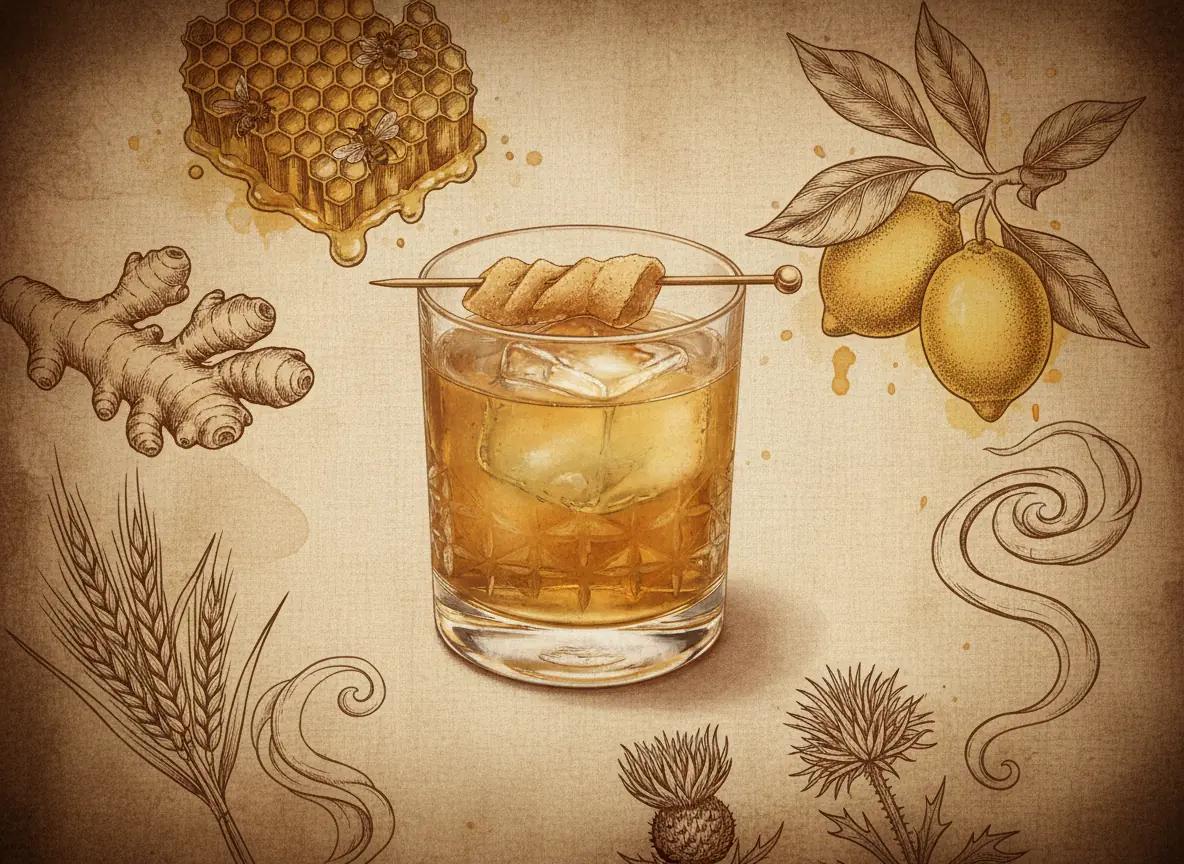
A Penicillin is 60ml blended Scotch, 22.5ml honey syrup, 22.5ml fresh lemon juice and two or three thin slices of fresh ginger, shaken hard and double strained over one large cube, with 7.5ml of Lagavulin 16 floated on top and candied ginger on the rim. That is the IBA specification, at about 2.7 UK units. Difford’s Guide, a secondary source, dates it to 2005 and credits Sam Ross with creating it at Milk & Honey in Manhattan; Chilled Magazine calls Ross an Australian bartender. Chilled says Ross described the name as a tongue-in-cheek reference to the drink’s cure-all properties, and that a nod to the antibiotic discovered by the Scottish scientist Alexander Fleming may have been a factor. It is a whisky sour in structure. The ginger gives it heat, and the smoky malt on top reaches the nose before the first sip.
Glassware: Rocks Glass
Garnish: Candied ginger
Ingredients
60ml
A blend with some malt character and a little smoke. At 60ml it carries the drink, and a thin, neutral blend leaves it tasting of honey and lemon.
22.5ml
Two parts honey to one of warm water, stirred and cooled. Nothing steeped in it: the ginger goes into the shaker fresh, which keeps its heat sharp.
2 to 3 slices
Thin slices about the size of a 10p coin, shaken in with everything else. Fresh ginger hits hotter and brighter than a ginger syrup, and the heat stops the honey turning the drink soft.
22.5ml
Squeezed the same day, ideally to order. It sets the acid against the honey, and stale juice leaves the drink sweet.
7.5ml
The float the IBA names. Its smoke and iodine have to register at 7.5ml; another heavily peated Islay malt works, and the drink then differs a little from the specification.
Instructions
Squeeze the lemon juice the same day, ideally just before you build.
Make the honey syrup in advance: two parts honey to one of warm water, stirred until smooth, then cooled.
Add the blended Scotch, honey syrup, lemon juice and ginger slices to a shaker.
Fill the shaker with cubed ice and shake hard for 10 to 12 seconds.
Double strain over one large ice cube in a rocks glass.
Float the Lagavulin slowly over the back of a bar spoon held just over the surface.
Put candied ginger on the rim and serve.
Source: the IBA (Official IBA specification, with the ginger shaken in rather than muddled; method ours). Last checked 9 October 2026.
Expert Tip
Slice the ginger thin and shake it hard. Two or three slices the size of a 10p coin go into the shaker with everything else, and 10 to 12 hard seconds against cubed ice draws the heat out. The IBA muddles the ginger first, which gives more heat if yours is mild. Double strain. The fine strainer catches the ginger fibres and ice shards, which would otherwise float in a drink served over one clear cube. Float the Lagavulin last, slowly, over the back of a bar spoon held just over the surface. Poured fast, it mixes in, and the smoke stops arriving first.
Behind the Penicillin
Flavour Profile
The Origin
Difford’s Guide says Sam Ross created the Penicillin in 2005 at Milk & Honey in New York, and Chilled Magazine calls Ross an Australian bartender. The Oxford Companion to Spirits and Cocktails says Sasha Petraske opened the bar on New Year’s Eve in 1999, and Ross went on to create the Paper Plane, which Punch places on a Chicago menu in the summer of 2008.
Chilled Magazine says Ross described the name as a tongue-in-cheek reference to the drink’s cure-all properties, and that a nod to the antibiotic and its Scottish discoverer, Alexander Fleming, may have been a factor. The IBA lists it among its official cocktails as a New Era drink.
Honey and Ginger, Kept Apart
The honey and the ginger go into the shaker separately. The syrup is two parts honey to one of warm water; the ginger is two or three thin slices, fresh.
Shaken hard against cubed ice, the ginger gives up its heat straight into the drink and is strained out. The IBA muddles it first for more. Either way, the heat is sharper than a syrup steeped ahead of time, because ginger loses its bite as it stands.
A ready-made honey-ginger syrup is a fair shortcut for volume. It makes a rounder, gentler drink rather than the same drink prepared earlier.
Penicillin: what each ingredient does, with Lagavulin 16 as named by the IBA
Blended Scotch
- Measure
- 60ml
- Its job
- The base, with some malt and a little smoke
Honey syrup
- Measure
- 22.5ml
- Its job
- Sweetness with a floral edge
Fresh lemon juice
- Measure
- 22.5ml
- Its job
- The acid that keeps the honey in check
Fresh ginger
- Measure
- Two or three thin slices
- Its job
- Heat
Lagavulin 16
- Measure
- 7.5ml, floated
- Its job
- Smoke on the nose before the first sip
| Ingredient | Measure | Its job |
|---|---|---|
| Blended Scotch | 60ml | The base, with some malt and a little smoke |
| Honey syrup | 22.5ml | Sweetness with a floral edge |
| Fresh lemon juice | 22.5ml | The acid that keeps the honey in check |
| Fresh ginger | Two or three thin slices | Heat |
| Lagavulin 16 | 7.5ml, floated | Smoke on the nose before the first sip |
The Float Technique
The float is what separates the Penicillin from a plain Scotch sour. Poured slowly over the back of a bar spoon held just over the surface, the malt rests on the cold drink as a layer. The peat and iodine reach the nose first, and the honey and ginger follow. Poured fast, it mixes in: the drink is still good, but the order is lost.
Choosing the Malt
The IBA names Lagavulin 16 rather than leaving the bottle open, because peat varies widely and 7.5ml is a small measure. Lagavulin’s heavy smoke reads at that volume. Another heavily peated Islay malt works; a lightly peated one barely registers.
The Blend Underneath
The 60ml of blend is the body of the drink. One with some malt character holds its own against the honey, ginger and lemon; a thin, neutral one leaves a drink that tastes of syrup and lemon.
Blend in the glass, Islay on top: grain sweetness and gentle malt underneath, heavy peat on the surface.
How to Serve It
Double strained over one large, clear cube in a rocks glass, the malt floated on top and candied ginger on the rim. Serve it straight away, while the float still sits on the surface. It suits the start of an evening, Burns Night included.
Make it at home
The Spirit
Lagavulin 16Lagavulin 16 is a heavily peated Islay single malt Scotch, aged, by its own account, at least sixteen years in oak, and listed at 43% ABV by the retailer Costco. It is the whisky the IBA Penicillin names by bottle: 7.5ml floated over a shaken base of blended Scotch, honey, lemon and fresh ginger. The distillery’s own site puts it near Port Ellen on Islay’s south coast and dates its founding to 1816.
More to explore
Frequently Asked Questions
What is a Penicillin cocktail?
Who invented the Penicillin?
Why is it called a Penicillin?
Which whisky goes on top?
Should the ginger be muddled or shaken in?
Can I use honey-ginger syrup instead?
How strong is a Penicillin?
Is the Penicillin a good Burns Night drink?
Sources.
Checked between 18 October and 19 October 2026.
- Difford’s Guide, “Penicillin cocktail” (secondary source: adapted from a 2005 recipe created by Sam Ross at Milk & Honey in Manhattan; originated as a riff on a Gold Rush).
- IBA, “Penicillin” (official specification: 60ml blended Scotch, 7.5ml Lagavulin 16, 22.5ml lemon juice, 22.5ml honey syrup, 2 to 3 quarter-size slices of fresh ginger; New Era drink).
- Oxford Companion to Spirits and Cocktails (spiritsanddistilling.com), “Milk & Honey” (secondary source: opened by Sasha Petraske on Eldridge Street, Lower East Side, on New Year’s Eve 1999).
- Punch, “How the Paper Plane Became a Modern Classic” (secondary source: created by Sam Ross for Toby Maloney’s Violet Hour, Chicago; on the menu in the summer of 2008).
- Drinkfinder, “Lagavulin 16 Year Old 70cl” (UK retail listing: ABV 43%).
- Chilled Magazine, “Drink in History: The Penicillin” (secondary source: Sam Ross, an Australian bartender, created it in 2005 at Milk & Honey; Ross called the name a tongue-in-cheek reference to its cure-all properties; a nod to Alexander Fleming may have been a factor).
You Might Also Like
Paper Plane
A Paper Plane is 30ml each of bourbon, Aperol, Amaro Nonino and fresh lemon juice, shaken hard and double strained into a chilled coupe. Four equal parts, which is the IBA specification: bitter orange, herbs and lemon over bourbon, at about 2.6 UK units. Punch, a secondary source, says Toby Maloney, who helped open The Violet Hour in Chicago, asked Sam Ross to create a drink for the bar, and that it was on the menu there in the summer of 2008. Ross named it after the M.I.A. song Paper Planes. The first version used Campari; Punch quotes Ross finding it slightly too bitter and short of sweetness, and he moved to Aperol. Equal parts leaves nowhere to hide. Squeeze the lemon the same day and use Nonino, not a cheaper amaro, because each ingredient is a quarter of the drink.
Rob Roy
A Rob Roy is 60ml of Scotch whisky, 30ml of sweet vermouth and two dashes of Angostura bitters, stirred over ice for 20 to 30 seconds and strained into a chilled coupe, with a cherry or a strip of lemon peel. About 2.9 UK units. It is the Manhattan’s Scotch relation. The Oxford Companion says there are several claims to its creation, the most creditable a letter of 1941 describing how the bartender Henry August Orphal made it at Duke’s House in Hoboken, New Jersey, for a salesman of the newly introduced Usher’s blended Scotch, and that it was in circulation by the end of 1895 and most likely named after the popular Broadway show of the time. The choice of Scotch decides the drink. A good blend gives a steady, rounded Rob Roy; a Highland or Speyside malt adds fruit and honey; a heavily peated Islay takes over the glass. If the vermouth and the whisky fight, split the vermouth into 15ml sweet and 15ml dry for a Perfect Rob Roy.
Bee’s Knees
A Bee’s Knees is 52.5ml of London Dry gin, 22.5ml each of fresh lemon and orange juice and two teaspoons (10ml) of honey syrup, made with two parts honey to one of warm water. Shake it hard for 10 to 12 seconds and double strain it into a chilled coupe, with a strip of lemon peel. About 2.1 UK units. The measures are the IBA’s. The orange is the part most recipes leave out. The oldest printings are gin, lemon and honey alone; David Embury suggested a little orange juice as a variation in 1948, and the IBA built it in. Orange softens the lemon, which is why two teaspoons of honey syrup are enough. The drink is often filed under American Prohibition, with honey and lemon covering for bathtub gin. Difford’s Guide, a secondary source, says the earliest printing tells a different story: Cocktails de Paris, published in 1929, credits it to Frank Meier of the Ritz in Paris, and Meier claimed it again in his own book in 1936.
Where this one sits
Recipe by Jerry Can Spirits · Updated 19 October 2026