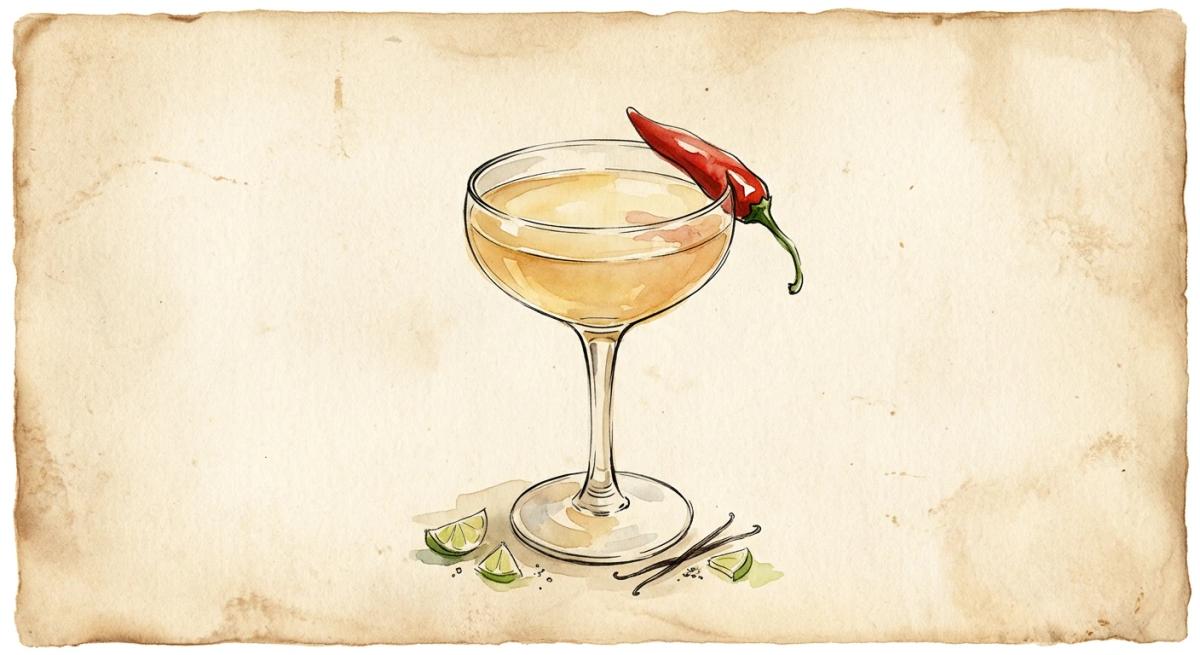
Spicy Fifty
A Spicy Fifty is 50ml of vanilla vodka, 15ml of elderflower cordial, 15ml of fresh lime juice, 10ml of honey syrup and two thin slices of red chilli, shaken hard with ice, double strained into a chilled coupe and garnished with a red chilli, all to the IBA’s specification. About 1.9 UK units. Difford’s Guide says Salvatore Calabrese adapted it from a recipe he created in 2004 or 2005 for his bar Fifty in London, which opened in February 2005 with the drink as a signature on its first menu. His starting point was the chilli-led cooking of the chef Jean-Georges Vongerichten. The IBA added the drink to its New Era list in 2020. The chilli is shaken with the liquid, not left as decoration, so its heat runs through the whole glass. Against it, vanilla, honey and elderflower bring sugar and scent, and the lime keeps that sweetness in check.
Glassware: Coupe Glass
Garnish: Red chilli
Ingredients
50ml
Difford’s Guide says both Calabrese’s Spicy Fifty and the MyZo were based on Stolichnaya Vanil, and Absolut Vanilia also works; by our working figure both sit around 37.5 to 38% ABV. Plain vodka plus a little vanilla extract is a flatter fallback.
15ml
Non-alcoholic elderflower cordial, undiluted, as the IBA specifies. A liqueur in its place gives a drier, stronger glass.
15ml
Cut and juiced on the day. Three sweet ingredients lean on this one sour one, so it sets the balance.
10ml
Honey thinned with warm water, roughly two to one, then cooled. The IBA names Monin’s honey syrup; a floral honey made up at home does the same job.
2 thin slices
Thin slices of a fresh red chilli, deseeded for a steady heat. The seeds and pith carry most of the burn.
Instructions
Chill a coupe in the freezer.
Squeeze the lime juice the same day.
Cut two thin slices of red chilli, and deseed them for a gentler heat.
Add the vanilla vodka, elderflower cordial, lime juice, honey syrup and chilli slices to a shaker with cubed ice.
Shake hard for 10 to 12 seconds.
Double strain into the chilled coupe.
Garnish with a whole red chilli on the rim.
Source: the IBA (Official IBA specification; home-made honey syrup rather than Monin, chilli deseeded; method ours). Last checked 9 October 2026.
Expert Tip
Taste the chilli before it goes in. Chillies of the same kind vary a great deal in heat; touch a cut slice to your tongue and use one slice or two accordingly. Deseed the slices for a steady warmth that builds through the glass. Leave the seeds and pith in and the heat arrives fast and keeps climbing. Double strain. A fine strainer catches the chilli pieces and seeds, which would otherwise keep releasing heat as the drink sits.
Behind the Spicy Fifty
Flavour Profile
The Origin
Difford’s Guide says Salvatore Calabrese created the Spicy Fifty in 2004 or 2005 for his bar Fifty in London, which opened in February 2005 with the drink as a signature on its first menu. In our reading the bar lent the drink its name. Difford’s gives the bar as Fifty St James.
His starting point was the cooking of the chef Jean-Georges Vongerichten, where chilli led many dishes. The drink pairs that heat with Stolichnaya Vanil, elderflower and honey.
MyZo
Difford’s Guide says that some months before, Myles Cunliffe, then a bartender at Brownes Bar and Restaurant in Brighton, created a similar cocktail called MyZo, based on Stolichnaya Vanil with elderflower cordial, citrus and chilli; it won third place in the Stolichnaya-sponsored UKBG Cocktail Challenge, held at Sosho Match in London on 13 June 2004.
Difford’s Guide puts both drinks down to the same moment, when vanilla vodka, elderflower cordial and chilli were all in fashion, and suggests the earlier drink may have inspired the later one without Calabrese knowing it. The Spicy Fifty is the one that reached the IBA list.
The Vanilla Vodka
Vanilla vodka gives the drink its soft, rounded middle. Against the chilli it reads as sweetness without adding sugar, and it links the honey to the elderflower.
Stolichnaya Vanil was the original bottle. A plain vodka with vanilla extract will do, though the vanilla tastes thinner and less settled.
The Chilli and the Heat
The chilli is an ingredient, not a garnish. Shaken with ice, the slices release capsaicin into the liquid, so the heat runs through every sip, building early and fading as the glass empties.
Sweetness and acid manage it. The honey and cordial soften the burn, and the lime sharpens the fruit so the heat does not take over.
Ours Against the IBA
The IBA Spicy Fifty beside our build
Vanilla vodka
- IBA
- 50ml
- Ours
- 50ml
Elderflower cordial
- IBA
- 15ml
- Ours
- 15ml
Lime juice
- IBA
- 15ml, fresh
- Ours
- 15ml, squeezed the same day
Honey syrup
- IBA
- 10ml Monin honey syrup
- Ours
- 10ml, honey and water roughly two to one
Red chilli
- IBA
- Two thin slices
- Ours
- Two thin slices, deseeded
Glass
- IBA
- Chilled cocktail glass
- Ours
- Chilled coupe
Garnish
- IBA
- Red chilli
- Ours
- Red chilli on the rim
| Element | IBA | Ours |
|---|---|---|
| Vanilla vodka | 50ml | 50ml |
| Elderflower cordial | 15ml | 15ml |
| Lime juice | 15ml, fresh | 15ml, squeezed the same day |
| Honey syrup | 10ml Monin honey syrup | 10ml, honey and water roughly two to one |
| Red chilli | Two thin slices | Two thin slices, deseeded |
| Glass | Chilled cocktail glass | Chilled coupe |
| Garnish | Red chilli | Red chilli on the rim |
The IBA added the Spicy Fifty to its New Era list in 2020. We change only the honey syrup, which is home-made, and seed the chilli.
How to Serve It
Double strained into a chilled coupe, with a red chilli on the rim as a warning of the heat. Serve it at once, while it is very cold.
For chilli with agave instead, the Spicy Margarita shakes jalapeño with tequila and lime.
Make it at home
The Spirit
Vanilla VodkaVanilla vodka is a flavoured vodka: vodka given a predominant vanilla flavour, which the retained Regulation (EC) 110/2008 also allows to be sweetened and coloured, as long as its strength is 37.5% ABV or higher. Our recipes count it at 37.5%, and the sugar differs from brand to brand. It is the vanilla in our Pornstar Martini and Spicy Fifty, carrying the aroma without a pod to steep.
More to explore
Frequently Asked Questions
What is a Spicy Fifty?
Why is it called the Spicy Fifty?
How much chilli should go in?
Can I make it without vanilla vodka?
How strong is a Spicy Fifty?
Elderflower cordial or liqueur?
Was the Spicy Fifty the first drink of its kind?
Sources.
Correct as of 19 October 2026.
- Difford’s Guide, “Spicy Fifty” (secondary source: adapted from a recipe created in 2004/5 by Salvatore Calabrese for Fifty, London, which opened in February 2005 with it a signature drink on the first menu; Calabrese’s own recipe (Classic Cocktails, 2015) 5cl vanilla vodka, 1.5cl elderflower cordial, 1.5cl lime, 1cl honey syrup, 2 thin slices of chile; MyZo by Myles Cunliffe of Brownes, Brighton, third in the Stolichnaya-sponsored UKBG Cocktail Challenge, Sosho Match, 13 June 2004; both based on Stolichnaya Vanil).
- LWC, “St Germain 70cl NRB” (wholesaler’s catalogue: 20% ABV).
You Might Also Like
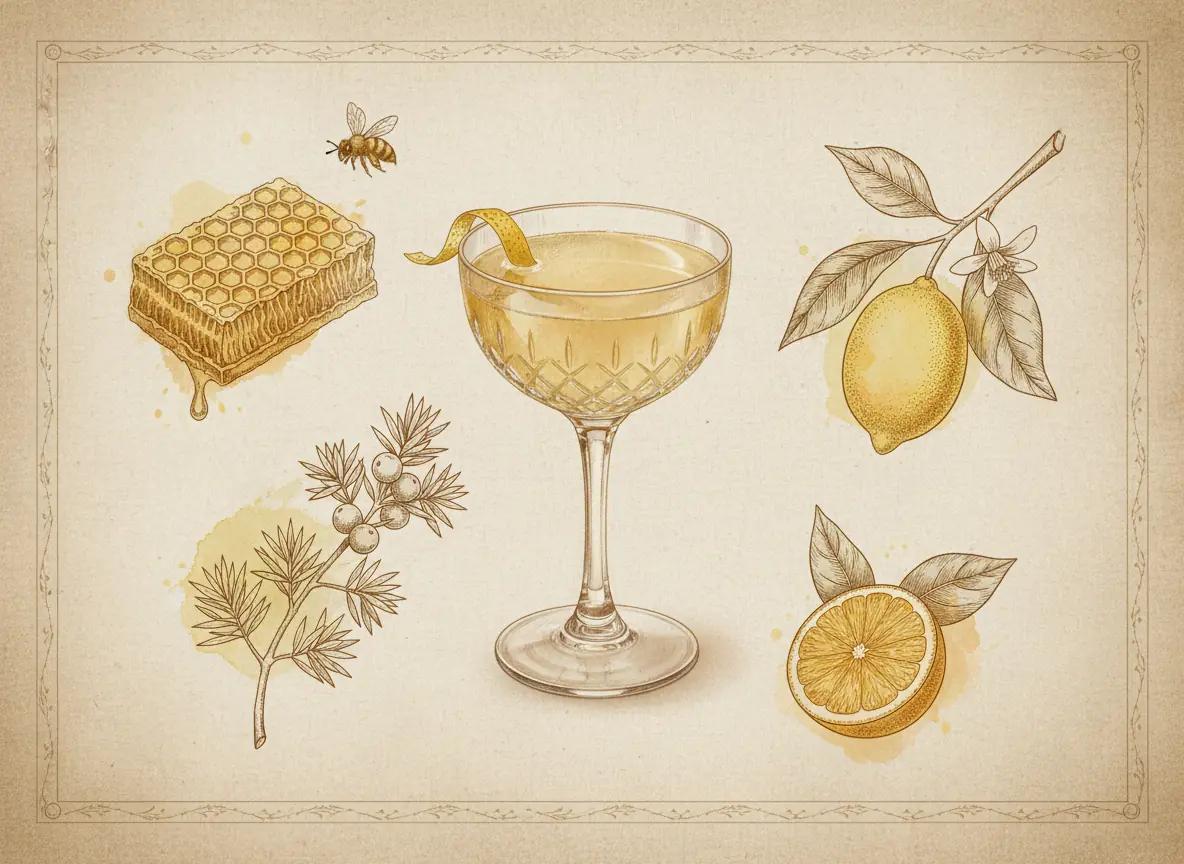
Bee’s Knees
A Bee’s Knees is 52.5ml of London Dry gin, 22.5ml each of fresh lemon and orange juice and two teaspoons (10ml) of honey syrup, made with two parts honey to one of warm water. Shake it hard for 10 to 12 seconds and double strain it into a chilled coupe, with a strip of lemon peel. About 2.1 UK units. The measures are the IBA’s. The orange is the part most recipes leave out. The oldest printings are gin, lemon and honey alone; David Embury suggested a little orange juice as a variation in 1948, and the IBA built it in. Orange softens the lemon, which is why two teaspoons of honey syrup are enough. The drink is often filed under American Prohibition, with honey and lemon covering for bathtub gin. Difford’s Guide, a secondary source, says the earliest printing tells a different story: Cocktails de Paris, published in 1929, credits it to Frank Meier of the Ritz in Paris, and Meier claimed it again in his own book in 1936.
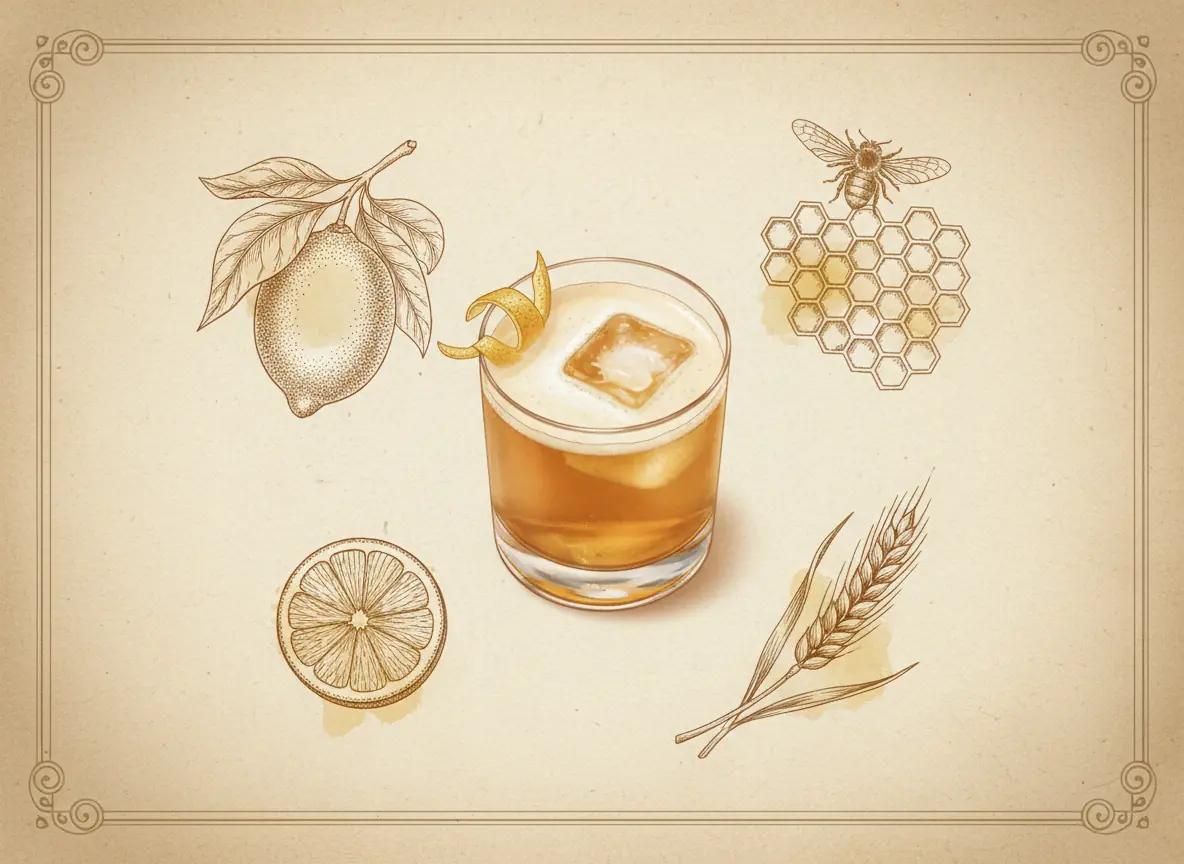
Honey Sour
A Honey Sour is a Whiskey Sour sweetened with honey: 60ml bourbon, 25ml fresh lemon juice and 15ml honey syrup mixed at two parts honey to one of warm water, shaken hard and double strained over a large cube in a rocks glass. A 15ml egg white is optional and gives it a soft foam, with three drops of Angostura on top. Honey changes more than the sweetness. It adds a floral, waxy note on top of the bourbon’s vanilla and caramel, and more body than sugar syrup. The drink sits between the Whiskey Sour and the Gold Rush, the bourbon, lemon and honey drink that Punch credits to T. J. Siegal at Milk & Honey in New York, in 2000 by its account and 2001 by VinePair’s. The Honey Sour adds back the egg white and the bitters, with a little less syrup. No one is recorded as its inventor. It is a sweetener swap on a sour. Difford’s Guide dates the first written sour recipes to Jerry Thomas’s 1862 guide and the oldest known whiskey sour mention to a Wisconsin newspaper of 1870. A glass holds about 2.4 UK units.
Where this one sits
Recipe by Jerry Can Spirits · Updated 19 October 2026