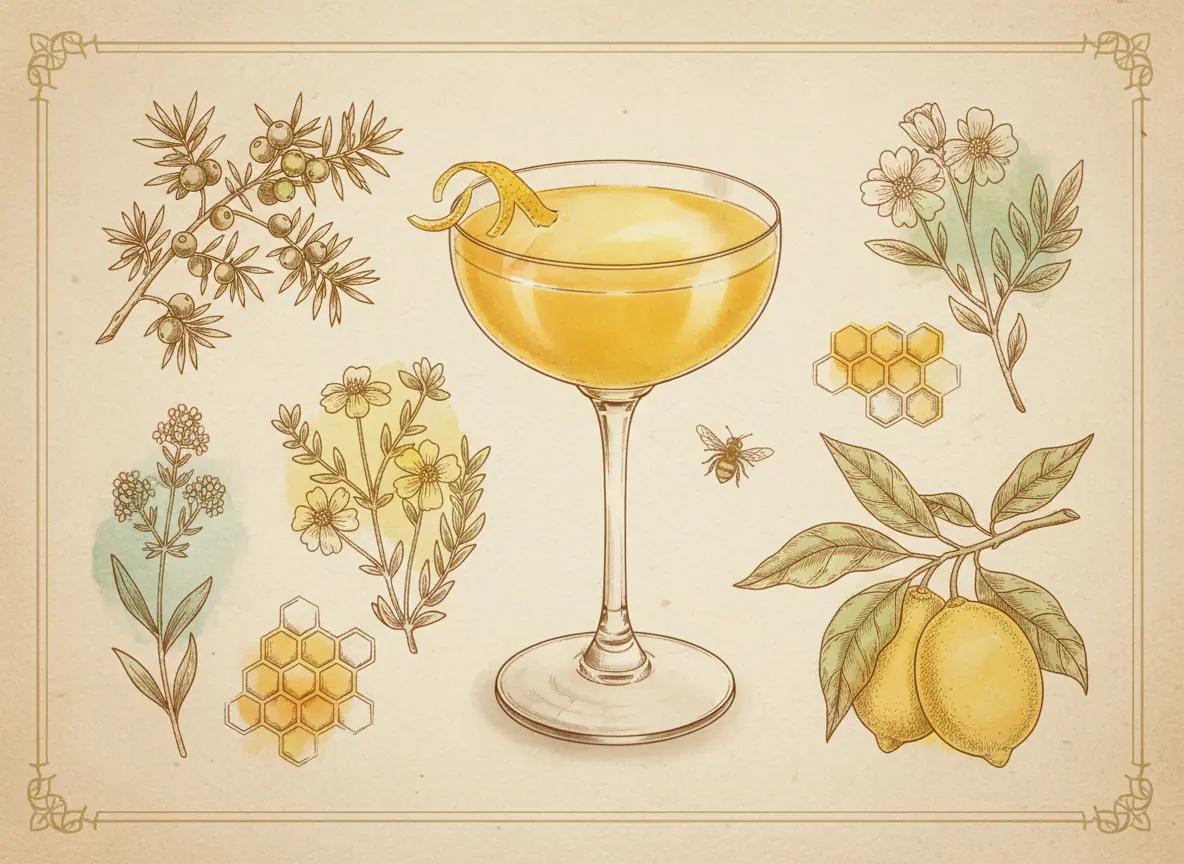
Yellow Jacket
The Yellow Jacket is a gin sour sweetened with yellow Chartreuse and honey: 45ml London Dry gin, 22.5ml yellow Chartreuse, 22.5ml fresh lemon juice and 15ml honey syrup, shaken hard and double strained into a chilled coupe. It comes out pale gold, tart first, then honey and soft herbs. Yellow Chartreuse and honey are the pairing that makes it. Chartreuse’s own page gives Yellow Chartreuse at 43% ABV and calls it sweet with spicy scents, so the honey syrup reads as part of it rather than a second sweetener stacked on top. The gin gives the drink its spine and the lemon its edge. No creator or date is documented for this combination. It sits in the Bee’s Knees family of gin, lemon and honey, which Difford’s Guide traces in print to Frank Meier at the Hôtel Ritz Paris, in his 1929 Cocktails de Paris, with the Chartreuse added, and it carries about 2.8 UK units in a short glass.
Glassware: Coupe Glass
Garnish: Lemon twist expressed over the glass and rested on the rim, or a small edible flower if available
Ingredients
45ml
A juniper-forward London Dry at 40% ABV or more. The drink is already sweet and herbal; the gin keeps it dry.
22.5ml
The herbal liqueur of the Carthusian monks, at 43% ABV on Chartreuse’s own page, which calls it sweet with a soft structure; Green is 55%. It is the source of the drink’s colour and character.
22.5ml
Squeezed the same day. Equal to the Chartreuse, and the only acid against two sweet ingredients.
15ml
Two parts honey to one part warm water, cooled. A mild floral honey. Neat honey will not mix into a cold drink.
Instructions
Make the honey syrup and let it cool, and squeeze the lemon juice the same day.
Chill a coupe.
Add the gin, yellow Chartreuse, lemon juice and honey syrup to a shaker.
Fill with cubed ice and shake hard for 10 to 12 seconds.
Double strain into the chilled coupe.
Express a lemon twist over the surface, rest it on the rim and serve.
Our version
No published specification for this combination has come to light, so the measures are ours: a gin sour with yellow Chartreuse and lemon at 22.5ml each and honey syrup for the sugar.
Source: our own specification. Last checked 9 October 2026.
Expert Tip
Make the honey syrup first: two parts honey to one part warm water, stirred until smooth and cooled. Neat honey thickens on contact with ice and stays in the shaker. We keep the syrup for two weeks in the fridge. Use a mild, floral honey. A strong one, such as heather or manuka, fights the Chartreuse for the same space in the glass. Keep the Chartreuse at 22.5ml. Less and it is a gin and honey sour; more and the liqueur’s sugar and herbs push the lemon aside. If it tastes flat, the lemon is old: squeeze it the same day.
Behind the Yellow Jacket
Flavour Profile
Why Yellow Chartreuse and Honey
Chartreuse’s own page describes Yellow Chartreuse by its sweetness, spicy scents and soft structure, with scents of turmeric, citrus and anise, so honey syrup reads as an extension of it rather than a second sweetener stacked on top. That is the idea of the drink: two sweet ingredients that taste of the same things, held in line by gin and lemon.
The lemon matches the Chartreuse measure for measure, and the honey syrup tops up the sugar the liqueur already brings. The result sits a little on the sweet side of a classic sour, with the herbs carrying through to the finish.
The Chartreuse
Chartreuse’s own page says Yellow Chartreuse is produced and still made by the Chartreux Fathers from 130 plants, bark, roots, spices and flowers, ground by the monks at the Grande Chartreuse monastery. It gives Yellow at 43% ABV and Green at 55%. Yellow is the softer and sweeter of the two, which is why it suits a sour with honey: it blends in where green would take over.
Yellow and green Chartreuse in a Yellow Jacket, strengths from Chartreuse’s own pages
Yellow
- ABV
- 43%
- Character
- Sweet, honeyed, soft herbs
- At 22.5ml in this drink
- Blends with the honey
Green
- ABV
- 55%
- Character
- Drier, sharper, strongly herbal
- At 22.5ml in this drink
- Takes over the drink
| Chartreuse | ABV | Character | At 22.5ml in this drink |
|---|---|---|---|
| Yellow | 43% | Sweet, honeyed, soft herbs | Blends with the honey |
| Green | 55% | Drier, sharper, strongly herbal | Takes over the drink |
The Honey
Honey syrup is two parts honey to one part warm water. With only four ingredients, the honey is in every sip. A mild floral honey suits it; heather or manuka has a strong flavour of its own that competes with the Chartreuse.
The Gin
The gin is the base and the brake. A juniper-forward London Dry at 45ml gives the drink its strength and a dry, piney line through the sweetness. A soft or sweet gin loses that line and the drink turns syrupy.
Without the Chartreuse, the same frame is the Bee’s Knees.
Building It
Shake hard for 10 to 12 seconds and double strain into a chilled coupe, so no ice shards thin the surface. The lemon twist goes over the top last. Its oil is the first thing you smell, and it sharpens the honey before you taste it.
How Strong It Is
Taking the gin at our working figure of 40% ABV and the yellow Chartreuse at 43% on its maker’s page, a Yellow Jacket carries about 2.8 UK units: the alcohol of almost three pub measures, in a short, sweet drink.
Make it at home
The Spirit
GinGin is a spirit flavoured with juniper berries. Under the retained Regulation (EC) 110/2008, juniper must lead the taste, the floor is 37.5% ABV, and the route the flavour takes sets the grade: plain gin, distilled gin or London gin. Our recipes count it at 40%, and it carries the Martini, the Negroni and the Gin and Tonic.
Master the Techniques
More to explore
Frequently Asked Questions
What is a Yellow Jacket cocktail?
Why yellow Chartreuse rather than green?
How strong is a Yellow Jacket?
Why honey syrup rather than honey?
Who invented the Yellow Jacket?
Can I use a different gin?
How is it different from a Bee’s Knees?
Sources.
Checked between 18 October and 19 October 2026.
- Chartreuse, “Yellow Chartreuse” (maker’s page: 43% vol.; 130 plants, bark, roots, spices and flowers; sweetness, spicy scents, a soft structure; turmeric, citrus and anise; made by the Chartreux Fathers).
- Chartreuse, “Green Chartreuse” (maker’s page: 55% vol.; 130 plants, bark, roots, spices and flowers).
- Difford’s Guide, “Bee’s Knees” (secondary source: first appears in a cocktail book in the French 1929 Cocktails de Paris, credited to Frank Meier, head bartender at the Hôtel Ritz Paris; gin, lemon and honey).
You Might Also Like
Bee’s Knees
A Bee’s Knees is 52.5ml of London Dry gin, 22.5ml each of fresh lemon and orange juice and two teaspoons (10ml) of honey syrup, made with two parts honey to one of warm water. Shake it hard for 10 to 12 seconds and double strain it into a chilled coupe, with a strip of lemon peel. About 2.1 UK units. The measures are the IBA’s. The orange is the part most recipes leave out. The oldest printings are gin, lemon and honey alone; David Embury suggested a little orange juice as a variation in 1948, and the IBA built it in. Orange softens the lemon, which is why two teaspoons of honey syrup are enough. The drink is often filed under American Prohibition, with honey and lemon covering for bathtub gin. Difford’s Guide, a secondary source, says the earliest printing tells a different story: Cocktails de Paris, published in 1929, credits it to Frank Meier of the Ritz in Paris, and Meier claimed it again in his own book in 1936.
Alaska
An Alaska is 50ml of London Dry gin and 25ml of yellow Chartreuse with two dashes of orange bitters, stirred over ice for 30 seconds and strained into a chilled Nick & Nora, with a lemon twist. About 3.1 UK units, all of it spirit. It was in print by 1914, Punch says, when Jacques Straub’s Drinks listed it as Old Tom gin with a smaller measure of yellow Chartreuse and a dash of orange bitters, shaken. The gin-led ratio has held; the Old Tom and the shaking have not. The name is unexplained; Difford’s Guide offers only a conjecture about the Alaska gold rush and the drink’s golden colour. Yellow Chartreuse is the drink. Sweet and spicy at 43% ABV on Chartreuse’s own page, softer than green, it sweetens the gin and seasons it at once. A full 30-second stir is what turns two strong bottles into one smooth drink.
Last Word
A Last Word is 22.5ml each of gin, green Chartreuse, maraschino liqueur and fresh lime juice, shaken hard for 10 to 12 seconds and double strained into a chilled Nick & Nora or coupe. About 2.9 UK units. The measures are the IBA’s; the cherry or lime twist is ours. The Oxford Companion says the drink first appears in print in the Detroit Athletic Club News in 1916, on a menu at 35 cents, a high price then. Ted Saucier’s Bottoms Up of 1951 prints the recipe, quoting a club source who says Frank Fogarty, a vaudeville monologist, introduced it there about thirty years earlier. In 2003 Murray Stenson put it on the menu at the Zig Zag Café in Seattle, from where it spread, the Companion says. Four strong flavours at equal volume, and none takes over. Chartreuse brings herbs and heat, maraschino cherry and a bitter almond edge, lime the acid, and gin holds them together.
Where this one sits
Recipe by Jerry Can Spirits · Updated 19 October 2026