Aperol Sour
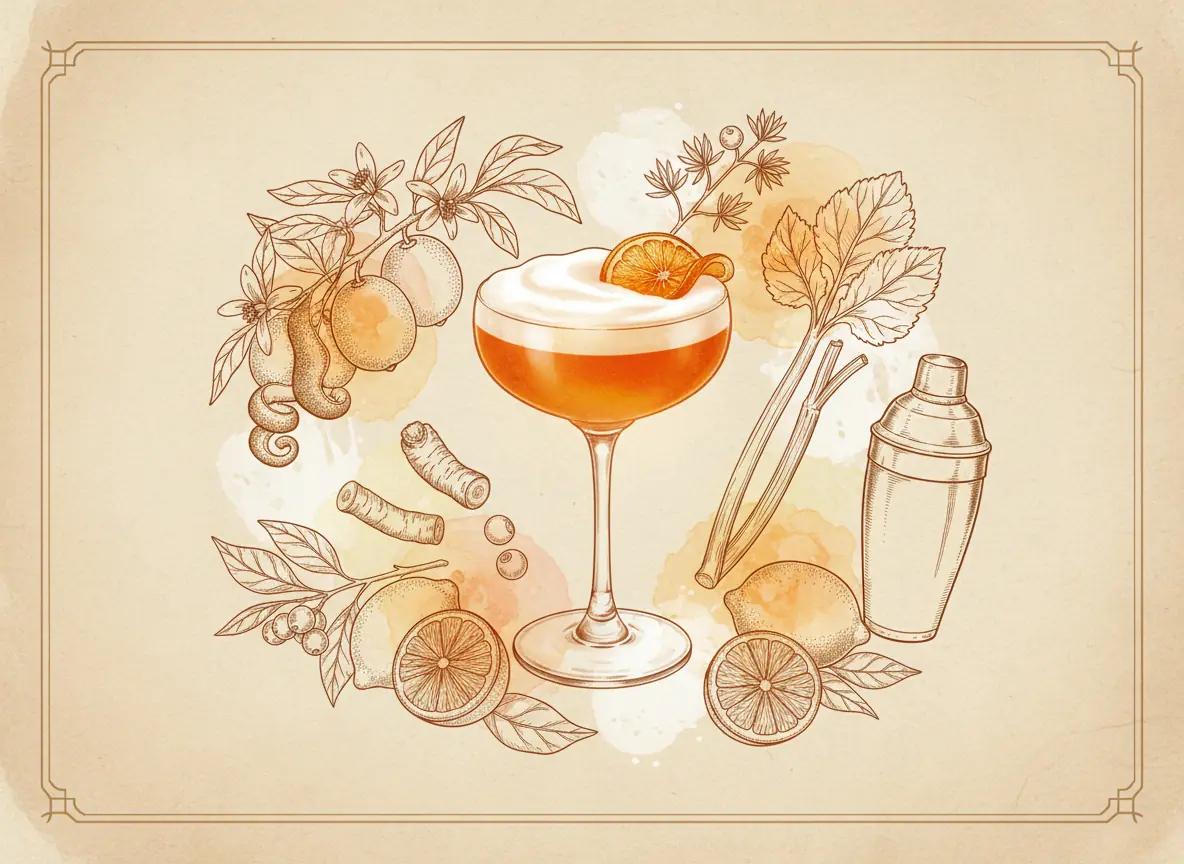
An Aperol Sour is 60ml Aperol, 25ml fresh lemon juice, 15ml simple syrup and 15ml egg white, dry shaken, shaken again with ice and double strained into a chilled coupe, with three dots of Angostura on top and a dried orange wheel. Aperol takes the place of the spirit, so the whole drink holds about 0.7 UK units, taking Aperol at the 11% ABV on its own FAQ. Aperol’s own FAQ gives 11% ABV, close to a glass of wine. It brings its own sugar and bitterness, so the syrup is kept lower than the lemon and the bitter orange stands where gin or whisky would. The foam is what makes it. It softens the bitterness on the way in. The white goes in raw, and aquafaba gives an egg-free version.
Glassware: Coupe Glass
Garnish: Orange wheel dried, on the rim and Angostura bitters three drops on the foam
Ingredients
60ml
Aperol, 11% ABV on its own FAQ; the Oxford Companion names cinchona, rhubarb and gentian as the chief bitter barks and roots, and Aperol says citrus peel leads. At 60ml it fills the place of the spirit and brings much of the drink’s sugar with it.
25ml
Juiced the same day. Lemon sits beside Aperol’s orange; lime is sharper and fights it.
15ml
One to one sugar and water by weight, held at 15ml so the sugar stays small beside the Aperol; the Oxford Companion calls Aperol less bitter than Campari.
15ml
From a fresh egg, about half a white. It builds the foam in the dry shake and adds almost no flavour. Raw. Following the FSA, British Lion-mark eggs are safe raw, including for vulnerable groups and in pregnancy; pasteurised carton white is the alternative. Eating out, where the mark cannot be checked, the FSA advises vulnerable people to have their eggs thoroughly cooked. Contains egg: leave it out, or use aquafaba, for anyone allergic.
3 drops
Three dots on top, for scent and the pattern. At that quantity it adds almost no alcohol.
Instructions
Squeeze the lemon juice the same day, ideally just before you build.
Chill a coupe in the freezer or with ice water.
Add the Aperol, lemon juice, simple syrup and egg white to a shaker with no ice.
Dry shake hard for 15 seconds to build the foam.
Fill the shaker with cubed ice and shake hard for 10 to 12 seconds.
Double strain into the chilled coupe.
Rest a dried orange wheel on the rim and dot three drops of Angostura on the foam.
Expert Tip
Dry shake hard for 15 seconds before any ice goes in. Cold slows the proteins down, so ice added early gives a thin foam that collapses before the glass reaches the table. Next, ice in, and a hard shake of 10 to 12 seconds to chill and dilute. Double strain, so no ice chips break up the foam. Keep the syrup at 15ml. Aperol is already sweet, and matching the syrup to the lemon gives a drink closer to orange squash than to a sour.
Behind the Aperol Sour
Flavour Profile
Where It Comes From
The Aperol Sour has no recorded creator or first bar. Aperol itself is older: the Oxford Companion says Luigi and Silvio Barbieri introduced it in 1919, at the company they had inherited in Padua, and Aperol’s own FAQ dates the Barbieri Brothers’ first crafting to 1919. At 11% ABV on that FAQ, its strength is close to wine.
The sour is an old frame of spirit, citrus and sugar. The same frame works with a bitter aperitif where the spirit would go, Aperol among them, and the result keeps the shape of a sour at a fraction of the strength.
What Changes Without a Spirit
Two things change when Aperol takes the spirit’s place: strength and sugar.
Strength first. At 11% ABV on Aperol’s own FAQ, it carries about a quarter of the alcohol of a gin at our working figure of 40%, so the measure rises to 60ml and the finished drink still holds only about 0.7 UK units.
Then sugar. Aperol is sweet, so the syrup is set against the Aperol as well as the lemon. At 15ml against 25ml of lemon it looks short for a sour; match the two and it tastes of squash.
Aperol Sour: what each ingredient does
Aperol
- Measure
- 60ml
- Its job
- Bitter orange, body and much of the sugar
Fresh lemon juice
- Measure
- 25ml
- Its job
- The acid
Simple syrup
- Measure
- 15ml
- Its job
- Balance, kept low
Egg white
- Measure
- 15ml
- Its job
- Foam that softens the bitterness
Angostura
- Measure
- Three drops
- Its job
- Aroma on the foam
| Ingredient | Measure | Its job |
|---|---|---|
| Aperol | 60ml | Bitter orange, body and much of the sugar |
| Fresh lemon juice | 25ml | The acid |
| Simple syrup | 15ml | Balance, kept low |
| Egg white | 15ml | Foam that softens the bitterness |
| Angostura | Three drops | Aroma on the foam |
The Egg White
Egg white adds almost no flavour and changes the texture completely. Shaken without ice, its proteins unfold and trap air, and the foam sits on the drink for several minutes.
Shake it without ice first, hard, for 15 seconds, then add ice and shake again to chill. The foam softens the first contact with the bitterness, which is where a version without it is harshest.
For Aperol at its lightest, the Aperol Spritz lengthens it with prosecco and soda.
How to Serve It
In a chilled coupe, straight after the second shake, while the foam is at its fullest. Finish with the orange wheel and the three dots of bitters.
At about 0.7 UK units it makes an aperitif, before food.
Make it at home
The Spirit
AperolAperol is an Italian bitter aperitivo, 11% ABV on its maker’s site, orange-led and gently bitter. Aperol says the recipe is secret; The Oxford Companion, a secondary source, names chiefly cinchona, rhubarb and gentian among its bitter barks and roots. Aperol says the brothers Luigi and Silvio Barbieri created it in 1919. At 11% it misses the 15% a liqueur needs under Regulation (EC) No 110/2008, which is why it suits a long spritz rather than a short stirred drink.
More to explore
Frequently Asked Questions
What is in an Aperol Sour?
How strong is an Aperol Sour?
Can I make it without egg white?
Is the raw egg white safe?
How does it compare with the Aperol Spritz and the Paper Plane?
Why 60ml of Aperol?
Who invented the Aperol Sour?
Sources.
Checked between 18 October and 19 October 2026.
- Aperol, “Frequently Asked Questions” (producer’s FAQ: 11% ABV (the Aperol Spritz 9%); the Barbieri Brothers crafted it in 1919; citrus peel, herbs, roots and woods).
- The Oxford Companion to Spirits and Cocktails (David Mahoney), “Aperol” (secondary source: introduced in 1919 by Luigi and Silvio Barbieri in Padua; oranges and bitter barks and roots (chiefly cinchona, rhubarb and gentian); less bitter than Campari; 11 to 15% ABV depending on market).
You Might Also Like
Paper Plane
A Paper Plane is 30ml each of bourbon, Aperol, Amaro Nonino and fresh lemon juice, shaken hard and double strained into a chilled coupe. Four equal parts, which is the IBA specification: bitter orange, herbs and lemon over bourbon, at about 2.6 UK units. Punch, a secondary source, says Toby Maloney, who helped open The Violet Hour in Chicago, asked Sam Ross to create a drink for the bar, and that it was on the menu there in the summer of 2008. Ross named it after the M.I.A. song Paper Planes. The first version used Campari; Punch quotes Ross finding it slightly too bitter and short of sweetness, and he moved to Aperol. Equal parts leaves nowhere to hide. Squeeze the lemon the same day and use Nonino, not a cheaper amaro, because each ingredient is a quarter of the drink.
Americano
An Americano is 30ml Campari and 30ml sweet vermouth built over ice in a highball, topped with 75ml of cold soda and stirred once, with an orange slice. Bitter and sweet in equal measure, lengthened with soda: a Negroni with soda in place of the gin, at about half the alcohol. It grew out of the Milano-Torino, Campari from Milan with vermouth from Turin, which Difford’s Guide says Gaspare Campari created in the 1860s at his Caffè Campari in Milan. Difford’s adds that soda was said to have been added later, to make the Americano. The vermouth decides the result. At equal volume with the Campari it has nowhere to hide, and in our experience an opened bottle that has stood at room temperature for months will flatten the drink. Keep it in the fridge.
Berry Sour
A Berry Sour is 50ml of London Dry gin, 20ml of crème de mûre, 25ml of fresh lemon juice, 10ml of sugar syrup and 15ml of egg white, dry shaken, shaken again with ice and double strained into a chilled coupe, with two blackberries on the foam. About 2.4 UK units. The egg white is raw, so leave it out for anyone allergic to egg. It is our gin sour built from the Bramble’s bottles. Dick Bradsell says in Difford’s Guide that he created the Bramble in the mid-eighties at Fred’s Club in Soho (the Oxford Companion says 1989), and its method pours the crème de mûre over crushed ice so it bleeds down through the drink. Here the liqueur goes into the shaker, and the glass stays one even colour all the way down, under a white head. The trade is deliberate. You lose the Bramble’s shift from sharp to dark as you drink; you gain a silkier texture and a drink that tastes the same at the bottom as at the top. The juniper should still come through the fruit.
Where this one sits
Recipe by Jerry Can Spirits · Updated 19 October 2026