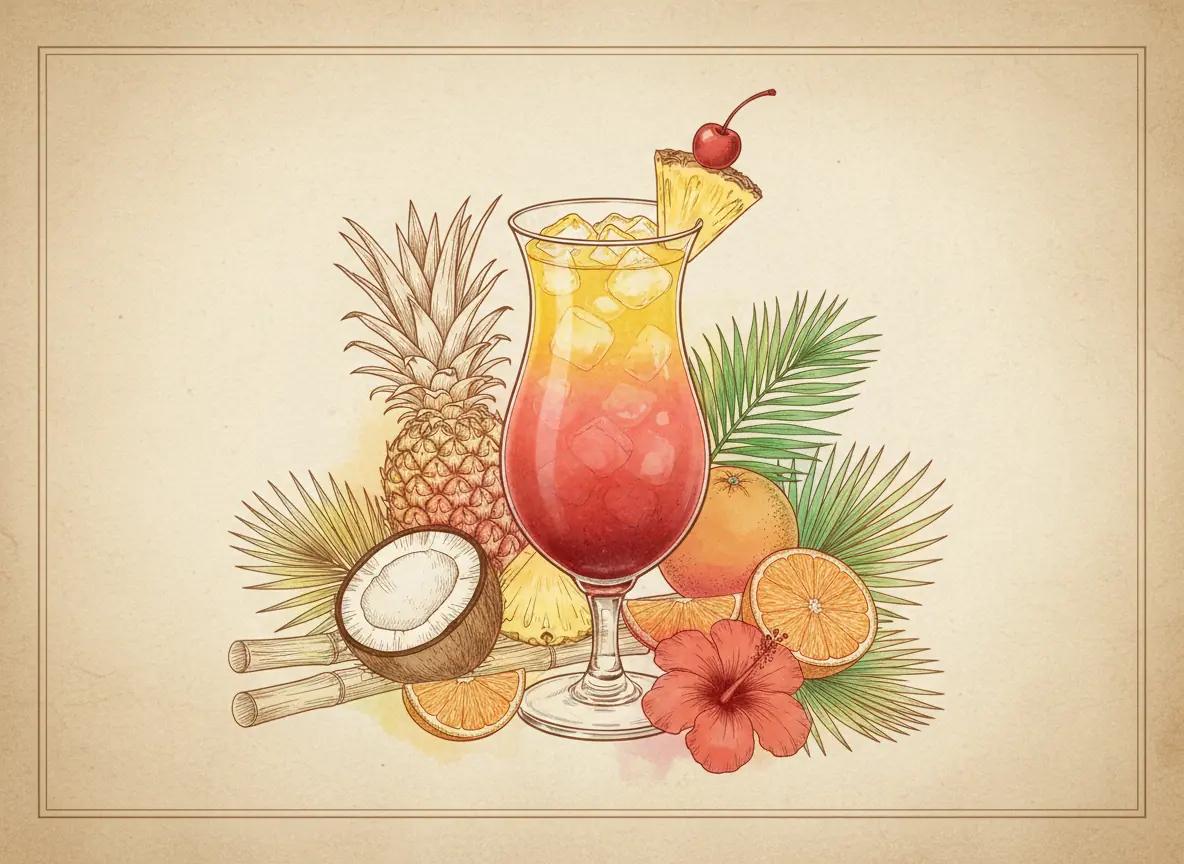
Bahama Mama
A Bahama Mama is a long rum punch: 30ml dark rum, 30ml coconut rum and 15ml overproof rum, with 60ml each of pineapple and orange juice, 15ml fresh lime juice and 15ml grenadine, shaken and strained over crushed ice in a hurricane glass. It tastes of coconut, pineapple and orange, and it is stronger than any of that suggests. Its history is loose. The Oxford Companion to Spirits and Cocktails places a Bahama Mama at Nassau’s British Colonial Hotel in 1960 and at Trader Vic’s in Beverly Hills in 1961, with neither formula recorded. The Nassau bartender Oswald Greenslade claims to have invented it, Travel Distilled reports, though he started work at the Nassau Beach Hotel in 1961. The fruit-and-coconut punch most bars now pour has no documented creator. A glass holds about 2.8 UK units. Squeeze the citrus the same day and use a grenadine made from pomegranate: in a drink that is mostly juice, the juice decides the result.
Glassware: Hurricane Glass
Garnish: Pineapple wedge, Orange slice and Luxardo maraschino cherry
Ingredients
30ml
A Jamaican or Demerara-style dark rum. It gives the drink its weight, so the coconut and fruit sit on something.
30ml
A coconut-flavoured liqueur made with rum, often sold as coconut rum, around 21% ABV and sweet. Pick one that tastes of coconut rather than sun cream; it is the note the drink is known for.
15ml
Jamaican overproof, around 63% ABV. The 15ml brings nearly a full unit and most of the aroma. Shake it in or float it.
60ml
Pressed from fresh fruit where possible, or a not-from-concentrate carton. It brings body and a little foam to the top.
60ml
Squeezed the same day. Matched to the pineapple at 60ml, it keeps the drink bright rather than heavy.
15ml
Squeezed the same day. Only 15ml, and the only sharp acid set against two juices, a sweet rum and grenadine.
15ml
Made from pomegranate. It gives the red at the foot of the glass and a little tartness; red sugar syrup gives only the colour.
Instructions
Squeeze the orange and lime, and juice the pineapple, the same day.
Fill a hurricane glass with crushed ice.
Add the dark rum, coconut rum, overproof rum, pineapple juice, orange juice, lime juice and grenadine to a shaker with cubed ice.
Shake hard for 10 to 12 seconds.
Strain over the crushed ice.
Garnish with a pineapple wedge, an orange slice and a Luxardo maraschino cherry, and serve with a straw.
Our version
The coconut and fruit Bahama Mama has no published specification, so the measures are ours: three rums at 75ml in total, with equal pineapple and orange and fresh lime.
Source: our own specification. Last checked 9 October 2026.
Expert Tip
Decide on the overproof before you shake. Shaken in, it lifts the whole drink evenly. Floated on top over the back of a bar spoon, it puts a strong rum aroma at the rim and softens as you drink down. The units are the same either way. If the drink tastes like fruit squash, the lime is short or the juice came from a carton. Take the lime to 20ml before changing anything else. Coconut rums run from about 21% ABV to well over 30%, and the weaker ones tend to be sweeter. Taste yours on its own first. A sweet one may want the grenadine cut to 10ml.
Behind the Bahama Mama
Flavour Profile
Where It Comes From
There are two Bahama Mamas, Travel Distilled says: one made with coffee liqueur and one with grenadine. Oswald “Slade” Greenslade, a Bahamian bartender at the Nassau Beach Hotel, says he invented the drink, but he started work there in 1961. The Oxford Companion to Spirits and Cocktails places a Bahama Mama at the British Colonial Hotel in Nassau in 1960 and at Trader Vic’s in Beverly Hills in 1961, with neither formula recorded.
The other is the coconut and fruit punch, which is what most menus now mean by the name. It has no documented creator. Recipes begin to appear in print in the United States in the early 1970s, and in the middle of that decade the Bahamas Tourist Board’s advertising called for visitors to drink a Goombay Smash or a Bahama Mama, the Oxford Companion says.
Why Three Rums
Each rum does a job the others cannot at the same volume. The dark rum gives body and a dark caramel depth. The coconut rum gives the coconut, and sugar with it, at low strength. The overproof gives aroma and almost a unit of alcohol in 15ml. Take the dark rum out and the drink is thin; take the coconut out and it is a rum punch with no character of its own.
The Juice Is Most of the Glass
Pineapple and orange at 60ml each make up more than half the drink. Pineapple gives body and a little froth; orange keeps it bright. The 15ml of lime does more than its size suggests: it is the only sharp acid against two sweet juices, a sweet rum and grenadine. Carton juice and synthetic grenadine are where most bad Bahama Mamas start.
Bahama Mama and Rum Runner
The two get confused because they share pineapple, orange and crushed ice. The rums and the liqueurs are where they part.
Bahama Mama and Rum Runner compared
Bahama Mama
- Rums
- 30ml dark, 30ml coconut, 15ml overproof
- Liqueurs
- None
- Juice
- 60ml pineapple, 60ml orange, 15ml lime
- UK units
- 2.8
Rum Runner
- Rums
- 30ml dark, 30ml white
- Liqueurs
- 15ml blackberry, 15ml banana
- Juice
- 45ml pineapple, 30ml orange, 15ml lime
- UK units
- 3.0
| Drink | Rums | Liqueurs | Juice | UK units |
|---|---|---|---|---|
| Bahama Mama | 30ml dark, 30ml coconut, 15ml overproof | None | 60ml pineapple, 60ml orange, 15ml lime | 2.8 |
| Rum Runner | 30ml dark, 30ml white | 15ml blackberry, 15ml banana | 45ml pineapple, 30ml orange, 15ml lime | 3.0 |
The Rum Runner carries the Florida Keys story and a frozen version.
How Strong It Is
Taking the dark rum at 40% ABV, the coconut rum at 21% and the overproof at 63%, a Bahama Mama carries about 2.8 UK units: nearly three 25ml pub singles under 150ml of juice and grenadine. The fruit hides it well. Treat the second glass with more caution than the first.
Make it at home
The Spirit
Dark RumDark rum is a heavy, deep-coloured rum, counted at 40% ABV in our recipes, whose colour may come from years in oak, from blending or from added caramel, which Regulation (EC) 110/2008 allows. It brings weight and a burnt-sugar note to punches, hot drinks and tiki builds: the Rum Runner, the Hurricane and the Planter’s Punch.
Master the Techniques
More to explore
Frequently Asked Questions
What’s in a Bahama Mama?
What does Bahama Mama mean?
How strong is a Bahama Mama?
Is there coffee liqueur in a Bahama Mama?
How is a Bahama Mama different from a Rum Runner?
Is a Bahama Mama a tiki drink?
Can I make Bahama Mamas in a jug?
Sources.
Correct as of 18 October 2026.
- Travel Distilled, “Bahama Mama Cocktail History” (two variants, coffee liqueur and grenadine; Greenslade claims to have invented it, started at the Nassau Beach Hotel in 1961).
- The Oxford Companion to Spirits & Cocktails, “The Bahama Mama” (British Colonial Hotel, Nassau, 1960; Trader Vic’s, Beverly Hills, 1961; neither formula recorded; in print in the early 1970s; the 1932 song).
- Mel Magazine, “The Bahama Mama drink” (the Dottie Lee Anderson story rests on a misreading of a 1954 Jet Magazine page; the 1932 song).
You Might Also Like
Hurricane
A Hurricane is 60ml of dark rum, 60ml of white rum, 45ml of passion fruit syrup, 30ml each of fresh lime and orange juice, and 15ml each of grenadine and simple syrup, shaken hard and strained over crushed ice in a hurricane glass. Garnish with orange and a cherry. At about 4.8 UK units it is a strong drink, a third of a week’s guideline in a single glass. The Hurricane most people know is Pat O’Brien’s, the New Orleans bar, where the Oxford Companion says it was introduced and head bartender Louis Culligan is credited with creating it. Difford’s Guide thinks it originated in 1939 at The Hurricane Bar in New York. The usual account is O’Brien’s own: during the Second World War whisky was only available to a bar that bought large amounts of rum, and the drink was a way to use it, served in a glass shaped like a hurricane lantern. Premixed versions later became the standard serve in the city. Made with fresh juice and a passion fruit syrup with real fruit in it, the Hurricane is a tart, balanced rum punch.
Painkiller
A Painkiller is 60ml of Pusser’s Rum, 120ml of pineapple juice, 30ml of fresh orange juice and 30ml of cream of coconut, given a hard 10 to 12 second shake and strained onto cubed ice in a tiki mug or a big glass, with fresh nutmeg grated on top. About 2.4 UK units. Cream of coconut is coconut and sugar, usually with no dairy, but check the label. The name belongs to Pusser’s. Pusser’s prints the name with the registered symbol on its own Painkiller page, and the Oxford Companion says the company owns the trademark for the Pusser’s Painkiller cocktail. The recipe here is its own: four parts pineapple, one of cream of coconut and one of orange, with Pusser’s to suit. Difford’s Guide says it trademarked the name in the United States and the UK in 2003 and in 2010 forced a New York bar called Painkiller to rename itself PKNY. Pusser’s traces the drink to Daphne Henderson’s Soggy Dollar Bar on Jost Van Dyke, in the British Virgin Islands.
Rum Runner
A Rum Runner is a Florida Keys tiki drink: 30ml each of dark and white rum, 15ml each of blackberry and banana liqueur, 10ml grenadine, 15ml fresh lime juice, 45ml pineapple juice and 30ml orange juice, shaken hard and strained over crushed ice in a hurricane glass. A 15ml float of overproof rum is optional. Blended with the ice instead, it becomes the frozen Rum Runner the Keys are known for. The usual account, which Difford’s Guide quotes from the Holiday Isle Tiki Bar’s own site and calls legend, credits the bar’s manager John “Tiki John” Elber with mixing it to clear surplus rum and liqueur before a delivery; the bar took its name in 1971, so the early 1970s is the likely date. That first version had no fruit juice. Pineapple and orange came later and made it the long, fruity drink most bars pour now. It is stronger than it tastes: about 3.0 UK units a glass, 3.9 with the float. Fresh lime and a pomegranate grenadine are what keep it from tasting of boiled sweets.
Where this one sits
Recipe by Jerry Can Spirits · Updated 18 October 2026