Brandy Crusta
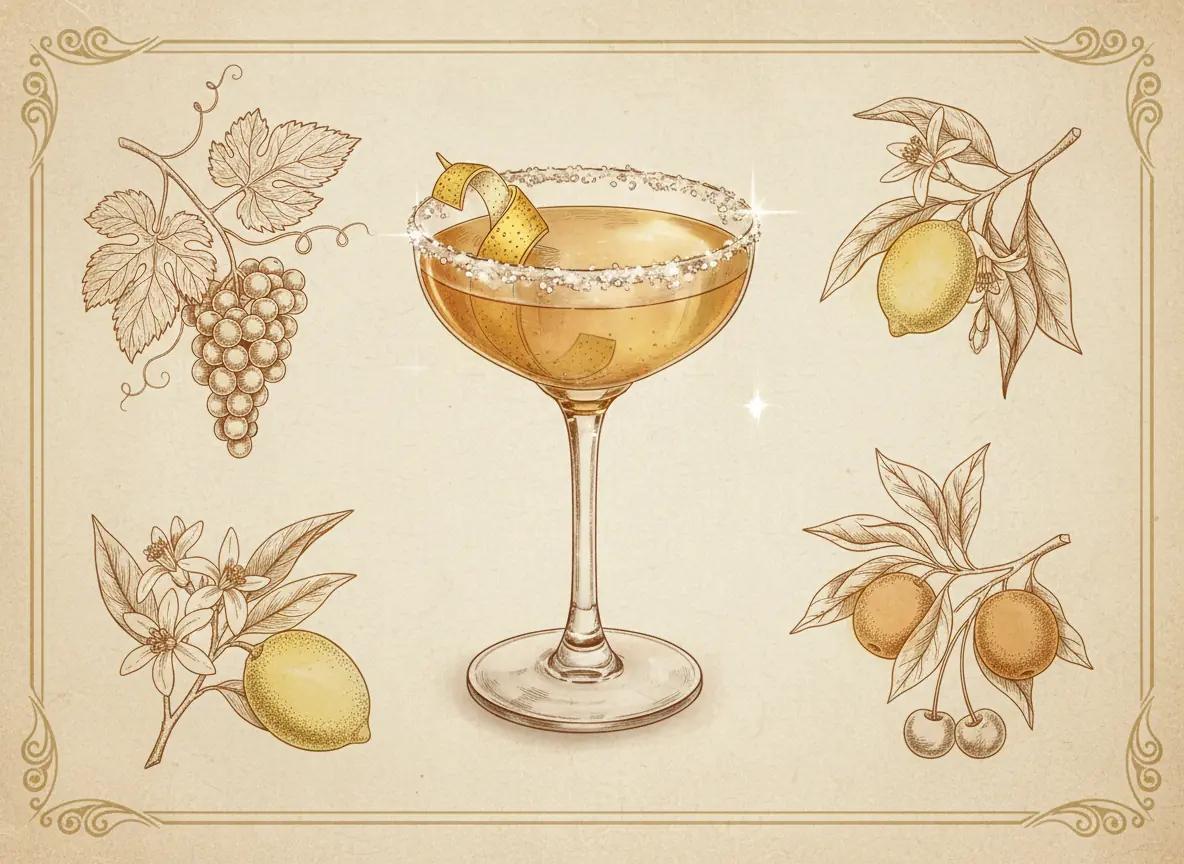
A Brandy Crusta is 52.5ml of cognac, 7.5ml of maraschino, a bar spoon each of orange curaçao and sugar syrup, 15ml of fresh lemon juice and two dashes of Angostura, shaken hard and strained into a chilled coupe with a sugared rim and a long spiral of lemon peel curled inside. About 2.6 UK units. The measures are the IBA’s. Jerry Thomas printed it in his bar guide of 1862 and wrote that the crusta was said to have been invented by “Santina, a celebrated Spanish caterer”. Difford’s Guide identifies him as Joseph Santini, an Italian from Trieste in New Orleans, and dates the drink to the 1850s, made either at the City Exchange or at his own bar, the Jewel of the South, which he opened in 1855. The crust of sugar on the rim gives the drink its name. With the peel lining the glass, the first sip meets sugar and lemon oil before the cognac.
Glassware: Coupe Glass
Garnish: Lemon spiral lining the inside of the glass and Sugared rim
Ingredients
52.5ml
A VS or VSOP at our working figure of 40% ABV. The IBA asks for brandy; cognac brings enough fruit to carry the maraschino and bitters.
7.5ml
Luxardo (32% ABV on Luxardo’s own page) or another maraschino. Clear, with the roasted nuttiness in Luxardo’s description and more sugar than it tastes of, it sits against the lemon; at 7.5ml it seasons rather than sweetens.
1 bar spoon
One bar spoon, about 5ml. A dry orange curaçao adds orange without much sugar. The IBA asks simply for curaçao.
15ml
Squeezed the same day. It is the only acid in the drink, so its freshness shows in every sip.
1 bar spoon
One bar spoon, about 5ml, shaken into the drink. It balances the lemon; the sugar rim only seasons the lip of the glass.
2 dashes
At 44.7% ABV on a DrinkSupermarket listing. The IBA specifies two dashes of aromatic bitters, and Angostura is the one we use; they tie the cognac to the citrus and keep the liqueurs from tasting sweet.
1 pinch
Caster sugar for the rim only, on a rim wiped with lemon. A fine, even crust; a thick one makes every sip sweeter than the drink.
Instructions
Cut a long spiral of peel from a whole lemon, wide enough to line the inside of a coupe.
Moisten the rim of the coupe with a spent lemon half and dip it in caster sugar. Let it set while you build the drink.
Curl the lemon spiral inside the glass.
Add the cognac, maraschino, orange curaçao, sugar syrup, lemon juice and Angostura to a shaker.
Fill with cubed ice and shake hard for 10 to 12 seconds.
Double strain into the prepared glass and serve at once.
Source: the IBA (IBA measures; shaken where the IBA stirs, and served in a coupe). Last checked 10 October 2026.
Expert Tip
Cut the peel first. Take one long spiral from a whole lemon with a channel knife or peeler, wide enough to line the bowl of the glass, and curl it in before you shake. A broken or thin strip will not hold against the glass. Keep the sugar rim fine and even. Run a spent lemon half round the rim, dip it in caster sugar and tap off the excess. Let it set for a minute while you shake, so the cold drink does not wash it off. Squeeze the lemon the same day. At 15ml it is a small measure carrying all the acidity, and juice that has stood overnight turns flat.
Behind the Brandy Crusta
Flavour Profile
The Origin
Difford’s Guide quotes Jerry Thomas’s bar guide of 1862, which prints the Brandy Crusta and says the crusta “is said to have been invented by Santina, a celebrated Spanish caterer”. Difford’s Guide says Santini is wrongly credited as Spanish and spelt “Santina”, but the line ties the drink to one man.
Difford’s Guide identifies the man as Joseph Santini, an Italian from Trieste, and says he created the drink in the 1850s in New Orleans, either at the City Exchange in the French Quarter or at his own saloon, the Jewel of the South on Gravier Street, which he opened in 1855; Cocktail Kingdom also dates the Jewel of the South to 1855. Which bar it was is not settled.
The Structure
It is a sour with very little sour in it. Fifteen millilitres of lemon against 52.5ml of cognac is far less acid than a Sidecar carries, so the drink stays led by the spirit, with the citrus as an edge.
The sweetness comes from three places: maraschino for cherry stone and almond, curaçao for orange, and a bar spoon of syrup to round the lemon. Two dashes of Angostura dry the finish and tie the liqueurs to the cognac.
The Rim and the Spiral
The sugar rim must be fine and even. A thick crust makes every sip sweeter than the drink in the glass; a patchy one makes some sips sweet and others sharp.
The spiral lines the bowl from the rim down. Cut it in one piece from a whole lemon so it holds against the glass, and curl it in before you strain. It scents each sip with lemon oil.
The Crusta and Two Cognac Sours
The Brandy Crusta and the Sidecar to the IBA’s measures (the IBA lists aromatic bitters; we use Angostura), beside our Champs-Élysées; UK units ours
Brandy Crusta (IBA)
- Cognac
- 52.5ml
- Lemon
- 15ml
- Sweeteners
- 7.5ml maraschino, a bar spoon each of curaçao and syrup
- Bitters
- Two dashes Angostura
- Rim
- Sugar
- UK units
- About 2.6
Sidecar (IBA)
- Cognac
- 50ml
- Lemon
- 20ml
- Sweeteners
- 20ml triple sec
- Bitters
- None
- Rim
- None
- UK units
- About 2.8
Champs-Élysées
- Cognac
- 45ml
- Lemon
- 20ml
- Sweeteners
- 15ml green Chartreuse, 10ml syrup
- Bitters
- One dash Angostura
- Rim
- None
- UK units
- About 2.6
| Drink | Cognac | Lemon | Sweeteners | Bitters | Rim | UK units |
|---|---|---|---|---|---|---|
| Brandy Crusta (IBA) | 52.5ml | 15ml | 7.5ml maraschino, a bar spoon each of curaçao and syrup | Two dashes Angostura | Sugar | About 2.6 |
| Sidecar (IBA) | 50ml | 20ml | 20ml triple sec | None | None | About 2.8 |
| Champs-Élysées | 45ml | 20ml | 15ml green Chartreuse, 10ml syrup | One dash Angostura | None | About 2.6 |
How to Serve It
Straight up, the moment it is strained, in the sugared coupe with the peel already in place. No ice and no further garnish. The IBA serves it in a slim cocktail glass; any small stemmed glass that holds the spiral will do.
For the leaner cognac sour that followed, make a Sidecar; for cognac with green Chartreuse, a Champs-Élysées.
Make it at home
The Spirit
CognacCognac is a grape spirit distilled twice from white wine in copper pot stills in the Cognac area of western France and, under INAO’s specification, aged at least two years in oak and sold at no less than 40% ABV. The letters on the label are minimum ages, by the BNIC’s account: VS at least two years, VSOP four, XO ten. A VS or VSOP is what our cocktails assume.
Master the Techniques
More to explore
Frequently Asked Questions
What is in a Brandy Crusta?
Who invented the Brandy Crusta?
Why is it called a crusta?
How does it relate to the Sidecar?
Shaken or stirred?
Are the sugar rim and lemon spiral just for show?
How strong is a Brandy Crusta?
Sources.
Checked between 18 October and 19 October 2026.
- Difford’s Guide, “Brandy Crusta” (secondary source: created in the 1850s by Joseph Santini, an Italian from Trieste, in New Orleans, either at the City Exchange or at his Jewel of the South saloon on Gravier Street, opened in 1855; named for the crust of sugar; regarded by many as the forerunner to the Sidecar).
- Difford’s Guide, “Crusta cocktails” (secondary source: quotes Jerry Thomas, 1862: the Crusta “is said to have been invented by Santina, a celebrated Spanish caterer”; Thomas’s Whiskey Crusta and Gin Crusta made like the brandy crusta).
- Cocktail Kingdom, “Joseph Santini” (secondary source: 1817 to 1874; owned the Jewel of the South coffee house beginning in 1855; Thomas mentions him by name but misspells it and calls him Spanish).
- IBA, “Brandy Crusta” (official specification: 52.5ml brandy, 7.5ml Luxardo maraschino, 1 bar spoon curaçao, 15ml fresh lemon juice, 1 bar spoon simple syrup, 2 dashes aromatic bitters; mixed with ice in a mixing glass and strained; sugared rim and peel inside the glass).
- The Oxford Companion to Spirits and Cocktails (François Monti), “crusta” (secondary source: a family of drinks created in the 1850s by Joseph Santini, an Italian-born New Orleans bartender; recipes first in print in Jerry Thomas’s 1862 Bar-Tender’s Guide; “crusta” means crust in various Italian dialects; a dash of lemon juice, the first citrus in the formula).
- The Oxford Companion to Spirits and Cocktails (Fernando Castellon), “The Sidecar” (secondary source: recipe first in print in 1922 in Vermeire and McElhone; cognac, triple sec and lemon; the equal-parts and two-one-one schools).
- Luxardo, “Maraschino Originale” (maker’s page: 32% Alc. by Vol.; roasted nuttiness).
- DrinkSupermarket, “Angostura Aromatic Bitters 20cl” (UK retailer listing: 44.7% ABV).
- The Oxford Companion to Spirits and Cocktails (David Wondrich), “The Brandy Crusta” (secondary source: an elaboration on the Cock-Tail accented with liqueur and lemon juice; Santini; the Crusta’s citrus is only an accent, and the Sidecar’s ancestry is better traced through the Daisy).
You Might Also Like
Champs-Élysées
A Champs-Élysées is 45ml of cognac, 15ml of green Chartreuse, 20ml of fresh lemon juice, 10ml of sugar syrup and a dash of Angostura, shaken hard with ice for 10 to 12 seconds and double strained into a chilled coupe, finished with an expressed lemon twist. About 2.6 UK units. Difford’s Guide gives the earliest known recipe as the one in Drinks, Long and Short by Nina Toye and A. H. Adair, published in 1925: three parts brandy, one of Chartreuse and one and a half of sweetened lemon juice, with a dash of Angostura. Our measures keep the three to one of brandy to Chartreuse and split the sweetened lemon into fresh juice and syrup. It reads as a Sidecar with green Chartreuse in place of the orange liqueur. Chartreuse is 55% ABV on its own page and, in our view, intensely herbal, so even a small measure changes the whole drink: the cognac and lemon are still there, under a layer of mountain herbs.
Aviation
An Aviation is gin, maraschino, lemon and a little crème de violette: 45ml gin, 15ml maraschino liqueur, 15ml fresh lemon juice and one bar spoon of crème de violette, shaken hard and double strained into a chilled coupe, with a cherry dropped in. The measures are the International Bartenders Association’s. The violette gives the drink its pale blue-violet colour. Hugo Ensslin, bar manager at the Wallick Hotel in New York, published the original formula for the classic Aviation in his 1916 Recipes for Mixed Drinks, the Oxford Companion says. In 1930 the Savoy Cocktail Book printed it without the violette, and many bartenders followed that version. Keep the violette to a bar spoon: more turns the drink soapy and purple. A glass holds about 2.4 UK units.
Sidecar
A Sidecar is a cognac sour: 50ml cognac, 20ml Cointreau or another triple sec and 20ml fresh lemon juice, shaken hard and double strained into a chilled coupe under an expressed strip of lemon peel. The IBA gives these measures, which put the cognac at two and a half parts to one each of orange and lemon. The Oxford Companion dates the first printed recipes to 1922, in Robert Vermeire’s Cocktails: How to Mix Them in May and Harry MacElhone’s Harry’s ABC of Mixing Cocktails at the end of the year, both at equal parts by Difford’s Guide. Both named Pat MacGarry of Buck’s Club in London; Difford’s says later editions of MacElhone’s book appear to take the credit for himself. The sugared rim came later: the earliest mention we have read is a 1932 American book, and the Oxford Companion says the drink has often been served with one since the 1930s. Ours has no rim. Each Sidecar carries about 2.8 UK units.
Where this one sits
Recipe by Jerry Can Spirits · Updated 19 October 2026