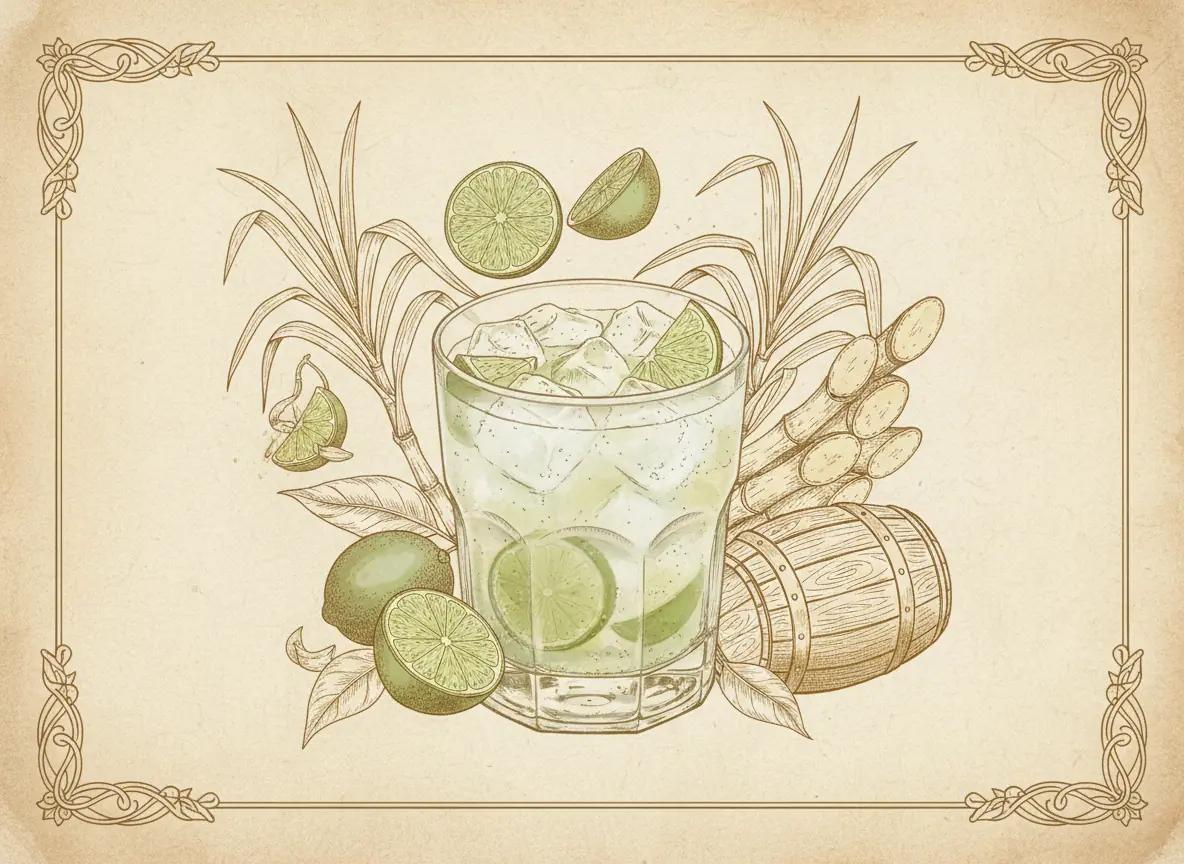
Caipirinha
A Caipirinha is 60ml of cachaça poured over one lime cut into eight pieces and muddled firmly with four teaspoons of caster sugar for 20 to 30 seconds, in a rocks glass filled with crushed ice and stirred briefly. About 2.4 UK units. The measures match the IBA’s. The Oxford Companion says non-Brazilians consider it the national drink of Brazil, though in Brazil it is the most famous of a large class of mixed drinks, the batidas. The Companion adds that the drink seems to have been called simply pinga com limão, cachaça with lime, before the 1950s, and that the name caipirinha, from caipira, a southern Brazilian word for a person from the rural hinterlands, was in occasional use by the 1950s and widespread by the end of the 1960s. Cachaça is what makes it. It is made from fresh sugarcane juice, where much rum starts from molasses, and it brings a grassy, green edge that the lime and sugar frame rather than cover.
Glassware: Rocks Glass
Garnish: None; serve with a short straw
Ingredients
60ml
Unaged cachaça, here taken at 40% ABV, inside the 38 to 48% that the Oxford Companion gives as the Brazilian legal range. Its grassy, vegetal edge is the drink; an aged one brings wood that fights the fresh lime.
1
One whole ripe lime, cut into eight pieces and muddled in the glass with the sugar. The oil from the peel matters as much as the juice.
4 teaspoons
Fine white sugar, added straight onto the lime before muddling. The crystals scour the peel and draw out its oil, which a syrup cannot do. The IBA specifies white cane sugar.
Instructions
Cut a lime into eight pieces and place them in a rocks glass.
Add four teaspoons of caster sugar over the lime.
Muddle firmly for 20 to 30 seconds, pressing and twisting, until the lime has released its juice and the sugar has begun to dissolve.
Fill the glass with crushed ice.
Pour the cachaça over the ice.
Stir briefly and serve with a short straw.
Source: the IBA (Official IBA specification; caster sugar for the IBA’s white cane sugar, crushed ice for cracked, and the lime muddled firmly; method ours). Last checked 9 October 2026.
Expert Tip
Muddle firmly for 20 to 30 seconds. You are pressing oil from the peel as well as juice from the flesh, so press and twist rather than grind. Too little and the drink is thin; grind the pith and it turns bitter. Use caster sugar, not syrup. The crystals scour the peel and draw out its oil, and a little undissolved sugar at the bottom of the glass is how the drink is meant to look. Choose a ripe lime, heavy for its size with a little give. A hard lime yields less juice and less oil.
Behind the Caipirinha
Flavour Profile
Where It Comes From
The Oxford Companion finds pinga com limão, cachaça with lime, from the mid-nineteenth century, in a folk song and in a Paraty cholera order of 1856, and says it was in São Paulo, in the first half of the twentieth century, that the drink became an institution, first as the Batida Paulista. We have found no primary record that settles who made the first one.
What is on record is more recent. The Oxford Companion says the name was widespread by the end of the 1960s, that the drink had a strong vogue in Europe in the 1980s, and that the vodka version, the Caipiroska, first appears in the early 1980s.
What Cachaça Is
The Oxford Companion says Brazil specified in 2001 that cachaça must be made from pure sugar-cane juice, as is modern practice, though historically it was also made from molasses and skimmings, and that it has been exclusively a cane-juice spirit since the end of the nineteenth century. Much rum begins with molasses, the syrup left after sugar is refined, which is why, in our view, cachaça tastes greener and grassier. Unaged cachaça is the one for a Caipirinha; aged in wood it picks up vanilla and spice that fight the fresh lime.
The Lime and the Sugar
One whole lime, cut into eight pieces. Smaller pieces give the muddler more surfaces to press, and the oil from the peel matters as much as the juice. A ripe lime, heavy for its size with a little give, yields more of both.
Four teaspoons of caster sugar go straight onto the lime. The crystals scour the peel as you press and dissolve slowly into the juice; a little left at the bottom of the glass is normal. Limes vary, so taste and adjust the sugar on the second drink.
Muddling and Ice
Press firmly for 20 to 30 seconds, pressing and twisting rather than grinding, until the lime has softened and the sugar has begun to wet. Ground pith is bitter, and once it is in the drink it stays there.
Then crushed ice, to the top of the glass. It chills the drink quickly and melts into it as it settles, softening the cachaça, and a brief stir brings the sugar and lime up through the ice.
The IBA and Ours
The Caipirinha at the IBA and in our glass
Cachaça
- IBA
- 60ml
- Ours
- 60ml, unaged
Lime
- IBA
- One, cut into small wedges
- Ours
- One, cut into eight pieces
Sugar
- IBA
- Four teaspoons of white cane sugar
- Ours
- Four teaspoons of caster sugar
Muddling
- IBA
- Gently
- Ours
- Firmly, 20 to 30 seconds, press and twist
Ice
- IBA
- Cracked
- Ours
- Crushed
Glass
- IBA
- Double old fashioned
- Ours
- Rocks glass
Garnish
- IBA
- None
- Ours
- None; a short straw
| Element | IBA | Ours |
|---|---|---|
| Cachaça | 60ml | 60ml, unaged |
| Lime | One, cut into small wedges | One, cut into eight pieces |
| Sugar | Four teaspoons of white cane sugar | Four teaspoons of caster sugar |
| Muddling | Gently | Firmly, 20 to 30 seconds, press and twist |
| Ice | Cracked | Crushed |
| Glass | Double old fashioned | Rocks glass |
| Garnish | None | None; a short straw |
How to Serve It
In the glass it was built in, filled with crushed ice, with a short straw and no garnish beyond the muddled lime already in it.
For white rum, lime and sugar shaken and served up, make a Daiquiri; for the same with mint and soda, a Mojito.
Make it at home
The Spirit
CachaçaCachaça is Brazil's cane spirit, distilled from fermented fresh sugar cane juice instead of molasses, which gives it a grassy, green taste. Brazil’s decree, as quoted in the US rule 78 FR 12591, reserves the name for cane spirit made in Brazil at 38 to 48% ABV with up to six grams of sugar per litre. It is the base of the Caipirinha; our two recipes assume 40%.
Master the Techniques
More to explore
Frequently Asked Questions
What is a Caipirinha?
Is cachaça the same as rum?
Can I use simple syrup instead of sugar?
What does cachaça taste like?
Does cachaça go bad once opened?
How long should I muddle a Caipirinha?
Crushed ice or cubes?
How strong is a Caipirinha?
Sources.
Checked between 18 October and 19 October 2026.
- The Oxford Companion to Spirits and Cocktails (David Wondrich), “The Caipirinha” (secondary source: pinga com limão from the mid-nineteenth century; the Batida Paulista of São Paulo; the name caipirinha in occasional use by the 1950s, widespread by the end of the 1960s; Europe in the 1980s; the Caipiroska from the early 1980s).
- The Oxford Companion to Spirits and Cocktails (Frederick H. Smith), “cachaça” (secondary source: by Brazilian law between 38 and 48 percent alcohol by volume; formally specified as pure sugar-cane juice in 2001; exclusively cane juice from the end of the nineteenth century).
- IBA, “Caipirinha” (official specification: 60ml cachaça, 1 lime cut into small wedges, 4 teaspoons white cane sugar; muddle gently, fill with cracked ice).
You Might Also Like
Mojito
A Mojito is 45ml of white rum, 20ml of fresh lime juice, two teaspoons of white cane sugar and six sprigs of mint, built in a highball. The mint is pressed gently with the sugar, the glass is filled with cubed ice, the rum and lime go in, and 75 to 100ml of chilled soda water tops it. About 1.8 UK units. Those are the IBA’s measures. The IBA only says to top up with soda, so the 75 to 100ml is ours. Press the mint once or twice and stop. Torn leaves make the drink bitter and grassy, and that, more often than the rum, is why a Mojito disappoints. The sugar grains help: they bruise the surface of the leaf as you press, and the lime then carries the oil through the glass.
Daiquiri
A Daiquiri is 60ml white rum, 20ml fresh lime juice and two bar spoons of caster sugar. Stir the sugar into the rum and lime in the shaker until it dissolves, then add ice, shake hard for 10 to 12 seconds and double strain into a chilled coupe. About 2.4 UK units. Those are the IBA’s measures, and its method dissolves the sugar first too. The name belongs to Daiquirí, an iron-mining district and beach near Santiago de Cuba. Difford’s Guide credits Jennings Stockton Cox, an American engineer who led one of the first mining parties into Cuba’s iron-ore country after the Spanish-American War of 1898; the Oxford Companion has him making or supervising the first Daiquiri in 1896, and a Santiago bartender naming it in 1908. Difford’s says Constantino Ribalaigua Vert of Havana’s El Floridita made the frozen version famous. With three ingredients and no liqueur or bitters, the Daiquiri hides nothing. A flat rum, tired lime or undissolved sugar shows in the first sip.
Where this one sits
Recipe by Jerry Can Spirits · Updated 19 October 2026