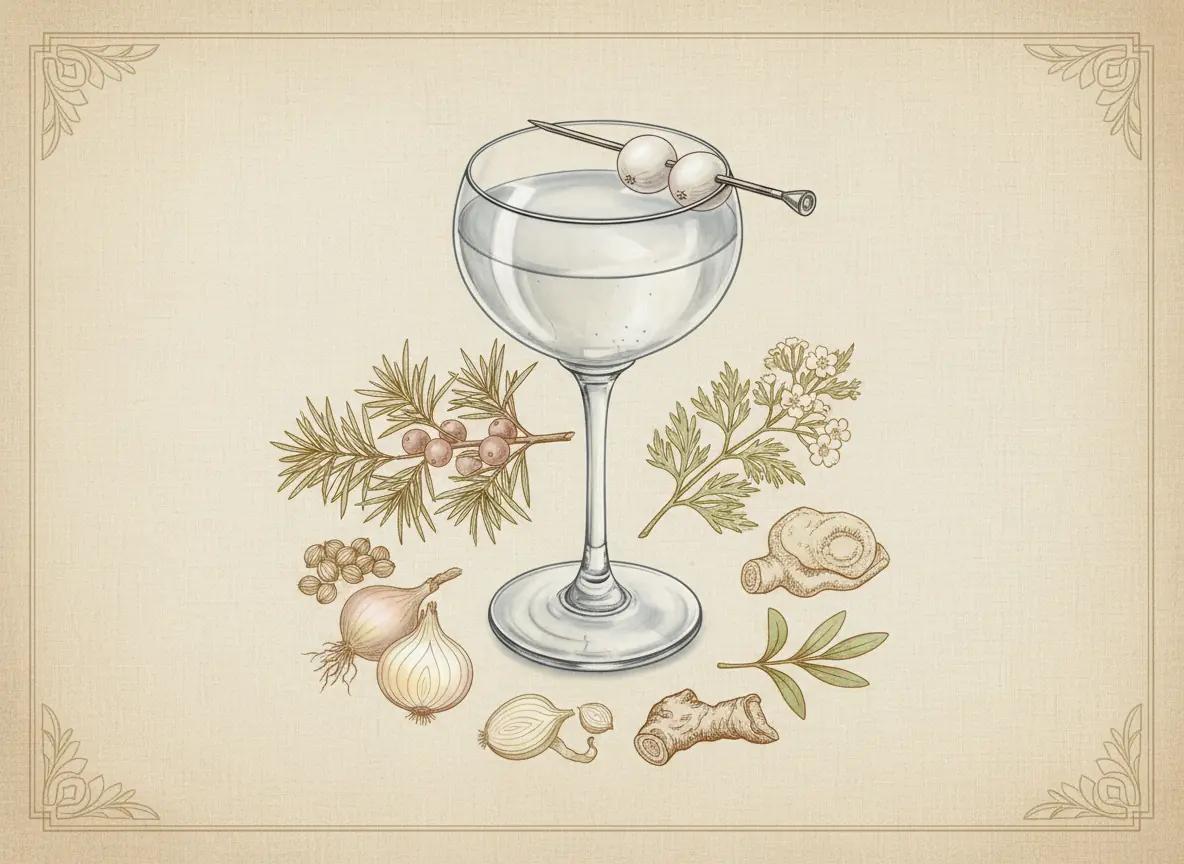
Gibson
A Gibson is 60ml London Dry gin and 10ml dry vermouth, stirred over ice for 20 to 30 seconds and strained into a chilled Nick & Nora glass, with two pickled cocktail onions on a pick. About 2.6 UK units. It is the IBA’s Dry Martini with onions where the Martini takes an olive or a lemon twist. Difford’s Guide says the full recipe for a Gibson first appears in William Boothby’s 1908 book, and that none of the early recipes mentions an onion. The name is less settled. Difford’s says the drink is said to have been created at San Francisco’s Bohemian Club in 1898, either by the businessman Walter D. K. Gibson or for the illustrator Charles Dana Gibson, and credits Charles Gibson with inspiring the onion a decade later at New York’s Players Club. The onion keeps working after it goes in. Its brine seeps into the cold gin as you drink, so the last sip is saltier and softer than the first.
Glassware: Nick & Nora Glass
Garnish: Two pickled cocktail onions on a pick
Ingredients
60ml
London Dry with clear juniper, at 40% ABV or slightly stronger. At six times the vermouth’s volume it is most of the drink, so pick a bottle you enjoy on its own.
10ml
French-style dry vermouth, at our working figure of 18% ABV; in our experience Noilly Prat is fuller and Dolin Dry lighter. At 10ml it seasons the gin rather than sharing the glass, and it still has to be fresh: we keep an opened bottle in the fridge and use it within about a month.
Instructions
Chill a Nick & Nora glass in the freezer or with ice water.
Add the gin and dry vermouth to a mixing glass.
Fill with cubed ice and stir for 20 to 30 seconds.
Empty the chilled glass and strain the drink into it.
Garnish with two pickled cocktail onions on a pick, resting it across the rim or dropping it in.
Source: the IBA (Official IBA specification, listed as Dry Martini; two cocktail onions as in Difford’s Guide’s Gibson; method ours). Last checked 10 October 2026.
Expert Tip
Choose the onion as carefully as the gin. A good cocktail onion is crisp, sharp and only lightly sweet; one sitting in sugary, artificially coloured brine leaves that sugar in the drink. Taste one before it goes in. Decide when the brine should arrive. Rest the onions on a pick across the rim and the first sips taste of gin and vermouth, with the onions dropped in later; put them straight in and the salt builds from the start. Stir for 20 to 30 seconds over plenty of cold, hard ice. With no juice and no sugar, temperature and dilution are what you are making, and an under-stirred Gibson tastes hot and thin.
Behind the Gibson
Flavour Profile
The Origin
The Gibson’s recipe is better documented than its name. The first known recipe that garnishes it with an onion is William Boothby’s, published in 1908. Earlier recipes under the same name leave the onion out; some use a citrus twist and some no garnish at all.
Difford’s Guide reports two men credited with the name, a decade apart. In Difford’s account of the onion, the illustrator Charles Dana Gibson was drinking at New York’s Players Club in 1908, where the bartender Charley Connolly is credited with adding an onion to Gibson’s signature Martini.
Difford’s Guide says Edward W. Townsend, a former vice president of the Bohemian Club, wrote the first written reference to a Gibson, in the New York World of 13 February 1898, and that historians tend to credit the businessman Walter D. K. Gibson with removing the bitters at the club. It places the full recipe first in William Boothby’s 1908 book, where the Gibson is equal parts French vermouth and Plymouth gin, with no onion mentioned.
The Garnish as Ingredient
A lemon twist gives up its oils and is finished. A pickled onion keeps going. Its liquor, usually vinegar, salt and a little sugar, seeps into the cold gin and vermouth from the moment it goes in: salt first, then acidity, then a faint roundness from the sugar.
That is why a Gibson changes as you drink it, and why the onion has to be good. A crisp cocktail onion in a sharp, clean brine adds to the gin; a soft one in sweet, coloured brine adds only sugar.
The Gibson and Its Neighbours
Gibson, dry Martini and Dirty Gibson compared
Gibson
- Spec
- 60ml gin, 10ml dry vermouth
- Garnish
- Pickled cocktail onion
- Strength
- About 2.6 UK units
Dry Martini
- Spec
- 60ml gin, 10ml dry vermouth
- Garnish
- Olive or lemon twist
- Strength
- About 2.6 UK units
Dirty Gibson
- Spec
- 60ml gin, 10ml dry vermouth, about 5ml onion brine
- Garnish
- Pickled cocktail onion
- Strength
- About 2.6 UK units
| Drink | Spec | Garnish | Strength |
|---|---|---|---|
| Gibson | 60ml gin, 10ml dry vermouth | Pickled cocktail onion | About 2.6 UK units |
| Dry Martini | 60ml gin, 10ml dry vermouth | Olive or lemon twist | About 2.6 UK units |
| Dirty Gibson | 60ml gin, 10ml dry vermouth, about 5ml onion brine | Pickled cocktail onion | About 2.6 UK units |
The Dirty Gibson
Stir a little onion brine in with the gin and vermouth, as olive brine goes into a Dirty Martini, and the salt runs through the drink from the first sip instead of building as you go. Start at 5ml. Much more than that and brine is all you taste.
How to Serve It
Very cold, with no ice, in a frozen Nick & Nora or a coupe, with the onions on a pick. Rest the pick across the rim and drop the onions in halfway if you want to choose when the brine arrives. Drink it while it is cold; a warm Gibson tastes mostly of alcohol.
Make it at home
The Spirit
GinGin is a spirit flavoured with juniper berries. Under the retained Regulation (EC) 110/2008, juniper must lead the taste, the floor is 37.5% ABV, and the route the flavour takes sets the grade: plain gin, distilled gin or London gin. Our recipes count it at 40%, and it carries the Martini, the Negroni and the Gin and Tonic.
More to explore
Frequently Asked Questions
What is a Gibson?
Is the onion just a garnish?
What is a Dirty Gibson?
How strong is a Gibson?
Who was the Gibson named after?
How is a Gibson different from a Martini?
Which dry vermouth should I use?
Sources.
Correct as of 19 October 2026.
- Difford’s Guide, “Gibson Dry Martini” (secondary source: the first written reference in Edward W. Townsend’s piece in the New York World, 13 February 1898; said created at the Bohemian Club in 1898 by Walter D. K. Gibson or for Charles Dana Gibson; the full recipe first in Boothby, 1908, without an onion; Charley Connolly and the onion at the Players Club in 1908).
- Internet Archive, “The World’s Drinks and How to Mix Them (1908), scan” (primary source, read as text: Gibson Cocktail “a la Charles Dana Gibson, Bohemian Club, San Francisco”, equal parts French vermouth and Coates Plymouth gin, thoroughly chilled; no onion in the text).
You Might Also Like
Martini
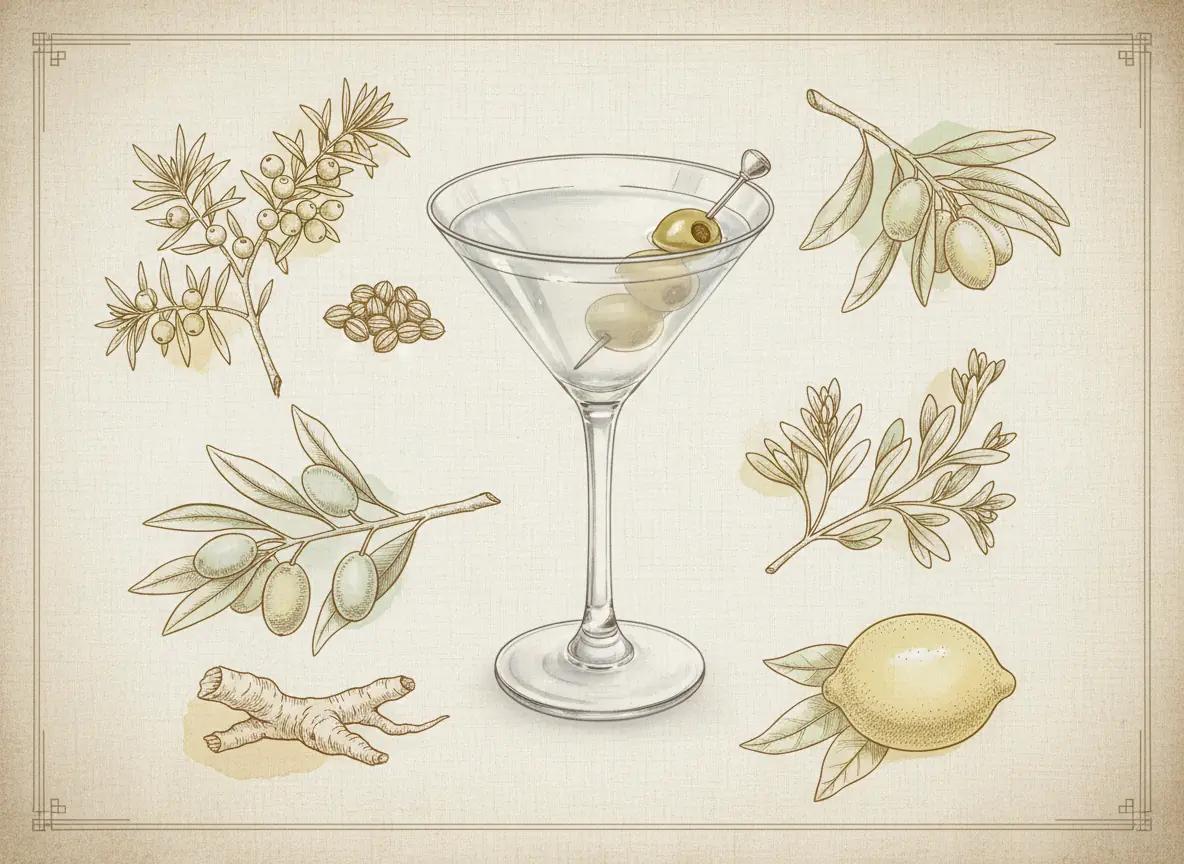
A Martini is 60ml of gin and 10ml of dry vermouth, stirred over ice for 20 to 30 seconds and strained into a chilled Martini glass, with oil from a strip of lemon peel expressed over the top, or green olives if you prefer them. That is the IBA’s Dry Martini, a six-to-one build, and about 2.6 UK units. At six to one the vermouth stops being a partner and becomes a seasoning: a dry wine note and a rounder finish under the juniper. Older recipes were far wetter, and the drink has been poured at every ratio from equal parts to a bare rinse. Nothing in a Martini is sweet or sour: it is gin, vermouth, cold and water. The stir supplies the last two, so it shapes the result as surely as the gin.
Sherry Martini
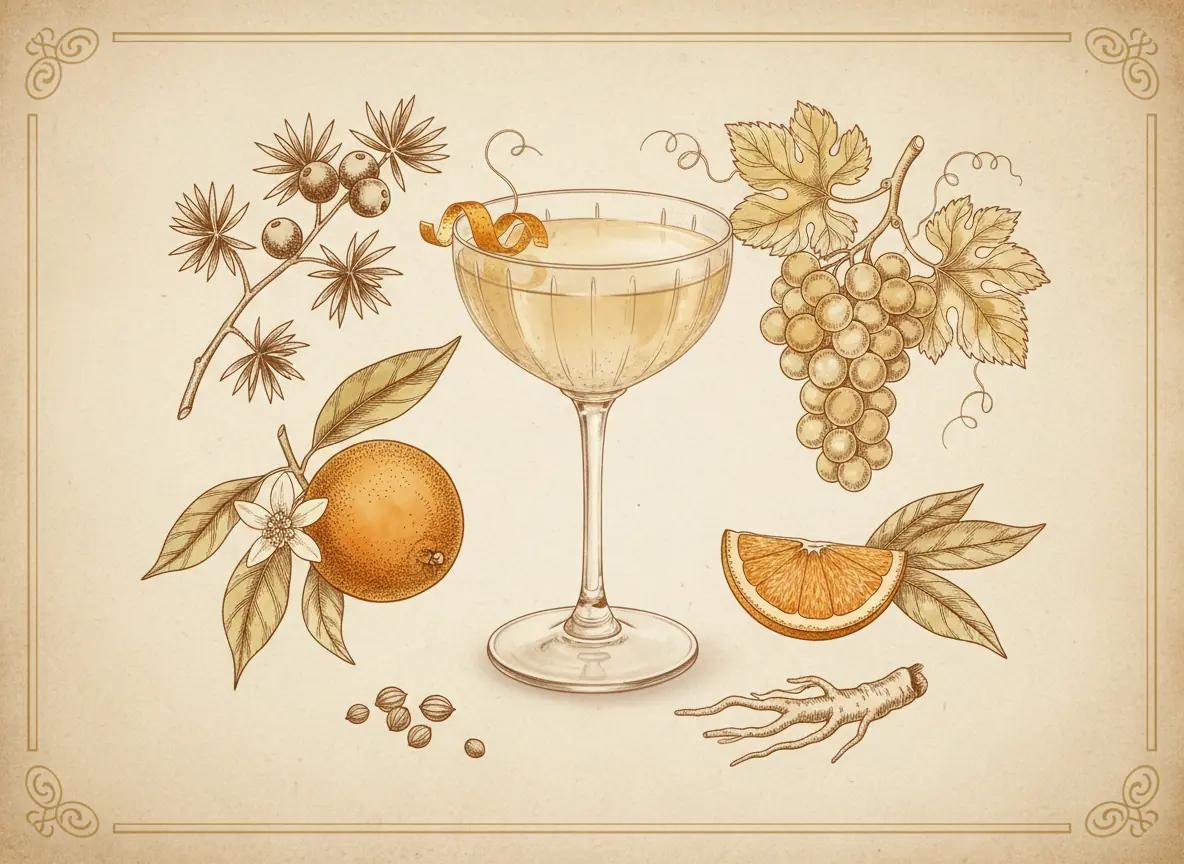
A Sherry Martini is 60ml of London Dry gin and 30ml of fino sherry with a dash of orange bitters, stirred over ice for 20 to 30 seconds and strained into a chilled coupe, with lemon peel expressed over the top. About 2.9 UK units. The fino takes the place of dry vermouth. Fino brings salt, almond and a dry, nutty edge where vermouth brings herbs. The gin still leads, with the sherry underneath it. The fino must be fresh, since the Consejo Regulador gives an open bottle of fino or manzanilla up to a week, tightly corked in the fridge. Chill it and drink the bottle quickly. The drink sits beside the Bamboo and the Adonis, longer-established sherry cocktails.
Bamboo
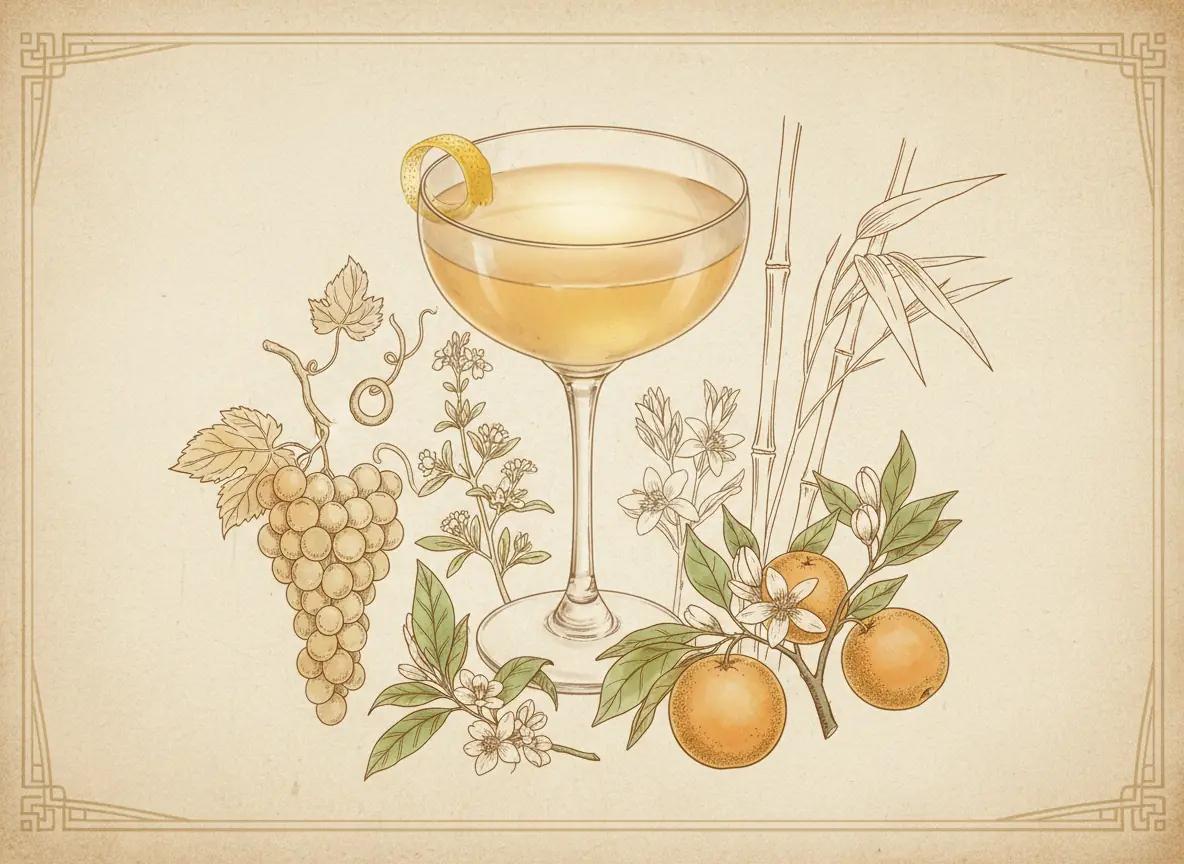
A Bamboo is 45ml fino sherry and 45ml dry vermouth with two dashes of orange bitters and one of Angostura, stirred over ice for 20 to 30 seconds and strained into a chilled coupe, with lemon peel expressed over the top. It is built like a Martini with no spirit in it: two fortified wines, about 1.5 UK units, and around 13% ABV in the glass. William Boothby’s 1908 book credits Louis Eppinger of the Grand Hotel in Yokohama, a German bartender brought to Japan in 1889, as Difford’s Guide, a secondary source, reports. Difford’s finds the drink in newspapers from 1886, three years before Eppinger reached Japan, and an early printed recipe, Thomas Stuart’s of 1904, uses Italian sweet vermouth, which makes the drink now called the Adonis. The sherry decides it. Fino or manzanilla, served cold from a bottle opened in the last few days, gives a dry, saline drink with a nutty edge. The Consejo Regulador gives an open bottle up to a week in the fridge, and one left open longer gives a flat drink, which is usually why a Bamboo disappoints.
Where this one sits
Recipe by Jerry Can Spirits · Updated 19 October 2026