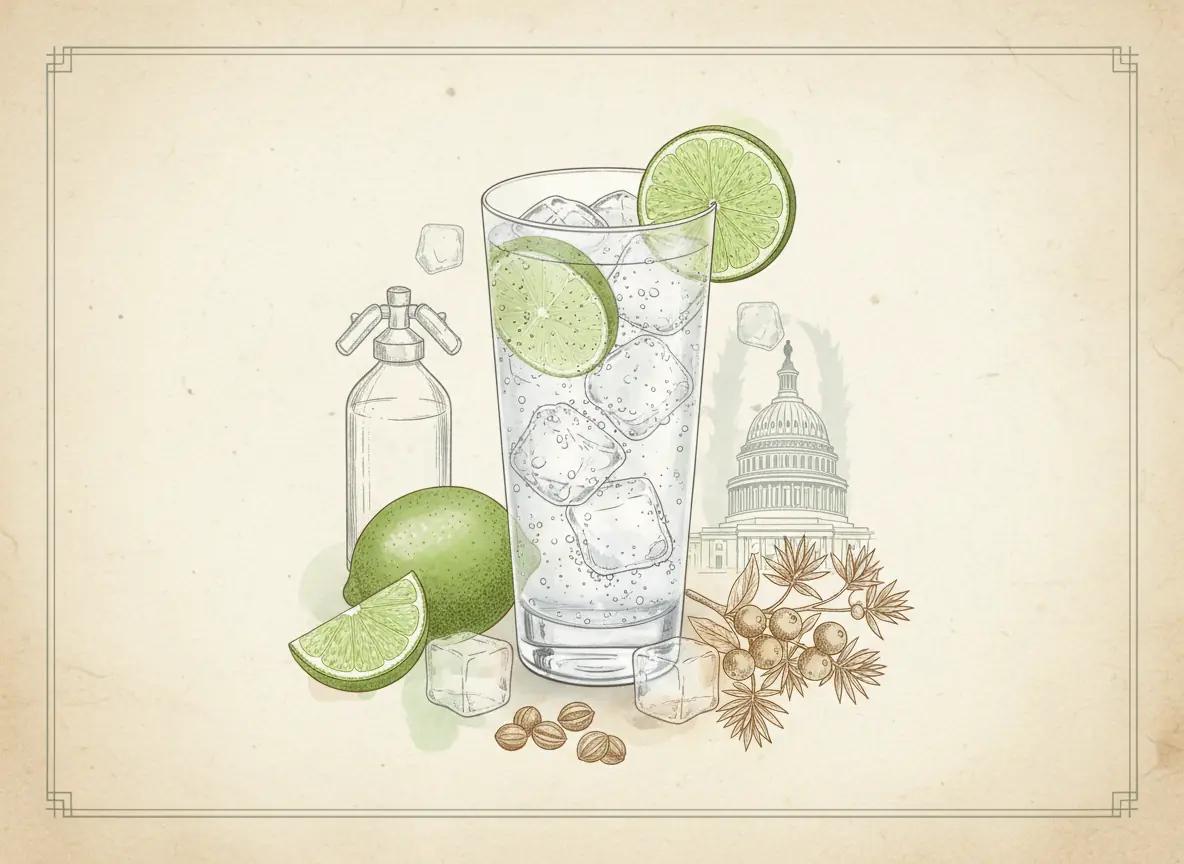
Gin Rickey
A Gin Rickey is 60ml of London Dry gin and 25ml of fresh lime juice over ice in a highball, topped with 100 to 125ml of cold soda water and finished with a lime wheel. There is no sugar in it. About 2.4 UK units. The Oxford Companion says the Rickey was popularised in the late 1880s at Shoomaker’s bar in Washington, D.C., by Colonel Joseph Kerr “Joe” Rickey, a lobbyist from Missouri, and the bartender George Williamson, that it began with bourbon, and that the Gin Rickey, first found in print in 1893, was the version most widely known by the mid-1890s. With no sugar to round anything off, the gin and the lime carry it. Squeeze the lime on the day and close to the drink: in our experience lime turns flat and bitter within hours, and a Rickey has nothing to hide that behind.
Glassware: Highball Glass
Garnish: Lime wheel
Ingredients
60ml
A juniper-heavy London Dry, around 40% ABV. With no sugar in the glass, the gin carries most of the flavour.
25ml
Squeezed on the day and close to the drink. Lime loses its brightness within hours and turns bitter, and a Rickey shows the difference at once.
100 to 125ml
Well chilled and from a fresh bottle, poured last down the inside of the glass. Less soda gives a sharper drink, more a longer one.
Instructions
Squeeze the lime juice the same day, as close to the drink as you can.
Fill a highball glass to the top with large cubed ice.
Add the gin and lime juice and stir briefly.
Pour the chilled soda water gently down the inside of the glass.
Lift once with a bar spoon, add a lime wheel and serve.
Our version
The IBA lists no Gin Rickey. We pour 60ml of London Dry gin, 25ml of fresh lime and 100 to 125ml of soda over ice, with no sugar and a lime wheel.
Source: our own specification. Last checked 9 October 2026.
Expert Tip
If it tastes too sharp, take out lime rather than add sugar. Five millilitres less juice fixes most over-sharp Rickeys; sugar and lemon turn it into a Tom Collins, a good drink and a different one. Use a London Dry with real juniper. There is no sweetener to round the edges, and a thin or very floral gin leaves lime and soda with a faint spirit note behind it. Pour the soda down the inside of the glass and lift once with the spoon. The bubbles are half the drink, and stirring them out leaves it flat.
Behind the Gin Rickey
Flavour Profile
Where It Comes From
The Rickey began with bourbon. The Oxford Companion puts the Rickey in Washington in the late 1880s, at Shoomaker’s bar, where Colonel Joe Rickey, a lobbyist from Missouri, took his bourbon with carbonated water and the lime was more than likely added by the bartender George Williamson. It adds that the name is also attributed to Representative William Henry Hatch and Fred Mussey, said to have been there and to have asked afterwards for a “Joe Rickey”.
The gin version took over by the mid-1890s, the Oxford Companion says, and its entry on the Gin Rickey finds it first in print in 1893. Rickey himself told the New York Herald that year that he “was not the author” of the drink, only “its introducer to the East”.
No Sugar
The Tom Collins and the Gin Fizz share the gin, citrus and soda and add syrup. The syrup softens the citrus and rounds the juniper.
Without it, the drink is sharper and drier, and everything rests on the gin and the lime. A gin with plenty of juniper gives a long drink with real flavour; a thin one gives lime and soda with a faint spirit note.
The Rickey Beside Its Sweetened Relations
Gin, citrus and soda, with and without sugar
Gin Rickey
- Gin
- 60ml
- Citrus
- 25ml lime
- Sugar
- None
- Soda
- 100 to 125ml
- Method
- Built over ice
- UK units
- About 2.4
Tom Collins
- Gin
- 60ml
- Citrus
- 30ml lemon
- Sugar
- 15ml simple syrup
- Soda
- 90ml
- Method
- Built over ice
- UK units
- About 2.4
Gin Fizz
- Gin
- 45ml
- Citrus
- 30ml lemon
- Sugar
- 10ml simple syrup
- Soda
- 60ml
- Method
- Shaken, served without ice
- UK units
- About 1.8
| Drink | Gin | Citrus | Sugar | Soda | Method | UK units |
|---|---|---|---|---|---|---|
| Gin Rickey | 60ml | 25ml lime | None | 100 to 125ml | Built over ice | About 2.4 |
| Tom Collins | 60ml | 30ml lemon | 15ml simple syrup | 90ml | Built over ice | About 2.4 |
| Gin Fizz | 45ml | 30ml lemon | 10ml simple syrup | 60ml | Shaken, served without ice | About 1.8 |
Add sugar and lemon and you have the Tom Collins; shake it and leave out the ice for the Gin Fizz.
Lime, Squeezed on the Day
Lime is the only citrus here, there is no sugar to mask it going stale, and no foam or liqueur to distract from it.
In our experience fresh lime holds its brightness for a few hours, then turns flat and slightly bitter. Squeeze it on the day and as close to the drink as you can.
A lime wheel dropped into the glass adds a little peel oil as the drink sits, and it costs nothing.
Built for the Long Afternoon
Its origin was a bar where political business was done slowly, over several drinks. The Rickey suits that: dry, cold and long enough to last.
How to Serve It
Built in a highball full of ice, the soda poured gently down the inside, a lime wheel dropped in. Serve it at once.
Make it at home
The Spirit
GinGin is a spirit flavoured with juniper berries. Under the retained Regulation (EC) 110/2008, juniper must lead the taste, the floor is 37.5% ABV, and the route the flavour takes sets the grade: plain gin, distilled gin or London gin. Our recipes count it at 40%, and it carries the Martini, the Negroni and the Gin and Tonic.
More to explore
Frequently Asked Questions
What is a Gin Rickey?
Who was the Rickey named after?
How is a Gin Rickey different from a Gin Fizz or Tom Collins?
What gin should I use?
What does the soda water do?
When should I squeeze the lime?
How strong is a Gin Rickey?
Sources.
Correct as of 19 October 2026.
- The Oxford Companion to Spirits and Cocktails (Derek Brown), “The Rickey” (secondary source: popularised in the late 1880s at Shoomaker’s in Washington by Colonel Joe Rickey and the bartender George Williamson; Hatch and Mussey; Rickey’s 1893 statement to the New York Herald; the Gin Rickey best known by the mid-1890s).
- The Oxford Companion to Spirits and Cocktails (Derek Brown), “The Gin Rickey” (secondary source: a variation on the original bourbon Rickey, first found in print in 1893; the official cocktail of Washington, DC).
You Might Also Like
Whiskey Highball
A Whiskey Highball is 50ml Scotch whisky and 100 to 125ml cold soda water in a highball glass packed with ice, stirred once, with a strip of lemon peel twisted over it. About 2.0 UK units. With two ingredients, everything rests on the whisky, the soda and how cold both are. The Oxford Companion says whisky and soda crossed to America, where by 1895 it was rapidly edging into the mainstream under the name Scotch Highball. Where the word comes from is disputed: a tall glass, or one of the senses it had in baseball, poker and railroads. In Japan, where the highball means whisky and soda water, Suntory’s master blender Shinji Fukuyo told The Spirits Business that the highball campaign succeeded in the late 2000s, maybe 2008. The method exists to keep the bubbles: cold glass, cold soda, a gentle pour and one stir.
Campari & Soda
A Campari and soda is 45ml of Campari and 90ml of cold soda water, built over a highball full of ice, stirred once and finished with an orange slice. One part Campari to two of soda: bitter, orange-edged and long, and at about 1.1 UK units a light drink to have before a meal. Gaspare Campari created his bitter in 1860, by Campari’s own account. In 1932, by Campari’s own account, the company put it and soda together in a single-serve bottle designed by the Futurist artist Fortunato Depero, and Difford’s Guide, a secondary source, lists Campari Soda, as that bottle is called, at 10% ABV. The ratio is the only real decision. More soda and the bitterness thins out; less and the drink turns heavy. Start at one to two and adjust by 15ml either way.
Daiquiri
A Daiquiri is 60ml white rum, 20ml fresh lime juice and two bar spoons of caster sugar. Stir the sugar into the rum and lime in the shaker until it dissolves, then add ice, shake hard for 10 to 12 seconds and double strain into a chilled coupe. About 2.4 UK units. Those are the IBA’s measures, and its method dissolves the sugar first too. The name belongs to Daiquirí, an iron-mining district and beach near Santiago de Cuba. Difford’s Guide credits Jennings Stockton Cox, an American engineer who led one of the first mining parties into Cuba’s iron-ore country after the Spanish-American War of 1898; the Oxford Companion has him making or supervising the first Daiquiri in 1896, and a Santiago bartender naming it in 1908. Difford’s says Constantino Ribalaigua Vert of Havana’s El Floridita made the frozen version famous. With three ingredients and no liqueur or bitters, the Daiquiri hides nothing. A flat rum, tired lime or undissolved sugar shows in the first sip.
Where this one sits
Recipe by Jerry Can Spirits · Updated 19 October 2026