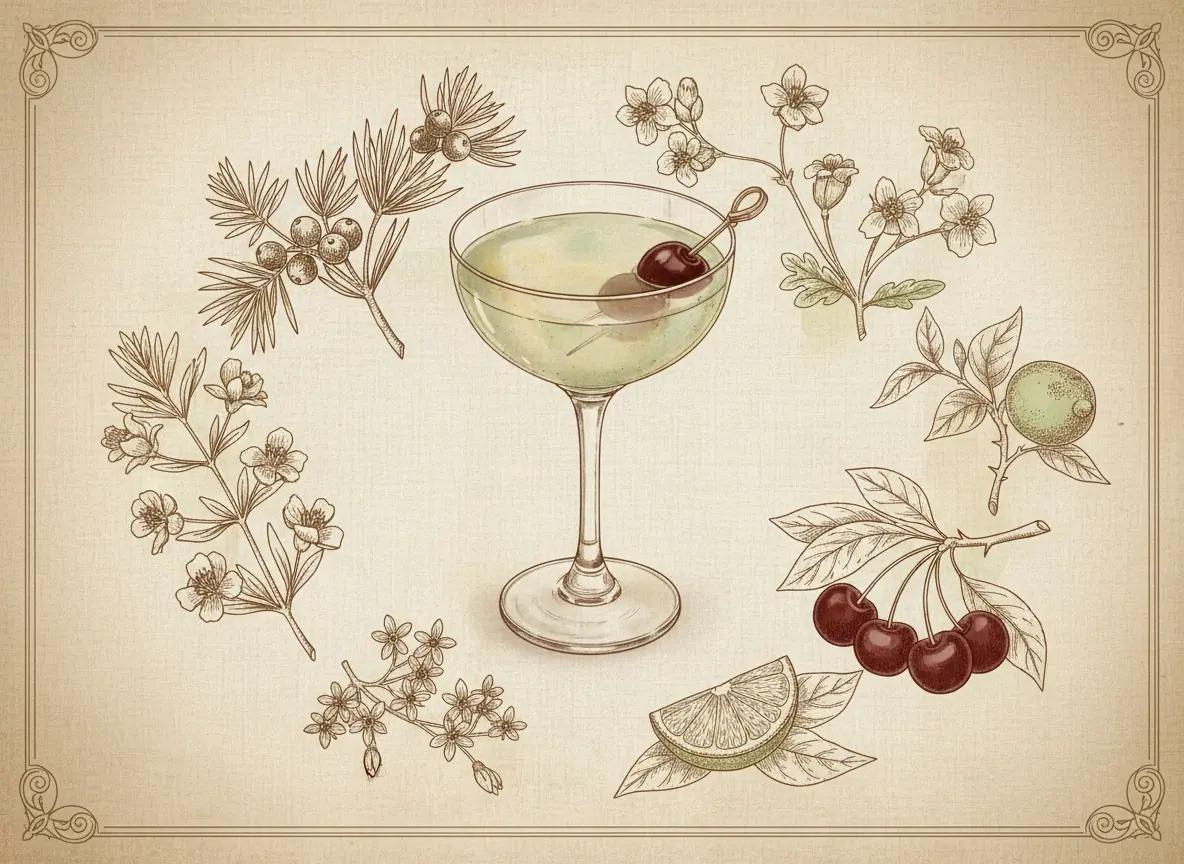
Last Word
A Last Word is 22.5ml each of gin, green Chartreuse, maraschino liqueur and fresh lime juice, shaken hard for 10 to 12 seconds and double strained into a chilled Nick & Nora or coupe. About 2.9 UK units. The measures are the IBA’s; the cherry or lime twist is ours. The Oxford Companion says the drink first appears in print in the Detroit Athletic Club News in 1916, on a menu at 35 cents, a high price then. Ted Saucier’s Bottoms Up of 1951 prints the recipe, quoting a club source who says Frank Fogarty, a vaudeville monologist, introduced it there about thirty years earlier. In 2003 Murray Stenson put it on the menu at the Zig Zag Café in Seattle, from where it spread, the Companion says. Four strong flavours at equal volume, and none takes over. Chartreuse brings herbs and heat, maraschino cherry and a bitter almond edge, lime the acid, and gin holds them together.
Glassware: Nick & Nora Glass
Garnish: Maraschino cherry and Lime twist expressed over the glass
Ingredients
22.5ml
A juniper-forward London Dry at 40% ABV or a little more. It needs enough backbone to stand among three louder ingredients.
22.5ml
At 55% ABV, the strongest bottle in the glass and the source of its herbal heat. Keep it at a full 22.5ml; less and the drink goes flat.
22.5ml
Luxardo, at 32% ABV on Luxardo’s own page, is the IBA’s choice. Made from marasca cherries, it is clear, with roasted nuttiness in Luxardo’s description that bridges the Chartreuse and the lime, and sweeter than it tastes.
22.5ml
Squeezed the same day. At a quarter of the drink it carries all the acid, and bottled juice tastes flat and bitter against the liqueurs.
Instructions
Squeeze the lime juice the same day.
Add the gin, green Chartreuse, maraschino liqueur and lime juice to a shaker.
Fill with cubed ice and shake hard for 10 to 12 seconds.
Double strain into a chilled Nick & Nora or coupe.
Garnish with a maraschino cherry on a pick or a lime twist expressed over the glass.
Source: the IBA (Official IBA specification; a cherry or lime twist where the IBA gives no garnish; method ours). Last checked 9 October 2026.
Expert Tip
Keep the four measures equal on the first attempt. Cut the Chartreuse and the drink goes flat; add lime and it turns sharp. Learn the balance before adjusting it. Use Luxardo maraschino or a bottle like it. It is a clear cherry liqueur, not the syrup from a jar of cocktail cherries, and a sweeter maraschino tips the drink towards cloying. Double strain into a chilled glass. Ice shards melt and thin the drink as you go, and a warm glass dulls the Chartreuse.
Behind the Last Word
Flavour Profile
Equal Parts
With four equal measures, every flaw shows. Each of the four would dominate a lesser recipe; here each is held in check by the other three, and that balance is the drink.
Detroit, 1916
The Oxford Companion calls the Last Word a pre-Prohibition drink of the Detroit Athletic Club and says it first appears in print in the Detroit Athletic Club News in 1916, on a menu at 35 cents, which it calls a high price.
Ted Saucier’s Bottoms Up, published in 1951, prints the recipe, and the Companion says an unnamed Detroit Athletic Club source in it writes that Frank Fogarty, a vaudeville monologist known as the Dublin Minstrel, introduced the drink there about thirty years earlier. The Companion says no other print source links Fogarty to the Last Word, and that the drink was largely forgotten until 2003.
The Rediscovery
The Oxford Companion says Murray Stenson was one of the earliest bartenders to rediscover Saucier’s Bottoms Up, and that at the Zig Zag Café in Seattle he single-handedly revived the Last Word. The Companion’s Last Word entry dates it to 2003 and says the drink then spread across the country and around the world. The IBA now lists it among its official cocktails.
Green Chartreuse
Chartreuse’s own page says green Chartreuse is still made by the Chartreux Fathers, with the grinding done by the monks at the Grande Chartreuse monastery, from 130 plants, flowers, bark, roots and spices. At 55% ABV it is the strongest bottle in the drink and brings its herbal heat; the lime balances its sugar, and the maraschino softens its edge.
Maraschino
Maraschino liqueur is made from marasca cherries; Luxardo says it distils both the liquid and the solid parts, and describes the result as having roasted nuttiness. It is clear and sweeter than it tastes, nothing like the syrup in a jar of cocktail cherries. It sits between the Chartreuse and the lime, softening one and rounding the other.
The Lime
Lime is the only acid in the glass and a quarter of it. Squeeze it the same day: bottled juice is flat and slightly bitter, and in an equal-parts drink that throws the whole balance.
The IBA and Ours
The Last Word: the IBA’s measures beside ours
Gin
- IBA
- 22.5ml
- Ours
- 22.5ml London Dry
Green Chartreuse
- IBA
- 22.5ml
- Ours
- 22.5ml
Maraschino
- IBA
- 22.5ml Luxardo
- Ours
- 22.5ml Luxardo
Fresh lime juice
- IBA
- 22.5ml
- Ours
- 22.5ml, squeezed the same day
Method
- IBA
- Shaken, strained
- Ours
- Shaken 10 to 12 seconds, double strained
Glass
- IBA
- Chilled cocktail glass
- Ours
- Chilled Nick & Nora or coupe
Garnish
- IBA
- None
- Ours
- Maraschino cherry or lime twist
| Element | IBA | Ours |
|---|---|---|
| Gin | 22.5ml | 22.5ml London Dry |
| Green Chartreuse | 22.5ml | 22.5ml |
| Maraschino | 22.5ml Luxardo | 22.5ml Luxardo |
| Fresh lime juice | 22.5ml | 22.5ml, squeezed the same day |
| Method | Shaken, strained | Shaken 10 to 12 seconds, double strained |
| Glass | Chilled cocktail glass | Chilled Nick & Nora or coupe |
| Garnish | None | Maraschino cherry or lime twist |
For green Chartreuse stirred with gin and sweet vermouth, make a Bijou; for a modern equal-parts drink built on the same frame, try the Naked and Famous.
Make it at home
The Spirit
GinGin is a spirit flavoured with juniper berries. Under the retained Regulation (EC) 110/2008, juniper must lead the taste, the floor is 37.5% ABV, and the route the flavour takes sets the grade: plain gin, distilled gin or London gin. Our recipes count it at 40%, and it carries the Martini, the Negroni and the Gin and Tonic.
More to explore
Frequently Asked Questions
What is a Last Word?
How was it rediscovered?
Can I use the syrup from a jar of cherries?
Who invented the Last Word?
What is the difference between a Last Word and a Bijou?
Can I use yellow Chartreuse?
How strong is a Last Word?
Sources.
Checked between 18 October and 19 October 2026.
- The Oxford Companion to Spirits and Cocktails (St. John Frizell), “The Last Word” (secondary source: first in print in the Detroit Athletic Club News, 1916, a menu at 35 cents; Saucier’s Bottoms Up, 1951, and Frank Fogarty; largely forgotten until Murray Stenson’s menu at the Zig Zag Cafe, Seattle, 2003).
- IBA, “Last Word” (official specification: 22.5ml each of gin, green Chartreuse, Maraschino Luxardo, fresh lime juice; garnish N/A).
- Chartreuse, “Green Chartreuse” (maker’s page: 55% vol.; 130 plants, bark, roots, spices and flowers; made by the Chartreux Fathers).
- Chartreuse, “Yellow Chartreuse” (maker’s page: 43% vol.; sweetness, spicy scents, a soft structure).
- Luxardo, “Maraschino Originale” (maker’s page: 32% Alc. by Vol.; marasca cherries infused, liquid and solid parts distilled; roasted nuttiness).
- The Oxford Companion to Spirits and Cocktails (Jeffrey Morgenthaler), “Stenson, Murray” (secondary source: Stenson, Seattle bartender, Zig Zag Café 2001 to 2012, one of the earliest to rediscover Saucier’s Bottoms Up and revive the Last Word).
You Might Also Like
Bijou
A Bijou is 40ml of London Dry gin, 20ml of green Chartreuse, 20ml of sweet vermouth and two dashes of orange bitters, stirred over cubed ice for 30 seconds and strained into a chilled Nick and Nora glass, with a lemon twist expressed over it and a cherry. About 3.0 UK units. The Oxford Companion says the drink appears to be Harry Johnson’s adaptation of a cocktail first recorded in St. Louis and Cincinnati in the spring of 1895, and that his version appeared in the 1900 edition of his Bartenders’ Manual. Bijou is French for jewel, and Difford’s Guide gives the explanation that each bottle stands for a stone by its colour: gin for diamond, vermouth for ruby, Chartreuse for emerald. At 55% ABV on Chartreuse’s own page, green Chartreuse is the force to manage. Many recipes pour the three in equal measures; ours doubles the gin so its juniper holds against the Chartreuse, with the vermouth giving body and the bitters tying the herbs together.
Champs-Élysées
A Champs-Élysées is 45ml of cognac, 15ml of green Chartreuse, 20ml of fresh lemon juice, 10ml of sugar syrup and a dash of Angostura, shaken hard with ice for 10 to 12 seconds and double strained into a chilled coupe, finished with an expressed lemon twist. About 2.6 UK units. Difford’s Guide gives the earliest known recipe as the one in Drinks, Long and Short by Nina Toye and A. H. Adair, published in 1925: three parts brandy, one of Chartreuse and one and a half of sweetened lemon juice, with a dash of Angostura. Our measures keep the three to one of brandy to Chartreuse and split the sweetened lemon into fresh juice and syrup. It reads as a Sidecar with green Chartreuse in place of the orange liqueur. Chartreuse is 55% ABV on its own page and, in our view, intensely herbal, so even a small measure changes the whole drink: the cognac and lemon are still there, under a layer of mountain herbs.
Alaska
An Alaska is 50ml of London Dry gin and 25ml of yellow Chartreuse with two dashes of orange bitters, stirred over ice for 30 seconds and strained into a chilled Nick & Nora, with a lemon twist. About 3.1 UK units, all of it spirit. It was in print by 1914, Punch says, when Jacques Straub’s Drinks listed it as Old Tom gin with a smaller measure of yellow Chartreuse and a dash of orange bitters, shaken. The gin-led ratio has held; the Old Tom and the shaking have not. The name is unexplained; Difford’s Guide offers only a conjecture about the Alaska gold rush and the drink’s golden colour. Yellow Chartreuse is the drink. Sweet and spicy at 43% ABV on Chartreuse’s own page, softer than green, it sweetens the gin and seasons it at once. A full 30-second stir is what turns two strong bottles into one smooth drink.
Where this one sits
Recipe by Jerry Can Spirits · Updated 19 October 2026