Martini
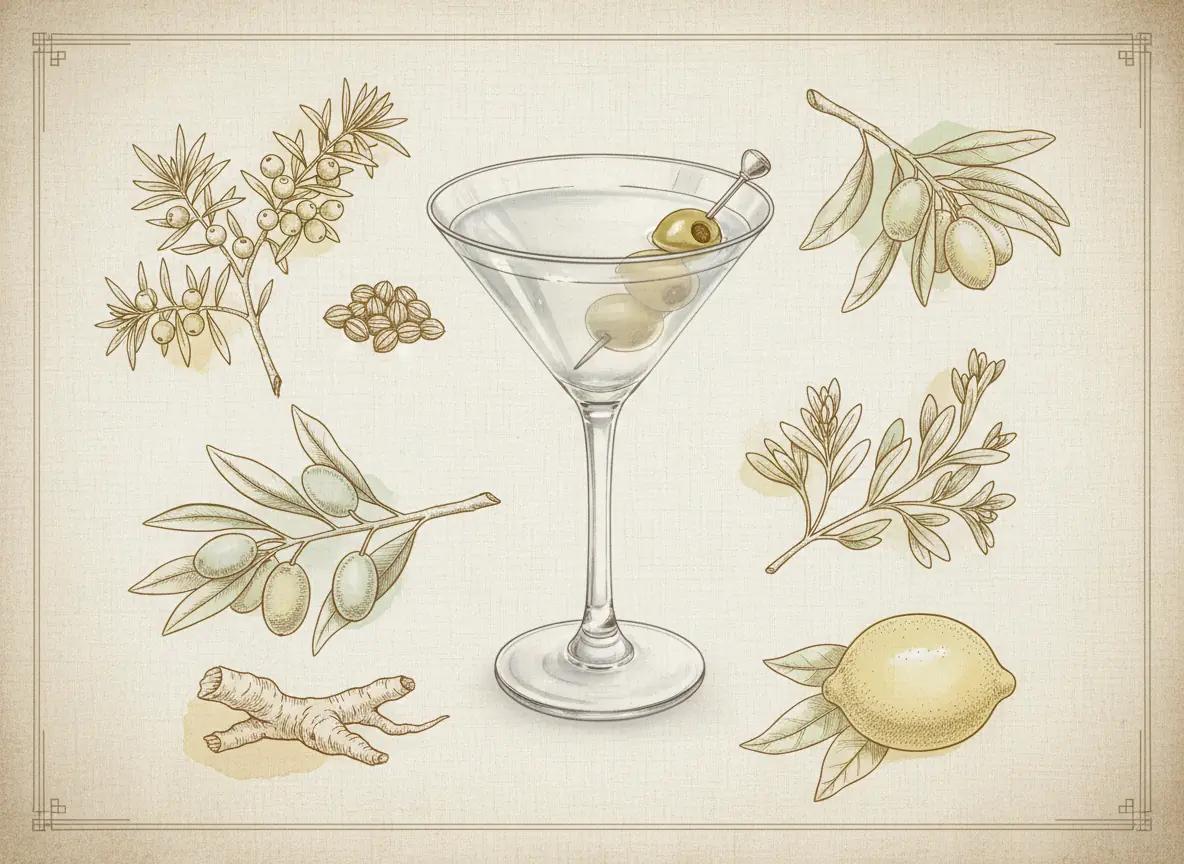
A Martini is 60ml of gin and 10ml of dry vermouth, stirred over ice for 20 to 30 seconds and strained into a chilled Martini glass, with oil from a strip of lemon peel expressed over the top, or green olives if you prefer them. That is the IBA’s Dry Martini, a six-to-one build, and about 2.6 UK units. At six to one the vermouth stops being a partner and becomes a seasoning: a dry wine note and a rounder finish under the juniper. Older recipes were far wetter, and the drink has been poured at every ratio from equal parts to a bare rinse. Nothing in a Martini is sweet or sour: it is gin, vermouth, cold and water. The stir supplies the last two, so it shapes the result as surely as the gin.
Variations
Glassware: Martini Glass
Garnish: Lemon peel or green olives
Ingredients
60ml
London Dry or Plymouth at our working figure of 40% ABV or slightly stronger, with clear juniper. It is six-sevenths of the drink, so pour a gin worth sipping neat.
10ml
French-style dry vermouth at around 18% ABV. In our view Dolin Dry is light and clean, Noilly Prat rounder and more herbal. We keep it in the fridge once opened and use it within about four weeks.
Instructions
Chill a Martini glass in the freezer, or fill it with ice and water.
Add the gin and dry vermouth to a mixing glass.
Fill with large cubed ice and stir for 20 to 30 seconds.
Empty the chilled glass and strain the drink into it.
Express a strip of lemon peel over the surface and rest it on the rim, or add green olives on a pick.
Source: the IBA (Official IBA specification, listed as Dry Martini; method ours). Last checked 9 October 2026.
Expert Tip
Stir for 20 to 30 seconds over large, hard cubes, and taste at 20. An under-stirred Martini is too strong and too warm, which is why so many people find the drink harsh. Melted ice belongs in it. We keep opened vermouth in the fridge and finish it within four weeks. It is a wine, at around 18% ABV, and in our experience an opened bottle on a warm shelf turns flat and sour. Even at 10ml, a tired bottle shows. Freeze the glass, or fill it with ice and water while you stir. The drink is served without ice, so once the strainer stops, the glass is all that keeps it cold.
Behind the Martini
Flavour Profile
The Origin
By the 1880s American bartenders were mixing gin with vermouth: Difford’s Guide says the first known recipe for the Martinez appears in O. H. Byron’s 1884 The Modern Bartender, and Jerry Thomas printed one in 1887. Difford’s says the Martini, like the Martinez and the Marguerite it morphed from, was initially sweet, which is why its descendant had to be called a Dry Martini.
Difford’s Guide says the Martini started wet and became steadily drier. Its ratio chart names the seven-to-one Martini after David Embury, whose The Fine Art of Mixing Drinks, the Oxford Companion says, was first published in 1948. Difford’s also notes that some say the Martini is simply a renamed Marguerite, after the brand of vermouth used to make it.
Six to One
At six to one, vermouth is about a seventh of the glass. You notice it as a dry, slightly herbal wine note and a rounder finish, not as a flavour of its own. Leave it out and you are drinking cold gin; move towards two to one and the vermouth starts to lead.
The very dry Martinis of the mid-twentieth century are often put down to poor vermouth, bottles left open and warm until they were unpleasant. Fresh, cold vermouth is a better answer than less of it.
The Gin
London Dry is the usual choice. Nothing can be added to it after distillation but water, so the juniper stays clear and consistent between bottles.
Floral, modern gins make interesting Martinis that taste mostly of the gin. With 60ml in the glass, nothing else in it matters as much.
The Stir
Stirring over large cubes brings the drink close to freezing and adds water as the ice melts, while keeping it clear and silky. That water is what makes 70ml of gin and vermouth easy to drink.
Shaking gets the drink colder faster and beats in air, which clouds it and thins the texture. The shaken version has its own name, the Bradford, which Harry Johnson printed beside the stirred Martini.
The Martini Family
The Martini and its relations, as we make them; the units are our calculation at our working strengths, with Lillet Blanc at 17%, the figure on Pernod Ricard’s product page
Martini
- Spec
- 60ml gin, 10ml dry vermouth
- Method
- Stirred
- Garnish
- Lemon peel or green olives
- UK units
- About 2.6
Gibson
- Spec
- 60ml gin, 30ml dry vermouth
- Method
- Stirred
- Garnish
- Pickled cocktail onion
- UK units
- About 2.9
Vesper
- Spec
- 45ml gin, 15ml vodka, 7.5ml Lillet Blanc
- Method
- Shaken
- Garnish
- Lemon peel
- UK units
- About 2.5
Martinez
- Spec
- 45ml gin, 45ml sweet vermouth, 5ml maraschino, two dashes orange bitters
- Method
- Stirred
- Garnish
- Lemon peel
- UK units
- About 2.7
Gin and It
- Spec
- 50ml gin, 25ml sweet vermouth
- Method
- Stirred
- Garnish
- Orange slice or a cherry
- UK units
- About 2.4
Left Bank Martini
- Spec
- 60ml gin, 15ml elderflower liqueur, 15ml white wine, 7.5ml dry vermouth
- Method
- Stirred
- Garnish
- Lime twist
- UK units
- About 3.0
| Drink | Spec | Method | Garnish | UK units |
|---|---|---|---|---|
| Martini | 60ml gin, 10ml dry vermouth | Stirred | Lemon peel or green olives | About 2.6 |
| Gibson | 60ml gin, 30ml dry vermouth | Stirred | Pickled cocktail onion | About 2.9 |
| Vesper | 45ml gin, 15ml vodka, 7.5ml Lillet Blanc | Shaken | Lemon peel | About 2.5 |
| Martinez | 45ml gin, 45ml sweet vermouth, 5ml maraschino, two dashes orange bitters | Stirred | Lemon peel | About 2.7 |
| Gin and It | 50ml gin, 25ml sweet vermouth | Stirred | Orange slice or a cherry | About 2.4 |
| Left Bank Martini | 60ml gin, 15ml elderflower liqueur, 15ml white wine, 7.5ml dry vermouth | Stirred | Lime twist | About 3.0 |
The Gibson keeps the gin and dry vermouth, adds more vermouth and changes the garnish. The Vesper adds vodka and Lillet Blanc and is shaken. The Martinez is the sweet-vermouth ancestor, Gin and It the sweet Martini of the British lounge bar, and the Left Bank Martini trades most of the vermouth for elderflower liqueur and white wine.
How to Serve It
Straight from the mixing glass into a frozen Martini glass, with no ice, and drunk while it is cold. Express the lemon peel so the oil sits on the surface, or add olives on a pick. It loses its edge quickly once it warms in the hand.
Make it at home
The Spirit
GinGin is a spirit flavoured with juniper berries. Under the retained Regulation (EC) 110/2008, juniper must lead the taste, the floor is 37.5% ABV, and the route the flavour takes sets the grade: plain gin, distilled gin or London gin. Our recipes count it at 40%, and it carries the Martini, the Negroni and the Gin and Tonic.
Master the Techniques
More to explore
Frequently Asked Questions
What is in a Martini?
What is the difference between a shaken and a stirred Martini?
How strong is a Martini?
How much vermouth goes in a dry Martini?
Olive or lemon twist?
Can I make a Martini with vodka?
Why does my Martini taste harsh?
Sources.
Correct as of 19 October 2026.
- Difford’s Guide, “Martini History” (secondary source: the first known Martinez recipe in O. H. Byron’s 1884 The Modern Bartender; Harry Johnson’s 1888 Bartender Manual with the first known “Martini” (old tom gin, sweet vermouth, curaçao); the Martini initially sweet; the Marguerite; some say the Martini is a renamed Marguerite).
- Difford’s Guide, “Dry Martini Ratios” (secondary source: ratios from 1:1 to 15:5 dumped; “Embury’s” 7:1, “Montgomery’s” 15:1, “Franklin” 15:5 dumped; Difford prefers shaken at 10:1).
- Internet Archive, “The Bar-Tender’s Guide (Jerry Thomas, 1887)” (scanned reproduction of the 1887 edition: Martinez Cocktail, 1 pony Old Tom gin, 1 wine-glass of Vermouth, 2 dashes Maraschino, 1 dash Boker’s bitters).
- The Oxford Companion to Spirits and Cocktails (Audrey Saunders and Robert Hess), “Embury, David A.” (secondary source: author of The Fine Art of Mixing Drinks, first published in 1948; the Martini among his six basic drinks).
- Cipriani Drinks (Harry’s Bar), “Montgomery” (the owners’ own page: a Montgomery is a Dry Martini at 15 to 1, gin to dry vermouth; Hemingway at Harry’s Bar wanted the vermouth not to exceed one part in fifteen, the proportion in which General Montgomery fought his battles, quoting Arrigo Cipriani’s Harry’s Bar Venezia).
- Pernod Ricard, “Lillet” (producer group’s product page: Lillet Blanc 17%).
You Might Also Like
Sherry Martini
A Sherry Martini is 60ml of London Dry gin and 30ml of fino sherry with a dash of orange bitters, stirred over ice for 20 to 30 seconds and strained into a chilled coupe, with lemon peel expressed over the top. About 2.9 UK units. The fino takes the place of dry vermouth. Fino brings salt, almond and a dry, nutty edge where vermouth brings herbs. The gin still leads, with the sherry underneath it. The fino must be fresh, since the Consejo Regulador gives an open bottle of fino or manzanilla up to a week, tightly corked in the fridge. Chill it and drink the bottle quickly. The drink sits beside the Bamboo and the Adonis, longer-established sherry cocktails.
Bamboo
A Bamboo is 45ml fino sherry and 45ml dry vermouth with two dashes of orange bitters and one of Angostura, stirred over ice for 20 to 30 seconds and strained into a chilled coupe, with lemon peel expressed over the top. It is built like a Martini with no spirit in it: two fortified wines, about 1.5 UK units, and around 13% ABV in the glass. William Boothby’s 1908 book credits Louis Eppinger of the Grand Hotel in Yokohama, a German bartender brought to Japan in 1889, as Difford’s Guide, a secondary source, reports. Difford’s finds the drink in newspapers from 1886, three years before Eppinger reached Japan, and an early printed recipe, Thomas Stuart’s of 1904, uses Italian sweet vermouth, which makes the drink now called the Adonis. The sherry decides it. Fino or manzanilla, served cold from a bottle opened in the last few days, gives a dry, saline drink with a nutty edge. The Consejo Regulador gives an open bottle up to a week in the fridge, and one left open longer gives a flat drink, which is usually why a Bamboo disappoints.
Alaska
An Alaska is 50ml of London Dry gin and 25ml of yellow Chartreuse with two dashes of orange bitters, stirred over ice for 30 seconds and strained into a chilled Nick & Nora, with a lemon twist. About 3.1 UK units, all of it spirit. It was in print by 1914, Punch says, when Jacques Straub’s Drinks listed it as Old Tom gin with a smaller measure of yellow Chartreuse and a dash of orange bitters, shaken. The gin-led ratio has held; the Old Tom and the shaking have not. The name is unexplained; Difford’s Guide offers only a conjecture about the Alaska gold rush and the drink’s golden colour. Yellow Chartreuse is the drink. Sweet and spicy at 43% ABV on Chartreuse’s own page, softer than green, it sweetens the gin and seasons it at once. A full 30-second stir is what turns two strong bottles into one smooth drink.
Where this one sits
Recipe by Jerry Can Spirits · Updated 19 October 2026