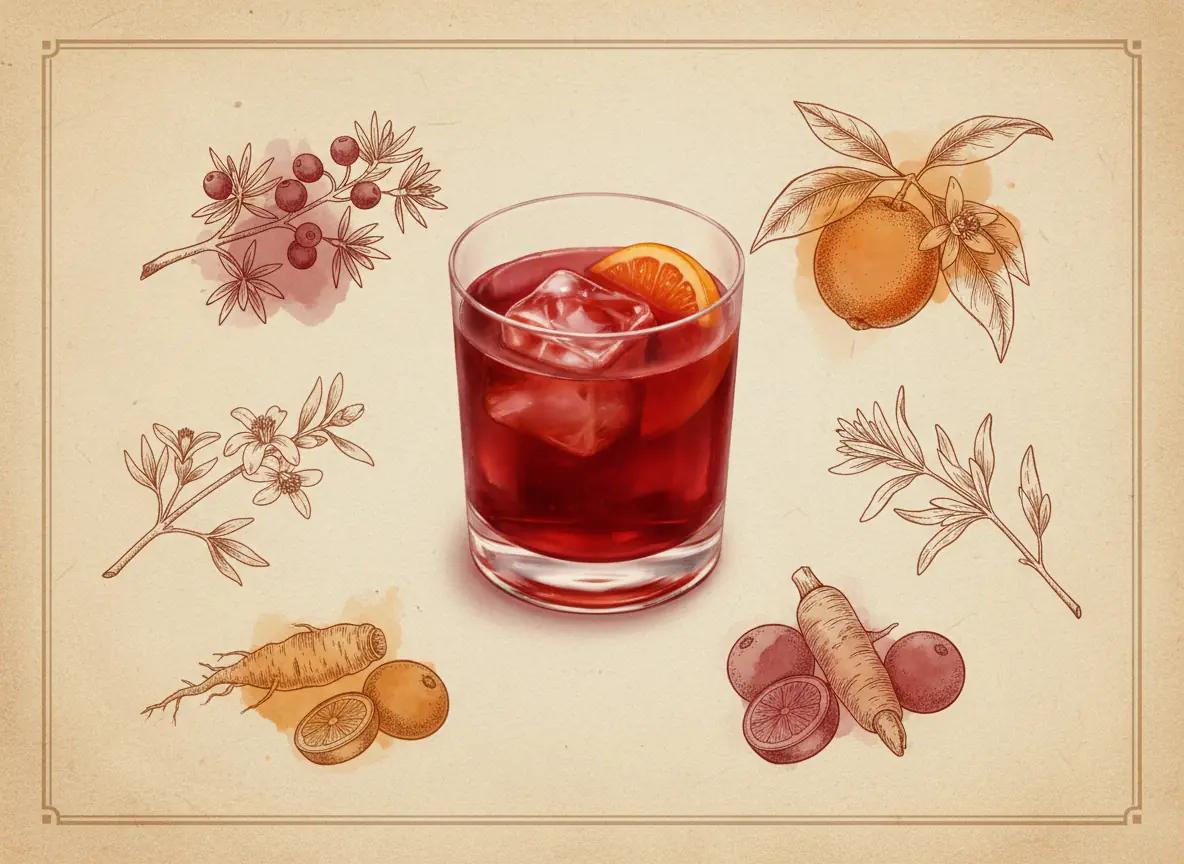
Negroni
A Negroni is 30ml each of gin, Campari and sweet vermouth, stirred with ice for 20 to 30 seconds and strained over fresh ice in a rocks glass, with an orange peel expressed over the top. About 2.4 UK units. The measures are the IBA’s; the IBA builds the drink in the glass and garnishes it with half an orange slice. Difford’s Guide gives the most widely reported account: Florence in 1919, at the Casoni Bar, where the bartender Fosco Scarselli is said to have replaced the soda in Count Camillo Negroni’s Americano with gin. The Oxford Companion has the drink named in a surviving letter of October 1920 and then absent under that name until 1947. A French book of 1929 by Alimbau and Milhorat, in the Internet Archive’s scan, gives equal parts of the three as the Campari Mixte. Each third has a job. Gin gives strength and juniper, the red bitter gives bitterness and orange, and the vermouth gives body and sugar. With no juice or soda in the glass, a tired vermouth shows at once.
Glassware: Rocks Glass
Garnish: Orange peel
Ingredients
30ml
A London Dry at 40% ABV with clear juniper. A soft, floral gin vanishes under the bitter; a gin bottled at 47% ABV would make a firmer drink, about 2.6 UK units by our arithmetic.
30ml
At 25% ABV on LWC’s UK listing, the bitter orange that defines the drink. Other red bitters make other drinks, and Aperol, at 11% by its maker’s FAQ, lighter and sweeter, makes a much softer one.
30ml
A rich Italian style at about 16% ABV, our working figure; we keep it in the fridge once open and use it within a month. It is a third of the drink, so a stale bottle is the first thing you taste.
Instructions
Fill a rocks glass with large cubed ice.
Add the gin, Campari and sweet vermouth to a mixing glass.
Fill with cubed ice and stir for 20 to 30 seconds.
Strain over the fresh ice in the rocks glass.
Express a wide strip of orange peel over the surface and rest it in the glass.
Source: the IBA (Official IBA specification, stirred in a mixing glass and strained over fresh ice with an orange peel, where the IBA builds it in the glass with half an orange slice). Last checked 10 October 2026.
Expert Tip
Stir it in a mixing glass rather than in the serving glass. The drink comes out colder and more evenly diluted, and the fresh ice it lands on has not been worn down by the stir. Building it in the glass, as the IBA does, is quicker and still makes a good Negroni. We store the opened vermouth cold and use it up inside a month. It is a third of the drink, and an oxidised bottle turns the whole glass flat and medicinal. Use large, cold, dry cubes in the rocks glass. Small or wet ice melts fast and leaves a thin, warm drink by the halfway point.
Behind the Negroni
Flavour Profile
An Origin Without Records
The story told most often, as Difford’s Guide tells it, places the drink at the Casoni Bar in Florence in 1919. Camillo Negroni, a regular, is said to have asked the bartender, Fosco Scarselli, for more kick in his Americano, and Scarselli to have switched the soda water for gin.
Little from the time supports it. The Oxford Companion, in an entry by David Wondrich, has the drink named in a surviving letter of October 1920 and then absent under that name until 1947, when Rome adopted it, and Difford’s Guide records a rival claim, from a member of the Negroni family, that the true inventor was General Pascal Oliver, Comte de Negroni. The firmer evidence is in print. The Internet Archive’s scan of Alimbau and Milhorat’s recipes for 1929 gives a Campari Mixte of equal thirds Campari, gin and Italian vermouth, shaken and served with lemon zest, and Difford’s Guide finds the earliest printed Negroni recipe in a Spanish book of 1949.
Three Equal Parts
Gin brings strength and juniper and keeps the drink dry. Campari brings bitterness and orange peel. Sweet vermouth brings body, wine and sugar, and rounds the bitter so the bitterness lands as flavour rather than as a jolt.
Push one up and the drink tips. More gin makes it hot and thin, more of the red bitter harsh, more vermouth soft and sticky. At equal measures each one holds the other two in check.
The Vermouth Decides It
Sweet vermouth is an aromatised wine, and it starts to fade once the bottle is open. We keep ours in the fridge for about a month; on a warm shelf it goes flat within weeks. At a third of the drink, with no citrus or soda to cover it, that shows in the first sip.
The Negroni and Its Relatives
The Negroni beside our Mezcal Negroni, Boulevardier, Old Pal and Americano
Negroni
- Spirit
- 30ml gin
- Campari
- 30ml
- Vermouth
- 30ml sweet
- Served
- Over ice
- UK units
- About 2.4
Mezcal Negroni
- Spirit
- 30ml mezcal
- Campari
- 30ml
- Vermouth
- 30ml sweet
- Served
- Over ice
- UK units
- About 2.4
Boulevardier
- Spirit
- 45ml bourbon
- Campari
- 30ml
- Vermouth
- 30ml sweet
- Served
- Over ice
- UK units
- About 3.0
Old Pal
- Spirit
- 45ml rye
- Campari
- 22.5ml
- Vermouth
- 22.5ml dry
- Served
- Up
- UK units
- About 2.8
Americano
- Spirit
- None
- Campari
- 30ml
- Vermouth
- 30ml sweet, with 75ml soda
- Served
- Long, over ice
- UK units
- About 1.2
| Drink | Spirit | Campari | Vermouth | Served | UK units |
|---|---|---|---|---|---|
| Negroni | 30ml gin | 30ml | 30ml sweet | Over ice | About 2.4 |
| Mezcal Negroni | 30ml mezcal | 30ml | 30ml sweet | Over ice | About 2.4 |
| Boulevardier | 45ml bourbon | 30ml | 30ml sweet | Over ice | About 3.0 |
| Old Pal | 45ml rye | 22.5ml | 22.5ml dry | Up | About 2.8 |
| Americano | None | 30ml | 30ml sweet, with 75ml soda | Long, over ice | About 1.2 |
How to Serve It
Over large, fresh cubes in a rocks glass, with orange peel expressed over the surface and rested in the drink, so the oil meets the nose before each sip. It is an aperitif by habit, and it holds through a slow evening as long as the ice is big enough to keep it cold.
With bourbon in place of the gin, a Boulevardier; with mezcal, a Mezcal Negroni; lengthened with soda and no gin, an Americano.
Make it at home
The Spirit
GinGin is a spirit flavoured with juniper berries. Under the retained Regulation (EC) 110/2008, juniper must lead the taste, the floor is 37.5% ABV, and the route the flavour takes sets the grade: plain gin, distilled gin or London gin. Our recipes count it at 40%, and it carries the Martini, the Negroni and the Gin and Tonic.
Master the Techniques
More to explore
Frequently Asked Questions
What is in a Negroni?
Is a Negroni shaken or stirred?
Who invented the Negroni?
Can I make a Negroni with bourbon?
How does it differ from an Americano?
Why does my Negroni taste medicinal?
Orange slice or orange peel?
How strong is a Negroni?
Sources.
Checked between 18 October and 19 October 2026.
- The Oxford Companion to Spirits and Cocktails (David Wondrich), “Negroni” (secondary source: named in a surviving letter of October 1920; not found again under that name until 1947; adopted in Rome as a postwar signature drink; Parisian gin, Italian vermouth and Campari drinks such as the Camparinete in the 1920s and 1930s).
- Difford’s Guide, “The history of the Negroni” (secondary source: Milano-Torino said to date from the 1860s at Gaspare Campari’s café; Casoni 1919 account; Gaz Regan on the chain from Milano-Torino to Americano to Negroni).
- LWC, “Campari 70cl” (UK wholesaler listing: Alcohol By Volume 25%).
- Aperol, “Frequently Asked Questions” (producer’s FAQ: Aperol has an alcohol content of 11%).
- MM Alimbau and Milhorat (1929), Internet Archive, “Recettes de cocktails pour 1929” (primary source, read 19 Oct in the Vintage Cocktail Books collection (OCR rough): Campari Mixte: in a shaker with ice, one third Campari, one third gin, one third Italian vermouth, well mixed, served with a lemon zest).
You Might Also Like
Americano
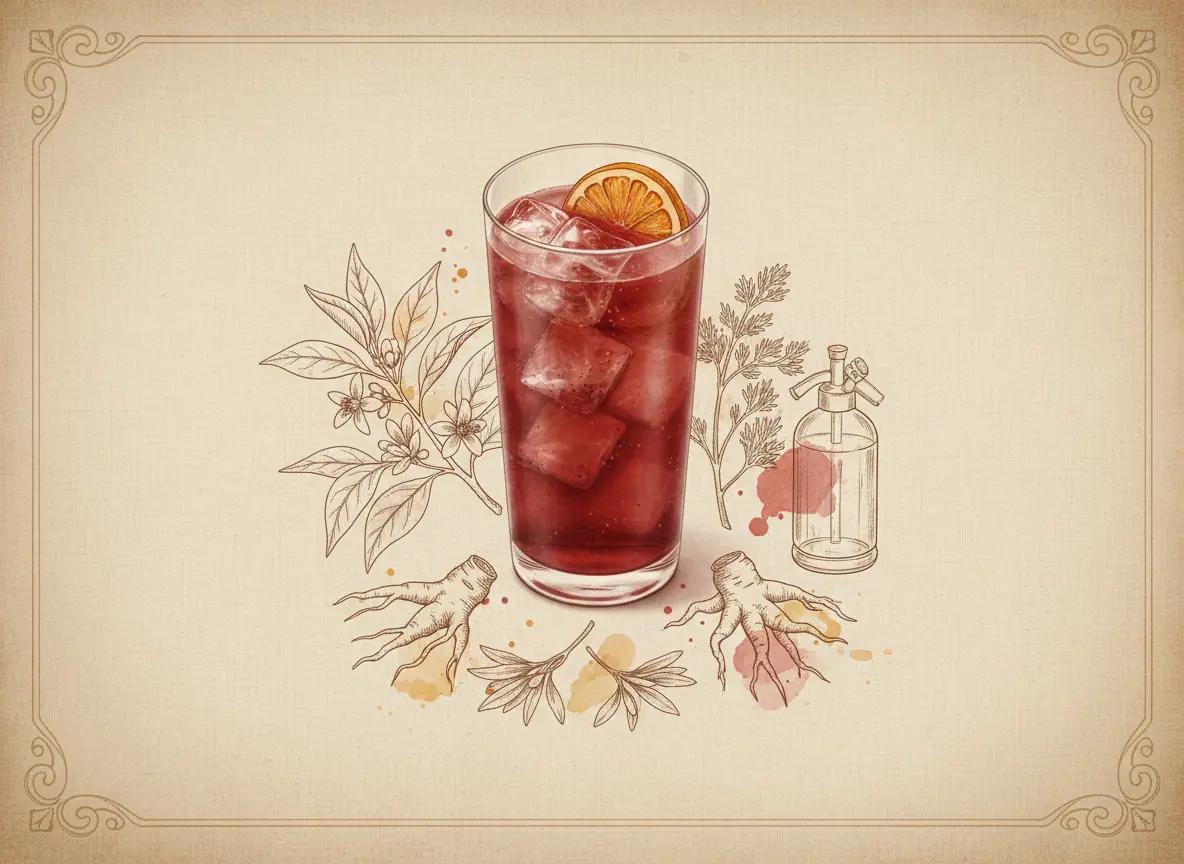
An Americano is 30ml Campari and 30ml sweet vermouth built over ice in a highball, topped with 75ml of cold soda and stirred once, with an orange slice. Bitter and sweet in equal measure, lengthened with soda: a Negroni with soda in place of the gin, at about half the alcohol. It grew out of the Milano-Torino, Campari from Milan with vermouth from Turin, which Difford’s Guide says Gaspare Campari created in the 1860s at his Caffè Campari in Milan. Difford’s adds that soda was said to have been added later, to make the Americano. The vermouth decides the result. At equal volume with the Campari it has nowhere to hide, and in our experience an opened bottle that has stood at room temperature for months will flatten the drink. Keep it in the fridge.
Campari & Soda
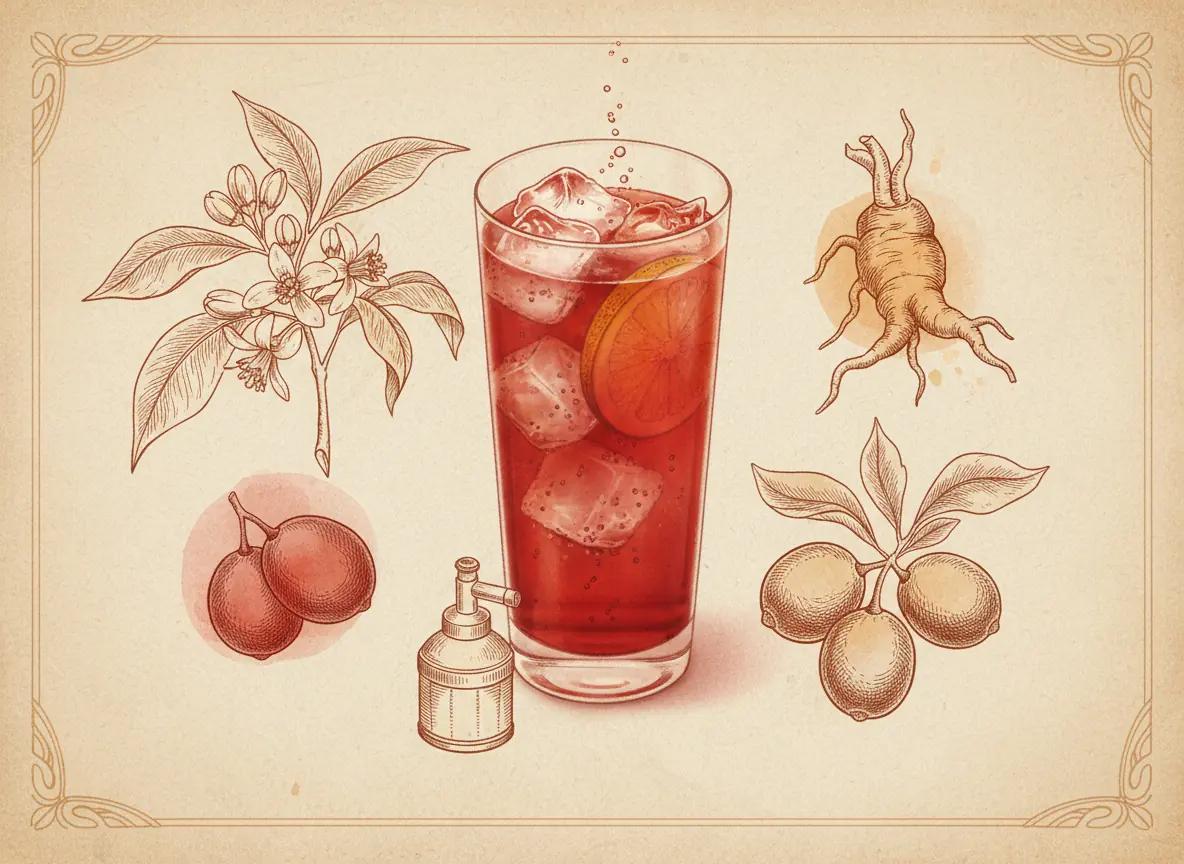
A Campari and soda is 45ml of Campari and 90ml of cold soda water, built over a highball full of ice, stirred once and finished with an orange slice. One part Campari to two of soda: bitter, orange-edged and long, and at about 1.1 UK units a light drink to have before a meal. Gaspare Campari created his bitter in 1860, by Campari’s own account. In 1932, by Campari’s own account, the company put it and soda together in a single-serve bottle designed by the Futurist artist Fortunato Depero, and Difford’s Guide, a secondary source, lists Campari Soda, as that bottle is called, at 10% ABV. The ratio is the only real decision. More soda and the bitterness thins out; less and the drink turns heavy. Start at one to two and adjust by 15ml either way.
La Louisiane
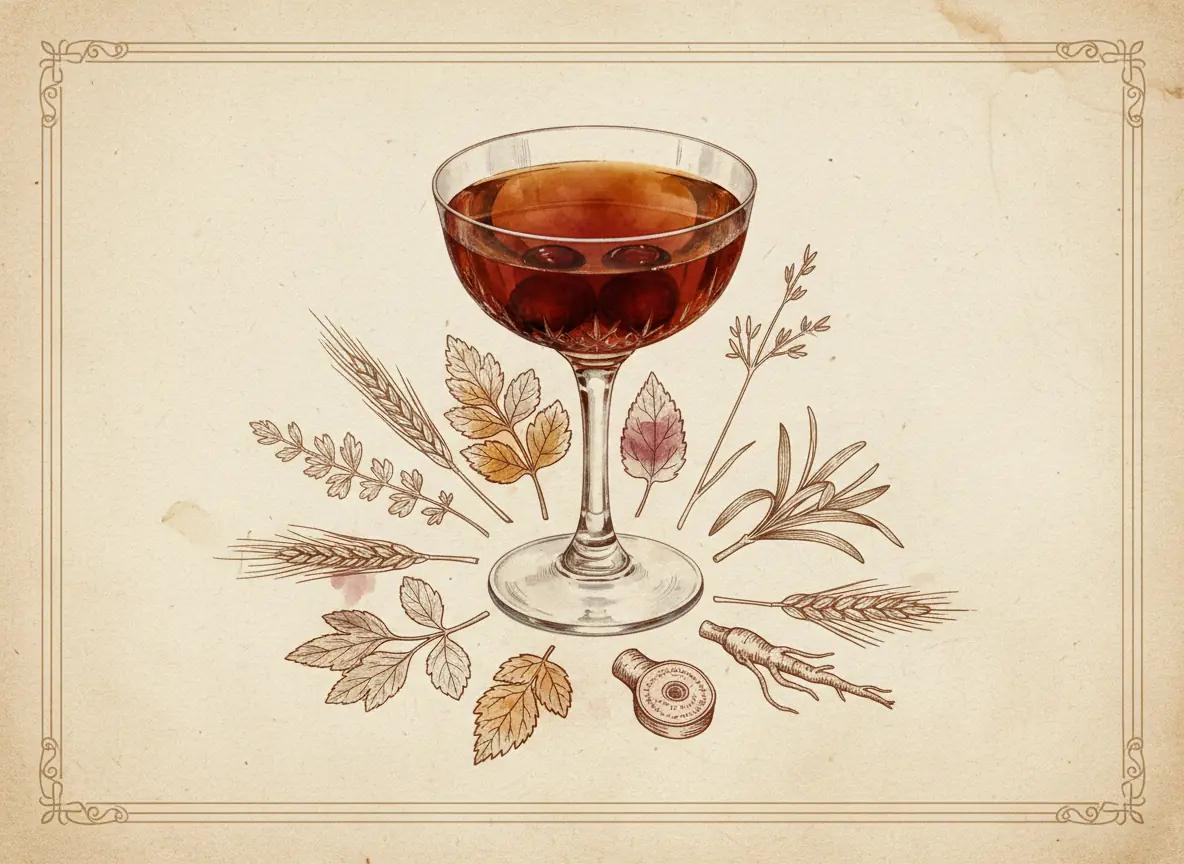
La Louisiane is 30ml each of rye whiskey, sweet vermouth and Bénédictine, with two dashes of absinthe and three of Peychaud’s bitters, stirred for 20 to 30 seconds and strained into a chilled Nick & Nora, with a maraschino cherry on a pick. About 3.1 UK units. Stanley Clisby Arthur printed it in 1937, in Famous New Orleans Drinks and How to Mix ’Em, as the special cocktail served at Restaurant de la Louisiane, “one of the famous French restaurants of New Orleans”, in Difford’s Guide’s reproduction of the book. His recipe, as Difford’s Guide reproduces it, pours a third of a jigger of each of the three, with three or four dashes each of absinthe substitute and Peychaud’s; ours keeps the thirds and trims the absinthe to two dashes. It sits on the Manhattan’s frame of rye and sweet vermouth, with Bénédictine poured at the same measure as both. In our view that makes it richer and more herbal than its parent, and the anise of the absinthe and the Peychaud’s places it in New Orleans.
Where this one sits
Recipe by Jerry Can Spirits · Updated 19 October 2026