Sherry Cobbler
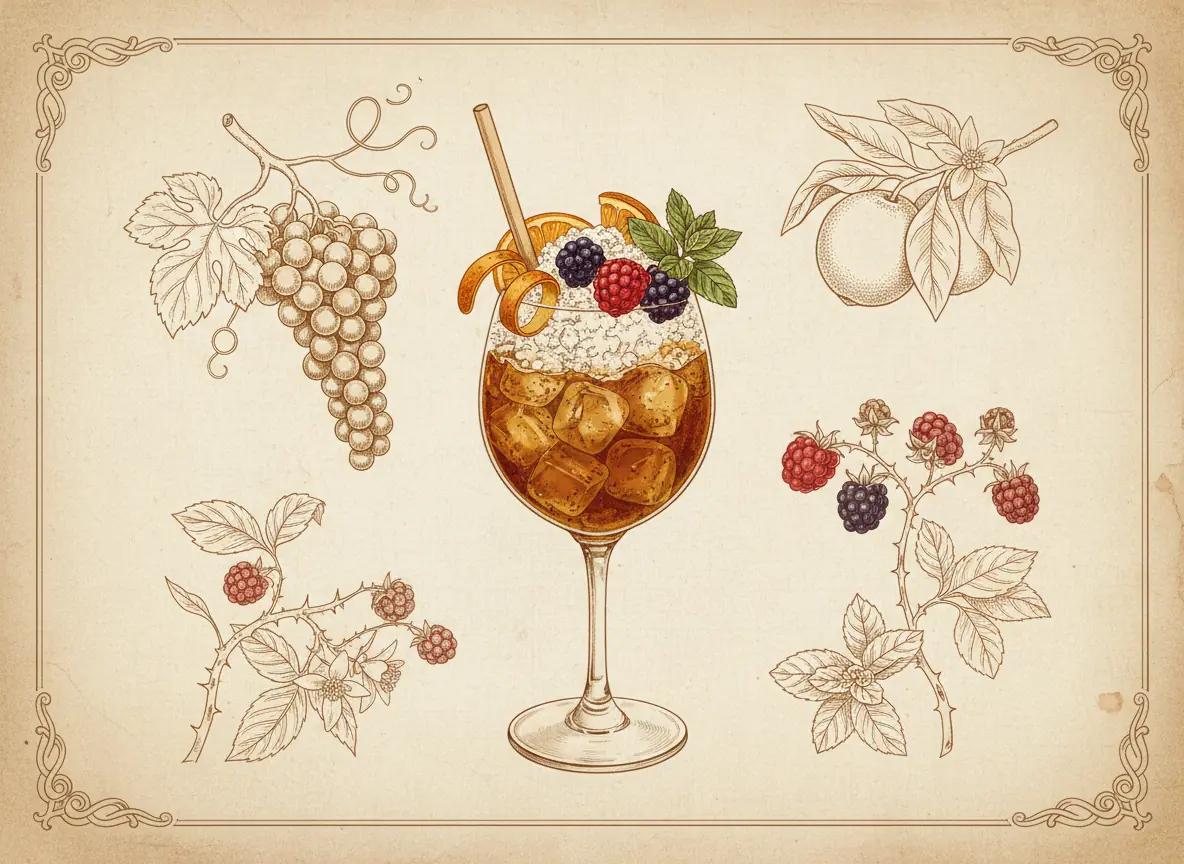
A Sherry Cobbler is 45ml amontillado and 45ml palo cortado shaken hard with a teaspoon of superfine sugar and two quarter wheels each of orange and lemon, then strained into a glass packed with crushed ice. Fresh berries and more quarter wheels of citrus go on top, with a straw. About 1.6 UK units. That is the IBA’s specification. The simpler recipe Jerry Thomas printed in 1862, in the Internet Archive’s scan of the book, has two wine-glasses of sherry, a table-spoonful of sugar and two or three slices of orange, shaken with shaved ice in a tumbler and ornamented with berries in season. In 1888 Harry Johnson’s manual, in the Internet Archive’s scan, called the drink “without doubt the most popular beverage in the country”, and the Oxford Companion says its decline was precipitous and Prohibition hammered in the final nail. It is a low-strength drink built on wine, so the sherry has nowhere to hide. Amontillado gives a dry, nutty base and palo cortado adds weight. The crushed ice chills it hard and dilutes it fast, and the sugar and citrus keep it bright while it does.
Glassware: Wine Glass
Garnish: Fresh berries whatever is in season, Orange quarter wheel, Lemon quarter wheel and Mint sprig slapped (optional)
Ingredients
45ml
It begins under flor and finishes ageing in contact with air, so it is dry and nutty. It gives the cobbler its backbone, and the Consejo Regulador gives an open bottle up to two months, tightly corked in the refrigerator.
45ml
A rarer style that also begins under flor and ends ageing oxidatively, with an amontillado’s nose and more body. It adds the weight that lasts against the ice. A second measure of amontillado works if you cannot find one.
1 tsp
Superfine sugar dissolves fastest in a cold shake; granulated works with a harder one. A teaspoon is enough, because the citrus wheels add little sourness.
2 quarter wheels, plus one to garnish
Shaken with the peel on, so oil goes into the drink along with the juice. A third quarter wheel goes on top.
2 quarter wheels, plus one to garnish
The only real sharpness in the glass. Shaken with the peel on, it lifts the sherry without making the drink sour.
Instructions
Pack a wine glass or julep cup with crushed ice.
Put the amontillado, palo cortado, sugar and two quarter wheels each of orange and lemon in a shaker.
Fill with cubed ice and shake hard for 10 to 12 seconds.
Strain over the crushed ice and mound more crushed ice on top.
Garnish with fresh berries and a quarter wheel each of orange and lemon, and a slapped mint sprig if you like.
Serve straight away with a straw.
Source: the IBA (Official IBA specification (New Era), served in a wine glass or julep cup, with an optional mint sprig; method as the IBA). Last checked 9 October 2026.
Expert Tip
Shake the citrus in with the sherry. The quarter wheels give up oil from the peel as well as juice, and the sugar dissolves in the cold. That is where the cobbler gets its brightness, since there is no measured juice in it. Pack the glass with crushed ice before you strain, then mound more on top. Crushed ice chills a low-strength wine within seconds, and the melt stretches a short pour into a long drink. Mind the age of the bottle. The Consejo Regulador gives an open bottle of amontillado or palo cortado up to two months and fino up to a week, tightly corked in the refrigerator, so if you swap fino in, open a bottle for the drink.
Behind the Sherry Cobbler
Flavour Profile
Where It Comes From
The cobbler’s exact origin is not known; the Oxford Companion calls its origin obscure and its creator unknown, with the first record a Madeira Cobbler in a New York newspaper of 1837. The Sherry Cobbler is first recorded in the summer of 1838, in the diary of Jane Ellice, an Englishwoman travelling in New York State, and Charles Dickens’s praise of it, in American Notes and Martin Chuzzlewit, effectively alerted the world to the drink’s charms.
Jerry Thomas printed it in 1862 with three ingredients: sherry, sugar and two or three slices of orange, shaken with shaved ice, as the 1862 book has it. In 1888 Harry Johnson wrote in his manual that it was “without doubt the most popular beverage in the country”, and the Oxford Companion says its decline was precipitous and Prohibition hammered in the final nail.
The IBA Specification
The IBA’s modern reading keeps Thomas’s outline and changes two things. The sherry is split between amontillado and palo cortado, and lemon joins the orange in the shaker.
Shaking the quarter wheels with the sherry is the step that matters. The peel releases oil as well as juice, and the sugar dissolves in the cold, so the drink turns out bright without any measured citrus juice.
Sherry styles for a cobbler; ageing, serving temperatures and open-bottle times from the Consejo Regulador
Fino
- How it ages
- Under flor
- In the cobbler
- Light, dry and salty
- Serve at
- 5 to 7°C
- Keeps once open
- Up to a week
Amontillado
- How it ages
- Under flor, then in contact with air
- In the cobbler
- Dry and nutty; the IBA’s first half
- Serve at
- 12 to 14°C
- Keeps once open
- Up to two months
Palo cortado
- How it ages
- Begins under flor, ends in contact with air
- In the cobbler
- Nutty with more body; the IBA’s second half
- Serve at
- 12 to 14°C
- Keeps once open
- Up to two months
Oloroso
- How it ages
- In contact with air throughout
- In the cobbler
- Darker and richer
- Serve at
- 12 to 14°C
- Keeps once open
- Up to two months
| Style | How it ages | In the cobbler | Serve at | Keeps once open |
|---|---|---|---|---|
| Fino | Under flor | Light, dry and salty | 5 to 7°C | Up to a week |
| Amontillado | Under flor, then in contact with air | Dry and nutty; the IBA’s first half | 12 to 14°C | Up to two months |
| Palo cortado | Begins under flor, ends in contact with air | Nutty with more body; the IBA’s second half | 12 to 14°C | Up to two months |
| Oloroso | In contact with air throughout | Darker and richer | 12 to 14°C | Up to two months |
The Straw and the Ice
A glass packed with crushed ice is hard to drink from at the rim, so the cobbler came with a straw. The Oxford Companion says the cobbler was one of the cornerstones of American drinking, with the cocktail and the julep, and did more than any other drink to popularize the straw, through which it was invariably drunk.
The ice does more than chill. Sherry is a low-strength wine, and the melt lengthens it. Serve the drink at once, before the ice turns it thin.
Choosing the Sherry
Amontillado alone makes a good cobbler and is the easiest of the pair to find. Palo cortado is rarer and costs more; it adds the weight that holds up against the ice.
Fino makes the lightest version, pale and salty. The Consejo Regulador says to serve fino chilled, at 5 to 7°C, and gives an open bottle up to a week, tightly corked in the refrigerator, because fino and manzanilla are the most delicate sherries once the bottle is open. Oloroso makes a darker, richer cobbler for a cool evening.
How to Serve It
In a wine glass or a julep cup packed with crushed ice, with more ice mounded on top. Fresh berries, a quarter wheel each of orange and lemon and a straw finish it. A slapped mint sprig is not in the IBA’s version, but it suits the fruit.
It is a daytime drink, low in alcohol and long. Make it when the glass is wanted; it does not wait.
More to explore
Frequently Asked Questions
What is in a Sherry Cobbler?
How strong is a Sherry Cobbler?
Did the Sherry Cobbler invent the drinking straw?
Which sherry should I use?
Is the Sherry Cobbler an IBA cocktail?
How long does sherry keep once opened?
Why crushed ice?
Sources.
Correct as of 19 October 2026.
- The Oxford Companion to Spirits and Cocktails (David Wondrich), “The Sherry Cobbler” (secondary source: first recorded in the summer of 1838 in Jane Ellice’s diary; Dickens in American Notes and Martin Chuzzlewit; Harry Johnson in 1888; the decline and Prohibition).
- Consejo Regulador (sherry.wine), “Conservation & Serving” (fino and manzanilla served chilled at 5 to 7°C, other oxidatively aged wines at 12 to 14°C; open bottle tightly corked in the refrigerator: fino and manzanilla up to a week, other wines up to two months).
- IBA, “Sherry Cobbler” (official New Era specification).
- Jerry Thomas, 1862 (Internet Archive scan), “How to Mix Drinks, or The Bon-Vivant’s Companion” (primary source: 98. Sherry Cobbler: 2 wine-glasses of sherry, 1 table-spoonful of sugar, 2 or 3 slices of orange; fill a tumbler with shaved ice, shake well, ornament with berries in season; a straw).
- The Oxford Companion to Spirits and Cocktails (David Wondrich), “The cobbler” (secondary source: origin obscure; a Madeira Cobbler in a New York newspaper of 1837; the straw).
- Harry Johnson (1888), Internet Archive, “Harry Johnson’s Bartenders’ Manual (1888), scan” (primary source, read as text: no. 79 Sherry Cobbler, “This drink is without doubt the most popular beverage in the country, with ladies as well as with gentlemen”).
You Might Also Like
Sherry Martini
A Sherry Martini is 60ml of London Dry gin and 30ml of fino sherry with a dash of orange bitters, stirred over ice for 20 to 30 seconds and strained into a chilled coupe, with lemon peel expressed over the top. About 2.9 UK units. The fino takes the place of dry vermouth. Fino brings salt, almond and a dry, nutty edge where vermouth brings herbs. The gin still leads, with the sherry underneath it. The fino must be fresh, since the Consejo Regulador gives an open bottle of fino or manzanilla up to a week, tightly corked in the fridge. Chill it and drink the bottle quickly. The drink sits beside the Bamboo and the Adonis, longer-established sherry cocktails.
Adonis
An Adonis is 45ml of fino sherry and 30ml of sweet vermouth with two dashes of orange bitters, stirred over ice for 20 to 30 seconds and strained into a chilled coupe, with orange peel expressed over the top. It contains no spirit at all, and comes to about 1.2 UK units. It takes its name from Adonis, a Broadway burlesque of 1884, by VinePair’s account. Imbibe says the drink was named in honour of the first Broadway musical to run for more than 500 performances, and Australian Bartender names the Waldorf-Astoria or, by David Wondrich’s account, the Hoffman House as the bar that made it. It is the sweet-vermouth sibling of the Bamboo, which takes dry vermouth. Our ratio leans towards the sherry, so the dry, saline fino keeps the vermouth from turning the drink sticky.
Bamboo
A Bamboo is 45ml fino sherry and 45ml dry vermouth with two dashes of orange bitters and one of Angostura, stirred over ice for 20 to 30 seconds and strained into a chilled coupe, with lemon peel expressed over the top. It is built like a Martini with no spirit in it: two fortified wines, about 1.5 UK units, and around 13% ABV in the glass. William Boothby’s 1908 book credits Louis Eppinger of the Grand Hotel in Yokohama, a German bartender brought to Japan in 1889, as Difford’s Guide, a secondary source, reports. Difford’s finds the drink in newspapers from 1886, three years before Eppinger reached Japan, and an early printed recipe, Thomas Stuart’s of 1904, uses Italian sweet vermouth, which makes the drink now called the Adonis. The sherry decides it. Fino or manzanilla, served cold from a bottle opened in the last few days, gives a dry, saline drink with a nutty edge. The Consejo Regulador gives an open bottle up to a week in the fridge, and one left open longer gives a flat drink, which is usually why a Bamboo disappoints.
Recipe by Jerry Can Spirits · Updated 19 October 2026