Start here.
Dark rum and spiced rum differ in what goes in after distillation
Both start as rum distilled from sugarcane. Dark rum is still rum in law: oak, caramel or both give it its colour, and it may be sweetened but not flavoured. Spiced rum has spices, and usually sugar, added to the rum, which makes it a different legal product.
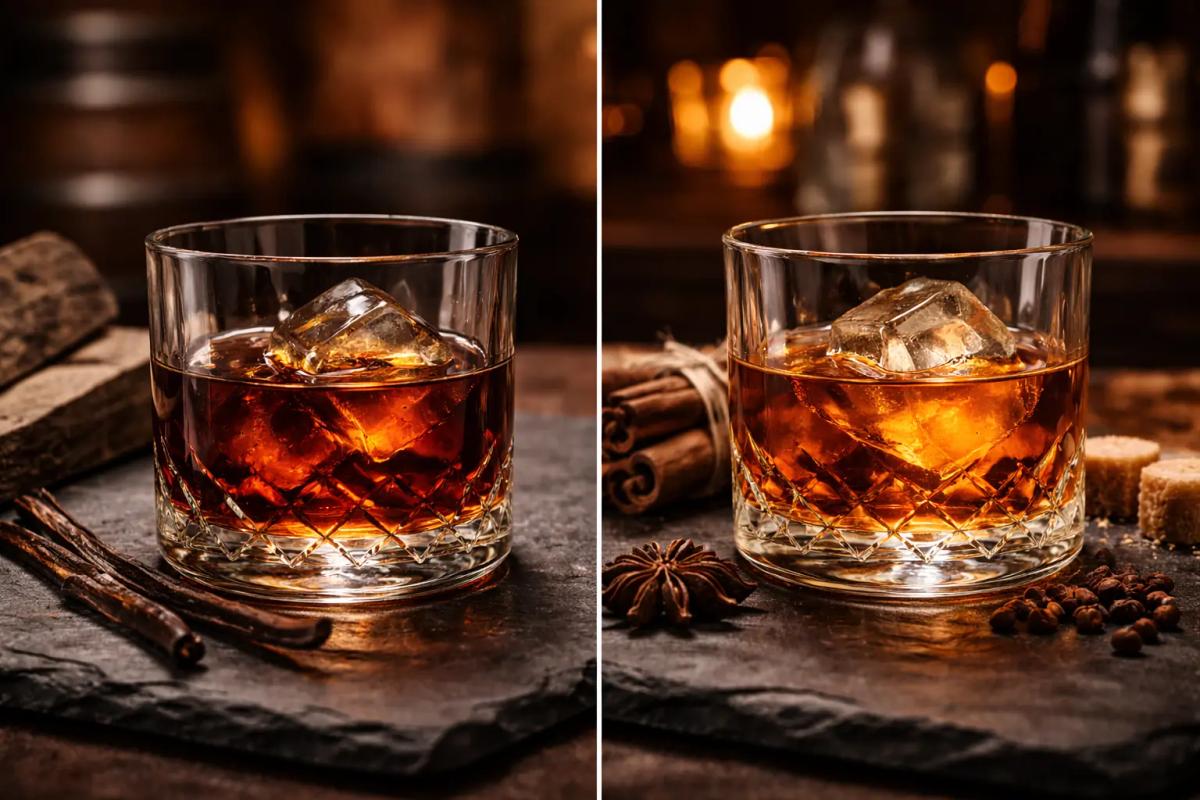
Dark rum and spiced rum side by side; legal rows from Regulation (EC) No 110/2008 and Regulation (EU) No 1169/2011
Base
- Dark rum
- Rum, often a heavier molasses rum or blend
- Spiced rum
- Rum of any colour, most often golden
Where the colour comes from
- Dark rum
- Oak ageing, caramel (E150a) or both
- Spiced rum
- The base rum, caramel, and a little from the spices
Flavour
- Dark rum
- Caramel, toffee, molasses and dried fruit; tobacco when old
- Spiced rum
- Vanilla first, then cinnamon or cassia, clove and allspice
Sweetness
- Dark rum
- Varies; sugar may be added and need not be declared
- Spiced rum
- Often sweetened, sometimes heavily; dry spiced rums use little
Legal name in GB
- Dark rum
- Rum; dark is not a legal term
- Spiced rum
- Spirit drink, with spiced rum allowed alongside
Minimum strength
- Dark rum
- 37.5% ABV
- Spiced rum
- 15% ABV
Best uses
- Dark rum
- Ginger beer highballs, tiki drinks, punches, hot drinks
- Spiced rum
- Cola and ginger beer, mules, smashes, warm punches; neat if dry
Field Manual drinks
- Dark rum
- Dark ’n’ Stormy, Jungle Bird, Hurricane, Rum Runner, Planter’s Punch, Hot Buttered Rum
- Spiced rum
- Storm & Spice, Pack Mule, Rum Smash, Spiced Rum Punch, The Old Standard
| Aspect | Dark rum | Spiced rum |
|---|---|---|
| Base | Rum, often a heavier molasses rum or blend | Rum of any colour, most often golden |
| Where the colour comes from | Oak ageing, caramel (E150a) or both | The base rum, caramel, and a little from the spices |
| Flavour | Caramel, toffee, molasses and dried fruit; tobacco when old | Vanilla first, then cinnamon or cassia, clove and allspice |
| Sweetness | Varies; sugar may be added and need not be declared | Often sweetened, sometimes heavily; dry spiced rums use little |
| Legal name in GB | Rum; dark is not a legal term | Spirit drink, with spiced rum allowed alongside |
| Minimum strength | 37.5% ABV | 15% ABV |
| Best uses | Ginger beer highballs, tiki drinks, punches, hot drinks | Cola and ginger beer, mules, smashes, warm punches; neat if dry |
| Field Manual drinks | Dark ’n’ Stormy, Jungle Bird, Hurricane, Rum Runner, Planter’s Punch, Hot Buttered Rum | Storm & Spice, Pack Mule, Rum Smash, Spiced Rum Punch, The Old Standard |
Which to buy depends on the drinks you make. What does rum taste like sets every rum style side by side by flavour.
Dark rum is a colour, not an age
Dark rum has no legal definition of its own. A rum can be dark from years in charred oak, from caramel added to a young spirit, or from both, and the two taste different. Long ageing gives toffee, dried fruit and a dry finish. Caramel adds colour and little flavour, so the rum underneath still tastes young.
Oak gives dark rum its vanilla and toffee
Most rum is aged in casks that held bourbon. The oak gives vanilla and caramel, the char adds toffee, and slow oxidation takes the edges off. Heat speeds all of it: a cask in a hot warehouse gives up more to evaporation and takes more from the wood each year than one in a cool one, so tropical-aged rum shows more oak than its age suggests.
Caramel can make a young rum look old
Caramel colouring, E150a, is the one addition rum law allows for colour, and many dark rums use it to keep each batch the same shade. Spirits are exempt from the ingredient list other food carries, so it rarely appears on the label. A pale rum can be older than a dark one.
Dark rum tastes of caramel, molasses and dried fruit
Expect caramel, toffee and molasses, with dried fruit such as raisin and fig, and tobacco and leather in older bottles. Any spice in a dark rum comes from the oak, which gives vanilla and a little clove-like warmth. Pot-still rum is heavier and fruitier, column rum cleaner. Blackstrap rum and Demerara rum sit at the heavy end.
Spiced rum is rum with spices added after distillation
Spiced rum starts with a rum, often a golden one, and adds spices, and usually sugar, before bottling. The spices give most of the flavour within days or weeks, where oak takes years.
Spices go in whole or as flavourings
Whole spices can be steeped in the rum, or the rum run through a bed of them. Some producers add natural or artificial flavourings instead. Labels rarely say which, and what is spiced rum explains the methods and how to judge a bottle.
Vanilla and cinnamon lead most spiced rums
Vanilla is nearly universal, with cinnamon or cassia, clove, allspice, nutmeg and ginger, and orange peel to lift them. Star anise appears in small amounts. Each producer has its own blend.
Spiced rum tastes of vanilla first
Vanilla arrives first, then the warming spices through the middle, with orange peel lifting them. A dry spiced rum keeps the spice and the base rum audible. A sweet one tastes mostly of vanilla and sugar, and the finish is short.
A rum sold as dark rum is never spiced, but a spiced rum can be dark
A bottle sold as rum may not contain spices, so a dark rum is never spiced. The reverse is common: many spiced rums are dark, from caramel, from an aged base or from both. However dark they look, they are spirit drinks in law.
Aged spiced rum sits closest to dark rum
A few producers spice a rum that has already spent years in oak, or rest a spiced rum in oak afterwards. The oak gives vanilla and a dry backbone, and the spices sit on top. These are the exception in the category, and the price usually shows it.
Colour proves nothing on either shelf
Caramel can turn a young spiced rum the colour of an old dark rum in seconds, and the spicing covers the rawness that ageing would have taken away. It is legal, and it makes colour an unreliable signal. A dark bottle may hold no aged rum at all.
The label says more than the colour
Read the legal name first. Rum means nothing has flavoured it. Spirit drink, with spiced rum alongside, means spices or flavourings have gone in. An age statement guarantees time in oak, and a named distillery or island tells you where the base came from. “Natural flavourings” can mean whole spices or concentrated extracts, so it settles nothing. How to read a rum label covers the rest.
Use the rum the recipe names
Recipes name dark rum or spiced rum for a reason. Swap one for the other and you change the drink.
Dark rum is for weight, molasses and oak
Reach for dark rum where the drink needs molasses depth or a dark float:
- Dark ’n’ Stormy: Gosling’s Black Seal and ginger beer. Gosling’s marks the name as a registered trade mark, and the rum floats because the ginger beer, with its sugar, is denser than the spirit.
- Jungle Bird: dark or blackstrap rum against Campari and pineapple.
- Planter’s Punch: dark Jamaican rum, lime and sugar.
- Hot Buttered Rum: dark rum in a spiced butter batter.
- Hurricane and Rum Runner: dark and white rum together.
Spiced rum is for drinks built around its spice
Reach for spiced rum where the drink is written around vanilla and baking spice:
- Storm & Spice: spiced rum, ginger beer, lime and bitters, floated the Bermudian way.
- Pack Mule: spiced rum, lime and ginger beer.
- Rum Smash: spiced rum, lemon, mint and demerara syrup.
- Spiced Rum Punch: a warm batch with apple, orange, lemon and honey.
- The Old Standard: spiced rum, demerara syrup and two bitters, stirred.
Long, spiced rum takes cola, ginger beer or ginger ale at about one part rum to three of mixer.
The ratio, garnish and glass for each of those mixers are in what to mix with spiced rum.
Spiced rum in place of dark rum changes the drink
You can pour spiced rum where a recipe asks for dark rum, but you get a different drink. The spices add vanilla and baking spice the recipe did not allow for, any added sugar throws the balance, and the molasses weight goes.
Some drinks show it more than others:
- Dark ’n’ Stormy: the name belongs to Gosling’s Black Seal, and the dark layer is the rum resting on ginger beer, which its sugar makes the denser liquid.
- Hot Buttered Rum: the batter already carries cinnamon, allspice, clove and vanilla, so a spiced rum doubles them and adds sugar to the brown sugar.
- Jungle Bird: the bitter molasses of a dark or blackstrap rum is what answers the Campari.
- Corn n’ Oil: blackstrap rum floats over falernum, which is already spiced with clove.
- Planter’s Punch and the Zombie: the Jamaican and Demerara rums are there for their fruit and weight.
If spiced rum is what you have, make a drink written for it. The Storm & Spice uses the same ginger beer and float as a Dark ’n’ Stormy, and it is a different drink with its own name.
Another dark rum is the best stand-in for dark rum
Swap dark rum for another dark rum first. For the heavy drinks, blackstrap or Demerara rum keeps the weight. Where the recipe wants oak more than colour, an aged rum works. Dark rum in place of spiced rum loses the spice, and the drink reads flatter unless the recipe brings spice of its own.
The facts here come from the regulations
The British definition of rum is Regulation (EC) No 110/2008, Annex II, category 1, as retained in UK law and published on legislation.gov.uk: no flavouring, and caramel only to adjust the colour. The 15% ABV minimum for a spirit drink is in Article 2 of the same regulation. The EU’s 20-gram sweetening limit for rum is in Regulation (EU) 2019/787, Annex I, category 1.
Drinks above 1.2% ABV are exempt from the ingredient list under Regulation (EU) No 1169/2011, Article 16(4), as retained.