Start here.
Spiced rum is made in two steps, and they can happen in different countries
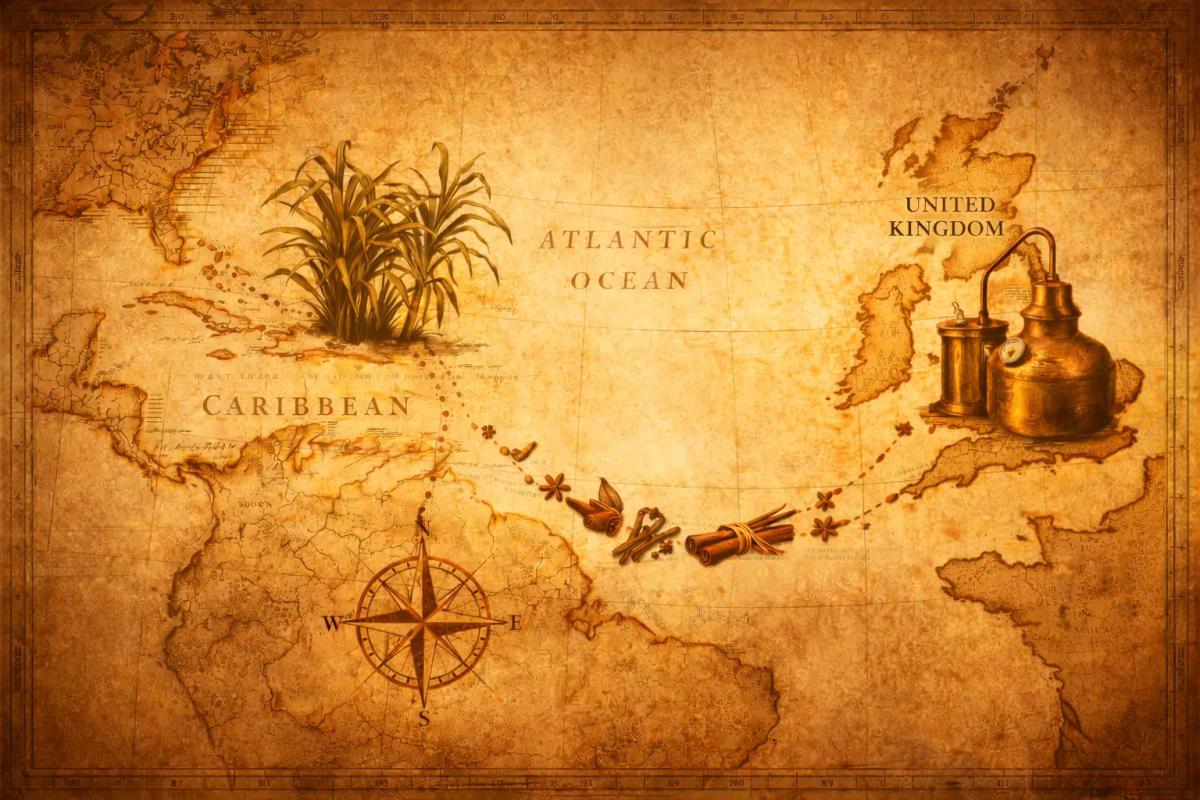
Every spiced rum is made in two steps. First a rum is distilled from sugarcane. Then spices, and usually a sweetener, are added and the spirit is bottled. Rum ships well in bulk, so the two steps can happen on one site or an ocean apart.
Where the rum base comes from, and where it is spiced; producer facts from Ninefold’s, Two Drifters’ and Bundaberg’s own sites, the US row from 27 CFR 5.151, the Martinique row from Regulation (EC) No 110/2008, and Flensburg from the Flensburg Fjord tourist board
Caribbean-made
- Where the rum base comes from
- Distilled on a Caribbean island, mostly from molasses
- Where it is spiced and bottled
- On the same island, or shipped in bulk and bottled in the country of sale
- What to know
- The rum has one origin; the bottling may still be elsewhere
British, spiced from imported rum
- Where the rum base comes from
- Imported rum, most often Caribbean
- Where it is spiced and bottled
- In Britain
- What to know
- The rum and the spicing come from different countries
British, distilled from scratch
- Where the rum base comes from
- Imported molasses, fermented and distilled in Britain
- Where it is spiced and bottled
- At the same British distillery
- What to know
- No Caribbean rum in the bottle; Ninefold in Scotland and Two Drifters in Devon make rum this way
American
- Where the rum base comes from
- Rum distilled in the United States, or imported
- Where it is spiced and bottled
- In the United States
- What to know
- Federal rules treat it as a flavoured rum, bottled at 30% ABV or more
Australian
- Where the rum base comes from
- Rum distilled in Queensland from local molasses
- Where it is spiced and bottled
- In Australia
- What to know
- Bundaberg dates its rum to 1888
Continental European
- Where the rum base comes from
- Mostly imported Caribbean rum
- Where it is spiced and bottled
- In Germany, Spain, France and elsewhere
- What to know
- Flensburg in Germany had an eighteenth-century rum trade
Martinique rhum agricole
- Where the rum base comes from
- Fresh cane juice, distilled on Martinique
- Where it is spiced and bottled
- Not spiced within the appellation
- What to know
- The appellation does not allow flavouring
| Type of spiced rum | Where the rum base comes from | Where it is spiced and bottled | What to know |
|---|---|---|---|
| Caribbean-made | Distilled on a Caribbean island, mostly from molasses | On the same island, or shipped in bulk and bottled in the country of sale | The rum has one origin; the bottling may still be elsewhere |
| British, spiced from imported rum | Imported rum, most often Caribbean | In Britain | The rum and the spicing come from different countries |
| British, distilled from scratch | Imported molasses, fermented and distilled in Britain | At the same British distillery | No Caribbean rum in the bottle; Ninefold in Scotland and Two Drifters in Devon make rum this way |
| American | Rum distilled in the United States, or imported | In the United States | Federal rules treat it as a flavoured rum, bottled at 30% ABV or more |
| Australian | Rum distilled in Queensland from local molasses | In Australia | Bundaberg dates its rum to 1888 |
| Continental European | Mostly imported Caribbean rum | In Germany, Spain, France and elsewhere | Flensburg in Germany had an eighteenth-century rum trade |
| Martinique rhum agricole | Fresh cane juice, distilled on Martinique | Not spiced within the appellation | The appellation does not allow flavouring |
The rum base sets the weight and character of the drink. The spicing sets most of its flavour, as what is spiced rum explains.
Caribbean rum styles carry through into the spiced rum built on them
Rum began in the Caribbean, and its distilleries still sell rum in bulk to be spiced and bottled elsewhere, as well as under their own names. The Caribbean rum houses each have a house style, and it shows through the spice.
Caribbean rum styles and what they bring to a spiced rum; the Martinique row from Regulation (EC) No 110/2008, which bars flavouring rum
Jamaica
- Rum style
- Pot-still rum from long fermentations, high in esters
- What it brings to a spiced rum
- Overripe banana and pineapple that stand up to heavy spicing
Barbados
- Rum style
- Pot and column rum blended
- What it brings to a spiced rum
- Banana, toffee and soft oak; a rounded base
Trinidad
- Rum style
- Light, column-distilled rum
- What it brings to a spiced rum
- A clean base that leaves the spices in front
Guyana
- Rum style
- Heavy Demerara rum from wooden stills
- What it brings to a spiced rum
- Burnt sugar and weight under deep spicing
Cuba, Puerto Rico, Dominican Republic
- Rum style
- Light, column-distilled ron, aged in casks
- What it brings to a spiced rum
- A mild, mixable base
Martinique
- Rum style
- Rhum agricole from fresh cane juice
- What it brings to a spiced rum
- Rarely spiced; the appellation does not allow flavouring
| Island | Rum style | What it brings to a spiced rum |
|---|---|---|
| Jamaica | Pot-still rum from long fermentations, high in esters | Overripe banana and pineapple that stand up to heavy spicing |
| Barbados | Pot and column rum blended | Banana, toffee and soft oak; a rounded base |
| Trinidad | Light, column-distilled rum | A clean base that leaves the spices in front |
| Guyana | Heavy Demerara rum from wooden stills | Burnt sugar and weight under deep spicing |
| Cuba, Puerto Rico, Dominican Republic | Light, column-distilled ron, aged in casks | A mild, mixable base |
| Martinique | Rhum agricole from fresh cane juice | Rarely spiced; the appellation does not allow flavouring |
Jamaica makes the heaviest, fruitiest base
Jamaican rum is known for funk, and the funk is measurable. Distillers grade their rums into marques by ester count, the fruity compounds built in long fermentations, and pot stills keep those compounds in. The result tastes of overripe banana and pineapple and holds its own under heavy spicing. Jamaica protects its rum with a geographical indication, by The Fat Rum Pirate’s secondary account.
Barbados blends pot and column rum into a rounded style
Richard Ligon recorded kill-devil distilled on Barbados between 1647 and 1650, and Difford’s Guide, a secondary source, gives a deed of 1703 as the earliest written evidence of rum-making at Mount Gay. Barbados blends pot and column rum into a rounded style of banana, toffee and soft oak. Drinks International reported in 2020 that three Barbados distillers had agreed a proposed geographical indication that would ban added sugar syrup and flavourings in Barbados rum.
Trinidad makes light rum for blending
Trinidad’s rum is mostly light and column-distilled, made to blend. Angostura, on Trinidad, makes its bitters and distils its rums in column stills, by its own account. A light base like this leaves the spices in front.
Guyana distils Demerara rum on wooden stills
Almost all Guyanese rum comes from one site, Diamond Distillery on the Demerara River, home of El Dorado. It keeps wooden stills that survive nowhere else, among them the double wooden pot still from the Port Mourant Estate, an estate El Dorado dates to 1732. The heavy Demerara style is the backbone of many navy blends and carries deep spicing.
Martinique’s rhum agricole stays outside the spiced category
Martinique distils rhum agricole from fresh cane juice, and it tastes of cut grass and green banana. Its appellation, in force since 1996, controls the cane, the fermentation and the stills, and as rum it may not be flavoured. A spiced rum made from Martinique rhum cannot carry the appellation.
Cuba, Puerto Rico and the Dominican Republic make light ron
Cuba, Puerto Rico and the Dominican Republic make a lighter, column-distilled ron, usually aged in casks and often filtered. It gives a mild base that leaves the spices in front. Rum, rhum or ron sets out how the Spanish style differs from the English and French.
Britain spices imported rum, and a few distilleries now make their own
Britain grows no sugarcane, but it has bonded, blended and drunk Caribbean rum for more than three centuries. British spiced rum is made in two ways, and the British rum renaissance covers the distilleries behind it.
Britain has imported Caribbean rum since the 1600s
Royal Museums Greenwich dates the Royal Navy’s daily rum ration from around 1655 to 31 July 1970, Black Tot Day. Bristol, Liverpool and London imported, blended and bonded Caribbean rum, and Bristol and Liverpool were also ports of the slave trade the sugar economy ran on. Rum was blended in Britain long before any was distilled here.
British spiced rum follows one of two models
The first model imports finished rum, most often from the Caribbean, and spices and bottles it in Britain. The rum and the spicing then come from different countries.
The second imports the raw material instead, molasses or another cane product, and ferments, distils and spices it at one British distillery. A spiced rum made this way may hold no Caribbean rum at all.
Both models make spiced rum, and neither guarantees quality. A distillery that makes its own rum will usually say so on the label. A brand that buys rum in should name where it comes from.
Gin distilling made room for British rum
In our view the gin boom left Britain with small stills, botanical know-how and drinkers used to buying from small distillers. Much of that moved across to rum, and to spiced rum in particular, which uses many of the same skills as a botanical gin.
British law calls every spiced rum a spirit drink
Rum may not be flavoured under the British definition, retained Regulation (EC) No 110/2008. Add spices and the product is legally a spirit drink, wherever it was made. Spiced rum may appear alongside that name, provided all the alcohol in it comes from rum. A spirit drink needs only 15% ABV, against 37.5% ABV for rum.
Sweetening is where British and EU rules part. The EU caps sweetening in rum at 20 grams a litre, under Regulation (EU) 2019/787. The British text names no limit.
Expedition Spiced Rum is a British spiced rum on a Caribbean base
Expedition Spiced Rum is a British spiced rum on a Caribbean rum base, with seven real spices, two natural sweeteners and bourbon oak. It comes in small, numbered batches from our British partner distillery. Its legal name, like every spiced rum’s, is spirit drink.
The United States, Australia and Europe make spiced rum too
Spiced rum is made wherever there is rum to spice. Three other regions have long rum histories of their own.
American rum began in colonial New England
Colonial New England distilled imported Caribbean molasses into rum on a large scale. Parliament taxed that molasses: the Sugar Act of 1764 continued and amended the duty set by an act of the sixth year of George II’s reign, the Molasses Act. Today American distilleries ferment molasses or cane syrup, and some buy rum in to spice. Federal rules set rum at 40% ABV or more, and treat a spiced rum as a flavoured rum, which may be bottled at 30% ABV.
Australia distils its own rum from Queensland molasses
Australian rum comes mostly from Queensland’s sugarcane country, where Bundaberg dates its rum to 1888. Australia distils its own base rum, so an Australian spiced rum can be made start to finish in one country.
Continental Europe mostly spices imported rum
Germany, Spain and France spice and blend rum, mostly from imported Caribbean stock. Spain’s ties to Latin American ron shape its market, and the Flensburg Fjord tourist board records that in the eighteenth century rum distilled on the Danish West Indies was shipped to the German port of Flensburg, where it was blended and refined.
Where the rum was distilled matters more to the taste than where it was spiced
The base rum sets the character
Jamaican rum tastes different from Trinidadian rum whatever is done to it afterwards. The spice sits on top of the base, so a heavy rum makes a heavier spiced rum and a light one leaves the spices in front.
How the spice goes in matters more than where
Whole spices steeped in the rum and flavourings added as extracts give different results, wherever the work is done. What is spiced rum sets out the methods and how to judge a bottle.
The label is where to look
A label can name a country without saying which step happened there, and “Caribbean rum” on the front may describe the base alone. Specific wording, such as a named distillery or a named island for the base, tells you more. How to read a rum label covers the rest of the small print.
The facts here come from the regulations and the producers
The British definition of rum is Regulation (EC) No 110/2008, Annex II, category 1, as retained in UK law and published on legislation.gov.uk. The 15% ABV minimum for a spirit drink is in Article 2 of the same regulation. The EU’s 20-gram sweetening limit is in Regulation (EU) 2019/787, Annex I, category 1.
The American standards are 27 CFR 5.147 for rum and 27 CFR 5.151 for flavoured spirits. Martinique’s appellation dates from 1996. Ninefold and Two Drifters describe their own production on their websites, and Bundaberg dates its rum to 1888. The Royal Navy dates are from Royal Museums Greenwich, and Black Tot Day sets out the ration in full.
Jerry Can Spirits is an independent company: we are not affiliated with any of the other producers named on this page, and we do not act for or on behalf of them. This page is our own account, drawn from the sources it lists.