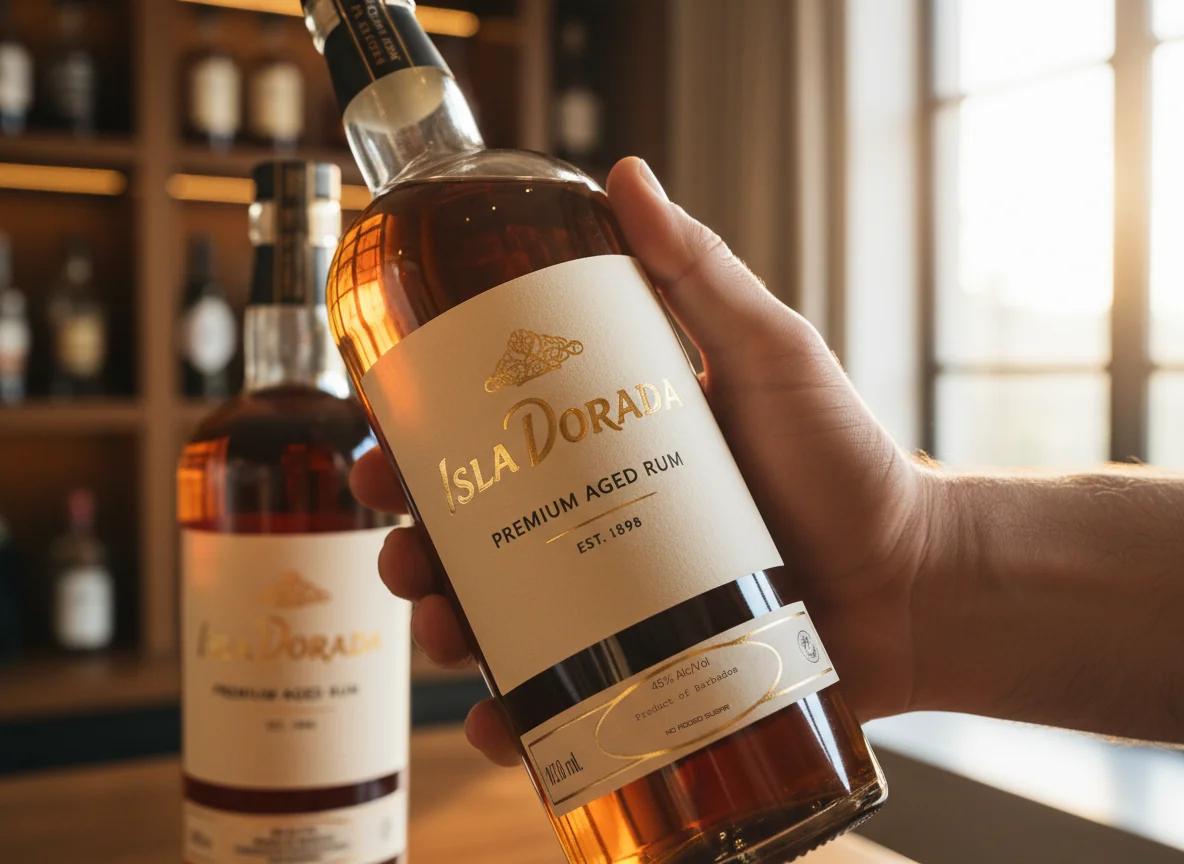
Start here.
A rum label must give the legal name, the strength and the volume
Three things are compulsory on every bottle of rum sold in Great Britain: the legal name, the alcoholic strength and the volume. Like other food, it must also name the business responsible and declare any allergen. Everything else is the producer’s choice.
Rum label terms: what each guarantees in Great Britain, and what it does not, from Regulation (EC) No 110/2008, Regulation (EU) No 1169/2011 and Regulation (EC) No 1334/2008, and for Jamaica Rum The Fat Rum Pirate, a secondary source
Rum, as the legal name
- What it guarantees
- Distilled only from sugarcane products, below 96% ABV, bottled at 37.5% ABV or more, not flavoured; caramel only to adjust colour
- What it does not
- An age, an origin, or that no sugar was added; GB sets no sugar limit for rum
Spirit drink
- What it guarantees
- At least 15% ABV; used for drinks outside a defined category, as every flavoured rum is
- What it does not
- Anything about quality, or what was added
Spiced rum, beside spirit drink
- What it guarantees
- All the alcohol comes from rum
- What it does not
- The strength, the spices or the sugar
ABV
- What it guarantees
- The strength at 20°C, within 0.3% for most spirits, or 1.5% where fruit or parts of plants are macerated in the drink
- What it does not
- Quality; strength carries flavour but does not create it
An age in years
- What it guarantees
- The age of the youngest spirit in the bottle, aged under revenue supervision
- What it does not
- That a number with no years attached is an age
A named origin
- What it guarantees
- Where a registered geographical indication applies, such as Jamaica Rum or Rhum de la Martinique, that it was made to that place’s rules
- What it does not
- Caribbean rum names no island and no rules
Agricultural, or agricole
- What it guarantees
- Cane-juice rum with a geographical indication of a French overseas department or Madeira
- What it does not
- An age or a style
Natural flavourings
- What it guarantees
- Flavouring made only from natural preparations or substances; natural vanilla flavouring means at least 95% from vanilla
- What it does not
- That whole spices were steeped; vanillin made by fermentation counts as natural
No added sugar
- What it guarantees
- The producer’s statement that nothing sweet went in after distillation
- What it does not
- A figure to check it against; spirits need not carry a nutrition table
Caramel or E150a
- What it guarantees
- Allowed in rum, only to adjust colour
- What it does not
- Declaration; a rum may contain it without saying so
“Premium”, “small batch”, “handcrafted”, “smooth”
- What it guarantees
- Nothing; none has a legal meaning on a rum label
- What it does not
- Anything
| Term on the label | What it guarantees | What it does not |
|---|---|---|
| Rum, as the legal name | Distilled only from sugarcane products, below 96% ABV, bottled at 37.5% ABV or more, not flavoured; caramel only to adjust colour | An age, an origin, or that no sugar was added; GB sets no sugar limit for rum |
| Spirit drink | At least 15% ABV; used for drinks outside a defined category, as every flavoured rum is | Anything about quality, or what was added |
| Spiced rum, beside spirit drink | All the alcohol comes from rum | The strength, the spices or the sugar |
| ABV | The strength at 20°C, within 0.3% for most spirits, or 1.5% where fruit or parts of plants are macerated in the drink | Quality; strength carries flavour but does not create it |
| An age in years | The age of the youngest spirit in the bottle, aged under revenue supervision | That a number with no years attached is an age |
| A named origin | Where a registered geographical indication applies, such as Jamaica Rum or Rhum de la Martinique, that it was made to that place’s rules | Caribbean rum names no island and no rules |
| Agricultural, or agricole | Cane-juice rum with a geographical indication of a French overseas department or Madeira | An age or a style |
| Natural flavourings | Flavouring made only from natural preparations or substances; natural vanilla flavouring means at least 95% from vanilla | That whole spices were steeped; vanillin made by fermentation counts as natural |
| No added sugar | The producer’s statement that nothing sweet went in after distillation | A figure to check it against; spirits need not carry a nutrition table |
| Caramel or E150a | Allowed in rum, only to adjust colour | Declaration; a rum may contain it without saying so |
| “Premium”, “small batch”, “handcrafted”, “smooth” | Nothing; none has a legal meaning on a rum label | Anything |
Single casks, cask strength and the other claims behind a higher price are covered in premium rum.
ABV is the strength, and 37.5% is the floor for rum
ABV is the percentage of the liquid that is alcohol, measured at 20°C. Rum must be bottled at 37.5% ABV or more. A spirit drink, which includes every spiced rum, needs only 15% ABV.
In our experience 40% ABV holds up better than 37.5%, neat and in a long drink. Navy-strength and overproof rums are bottled well above that, and ABV vs proof converts the old British proof figures.
Origin wording needs a careful read
Volume is usually 700ml in Britain. Origin is optional unless leaving it out would mislead, and a label can name a country without saying which step happened there. Caribbean rum on the front may describe only the base, spiced or bottled elsewhere.
A named distillery or island tells you where the rum was distilled. A registered geographical indication, such as Jamaica Rum or Rhum de la Martinique, tells you it was made to that place’s rules.
The legal name tells you what has been added
Rum means the spirit meets the legal definition: distilled from sugarcane products, bottled at 37.5% ABV or more, and not flavoured. Caramel may be added to adjust the colour.
Spiced rum is not a legal category. Because rum may not be flavoured, a spiced rum’s legal name is spirit drink. Spiced rum may appear alongside it, provided all the alcohol comes from rum.
Spirit drink is the name for a drink that has left a defined category: flavoured, bottled below 37.5% ABV, or, in the EU, sweetened beyond 20 grams a litre. It says nothing about quality. It tells you the drink is no longer plain rum.
Read the back label. The front may say Caribbean rum in large letters while the legal name in the small print is spirit drink. Both can be accurate.
An age on a rum label should describe the youngest rum
In Great Britain an age on a rum label has to mean the youngest rum in the bottle. Retained Regulation (EC) No 110/2008, Article 12(3), allows a maturation period or age on a spirit drink only where it refers to the youngest alcoholic component, and only if the spirit was aged under revenue supervision. Jamaica’s geographical indication sets the same youngest-rum rule at source, by The Fat Rum Pirate’s secondary account, while Martinique’s appellation sets a minimum age for each grade.
Age terms on a rum label, from Regulation (EC) No 110/2008, the AOC Rhum de la Martinique specification, and for Jamaica The Fat Rum Pirate (a secondary source) and the Jamaica Gleaner
A number of years
- Rule
- Retained Regulation (EC) No 110/2008, Article 12(3)
- What it means
- The youngest spirit in the bottle, aged under revenue supervision
An age on Jamaica Rum
- Rule
- Jamaica Rum geographical indication, registered in 2016
- What it means
- The youngest rum; a 2024 ruling added that it must be aged in Jamaica, and a court order paused its enforcement in September 2025
Élevé sous bois
- Rule
- AOC Martinique
- What it means
- At least twelve months in oak
VO, VSOP, XO on rhum agricole
- Rule
- AOC Martinique
- What it means
- At least three, four and six years in oak
A number without years, or a solera
- Rule
- The producer’s own use
- What it means
- Whatever the producer says it counts; ask before you compare it with an age
| Term | Rule | What it means |
|---|---|---|
| A number of years | Retained Regulation (EC) No 110/2008, Article 12(3) | The youngest spirit in the bottle, aged under revenue supervision |
| An age on Jamaica Rum | Jamaica Rum geographical indication, registered in 2016 | The youngest rum; a 2024 ruling added that it must be aged in Jamaica, and a court order paused its enforcement in September 2025 |
| Élevé sous bois | AOC Martinique | At least twelve months in oak |
| VO, VSOP, XO on rhum agricole | AOC Martinique | At least three, four and six years in oak |
| A number without years, or a solera | The producer’s own use | Whatever the producer says it counts; ask before you compare it with an age |
Some numbers on a rum bottle are not ages
Not every number on a bottle is an age statement. Some rums carry a number that names a blend, a solera or a year, without the words years old. A solera blends younger rum into older casks in stages, so a number tied to it may describe the oldest rum in the system rather than the youngest.
Where a number does not say years, read the producer’s own explanation of what it counts before you compare it with an age on another bottle.
Tropical ageing works faster than ageing in Europe
Where rum ages matters as much as how long. A cask in a hot warehouse gives up more to evaporation and takes more from the wood each year than one in a cool one, so tropical-aged rum shows more oak than its age suggests. Some rum is shipped young and aged in Europe, more slowly.
Labels rarely say where the ageing happened. A producer who does is telling you something useful.
A rum label need not declare sugar, caramel or ingredients
Spirits above 1.2% ABV are exempt from the ingredient list and the nutrition table other food must carry. So the label need not mention added sugar, caramel or flavourings, unless an allergen is present.
Added sugar is legal and rarely declared
Sugar softens a rough spirit and makes a rum taste rounder and older than it is. The EU caps sweetening in rum at 20 grams a litre, under Regulation (EU) 2019/787. The British definition of rum names no limit, and a spiced rum, as a spirit drink, sits outside the rum definition altogether.
Some producers state no added sugar on the label, and the more detail they give, the more the claim is worth. Sweden’s state retailer, Systembolaget, lists a sugar figure in grams per 100ml on its rum pages, one of the few public sources. A rum that tastes very sweet neat at standard strength has probably been sweetened.
Caramel colouring need not be declared
Caramel colouring (E150a) is widely used in rum to keep each batch the same shade and to give the deep amber drinkers associate with age. It adds little flavour at the amounts used, but it changes what you expect before you taste.
Spirits above 1.2% ABV are exempt from the ingredient list other food must carry, so caramel colouring does not have to be declared. When a producer lists ingredients voluntarily, the information can still be easy to miss.
Colour tells you little about age. Caramel can darken a young rum, and some aged white rums are filtered pale. Judge rum by taste, not by sight.
Natural flavourings has a legal meaning, and a wide one
Under retained Regulation (EC) No 1334/2008, a natural flavouring may contain only flavouring preparations or natural flavouring substances, from plant, animal or microbial sources. Natural vanilla flavouring means at least 95% of the flavouring came from vanilla. Natural vanilla flavouring with other natural flavourings means some of it did, and the vanilla can be recognised.
The term covers whole vanilla pods steeped in the rum and vanillin made by fermentation alike. Both are natural in law. A label that names the spices themselves tells you more.
Specific claims can be checked, and vague ones cannot
A claim worth trusting names something you could check. A claim that would fit any bottle on the shelf tells you nothing.
Claims that mean something
A named distillery ties the rum to one place and one method. An age in years, a registered origin, a single cask, cask strength and audited certification such as organic all say something specific. Bottled without chill filtration means the producer has kept the compounds that can haze a spirit when cold, which also carry flavour.
Premium rum sets out what each claim behind a higher price guarantees, and what it does not.
Claims that mean very little
“Premium”, “small batch”, “handcrafted” and “smooth” have no legal meaning on a rum label. “Caribbean rum” names a region of dozens of countries, not an island. “Aged in oak barrels” describes most rum that is not white. None of these makes a rum good or bad.
Five lines on the label, read in order
Reading a rum label takes half a minute once you know where to look.
The 30-second label check
- The legal name. Rum means nothing has flavoured it. Spirit drink, with spiced rum alongside, means spices or flavourings went in.
- The strength. In our experience 40% ABV or more holds up better than the 37.5% minimum.
- The origin. A named distillery, island or registered origin says where the rum was made.
- The age. Years means the youngest rum. A number without years needs the producer’s explanation.
- The ingredients and sugar, if the producer has chosen to give them. Read what is there, and note what is not.
When the label is not enough, ask
Ask the producer. One with nothing to hide will tell you where the rum was distilled, how old the youngest rum is, and whether anything was added after distillation. For sugar, published retail figures are a place to start. Your own palate decides the rest.
The rules come from the regulations
The British definition of rum is Regulation (EC) No 110/2008, Annex II, category 1, as retained in UK law, with the spirit drink minimum in Article 2, the compound-term rule in Article 10 and the age rule in Article 12(3). The EU sweetening limit is in Regulation (EU) 2019/787, Annex I, under rum, read in the text as adopted on legislation.gov.uk.
The ingredient and nutrition exemption is Regulation (EU) No 1169/2011, Article 16(4), and the strength tolerances are in its Annex XII. The meaning of natural flavouring is Article 16 of Regulation (EC) No 1334/2008.
The Fat Rum Pirate, a secondary source, records the Jamaica Rum geographical indication as registered in 2016, and the 2024 ruling on ageing was reported by the Jamaica Gleaner on 9 October 2024. Martinique’s age grades are in the AOC Rhum de la Martinique specification, approved by French Decree No 2014-1542, and rum, rhum or ron sets them out. E150a is plain caramel on the government’s list of approved additives, and Systembolaget’s sugar figures are on its product pages.