Start here.
St Patrick’s Day is a feast day that became Ireland’s national day
17 March is the feast of Saint Patrick, by tradition the date of his death in the fifth century. It is a public holiday in the Republic of Ireland and a bank holiday in Northern Ireland. The feast falls in Lent, and the day has long been treated as a break from the fast.
Drinking was not always part of it in Ireland itself. A law of 1927 treated St Patrick’s Day like Good Friday and Christmas Day for the pubs, and the Intoxicating Liquor Act 1960, passed on 4 July 1960, then treated St Patrick’s Day like a Sunday for opening hours while Christmas Day and Good Friday stayed closed.
Irish whiskey, stout and Irish cream carry the day. The Irish Coffee is its one cocktail with an Irish birthplace.
St Patrick’s Day drinks compared
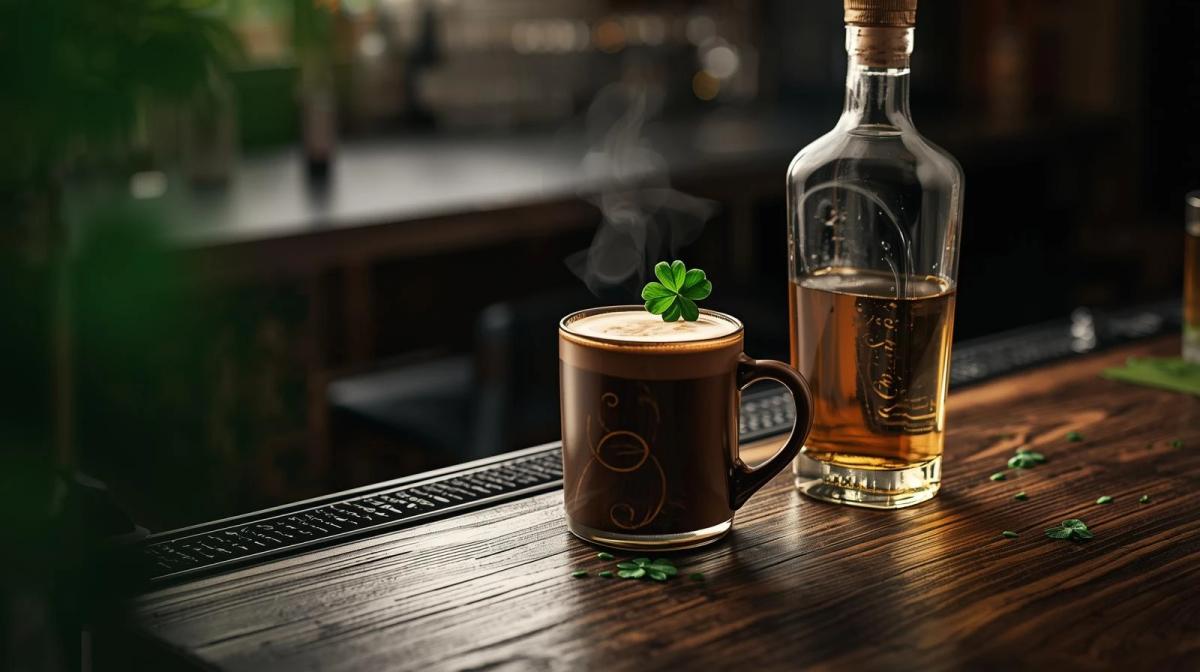
Irish Coffee
- Spirit
- 50ml Irish whiskey
- Style
- Hot, cream floated on top
- Serves
- One
- When it suits
- After a meal
The Emerald
- Spirit
- 60ml Irish whiskey
- Style
- Stirred, in a coupe
- Serves
- One
- When it suits
- Before dinner
Tipperary
- Spirit
- 50ml Irish whiskey
- Style
- Stirred, with green Chartreuse
- Serves
- One
- When it suits
- A slow, strong drink
Irish Maid
- Spirit
- 50ml Irish whiskey
- Style
- Shaken, with cucumber
- Serves
- One
- When it suits
- Early in the evening
Shamrock Sour
- Spirit
- 45ml Irish whiskey
- Style
- Shaken, green
- Serves
- One
- When it suits
- When the glass has to be green
Green Batched Punch
- Spirit
- 500ml Irish whiskey in the bowl
- Style
- Punch, green
- Serves
- About twelve
- When it suits
- A crowd
Dublin Mule
- Spirit
- 50ml Irish whiskey
- Style
- Long, with ginger beer
- Serves
- One
- When it suits
- A busy party
Baby Guinness
- Spirit
- 30ml coffee liqueur, 10ml Irish cream
- Style
- A layered shot
- Serves
- One
- When it suits
- A round
Stout Float
- Spirit
- 250ml Irish stout
- Style
- Stout and ice cream
- Serves
- One
- When it suits
- In place of pudding
| Drink | Spirit | Style | Serves | When it suits |
|---|---|---|---|---|
| Irish Coffee | 50ml Irish whiskey | Hot, cream floated on top | One | After a meal |
| The Emerald | 60ml Irish whiskey | Stirred, in a coupe | One | Before dinner |
| Tipperary | 50ml Irish whiskey | Stirred, with green Chartreuse | One | A slow, strong drink |
| Irish Maid | 50ml Irish whiskey | Shaken, with cucumber | One | Early in the evening |
| Shamrock Sour | 45ml Irish whiskey | Shaken, green | One | When the glass has to be green |
| Green Batched Punch | 500ml Irish whiskey in the bowl | Punch, green | About twelve | A crowd |
| Dublin Mule | 50ml Irish whiskey | Long, with ginger beer | One | A busy party |
| Baby Guinness | 30ml coffee liqueur, 10ml Irish cream | A layered shot | One | A round |
| Stout Float | 250ml Irish stout | Stout and ice cream | One | In place of pudding |
The Irish Coffee is the drink of the day, and the cream decides it
The Irish Coffee is credited to chef Joe Sheridan at the Foynes flying-boat terminal on the Shannon estuary, who by the Foynes Flying Boat Museum’s account added whiskey to the coffee of passengers whose New York flight had turned back, in the winter of 1943.
Warm an Irish coffee mug with hot water and tip it out. Add a teaspoon of demerara sugar and 120ml of hot filter coffee, and stir until the sugar dissolves. Add 50ml of Irish whiskey and stir once. Whip 50ml of cream only until it thickens to the texture of cold pouring custard, then float it over the back of a warm spoon to fill the last centimetre. Serve it without a spoon and with nothing on top; the coffee is drunk through the cream.
If the cream sinks, one of three things went wrong: the coffee was not sweetened, the cream was whipped too little or too much, or it went in without the spoon. The sugar makes the coffee dense enough to hold the cream up.
Without the whiskey, keep everything else. The sweet hot coffee under cold cream is what makes the drink, and it works for anyone not drinking.
Irish whiskey has a style of its own
Most Irish whiskey is unpeated, and much of it is distilled three times, which is where its light, soft reputation comes from. Its own style is single pot still whiskey, made from a mash of at least 30% malted and 30% unmalted barley, with up to 5% of other cereals, by the Irish Whiskey Technical File of October 2014. The raw barley gives a spicy, oily character that single malt does not have. Redbreast, Green Spot and Powers John’s Lane are single pot still whiskeys.
For mixing, a standard Irish blend does the job. Keep a single pot still bottle for drinking on its own, or for The Emerald, where the whiskey has nowhere to hide.
The Emerald is a Manhattan made with Irish whiskey, and it was in print by 1914, in Jacques Straub’s Drinks. Stir 60ml Irish whiskey, 30ml sweet vermouth and three dashes of orange bitters with plenty of ice for 20 to 30 seconds, strain into a chilled coupe, and express a lemon twist over it before dropping it in.
The Tipperary is the stronger stirred drink: 50ml Irish whiskey, 25ml sweet vermouth, 15ml green Chartreuse and two dashes of Angostura, stirred with ice for 25 seconds and strained into a chilled Nick and Nora glass under a lemon twist. Chartreuse’s own page gives green Chartreuse at 55% vol., so keep it to one.
The Irish Maid, from The Dead Rabbit in New York, is lighter and shaken. Press four slices of cucumber in a shaker, add 50ml Irish whiskey, 25ml elderflower liqueur and 25ml fresh lemon juice with ice, shake hard and double strain over fresh ice in a rocks glass. Run a ribbon of cucumber down the inside of the glass.
Green drinks get their colour from blue curaçao
Blue curaçao is orange curaçao with blue colouring added. Shaken with yellow citrus and a little orange juice, the blue turns green. That is the usual route to a green drink, and it uses a dye, so call the colour festive rather than natural.
The Shamrock Sour is the single green drink. Shake 45ml Irish whiskey, 20ml fresh lime juice, 20ml honey syrup, 15ml blue curaçao and a splash of orange juice hard with ice for 10 to 12 seconds, and strain into a chilled coupe. For a foam, add 15ml of egg white and dry shake for 10 to 15 seconds before the ice goes in; the white is raw, so leave it out for anyone allergic to egg. The colour is the garnish.
The Green Batched Punch serves about twelve. The day before, combine 500ml Irish whiskey, 200ml simple syrup, 200ml blue curaçao and 500ml apple juice in a jug and refrigerate it. On the day, squeeze 250ml of fresh lime juice, stir it in and taste. Just before guests arrive, pour the base into a punch bowl with 500ml of sparkling water and plenty of ice, and ladle it into punch cups. Each cup carries about 40ml of whiskey and 15ml of curaçao, close to two UK units.
The Dublin Mule is green only in the garnish. Build 50ml Irish whiskey, 20ml fresh lime juice and 15ml simple syrup over ice in a copper mug or highball, top with 90ml of ginger beer, stir gently, and finish with a mint sprig and a lime wheel.
Stout belongs on the table, and in two drinks
Guinness’s own site dates its brewery at St James’s Gate in Dublin to the lease signed on 31 December 1759. The dry stout style that grew there means roasted barley, a coffee edge and a dry finish. It is a beer at around 4.2%, so anything made with it contains alcohol.
The Stout Float does the job of pudding. Pour 250ml of Irish stout into a tall glass, let the head settle for about thirty seconds, lower in a scoop of vanilla ice cream and drizzle 15ml of Irish cream over it if you like. Serve it with a long spoon.
The Baby Guinness has no stout in it at all. Pour 30ml of cold coffee liqueur into a shot glass, leaving room at the top, then float 10ml of Irish cream over the back of a spoon to make the head. Irish cream is lighter than coffee liqueur, so it sits on top; poured the other way round, it will not layer. Keep citrus away from it, because acid curdles cream on contact.
Plan the evening around food and an alcohol-free glass
A 700ml bottle of Irish whiskey makes fourteen Irish Coffees or Dublin Mules at 50ml each. Add Irish cream, ginger beer, lemons and limes, simple syrup and honey syrup, a few cans of stout, and blue curaçao if the glass has to be green.
Oysters with dry stout is the old Dublin pairing, the roasted bitterness against the brine. Smoked salmon and soda bread suit whiskey with a splash of soda. A beef and stout stew, colcannon and Irish farmhouse cheeses such as Cashel Blue fill out the table and slow the drinking down.
Make the alcohol-free drinks with the same care. Ginger beer and fresh lime over ice, with a mint sprig, takes the Dublin Mule’s place, and an Irish Coffee without the whiskey keeps the hot coffee and cold cream.
Measure every pour with a jigger. A 25ml measure of a 40% ABV spirit is one UK unit, so a 50ml Irish Coffee carries two. St David’s Day, on the first of March, comes sixteen days earlier, and St David’s Day drinks covers it; St George’s Day drinks follows on 23 April.