Whiskey Sour
The Whiskey Sour is one of the oldest documented cocktails in the American canon, appearing in Jerry Thomas's 1862 bar guide and predating most of the drinks it is now grouped alongside in the sour family. Its structure, whiskey, fresh lemon juice, and sugar, is the foundational sour template from which the Honey Sour, the Amaretto Sour, the Penicillin, and every other whiskey-based sour in the Field Manual derives. Understanding the Whiskey Sour is the most direct route into understanding that entire family of drinks, because the relationship between a quality bourbon or rye, fresh lemon juice, and a correctly proportioned sweetener is the clearest expression of what the sour format is capable of when every ingredient earns its place. The egg white question is more consequential here than in most sours in the Field Manual because the Whiskey Sour exists in two distinct versions that are both widely ordered and both considered correct by different constituencies. The Boston Sour, which is simply the Whiskey Sour with egg white, produces a silky, texturally rich drink with a foam that carries the whiskey's vanilla and grain aromatics at the nose before the lemon acid arrives at the palate. The version without egg white is sharper, more direct, and more immediately tart. Both are correct. The choice should be made deliberately rather than by default, and the Field Manual recommends the egg white version because it produces a more complete expression of what the format is capable of. The Whiskey Sour's ubiquity in mainstream bar culture has generated the same problem as the Margarita and the Mojito. Pre-made sour mix, bottled lemon juice, and indifference to the quality of the whiskey have produced a generation of drinkers who have encountered the drink in its worst form and formed their opinion accordingly. The properly built version, with fresh lemon juice squeezed to order, a quality bourbon, and a correctly proportioned sugar syrup, is a drink that consistently surprises those who approach it with low expectations formed by previous experience.
Glassware: Rocks Glass
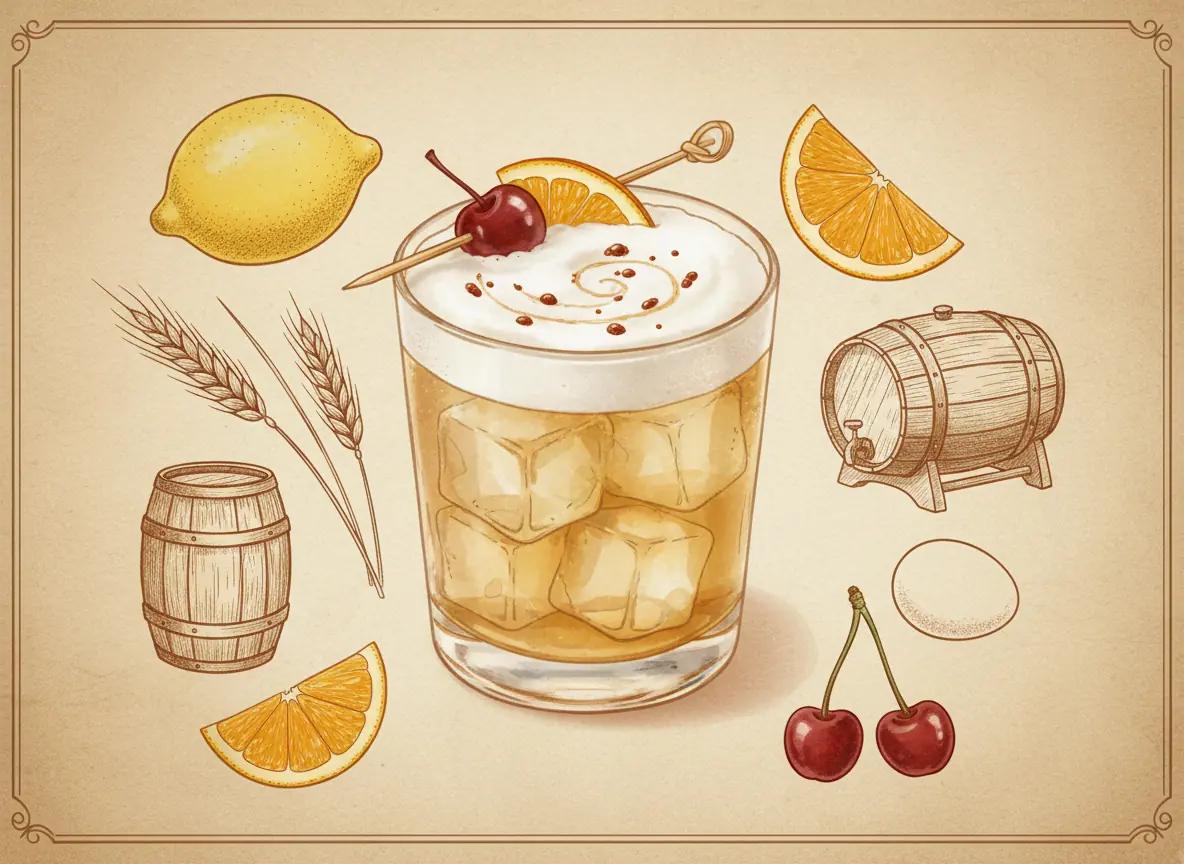
Garnish: Luxardo Maraschino Cherry, orange slice and Angostura bitters pattern
Ingredients
60ml
A bourbon with genuine vanilla and caramel character performs best here. Rye produces a drier, spicier result. Both are correct and the choice should be made according to preference rather than convention.
25ml
Squeezed immediately before use. The single most consequential variable in the Whiskey Sour. Pre-squeezed or bottled lemon juice will produce a flat, dull result that no quality bourbon can compensate for.
15ml
One part white sugar dissolved in one part warm water. The balance of this drink runs tart rather than sweet. The syrup should support the lemon without softening it into something cloying.
10ml
Strongly recommended. Dry shake first without ice to build the foam, then shake again with ice. The foam carries the bourbon's vanilla and grain aromatics at the nose before the lemon acid arrives at the palate.
1 scoop
For shaking and serving. The finished drink is served over fresh ice in a rocks glass or without ice in a coupe depending on preference.
1 slice
A single fresh slice placed on the rim. The traditional garnish for the Whiskey Sour and one that provides an aromatic complement to the bourbon's own fruit character.
1 cherry
Luxardo is the benchmark. Dropped into the drink or skewered alongside the orange slice. The classic garnish combination for this drink.
3 drops
Dotted onto the surface of the foam in a pattern immediately before serving. Provides a spice and aromatic top note that bridges the bourbon and the lemon at the nose.
Instructions
Squeeze lemon juice immediately before building the drink.
Add egg white to the shaker alone and dry shake vigorously for 15 seconds before adding any other ingredient.
Add bourbon, fresh lemon juice, sugar syrup, and egg white to the shaker.
Dry shake all ingredients together without ice for a further 15 seconds.
Add a scoop of cubed ice and shake hard for 12 seconds.
Strain over fresh ice in a rocks glass or double strain into a chilled coupe.
Dot Angostura bitters onto the surface of the foam in a pattern immediately before serving.
Place the orange slice on the rim and drop or skewer the Luxardo cherry alongside it.
Serve immediately.
Expert Tip
The double dry shake, egg white alone first and then with all ingredients, produces a more stable and more voluminous foam than a single dry shake with all ingredients combined. The initial shake on the egg white alone begins the protein denaturation process at its most efficient before the fat content of any other ingredient interferes with it. Thirty seconds of combined dry shake before the wet shake produces the foam the drink deserves every time.
Flavour Profile
The Origin
The Whiskey Sour appeared in Jerry Thomas's "How to Mix Drinks, or the Bon Vivant's Companion" in 1862, making it one of the earliest documented cocktail recipes in the American canon and one of the few drinks whose documented origin predates the period of greatest creativity in nineteenth century American bartending. Thomas's version was built on whiskey, fresh lemon juice, and sugar in proportions consistent with the foundational sour template that has been applied to every other spirit category in the century and a half since. The egg white that defines the Boston Sour variation came later, as egg white became a standard technique in the shaken sour tradition during the late nineteenth and early twentieth centuries.
The drink's survival across more than a century and a half of changing tastes, the rise and fall of different whiskey styles, the Prohibition period, the mid-century cocktail decline, and the contemporary revival, is a measure of how well the original balance was conceived. A three-ingredient sour built on a quality American whiskey and fresh lemon juice is as good a drink today as it was when Thomas documented it, which is a standard that most cocktails do not meet across that timeframe.
The Sour Template
The Whiskey Sour's foundational status in the sour family is not simply a matter of historical precedence. It is the drink that most clearly demonstrates the three-variable logic of the sour format: base spirit, fresh citrus, and sweetener, each present at volumes that allow the spirit to lead while the citrus and sweetener provide the acid-sweet frame that makes the spirit accessible and interesting rather than simply strong. Every sour in the Field Manual is a variation on that template, with one or more of the three variables changed to produce a different result while the underlying logic remains constant.
Understanding that logic through the Whiskey Sour, the simplest and most direct expression of it, is the most useful preparation available for understanding every other sour in the collection. The Honey Sour changes the sweetener. The Penicillin changes both the sweetener and the technique. The Amaretto Sour changes the base spirit and adds structural support. The Bee's Knees changes both the base spirit and the sweetener. All of them are readable as variations on the Whiskey Sour once the foundational template is understood.
Bourbon Versus Rye
The choice between bourbon and rye in the Whiskey Sour is the most commonly debated decision in building the drink and one of the more genuinely interesting debates in the sour canon because both choices produce correct drinks with meaningfully different characters. Bourbon, with its higher corn content and characteristic vanilla and caramel sweetness, produces a Whiskey Sour that is round, immediately approachable, and generous in the way that the bourbon's own sweetness reinforces the sugar syrup without duplicating it. The lemon's acid sits against the bourbon's warmth in a way that is immediately satisfying and consistently pleasing.
Rye, with its higher rye grain content and characteristic spice and dryness, produces a Whiskey Sour that is more assertive, more demanding of the drinker's attention, and more interesting to those who want the whiskey's character to be clearly audible rather than softened by the sweetener. The spice of the rye provides a counterpoint to the lemon's acid that the bourbon's sweetness does not, producing a drink that is drier, more complex, and more suited to those who approach the sour format as a spirit-forward drink rather than a citrus-forward one.
Both are correct. The bourbon version is the more commonly ordered and the more immediately accessible. The rye version is the more interesting to those who have encountered both.
The Fresh Citrus Standard
The Whiskey Sour is the drink most commonly ruined by pre-made sour mix and bottled lemon juice in high-volume bar service, and the gap between those versions and a properly built version with fresh juice squeezed to order is wider than for almost any other drink in the Field Manual. The reasons are the same as those discussed in the Daiquiri, the Mojito, and the Margarita entries: lemon juice oxidises quickly once squeezed, losing its brightness and developing a flat, slightly bitter quality that is immediately apparent in a drink this direct.
In a Whiskey Sour, where the lemon juice at 25ml represents a significant proportion of the total volume and there is no additional modifier or aromatic element to mask its degradation, pre-squeezed juice does not simply diminish the drink. It defines it. A Whiskey Sour built with fresh juice squeezed immediately before the shake is a genuinely different drink from one built with juice that has been sitting in a container since the start of service. The freshness standard is not optional and should not be treated as one.
The Foam and Its Purpose
The egg white foam in the Whiskey Sour, which produces the Boston Sour when included, serves the same aromatic and textural purpose as in every other egg white sour in the Field Manual, but the specific character of what the foam carries is worth understanding for this particular drink. Bourbon's dominant aromatic compounds, vanilla, caramel, and the grain sweetness of the corn, are carried efficiently by the fat and protein structure of the foam in a way that produces a distinctly different first approach to the drink from the still version. The foam in a Boston Sour smells of bourbon before it is tasted, the vanilla and caramel aromatics concentrated at the surface and encountered at the nose before the lemon acid arrives at the palate.
The Angostura bitters dotted over the foam reinforce this effect by adding a spice and aromatic layer that bridges the bourbon and the lemon, producing a combined aromatic top note of vanilla, grain spice, and gentian that changes the experience of the first sip and makes the drink more layered than the three-ingredient build would suggest. The bitters pattern is not decoration. It is the final aromatic adjustment that completes the drink.
How to Serve It
Shaken with a committed dry shake and double strained over fresh ice in a rocks glass or into a chilled coupe, with Angostura bitters dotted over the foam and orange slice and Luxardo cherry on the rim or in the glass. Both serving formats are correct and both are historically consistent with the drink's long history across different bar cultures. The rocks glass over ice is the more common contemporary serve and the more forgiving one for those who drink slowly. The coupe is the more elegant presentation and the one that best showcases the foam at its most stable immediately after straining.
Serve it to those who have never had it made properly and to those who already know what a good Whiskey Sour is. The former will be surprised. The latter will be satisfied. Both outcomes are worth achieving with every glass.
You Might Also Like
Master the Techniques
The Spirit
Whiskey (Bourbon)A distilled spirit made from fermented grain mash and aged in wooden barrels. Whiskey styles vary widely by origin, grain, and ageing, producing profiles from light and smooth to rich and robust.
Recipe by Jerry Can Spirits
Enjoyed This Recipe?
Explore our full collection of cocktails and discover your next favorite
Browse All Cocktails