Amaretto Sour
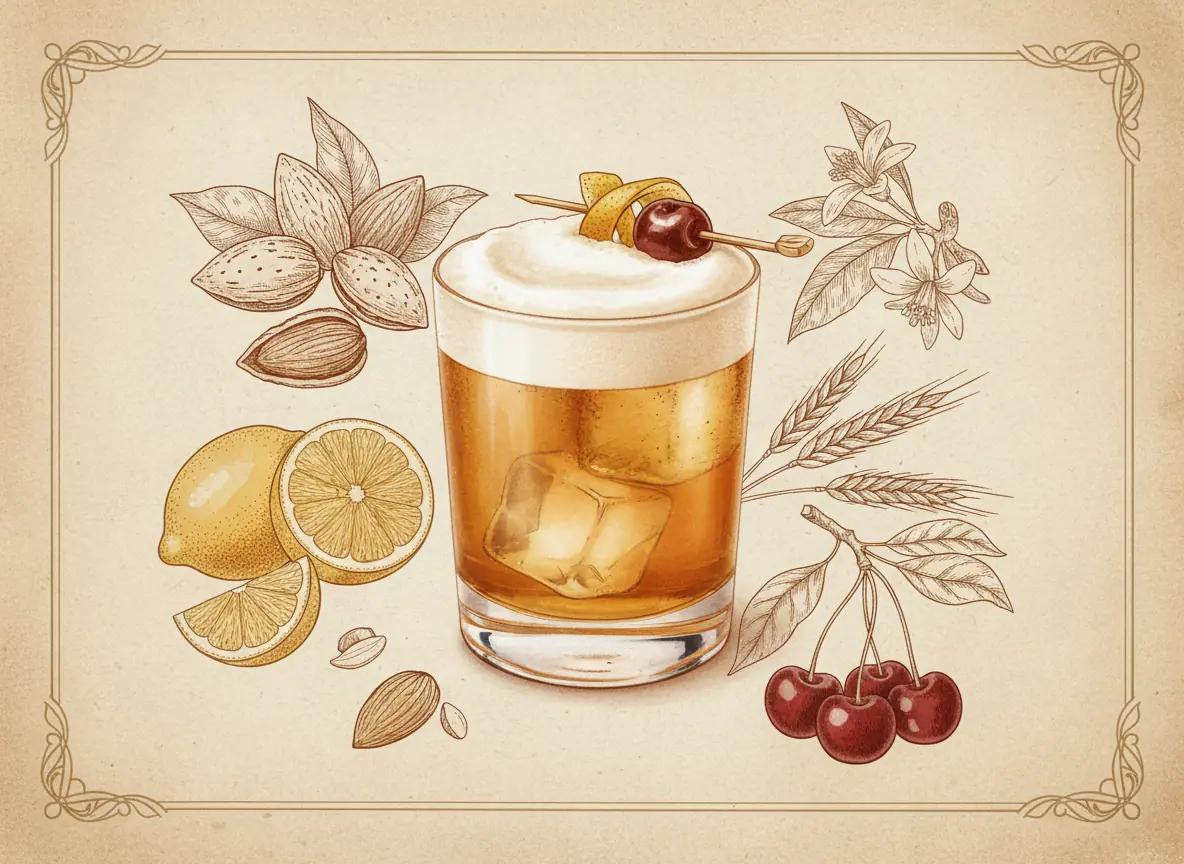
An Amaretto Sour made the way Jeffrey Morgenthaler published it in 2012, as Difford’s Guide records his formula, is 45ml amaretto, 22.5ml cask-strength bourbon, 30ml fresh lemon juice, 5ml rich sugar syrup and an optional 15ml egg white. It is shaken without ice, then with it, and strained onto a single large ice cube in a rocks glass, then finished with a lemon peel and a cherry. The bourbon is why it works. Amaretto is sweet and, at Disaronno’s 28% ABV on Drinkfinder’s listing, too light to carry a sour alone; Morgenthaler’s point was that it needs help. A small measure of cask-strength bourbon adds strength, oak and spice while the almond stays in front. The Oxford Companion to Spirits and Cocktails says amaretto is generally made from apricot kernels, though it is commonly thought of as almond-flavoured; anyone with a nut allergy should read the label. The egg white is raw egg. A glass holds about 2.6 UK units, taking the cask-strength bourbon at our working figure of 60% ABV and the amaretto at 28%, as Drinkfinder lists Disaronno.
Glassware: Rocks Glass
Garnish: Maraschino cherry and Lemon peel
Ingredients
45ml
Disaronno is 28% ABV on Drinkfinder’s listing, and amaretto is generally made from apricot kernels, though brands differ, by the Oxford Companion. Pick one with some bitterness at the finish, since it is most of the drink. Check the label for nut or egg allergies.
22.5ml
Bourbon bottled at barrel strength, often around 60% ABV or more. It adds alcohol, oak and spice in a small measure. With only a 40% bourbon, use about 35ml.
30ml
Squeezed the same day. At 30ml it is a full sour’s worth of acid, and it needs to be: amaretto is sweeter than any base spirit.
5ml
Sugar and warm water at two to one, stirred until clear and cooled. Five millilitres is a seasoning; the amaretto supplies most of the sweetness.
15ml
Optional. Roughly the white of half a medium egg, for a soft foam that carries the almond scent. Raw. Following the FSA, British Lion-mark eggs are safe raw, including for vulnerable groups and in pregnancy; pasteurised carton white is the alternative. Eating out, where the mark cannot be checked, the FSA advises vulnerable people to have their eggs thoroughly cooked. Contains egg: leave it out, or use aquafaba, for anyone allergic.
Instructions
Squeeze the lemon juice the same day.
Add the amaretto, bourbon, lemon juice, rich sugar syrup and egg white, if using, to a shaker without ice.
If using the egg white, dry shake for 10 to 15 seconds.
Add cubed ice and shake hard for 10 to 12 seconds.
Double strain over one large cube in a rocks glass.
Express a strip of lemon peel over the drink, then add it with a cherry on a pick.
Our version
Jeffrey Morgenthaler’s 2012 measures, as Difford’s Guide prints them: 45ml amaretto, 22.5ml cask-proof bourbon, 30ml lemon, 5ml two-to-one syrup and 15ml egg white. Ours treats the egg white as optional and serves the drink on one large cube.
Source: our own specification. Last checked 9 October 2026.
Expert Tip
Use cask-strength bourbon if you can. At 22.5ml and around 60% ABV it adds the alcohol and spice amaretto lacks without adding much volume. Without it, about 35ml of a 40% bourbon carries the same alcohol, though the drink comes out longer and a little softer. With the egg white, give everything 10 to 15 seconds in the shaker with no ice, so the white can whip, then a hard 10 to 12 seconds with ice. Strain through a fine sieve onto a large cube. Taste before adding more syrup. The amaretto already brings plenty of sugar; 5ml of rich syrup only rounds off the lemon.
Behind the Amaretto Sour
Flavour Profile
The Fix for a Sweet Drink
The Amaretto Sour most bars poured through the 1980s, the Oxford Companion says, was amaretto with commercial sour mix in place of lemon juice: sugar against sugar, with a little artificial citrus. Its reputation came from that version.
Jeffrey Morgenthaler’s own post of 9 February 2012 gives a new version of the drink using cask-proof bourbon, 2:1 simple syrup and egg white; Difford’s Guide places him in Oregon. He kept the amaretto in charge and changed two things: fresh lemon in place of the mix, and a measure of cask-strength bourbon, which Difford’s says gives the drink backbone.
What the Bourbon Does
Disaronno is 28% ABV on Drinkfinder’s listing, and amaretto is heavy with sugar; Morgenthaler calls it too weak to stand up to other ingredients on its own. Shaken with 30ml of lemon and diluted by ice, it turns thin. Cask-strength bourbon, often around 60% ABV, puts the alcohol back in a small volume: 22.5ml adds backbone, oak and vanilla without crowding the almond.
A 40% bourbon can do the same job at about 35ml. The drink is then longer and a touch softer, and still far better than amaretto and lemon alone.
The Amaretto Sour with and without bourbon, and the Whiskey Sour
Amaretto Sour (ours, after Morgenthaler)
- Base
- 45ml amaretto, 22.5ml cask-strength bourbon
- Lemon
- 30ml
- Sweetener
- 5ml rich syrup
- Egg white
- 15ml, optional
- UK units
- 2.6
Amaretto Sour without bourbon
- Base
- 45ml amaretto
- Lemon
- 30ml
- Sweetener
- 5ml rich syrup
- Egg white
- 15ml, optional
- UK units
- 1.3
Whiskey Sour (IBA)
- Base
- 45ml bourbon
- Lemon
- 25ml
- Sweetener
- 20ml sugar syrup
- Egg white
- 15ml, optional
- UK units
- 1.8
| Drink | Base | Lemon | Sweetener | Egg white | UK units |
|---|---|---|---|---|---|
| Amaretto Sour (ours, after Morgenthaler) | 45ml amaretto, 22.5ml cask-strength bourbon | 30ml | 5ml rich syrup | 15ml, optional | 2.6 |
| Amaretto Sour without bourbon | 45ml amaretto | 30ml | 5ml rich syrup | 15ml, optional | 1.3 |
| Whiskey Sour (IBA) | 45ml bourbon | 25ml | 20ml sugar syrup | 15ml, optional | 1.8 |
Take the bourbon out and the drink keeps its sweetness while losing half its alcohol, which is why it tastes thin. The Whiskey Sour shows the opposite balance: a full spirit base and plain syrup.
Where the Almond Comes From
The Oxford Companion to Spirits and Cocktails says amaretto, though commonly thought of as almond-flavoured, is generally made from apricot kernels macerated in brandy and then sweetened, and that brands differ in how they make it.
For anyone with a nut allergy that difference matters, and calling it amaretto does not settle the question. Read the label of the bottle you are using.
The Egg White
You can leave the egg white out. Given 10 to 15 seconds in the shaker before the ice goes in, then a hard shake with ice, it sets into a soft head that keeps the almond scent over the glass and takes the edge off the lemon.
Skip it and the drink turns sharper and thinner, though still balanced. It is raw egg, so skip it for anyone who avoids egg.
How Strong It Is
Taking Disaronno at its 28% ABV on Drinkfinder’s listing and the bourbon at our working figure of 60%, an Amaretto Sour holds about 2.6 UK units, against 1.8 for an IBA Whiskey Sour. Sugar and foam hide most of that.
Make it at home
The Spirit
AmarettoAmaretto is an almond-flavoured Italian liqueur, at 24 to 28% ABV across the three bottles below, and many bottles are flavoured with apricot kernels rather than almonds. Disaronno’s own site calls its bottle nut-allergy free, Lazzaroni infuses biscuits made with egg white, and the Oxford Companion, a secondary source, calls amaretto a nut-flavoured cordial, so with an allergy the label decides. It leads the Amaretto Sour and half of the French Connection.
Master the Techniques
More to explore
Frequently Asked Questions
What is in an Amaretto Sour?
Does an Amaretto Sour contain nuts?
How strong is an Amaretto Sour?
Why put bourbon in an Amaretto Sour?
Is the egg white necessary in an Amaretto Sour?
What if I do not have cask-strength bourbon?
Which amaretto should I use?
Sources.
Checked between 18 October and 19 October 2026.
- Difford’s Guide, “Amaretto Sour (by Jeffrey Morgenthaler)” (secondary source: adapted from a recipe created in 2012 by Jeffrey Morgenthaler in Oregon; original formula 45ml amaretto, 22.5ml cask-strength bourbon, 30ml lemon, 5ml sugar syrup (2:1), 15ml egg white; the bourbon gives backbone).
- The Oxford Companion to Spirits and Cocktails (Jeffrey Morgenthaler), “The Amaretto Sour” (secondary source: introduced by the importer of Amaretto di Saronno in 1974; a standard of the 1980s, usually made with commercial sour mix; improved by fresh lemon, simple syrup, egg white and cask-strength bourbon).
- The Oxford Companion to Spirits and Cocktails (Alia Akkam), “almond liqueurs” (secondary source: amaretto generally made from apricot kernels macerated in brandy and sweetened; Disaronno steeps herbs and fruits in crushed apricot kernel oil; Lazzaroni uses an infusion of Amaretti di Saronno biscuits).
- IBA, “Whiskey Sour” (official specification: 45ml bourbon, 25ml fresh lemon juice, 20ml sugar syrup).
- Jeffrey Morgenthaler (9 February 2012), “I Make the Best Amaretto Sour in The World” (primary source: other Amaretto Sours are too sweet; amaretto is weak and needs help from cask-proof bourbon; the recipe, 45ml amaretto, 22.5ml cask-proof bourbon, 30ml lemon, 5ml 2:1 simple syrup, 15ml egg white).
- Drinkfinder, “Disaronno 50cl” (UK retail listing: 28% ABV).
You Might Also Like
Honey Sour
A Honey Sour is a Whiskey Sour sweetened with honey: 60ml bourbon, 25ml fresh lemon juice and 15ml honey syrup mixed at two parts honey to one of warm water, shaken hard and double strained over a large cube in a rocks glass. A 15ml egg white is optional and gives it a soft foam, with three drops of Angostura on top. Honey changes more than the sweetness. It adds a floral, waxy note on top of the bourbon’s vanilla and caramel, and more body than sugar syrup. The drink sits between the Whiskey Sour and the Gold Rush, the bourbon, lemon and honey drink that Punch credits to T. J. Siegal at Milk & Honey in New York, in 2000 by its account and 2001 by VinePair’s. The Honey Sour adds back the egg white and the bitters, with a little less syrup. No one is recorded as its inventor. It is a sweetener swap on a sour. Difford’s Guide dates the first written sour recipes to Jerry Thomas’s 1862 guide and the oldest known whiskey sour mention to a Wisconsin newspaper of 1870. A glass holds about 2.4 UK units.
Paper Plane
A Paper Plane is 30ml each of bourbon, Aperol, Amaro Nonino and fresh lemon juice, shaken hard and double strained into a chilled coupe. Four equal parts, which is the IBA specification: bitter orange, herbs and lemon over bourbon, at about 2.6 UK units. Punch, a secondary source, says Toby Maloney, who helped open The Violet Hour in Chicago, asked Sam Ross to create a drink for the bar, and that it was on the menu there in the summer of 2008. Ross named it after the M.I.A. song Paper Planes. The first version used Campari; Punch quotes Ross finding it slightly too bitter and short of sweetness, and he moved to Aperol. Equal parts leaves nowhere to hide. Squeeze the lemon the same day and use Nonino, not a cheaper amaro, because each ingredient is a quarter of the drink.
Bee’s Knees
A Bee’s Knees is 52.5ml of London Dry gin, 22.5ml each of fresh lemon and orange juice and two teaspoons (10ml) of honey syrup, made with two parts honey to one of warm water. Shake it hard for 10 to 12 seconds and double strain it into a chilled coupe, with a strip of lemon peel. About 2.1 UK units. The measures are the IBA’s. The orange is the part most recipes leave out. The oldest printings are gin, lemon and honey alone; David Embury suggested a little orange juice as a variation in 1948, and the IBA built it in. Orange softens the lemon, which is why two teaspoons of honey syrup are enough. The drink is often filed under American Prohibition, with honey and lemon covering for bathtub gin. Difford’s Guide, a secondary source, says the earliest printing tells a different story: Cocktails de Paris, published in 1929, credits it to Frank Meier of the Ritz in Paris, and Meier claimed it again in his own book in 1936.
Where this one sits
Recipe by Jerry Can Spirits · Updated 19 October 2026