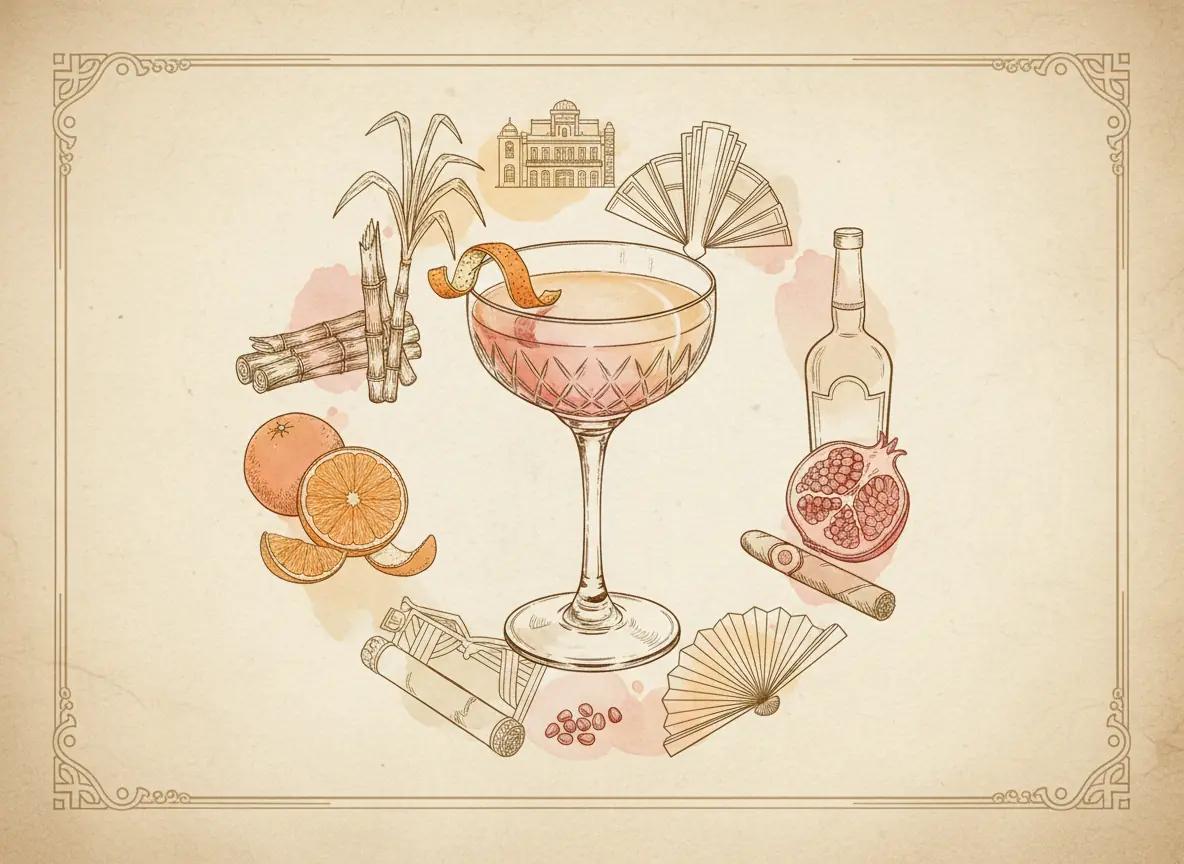
El Presidente
El Presidente is a stirred Cuban rum drink: 45ml white rum, 22.5ml dry vermouth, 10ml orange curaçao and 7.5ml grenadine, stirred for 20 to 30 seconds over ice and strained into a chilled coupe, finished with an expressed orange peel. It drinks like a light rum Manhattan, dry and aromatic, with a pale pink colour from the grenadine. Basil Woon’s 1928 book on Cuba calls it one of the two cocktails most in demand in Havana. Who created it and which president it honours are both disputed: the Floridita’s own 1939 book prints a 1937 report crediting Constante Ribalaigua, and Bar Vademecum reports David Wondrich naming Mario García Menocal, president from 1913 to 1921; Bar Vademecum adds that the story of a drink named for Gerardo Machado cannot be right for the earliest recipes, since Machado was not elected until 1925. Older recipes use Chambéry, a blanc vermouth sweeter than dry: two parts to one of rum in Escalante’s 1915 manual, half and half in Basil Woon’s 1928 account. Ours uses dry at two to one with a little more curaçao. Each one comes to about 2.6 UK units.
Glassware: Coupe Glass
Garnish: Orange peel
Ingredients
45ml
A lightly aged, Cuban-style white rum at 37.5 to 40% ABV, dry and clean. It leads the drink, so avoid a sweetened or flavoured rum.
22.5ml
We keep it cold and finish it within a month of opening. It supplies the wine and the dryness. Blanc vermouth, sweeter and softer, is the older choice; with blanc, consider trimming the curaçao.
10ml
A dry curaçao at 35 to 40% ABV gives orange and body without much sugar. A sweet bottling at around 20% makes the drink noticeably sweeter.
7.5ml
Pomegranate juice and sugar, nothing else. At 7.5ml it brings colour and a little fruit, and should be noticed in the glass more than on the tongue.
Instructions
Chill a coupe.
Add the white rum, dry vermouth, orange curaçao and grenadine to a mixing glass.
Fill with cubed ice and stir for 20 to 30 seconds.
Strain into the chilled coupe.
Express a strip of orange peel over the drink and rest it on the rim.
Our version
The older recipe, in Escalante’s manual of 1915, is two parts Chambéry vermouth to one of Bacardí rum with a few drops of curaçao and half a teaspoon of grenadine, as Bar Vademecum prints it; Woon’s of 1928 is half and half. Ours uses dry vermouth at half the rum, with 10ml curaçao and 7.5ml grenadine to replace the sweetness blanc brings.
Source: our own specification. Last checked 9 October 2026.
Expert Tip
Use fresh vermouth. At 22.5ml it is a large share of the drink, and in our experience an open bottle left at room temperature turns flat and sour within weeks. We store it cold after opening and finish it inside a month. Measure the grenadine. At 7.5ml it gives colour and a little fruit; a free pour makes the drink pink and sweet. Use one made from pomegranate. Stir for 20 to 30 seconds and strain into a cold glass. A stirred drink has no foam or ice to hide warmth, and El Presidente loses its edge as it warms.
Behind the El Presidente
Flavour Profile
Havana, in the 1920s
Basil Woon’s When It’s Cocktail Time in Cuba of 1928 calls the presidente one of the two cocktails most in demand in Havana, “the aristocrat of cocktails” and the one preferred by the better class of Cuban.
Its origin is disputed. Bar Vademecum, quoting David Wondrich, says Constantino Ribalaigua probably invented it in the mid-1910s as head bartender at a small café near Havana’s Parque Central, and the Floridita’s own 1939 cocktail book prints a 1937 report naming Ribalaigua as its inventor. The oldest published recipe Bar Vademecum lists is John B. Escalante’s Manual del cantinero of 1915. It reports Wondrich naming Mario García Menocal, president from 1913 to 1921, as the president honoured, and says the story that the American bartender Eddie Woelke named it for Gerardo Machado cannot be right: a recipe was printed before Woelke reached Havana, and Machado was not elected until 1925.
A Rum Drink Built Like a Manhattan
There is no citrus juice in El Presidente. Rum, vermouth and a liqueur are stirred together, as in a Manhattan, and the result is short, clear and aromatic. That puts it nearer the Bamboo and other vermouth drinks than the Daiquiri.
Blanc or Dry Vermouth
Escalante’s 1915 recipe calls for two parts Chambéry vermouth to one of Bacardí rum, with grenadine, curaçao and bitters in small amounts and an orange peel, and Woon in 1928 gives half Bacardí and half French vermouth with a dash of curaçao or grenadine. Blanc vermouth, also called Chambéry, carries more sugar and less bite than dry, and David Wondrich, as Bar Vademecum reports, found the drink thin and awkward with dry vermouth and right with Dolin Blanc.
Ours uses dry vermouth at half the rum and raises the curaçao and grenadine to replace the sweetness blanc would bring. The result is drier and sharper; made with blanc, it is rounder.
El Presidente, the 1915 recipe as Bar Vademecum prints it from Escalante, and ours
Escalante, 1915
- Rum
- One part Bacardí
- Vermouth
- Two parts Chambéry
- Curaçao
- A few drops
- Grenadine
- Half a teaspoon
Ours
- Rum
- 45ml white rum
- Vermouth
- 22.5ml dry
- Curaçao
- 10ml
- Grenadine
- 7.5ml
| Version | Rum | Vermouth | Curaçao | Grenadine |
|---|---|---|---|---|
| Escalante, 1915 | One part Bacardí | Two parts Chambéry | A few drops | Half a teaspoon |
| Ours | 45ml white rum | 22.5ml dry | 10ml | 7.5ml |
Curaçao and Grenadine
The orange curaçao adds orange and body. A dry curaçao at 35% or more keeps the drink lean; a sweet one pushes it towards dessert.
The grenadine is a seasoning at 7.5ml. It gives the pale pink colour and a trace of red fruit, and a pomegranate grenadine tastes of fruit where a cheap one tastes only of sugar.
How Strong It Is
Taking the rum and curaçao at our working figure of 40% ABV and the vermouth at our working figure of 18%, El Presidente comes to about 2.6 UK units in a short glass. The vermouth softens how it tastes, not how strong it is.
Make it at home
The Spirit
White RumWhite rum is clear rum, usually bottled at 40% ABV, either unaged or rested in oak and then charcoal-filtered back to clear. It is the light, dry rum of the Daiquiri, the Mojito and the Cuba Libre, and the rum most of our recipes mean when they want rum that sits under lime rather than over it.
Master the Techniques
More to explore
Frequently Asked Questions
What is in an El Presidente?
Who is El Presidente named after?
Should El Presidente use dry or blanc vermouth?
How strong is an El Presidente?
What does an El Presidente taste like?
Can I use aged or spiced rum in an El Presidente?
Is El Presidente shaken or stirred?
Sources.
Correct as of 19 October 2026.
- Bar Vademecum, “El Presidente” (secondary source quoting its primaries: Wondrich on Ribalaigua in the mid-1910s and on Menocal; Escalante 1915 (2 parts Chambéry, 1 part Bacardí, 0.5 teaspoon grenadine, a few drops of curaçao and bitters); Woon 1928; Corrales 1930; the Machado and Woelke stories refuted).
- Internet Archive scan, “Manual del Cantinero (John B. Escalante, 1915)” (primary source: Presidente Cocktail, chambery 2 partes, Bacardi 1 parte, with bitters, curaçao, grenadine and an orange peel (the scan’s OCR is poor; read with Bar Vademecum’s transcription)).
- Internet Archive scan, “When It’s Cocktail Time in Cuba (Basil Woon, 1928)” (primary source: “The presidente is made with half bacardi and half French vermouth, with a dash of either curaçoa or grenadine. It is the aristocrat of cocktails and is the one preferred by the better class of Cuban.”).
- Internet Archive scan, “Floridita Cocktails (Constante Ribalaigua Vert, 1939)” (primary source: the bar’s own booklet prints a 1937 Jack Cuddy report that Ribalaigua’s repertoire includes the Daiquiri Número 4, the Presidente and the Pepín Rivero, “Constante es el inventor de los tres”; prints a Presidente Cocktail).
You Might Also Like
Daiquiri
A Daiquiri is 60ml white rum, 20ml fresh lime juice and two bar spoons of caster sugar. Stir the sugar into the rum and lime in the shaker until it dissolves, then add ice, shake hard for 10 to 12 seconds and double strain into a chilled coupe. About 2.4 UK units. Those are the IBA’s measures, and its method dissolves the sugar first too. The name belongs to Daiquirí, an iron-mining district and beach near Santiago de Cuba. Difford’s Guide credits Jennings Stockton Cox, an American engineer who led one of the first mining parties into Cuba’s iron-ore country after the Spanish-American War of 1898; the Oxford Companion has him making or supervising the first Daiquiri in 1896, and a Santiago bartender naming it in 1908. Difford’s says Constantino Ribalaigua Vert of Havana’s El Floridita made the frozen version famous. With three ingredients and no liqueur or bitters, the Daiquiri hides nothing. A flat rum, tired lime or undissolved sugar shows in the first sip.
Bamboo
A Bamboo is 45ml fino sherry and 45ml dry vermouth with two dashes of orange bitters and one of Angostura, stirred over ice for 20 to 30 seconds and strained into a chilled coupe, with lemon peel expressed over the top. It is built like a Martini with no spirit in it: two fortified wines, about 1.5 UK units, and around 13% ABV in the glass. William Boothby’s 1908 book credits Louis Eppinger of the Grand Hotel in Yokohama, a German bartender brought to Japan in 1889, as Difford’s Guide, a secondary source, reports. Difford’s finds the drink in newspapers from 1886, three years before Eppinger reached Japan, and an early printed recipe, Thomas Stuart’s of 1904, uses Italian sweet vermouth, which makes the drink now called the Adonis. The sherry decides it. Fino or manzanilla, served cold from a bottle opened in the last few days, gives a dry, saline drink with a nutty edge. The Consejo Regulador gives an open bottle up to a week in the fridge, and one left open longer gives a flat drink, which is usually why a Bamboo disappoints.
Martinez
A Martinez is 45ml London Dry gin and 45ml sweet vermouth with a bar spoon (5ml) of maraschino and two dashes of orange bitters, stirred with ice for 20 to 30 seconds and poured into a cold coupe under a twist of lemon peel. About 2.7 UK units. The measures follow the IBA. It is usually named as the Martini’s forerunner, and Punch says historians squabble over where it came from. O. H. Byron’s guide of 1884, in the Internet Archive’s scan, lists a Martinez as “Same as Manhattan, only you substitute gin for whisky”; Jerry Thomas’s Bar-Tender’s Guide of 1887, in the Internet Archive’s scan, gives a full recipe on Old Tom gin, with more vermouth than gin, maraschino and Boker’s bitters. Equal parts on London Dry makes a drier, sharper drink than those early versions. Old Tom gin, a shorter vermouth measure and Angostura make the softer, sweeter variation.
Where this one sits
Recipe by Jerry Can Spirits · Updated 19 October 2026