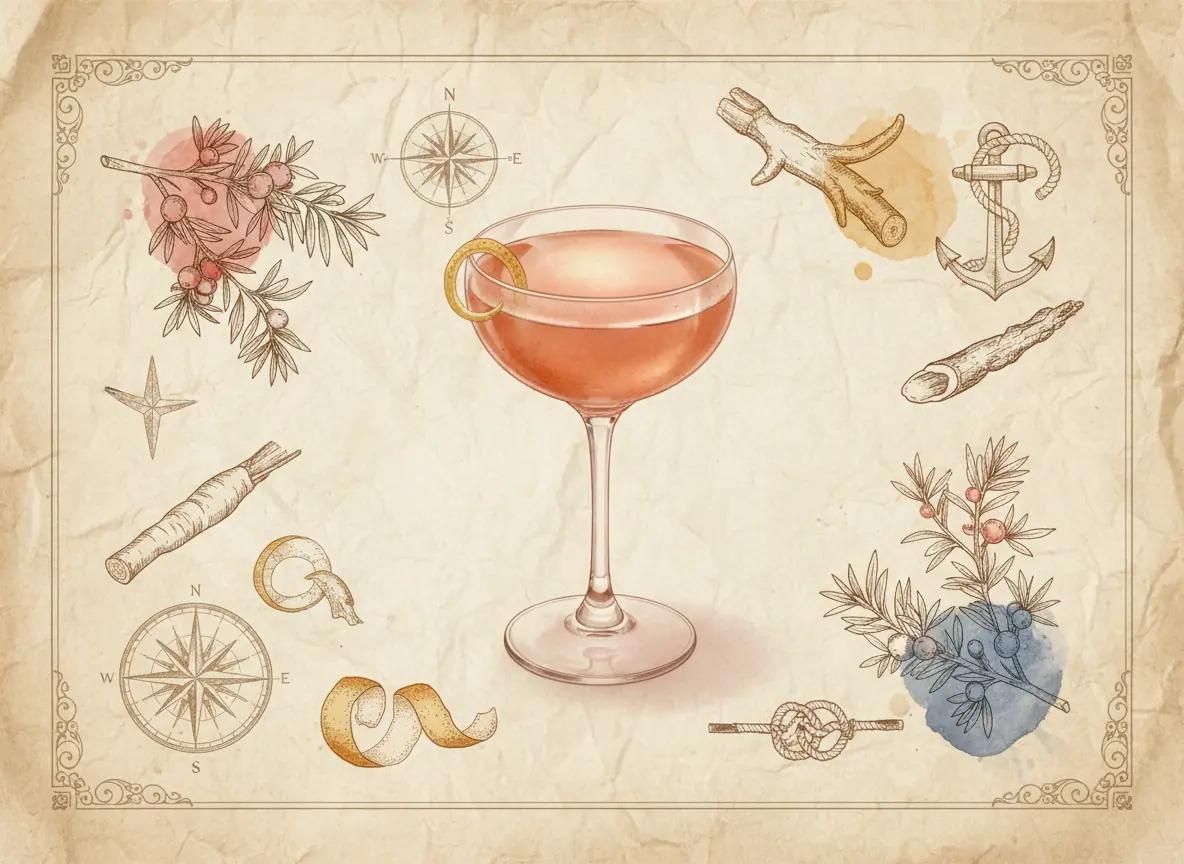
Pink Gin
A Pink Gin is 60ml Plymouth gin and four dashes of Angostura bitters, stirred over ice for 20 to 30 seconds and strained into a chilled coupe, with lemon peel twisted over the surface and discarded. The bitters turn the gin pale pink and give the drink its name. About 2.6 UK units. Punch, a secondary source, tells it as a Royal Navy drink: thousands of barrels of Plymouth gin were shipped to the Navy each year, naval officers took to Angostura’s bitters for their purported cures, including the promise to quell seasickness, and a dash in the daily gin ration made the Pink Gin. Angostura’s own site says Dr Johann Siegert first produced the bitters in 1824 as a medicinal tincture for stomach ailments. We found no primary source for the naval story. It is a different thing from the pink gins sold in bottles today, which are flavoured and coloured with red fruit. With only two ingredients, the gin and the measure of bitters decide everything.
Variations
Glassware: Coupe Glass
Garnish: Lemon twist expressed and discarded
Ingredients
60ml
Plymouth Gin at 41.2% ABV on Fareham Wine Cellar’s listing, the gin the drink is tied to. It is softer and earthier than most London Dry gins. A London Dry works and gives a sharper, more juniper-led drink.
4 dashes
Angostura, at 44.7% ABV on DrinkSupermarket’s listing. Four dashes colour the gin and carry gentian and spice through it; fewer and the drink is gin with a tint.
Instructions
Chill a coupe in the freezer or with ice water.
Add the gin and Angostura to a mixing glass.
Fill the mixing glass with cubed ice and stir for 20 to 30 seconds.
Discard the ice from the coupe and strain the drink into it.
Express a strip of lemon peel over the surface and discard it.
Expert Tip
Measure the bitters. Four dashes in 60ml of gin colour the drink and set its spice; two leave it tasting of gin with a tint, and six turn it medicinal. Use Plymouth if you can. It is softer and earthier than most London Dry gins, with less juniper, and the bitters blend into it rather than compete. A London Dry makes a sharper drink. Stir for 20 to 30 seconds and strain into a glass from the freezer. There is nothing in it but gin and bitters, so the cold and the water from the ice are all that soften it.
Behind the Pink Gin
Flavour Profile
The Origin of the Bitters
Angostura’s own site says Dr Johann Gottlieb Benjamin Siegert moved from Germany to the town of Angostura, Venezuela, in 1820 to serve as Surgeon General of Simón Bolívar’s armies, and by 1824 had perfected the formula for a medical elixir for the soldiers; the bitters began as a medicinal tincture for stomach ailments. Difford’s Guide notes that the town is now called Ciudad Bolívar.
Punch tells the story that Pink Gin was born at sea: thousands of barrels of Plymouth gin were shipped to the Royal Navy each year, and naval officers who took to Angostura’s bitters for their purported curative properties, including the promise to quell seasickness, added a dash or two to the daily gin ration. We found no primary source for that account. Punch also says the tradition of serving it at room temperature comes from there being little or no ice at sea.
Plymouth and the Navy
Pernod Ricard’s page says Plymouth gin has been handmade at the Blackfriars distillery since 1793. The Oxford Companion says the firm moved to the Black Friars distillery on South Side Street in 1821, that the brand has claimed 1793 since 1882, and that the significance of that year has never been detailed or documented. The city has long been a home of the Royal Navy, and the Companion says Plymouth gin, often bought directly from the distillery, had become an officers’ wardroom fixture by the second half of the nineteenth century, fuelling many a Pink Gin.
Plymouth gin is softer and earthier than London Dry, with less juniper and more root character. That softness is why it suits the drink. A sharper gin and four dashes of bitters pull against each other; Plymouth lets them meet.
In or Out
The traditional naval method coated the glass with bitters rather than mixing them in. The bartender swirled a few dashes around the glass and asked whether the drinker wanted them in or out: left in the glass, or poured away before the gin went in.
Out gives a faint bitters aroma that fades as the glass empties. Stirring the bitters through the gin gives an even, stronger spice that holds to the bottom of the glass, and it is easier to repeat.
Pink Gin, three ways
Stirred, served up
- How
- 60ml gin and four dashes, stirred and strained into a chilled coupe
- Effect
- Even spice, very cold
In or out
- How
- Glass coated with bitters, the excess kept or poured away, gin added
- Effect
- Bitters on the nose, fading as you drink
On the rocks
- How
- 60ml gin and three dashes over one large cube
- Effect
- Softer as the ice melts
| Method | How | Effect |
|---|---|---|
| Stirred, served up | 60ml gin and four dashes, stirred and strained into a chilled coupe | Even spice, very cold |
| In or out | Glass coated with bitters, the excess kept or poured away, gin added | Bitters on the nose, fading as you drink |
| On the rocks | 60ml gin and three dashes over one large cube | Softer as the ice melts |
Two Ingredients
With only gin and bitters, there is nothing to cover a poor gin, a short stir or a careless measure. The bitters, whose own page describes a bouquet of herbs, fruits and spices, carry the spice; the gin carries everything else.
How to Serve It
Stirred, strained into a chilled coupe, with lemon peel expressed over the surface and then discarded. No ice in the glass and no garnish.
For a long drink in the same spirit, the pink gin and tonic takes its colour and bitterness from aromatic tonic rather than Angostura.
Make it at home
The Spirit
GinGin is a spirit flavoured with juniper berries. Under the retained Regulation (EC) 110/2008, juniper must lead the taste, the floor is 37.5% ABV, and the route the flavour takes sets the grade: plain gin, distilled gin or London gin. Our recipes count it at 40%, and it carries the Martini, the Negroni and the Gin and Tonic.
Master the Techniques
More to explore
Frequently Asked Questions
What is a Pink Gin?
Is a Pink Gin the same as the pink gin in shops?
Why is it linked to the Royal Navy?
Why Plymouth gin?
What does ‘in or out’ mean?
How strong is a Pink Gin?
Can a Pink Gin be served over ice?
Sources.
Checked between 18 October and 19 October 2026.
- Punch, “Created and Forgotten at Sea: Pink Gin” (secondary source (Brad Thomas Parsons): the Royal Navy story; thousands of barrels of Plymouth gin shipped to the Navy each year; Angostura moved to Trinidad in 1875; served at room temperature for want of ice at sea).
- Angostura, “Our Story” (maker’s history: Dr Johann Siegert, Angostura, Venezuela, 1824, a medicinal tincture for stomach ailments).
- Difford’s Guide, “Angostura Aromatic Bitters” (secondary source: created in 1824 by Johann Gottlieb Benjamin Siegert from 1820 experiments with gentian root and other aromatic herbs; the town of Angostura, now Ciudad Bolivar; moved to Trinidad in 1875; alc./vol 44.7%).
- Fareham Wine Cellar, “Plymouth Gin Original Strength 41.2%” (UK retail listing: Plymouth Gin Original Strength 41.2%).
- Pernod Ricard, “Plymouth Gin” (owner’s brand page: handmade at the Blackfriars distillery since 1793).
- DrinkSupermarket, “Angostura Aromatic Bitters 200ml” (retailer listing: 44.7% ABV).
- House of Angostura, “Angostura Aromatic Bitters” (maker’s page: aromatic taste with a bouquet of fruits, spices and herbs; the page does not name gentian).
- The Oxford Companion to Spirits and Cocktails (Allen Katz and David Wondrich), “Plymouth gin” (secondary source: made at the Black Friars distillery, South Side Street, where the firm moved in 1821; the 1793 founding claimed since the 1882 trade mark, its significance never documented; an officers’ wardroom fixture in the second half of the nineteenth century).
You Might Also Like
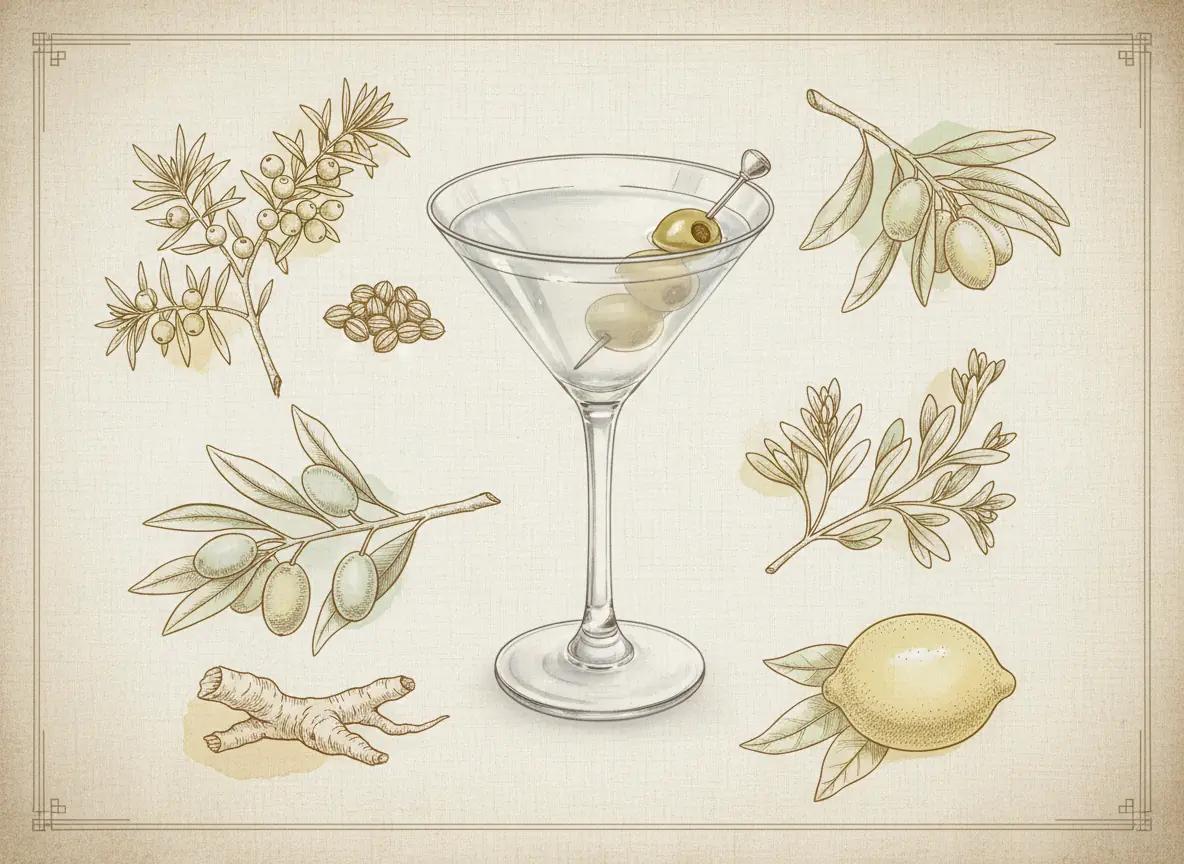
Martini
A Martini is 60ml of gin and 10ml of dry vermouth, stirred over ice for 20 to 30 seconds and strained into a chilled Martini glass, with oil from a strip of lemon peel expressed over the top, or green olives if you prefer them. That is the IBA’s Dry Martini, a six-to-one build, and about 2.6 UK units. At six to one the vermouth stops being a partner and becomes a seasoning: a dry wine note and a rounder finish under the juniper. Older recipes were far wetter, and the drink has been poured at every ratio from equal parts to a bare rinse. Nothing in a Martini is sweet or sour: it is gin, vermouth, cold and water. The stir supplies the last two, so it shapes the result as surely as the gin.
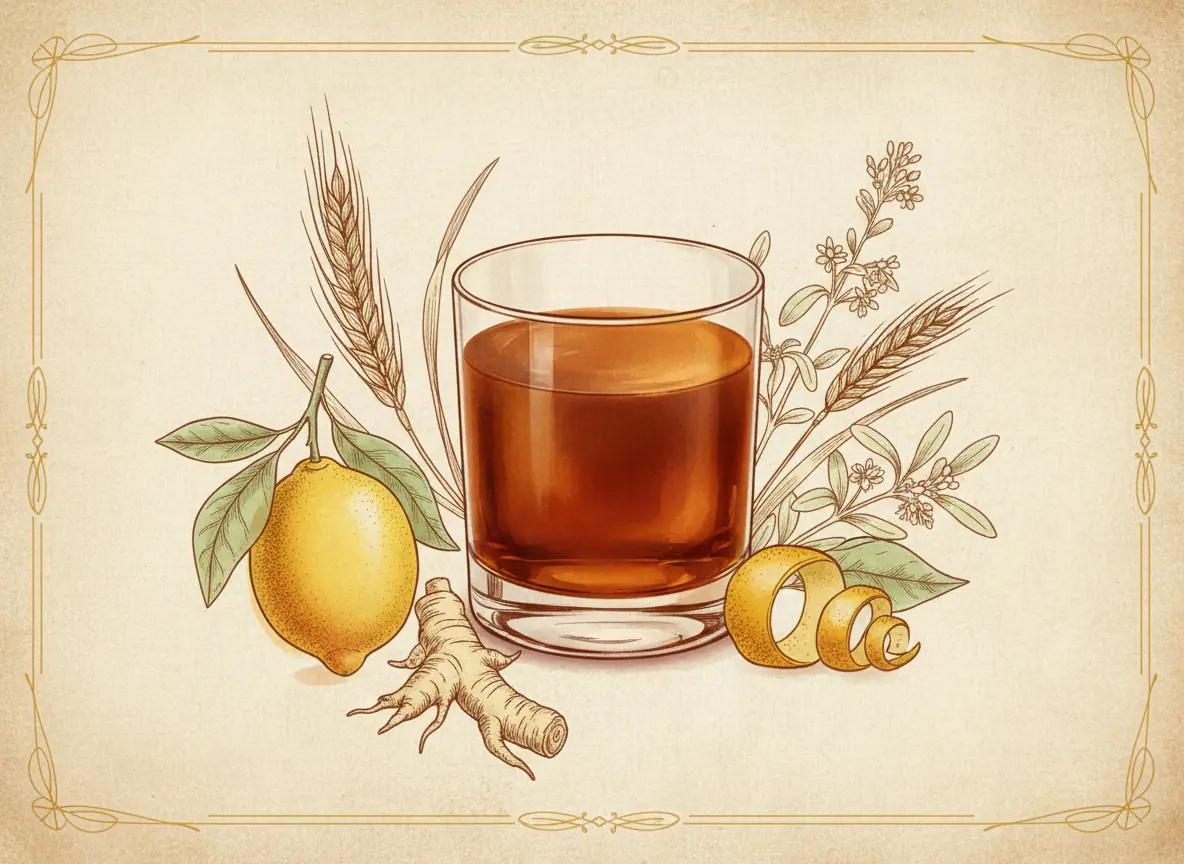
Sazerac
The IBA’s Sazerac is 50ml of cognac stirred with a sugar cube and two dashes of Peychaud’s bitters, then strained, with no ice, into a chilled rocks glass rinsed with absinthe, and finished with lemon zest. About 2.1 UK units. New Orleans more often makes it with rye whiskey. The Sazerac Company’s own history places Aaron Bird at the Sazerac House beside the Merchants Exchange from 1852 and dates the switch to rye to 1885. The Oxford Companion says the Sazerac cocktail was first mentioned in print only in 1899, and that the company’s account, which follows the historian Stanley Clisby Arthur, is undercut by numerous errors. The absinthe never goes into the mixing glass. It coats the glass and is poured away, leaving anise on the nose of every sip.
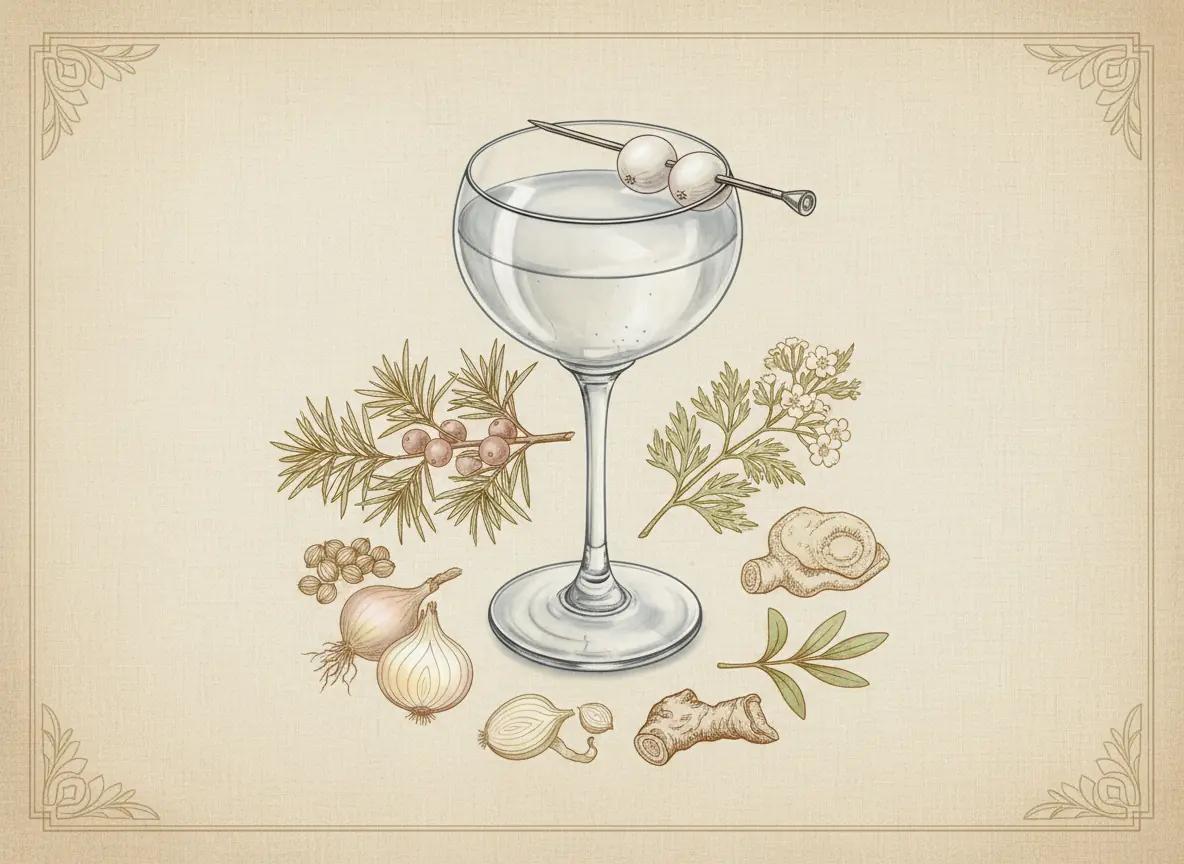
Gibson
A Gibson is 60ml London Dry gin and 10ml dry vermouth, stirred over ice for 20 to 30 seconds and strained into a chilled Nick & Nora glass, with two pickled cocktail onions on a pick. About 2.6 UK units. It is the IBA’s Dry Martini with onions where the Martini takes an olive or a lemon twist. Difford’s Guide says the full recipe for a Gibson first appears in William Boothby’s 1908 book, and that none of the early recipes mentions an onion. The name is less settled. Difford’s says the drink is said to have been created at San Francisco’s Bohemian Club in 1898, either by the businessman Walter D. K. Gibson or for the illustrator Charles Dana Gibson, and credits Charles Gibson with inspiring the onion a decade later at New York’s Players Club. The onion keeps working after it goes in. Its brine seeps into the cold gin as you drink, so the last sip is saltier and softer than the first.
Where this one sits
Recipe by Jerry Can Spirits · Updated 19 October 2026