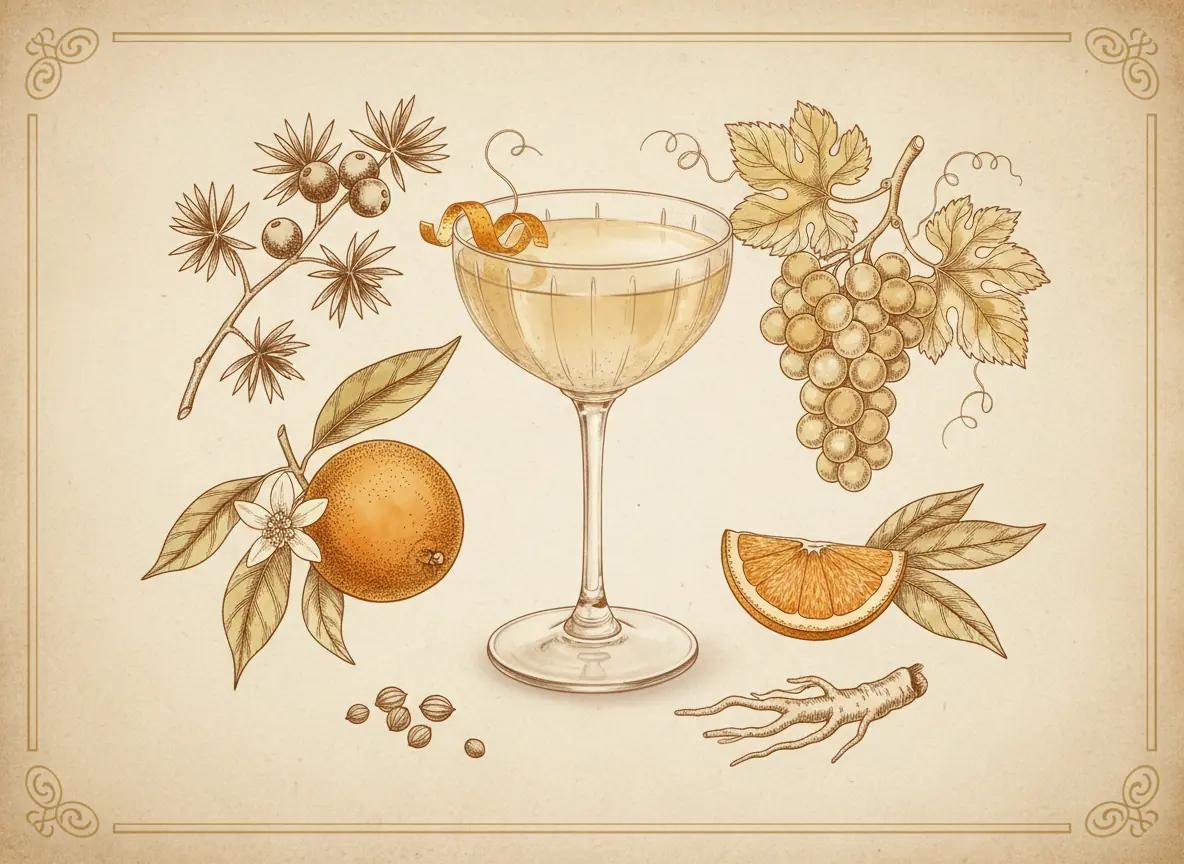
Sherry Martini
A Sherry Martini is 60ml of London Dry gin and 30ml of fino sherry with a dash of orange bitters, stirred over ice for 20 to 30 seconds and strained into a chilled coupe, with lemon peel expressed over the top. About 2.9 UK units. The fino takes the place of dry vermouth. Fino brings salt, almond and a dry, nutty edge where vermouth brings herbs. The gin still leads, with the sherry underneath it. The fino must be fresh, since the Consejo Regulador gives an open bottle of fino or manzanilla up to a week, tightly corked in the fridge. Chill it and drink the bottle quickly. The drink sits beside the Bamboo and the Adonis, longer-established sherry cocktails.
Glassware: Coupe Glass
Garnish: Lemon twist expressed
Ingredients
60ml
A London Dry at 40% ABV with clear juniper. The gin leads, and it needs enough backbone to stand over the salt of the fino.
30ml
Fino or manzanilla, at our working figure of 15% ABV, served fridge-cold. The Consejo Regulador gives an open bottle up to a week, so use a recently opened, chilled bottle. Sherry contains sulphites.
1 dash
One dash. It links the gin’s botanicals to the nutty sherry; without it the drink tastes thinner.
Instructions
Chill a coupe or Martini glass.
Add the gin, fino sherry and orange bitters to a mixing glass.
Fill with cubed ice and stir for 20 to 30 seconds.
Strain into the chilled glass.
Express a wide strip of lemon peel over the surface and rest it on the rim.
Expert Tip
Start with a fresh bottle of fino, or one opened this week and kept cold. Two ingredients and a dash of bitters leave nothing to cover a tired sherry, and it shows in the first sip. Stir for 20 to 30 seconds over plenty of ice. Gin and sherry need the water to knit together, and the drink should be cold enough to frost the glass. Buy half bottles. At 30ml a drink a full bottle outlasts its freshness, and a half bottle is finished while it still tastes bright and salty.
Behind the Sherry Martini
Flavour Profile
The Background
The Sherry Martini is one of many Martini variations that change the fortified wine and keep the format, and we found no source naming a creator.
Sherry was in American drinks long before the Martini. The Oxford Companion first records the Sherry Cobbler in the summer of 1838 and calls it one of the most popular mixed drinks of the nineteenth century. Imbibe dates the Adonis, dry sherry with sweet vermouth, to the mid-1880s. Difford’s Guide says Boothby’s 1908 book credits the Bamboo, sherry with French vermouth, to Louis Eppinger of the Grand Hotel in Yokohama, and that the drink predates 1902 by more than a decade.
Why Fino
Fino is the driest style of sherry. Flor, a yeast that grows across the surface of the wine in the barrel, shields it from air as it ages, and the sherry comes out pale and bone dry, tasting of salt and almonds. That is what the drink wants from its modifier.
Manzanilla, the same kind of sherry made in the coastal town of Sanlúcar de Barrameda, is often a little lighter and more briny. Both work; choose by how much salt you want.
Keeping the Sherry Fresh
The Consejo Regulador gives an open bottle of fino up to a week, tightly corked in the fridge. Stopper it, store it cold and pour it at between five and seven degrees, the temperature it also gives for fino and manzanilla.
The Ratio
Two to one, 60ml of gin to 30ml of fino, lets the gin lead and the sherry show. Move to equal parts for more sherry, closer to a Bamboo with gin in it. Take the fino down to 15ml for a very dry Martini with a salty edge.
Three ways to pour a Sherry Martini
Two to one (ours)
- Gin
- 60ml
- Fino
- 30ml
- Character
- Gin first, sherry clear
- UK units
- About 2.9
Equal parts
- Gin
- 45ml
- Fino
- 45ml
- Character
- Sherry forward, nuttier
- UK units
- About 2.5
Four to one
- Gin
- 60ml
- Fino
- 15ml
- Character
- Very dry, a salty edge
- UK units
- About 2.6
| Ratio | Gin | Fino | Character | UK units |
|---|---|---|---|---|
| Two to one (ours) | 60ml | 30ml | Gin first, sherry clear | About 2.9 |
| Equal parts | 45ml | 45ml | Sherry forward, nuttier | About 2.5 |
| Four to one | 60ml | 15ml | Very dry, a salty edge | About 2.6 |
How to Serve It
Stirred, strained into a cold coupe or Martini glass, lemon peel expressed over the top. It is an aperitif, for before a meal, and the gin measure is a full one. Serve it at once; it does not hold.
Make it at home
The Spirit
GinGin is a spirit flavoured with juniper berries. Under the retained Regulation (EC) 110/2008, juniper must lead the taste, the floor is 37.5% ABV, and the route the flavour takes sets the grade: plain gin, distilled gin or London gin. Our recipes count it at 40%, and it carries the Martini, the Negroni and the Gin and Tonic.
More to explore
Frequently Asked Questions
What is a Sherry Martini?
How does fino change a Martini?
How much sherry should I use?
How long does fino keep once opened?
How strong is a Sherry Martini?
Fino or manzanilla?
Who invented the Sherry Martini?
Sources.
Correct as of 19 October 2026.
- Consejo Regulador (sherry.wine), “Conservation and serving” (regulator’s own page: fino and manzanilla open bottle up to a week, tightly corked in the refrigerator; “keep always in the fridge”; fino and manzanilla served chilled, between 5° and 7°).
- The Oxford Companion to Spirits and Cocktails (David Wondrich), “The Sherry Cobbler” (secondary source: first recorded in the summer of 1838; one of the most popular mixed drinks of the nineteenth century).
- Imbibe, “Adonis cocktail” (secondary source: dates back to the mid-1880s, named for the first Broadway musical to run more than 500 performances).
- Difford’s Guide, “Bamboo” (secondary source: Boothby (1908) credits Louis Eppinger of the Grand Hotel, Yokohama; the drink predates the 1902 song by more than a decade).
You Might Also Like
Bamboo
A Bamboo is 45ml fino sherry and 45ml dry vermouth with two dashes of orange bitters and one of Angostura, stirred over ice for 20 to 30 seconds and strained into a chilled coupe, with lemon peel expressed over the top. It is built like a Martini with no spirit in it: two fortified wines, about 1.5 UK units, and around 13% ABV in the glass. William Boothby’s 1908 book credits Louis Eppinger of the Grand Hotel in Yokohama, a German bartender brought to Japan in 1889, as Difford’s Guide, a secondary source, reports. Difford’s finds the drink in newspapers from 1886, three years before Eppinger reached Japan, and an early printed recipe, Thomas Stuart’s of 1904, uses Italian sweet vermouth, which makes the drink now called the Adonis. The sherry decides it. Fino or manzanilla, served cold from a bottle opened in the last few days, gives a dry, saline drink with a nutty edge. The Consejo Regulador gives an open bottle up to a week in the fridge, and one left open longer gives a flat drink, which is usually why a Bamboo disappoints.
Alaska
An Alaska is 50ml of London Dry gin and 25ml of yellow Chartreuse with two dashes of orange bitters, stirred over ice for 30 seconds and strained into a chilled Nick & Nora, with a lemon twist. About 3.1 UK units, all of it spirit. It was in print by 1914, Punch says, when Jacques Straub’s Drinks listed it as Old Tom gin with a smaller measure of yellow Chartreuse and a dash of orange bitters, shaken. The gin-led ratio has held; the Old Tom and the shaking have not. The name is unexplained; Difford’s Guide offers only a conjecture about the Alaska gold rush and the drink’s golden colour. Yellow Chartreuse is the drink. Sweet and spicy at 43% ABV on Chartreuse’s own page, softer than green, it sweetens the gin and seasons it at once. A full 30-second stir is what turns two strong bottles into one smooth drink.
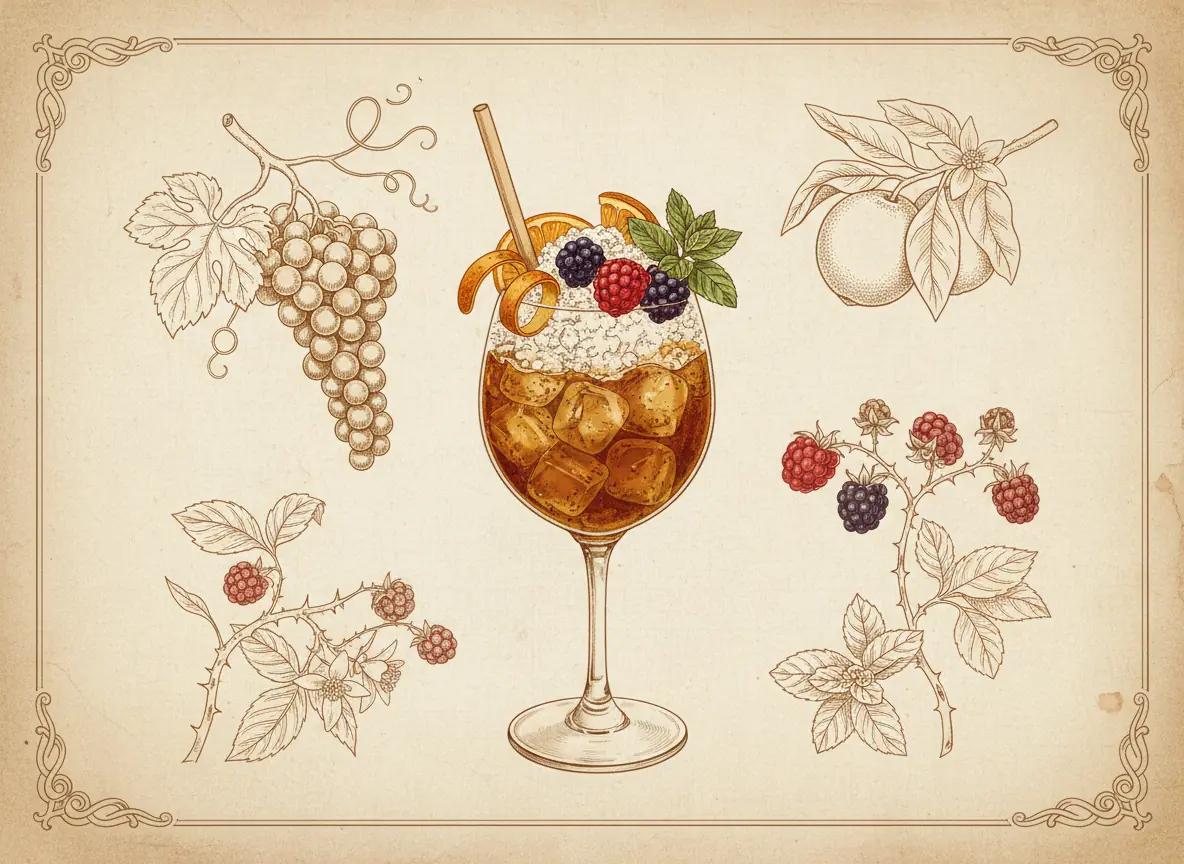
Sherry Cobbler
A Sherry Cobbler is 45ml amontillado and 45ml palo cortado shaken hard with a teaspoon of superfine sugar and two quarter wheels each of orange and lemon, then strained into a glass packed with crushed ice. Fresh berries and more quarter wheels of citrus go on top, with a straw. About 1.6 UK units. That is the IBA’s specification. The simpler recipe Jerry Thomas printed in 1862, in the Internet Archive’s scan of the book, has two wine-glasses of sherry, a table-spoonful of sugar and two or three slices of orange, shaken with shaved ice in a tumbler and ornamented with berries in season. In 1888 Harry Johnson’s manual, in the Internet Archive’s scan, called the drink “without doubt the most popular beverage in the country”, and the Oxford Companion says its decline was precipitous and Prohibition hammered in the final nail. It is a low-strength drink built on wine, so the sherry has nowhere to hide. Amontillado gives a dry, nutty base and palo cortado adds weight. The crushed ice chills it hard and dilutes it fast, and the sugar and citrus keep it bright while it does.
Where this one sits
Recipe by Jerry Can Spirits · Updated 19 October 2026