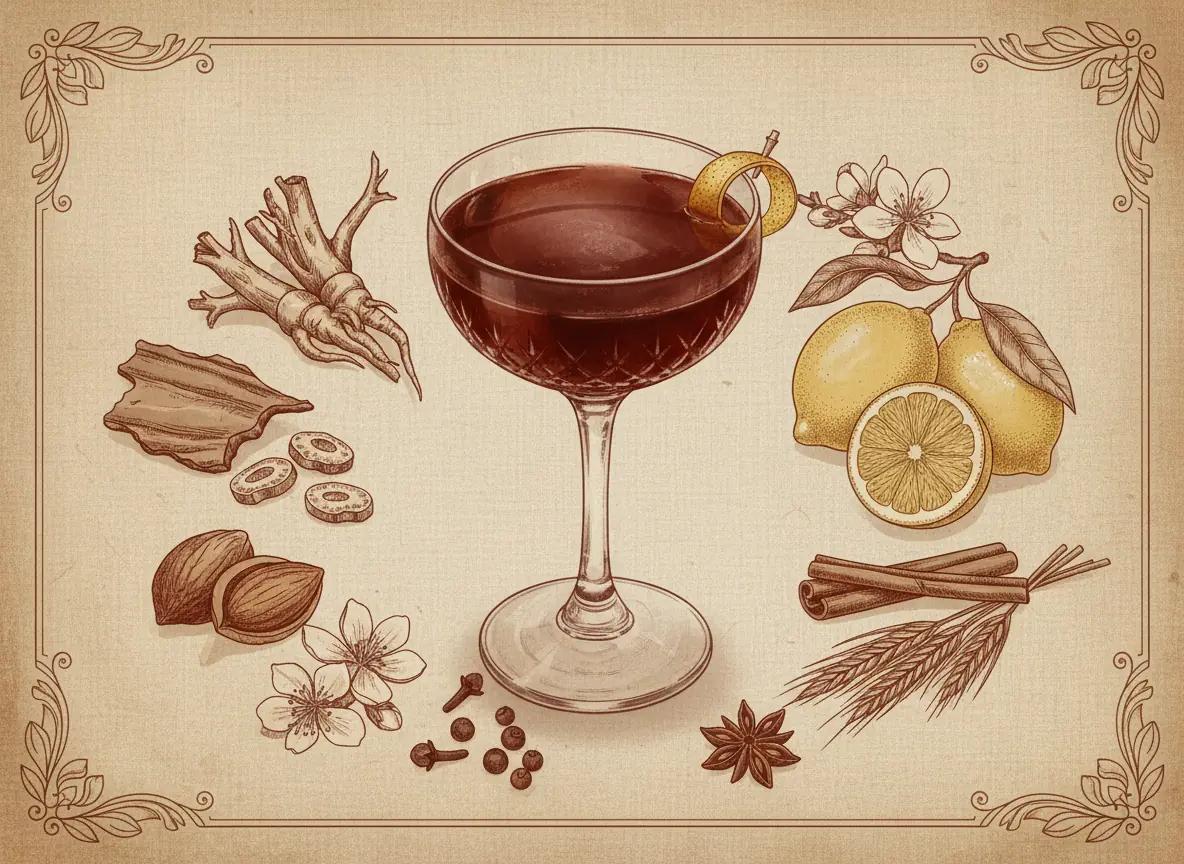
Trinidad Sour
A Trinidad Sour is 45ml Angostura bitters, 30ml orgeat, 22.5ml fresh lemon juice and 15ml rye whiskey, shaken hard for 10 to 12 seconds and double strained into a chilled coupe, with a strip of lemon peel twisted over the drink. Those are the IBA’s measures, in its New Era list. About 2.6 UK units, most of it from the bitters, which are 44.7% ABV on DrinkSupermarket’s listing. Angostura is the base here, not the seasoning. Difford’s Guide, a secondary source, says Giuseppe Gonzalez created the drink in 2009 at Clover Club in Brooklyn; Punch says he claims to have created it early in his brief time at the bar, which opened in 2008. It works because of the orgeat. At 30ml, an almond syrup has the sweetness and body to carry that much Angostura, and the lemon keeps it from cloying. The rye is small but adds the grain weight the bitters lack. Orgeat is an almond syrup, which rules the drink out for anyone allergic to tree nuts.
Glassware: Coupe Glass
Garnish: Lemon twist
Ingredients
45ml
The base, at 44.7% ABV on DrinkSupermarket’s listing. A bouquet of herbs, fruits and spices leads every mouthful, as Angostura’s own page describes it, and everything else is measured against it.
30ml
Almond syrup, the counterweight to the bitters. One made with real almonds brings body and a faint bitterness from the nut. Contains almonds, a tree nut.
22.5ml
Squeezed the same day. It stops the orgeat cloying and keeps the bitters lively.
15ml
Small and needed. A rye at our working figure of 40% ABV or a little stronger adds the grain weight Angostura lacks.
Instructions
Chill a coupe.
Squeeze the lemon juice.
Add the Angostura, orgeat, lemon juice and rye to a shaker.
Fill with cubed ice and shake hard for 10 to 12 seconds.
Double strain into the chilled coupe.
Express a strip of lemon peel over the surface and rest it on the rim.
Source: the IBA (Official IBA specification (New Era), with a lemon twist where the IBA has no garnish; method ours). Last checked 9 October 2026.
Expert Tip
The orgeat decides this drink. At 30ml against 45ml of Angostura it supplies the sweetness, the body and the texture at once. Use one made with real almonds; a thin, artificially flavoured orgeat is overwhelmed and the drink tastes harsh. Measure the Angostura in a jigger like any spirit. Shaken out through the dasher top it takes an age and the count drifts, and small changes to any of the four measures show in the glass. Do not skip the rye. At 15ml it looks negligible beside the bitters, but without it the drink tastes thin and perfumed rather than like a short sour.
Behind the Trinidad Sour
Flavour Profile
Where It Comes From
Difford’s Guide says Giuseppe Gonzalez created the Trinidad Sour in 2009 at Clover Club in Brooklyn, inspired by Valentino Bolognese’s competition-winning Trinidad Especial. Punch says Gonzalez claims to have created it early in his brief employment at the bar, which opened in 2008. The IBA now lists it in its New Era category at the same four measures.
Its premise is an inversion. Bitters normally season a drink in dashes; here they are the base, at a volume where their whole flavour comes through, and the other three ingredients are there to make that drinkable.
Bitters as the Base
An Old Fashioned uses two dashes of Angostura against 45ml of whiskey. The Trinidad Sour uses 45ml of Angostura against 15ml of rye.
At that volume Angostura behaves like a spirit: 44.7% ABV on DrinkSupermarket’s listing, with the bouquet of herbs, fruits and spices Angostura’s own page describes, where a whiskey has grain. The task is building enough sweetness and acid around it.
Where the alcohol in a Trinidad Sour comes from, with Angostura at its strength on DrinkSupermarket’s listing and rye at our working figure
Angostura bitters
- Measure
- 45ml
- ABV
- 44.7%
- UK units
- 2.0
Rye whiskey
- Measure
- 15ml
- ABV
- 40%
- UK units
- 0.6
Orgeat
- Measure
- 30ml
- ABV
- None
- UK units
- 0
Fresh lemon juice
- Measure
- 22.5ml
- ABV
- None
- UK units
- 0
Total
- Measure
- 112.5ml before dilution
- ABV
- About 23%
- UK units
- 2.6
| Ingredient | Measure | ABV | UK units |
|---|---|---|---|
| Angostura bitters | 45ml | 44.7% | 2.0 |
| Rye whiskey | 15ml | 40% | 0.6 |
| Orgeat | 30ml | None | 0 |
| Fresh lemon juice | 22.5ml | None | 0 |
| Total | 112.5ml before dilution | About 23% | 2.6 |
The Orgeat
At 30ml, orgeat has three jobs: sweetness to balance the bitters, body to give the drink texture, and almond flavour so it tastes of more than sugar.
In our experience a good orgeat made with real almonds also carries a faint bitterness from the skins, which sits well against the Angostura. A thin, artificial one tastes of sugar and flavouring, and the drink turns harsh.
The Rye
Fifteen millilitres is the smallest measure in the drink and the easiest to dismiss.
Angostura has spice but no grain and little weight in the middle of the palate. The rye supplies that; without it the drink is lighter and more perfumed, and less like a sour.
How to Serve It
In a chilled coupe after a double strain, the lemon peel twisted over the surface and laid on the rim. The IBA gives no garnish; the peel is ours, and its oil softens the first impression of the bitters.
Serve it after dinner, to someone who likes a bitter drink and is curious.
Make it at home
The Spirit
Angostura BittersAngostura aromatic bitters are a spirit with a bouquet of herbs, fruits and spices, by Angostura’s own account, made in Trinidad, 44.7% ABV on retailer listings, and measured into drinks by the dash. The name comes from the Venezuelan town of Angostura, where Angostura’s own site says Dr Johann Siegert perfected the formula by 1824; Difford’s Guide, a secondary source, says angostura bark is not an ingredient. More of our recipes use it than any other bitters, usually two dashes.
Master the Techniques
More to explore
Frequently Asked Questions
What is a Trinidad Sour?
How strong is a Trinidad Sour?
How can bitters be the base?
Why does the orgeat have to be good?
Does a Trinidad Sour contain nuts?
Is it as bitter as it sounds?
Why is it called a Trinidad Sour?
Sources.
Checked between 18 October and 19 October 2026.
- Difford’s Guide, “Trinidad Sour” (secondary source: created in 2009 by Giuseppe Gonzalez at Clover Club, Brooklyn; inspired by the Trinidad Especial of Valentino Bolognese).
- Punch, “Trinidad Sour” (secondary source: Gonzalez claims to have created it early in his brief employment at Clover Club, which opened in 2008).
- IBA, “Trinidad Sour” (official specification: 45ml Angostura bitters, 30ml orgeat, 22.5ml lemon juice, 15ml rye; New Era category).
- House of Angostura, “Angostura Aromatic Bitters” (maker’s page: aromatic taste with a bouquet of fruits, spices and herbs; the page does not name gentian).
- DrinkSupermarket, “Angostura Aromatic Bitters 200ml” (retailer listing: 44.7% ABV).
- Angostura, “Angostura aromatic bitters” (maker’s page: “one of Trinidad and Tobago’s crown jewels”; Dr Johann Siegert, 1824, named after the town of Angostura on the Orinoco).
You Might Also Like
Paper Plane
A Paper Plane is 30ml each of bourbon, Aperol, Amaro Nonino and fresh lemon juice, shaken hard and double strained into a chilled coupe. Four equal parts, which is the IBA specification: bitter orange, herbs and lemon over bourbon, at about 2.6 UK units. Punch, a secondary source, says Toby Maloney, who helped open The Violet Hour in Chicago, asked Sam Ross to create a drink for the bar, and that it was on the menu there in the summer of 2008. Ross named it after the M.I.A. song Paper Planes. The first version used Campari; Punch quotes Ross finding it slightly too bitter and short of sweetness, and he moved to Aperol. Equal parts leaves nowhere to hide. Squeeze the lemon the same day and use Nonino, not a cheaper amaro, because each ingredient is a quarter of the drink.
Sazerac
The IBA’s Sazerac is 50ml of cognac stirred with a sugar cube and two dashes of Peychaud’s bitters, then strained, with no ice, into a chilled rocks glass rinsed with absinthe, and finished with lemon zest. About 2.1 UK units. New Orleans more often makes it with rye whiskey. The Sazerac Company’s own history places Aaron Bird at the Sazerac House beside the Merchants Exchange from 1852 and dates the switch to rye to 1885. The Oxford Companion says the Sazerac cocktail was first mentioned in print only in 1899, and that the company’s account, which follows the historian Stanley Clisby Arthur, is undercut by numerous errors. The absinthe never goes into the mixing glass. It coats the glass and is poured away, leaving anise on the nose of every sip.
Last Word
A Last Word is 22.5ml each of gin, green Chartreuse, maraschino liqueur and fresh lime juice, shaken hard for 10 to 12 seconds and double strained into a chilled Nick & Nora or coupe. About 2.9 UK units. The measures are the IBA’s; the cherry or lime twist is ours. The Oxford Companion says the drink first appears in print in the Detroit Athletic Club News in 1916, on a menu at 35 cents, a high price then. Ted Saucier’s Bottoms Up of 1951 prints the recipe, quoting a club source who says Frank Fogarty, a vaudeville monologist, introduced it there about thirty years earlier. In 2003 Murray Stenson put it on the menu at the Zig Zag Café in Seattle, from where it spread, the Companion says. Four strong flavours at equal volume, and none takes over. Chartreuse brings herbs and heat, maraschino cherry and a bitter almond edge, lime the acid, and gin holds them together.
Where this one sits
Recipe by Jerry Can Spirits · Updated 19 October 2026