Vieux Carré
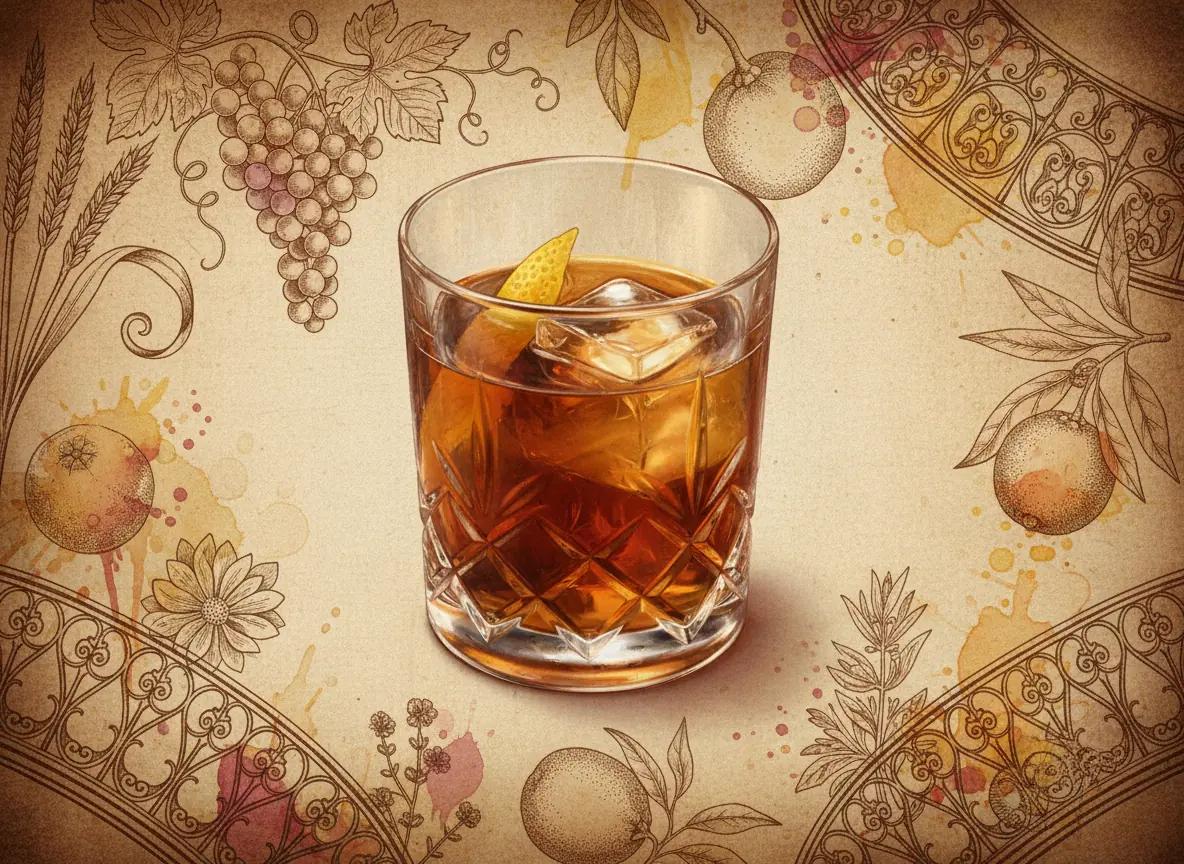
A Vieux Carré is 30ml each of rye whiskey, cognac and sweet vermouth, with 5ml of Bénédictine and two dashes of Peychaud’s bitters, stirred over ice for 20 to 30 seconds and strained over a large cube in a rocks glass, with lemon peel expressed over the top. About 3.1 UK units. Those are the IBA’s ingredients. The IBA serves it up, in a cocktail glass, finished with orange zest and a cherry; we keep the lemon peel of the recipe Stanley Clisby Arthur printed in Famous New Orleans Drinks and How to Mix ’Em, which Difford’s Guide dates to 1938, and serve it over ice. Difford’s Guide reproduces Arthur’s entry, in which Walter Bergeron, head bartender of the Hotel Monteleone cocktail lounge in New Orleans, says he originated the drink in honour of the Vieux Carré. Difford’s Guide dates it to 1938. Vieux carré means old square: the French Quarter, where the hotel stands.
Variations
Glassware: Rocks Glass
Garnish: Lemon peel
Ingredients
30ml
Rye at 40% ABV or a little stronger, with clear spice. It gives the drink its dry backbone against the cognac and vermouth.
30ml
VS or VSOP. It brings dried fruit and a round warmth that the rye lacks; an older cognac is wasted among four other ingredients.
30ml
Sweet vermouth, Italian in style and about 16% ABV, refrigerated and finished within a month. At a third of the base, a stale bottle shows.
5ml
A bar spoon, about 5ml, as the IBA specifies. Bénédictine is a herbal liqueur at 40% ABV by Bénédictine’s own page; at this measure it seasons the drink without leading it.
2 dashes
Two dashes, the only bitters the IBA lists: anise and cherry, lighter than Angostura. Arthur’s recipe, in Difford’s Guide’s reproduction, adds a dash of Angostura beside it, and that version is the variation.
Instructions
Put a large ice cube in a rocks glass to chill it.
Add the rye, cognac, sweet vermouth, Bénédictine and Peychaud’s bitters to a mixing glass.
Fill with cubed ice and stir for 20 to 30 seconds.
Strain over the large cube in the rocks glass.
Express a strip of lemon peel over the surface and rest it in the glass.
Source: the IBA (Official IBA ingredients; served over ice with lemon peel, after Arthur’s 1937 recipe, where the IBA serves it up with orange zest and a cherry; method ours). Last checked 9 October 2026.
Expert Tip
Serve it over one large cube. A big cube melts slowly and lets the drink open over twenty minutes; a glass of small cubes waters it down inside five, and the Bénédictine is the first thing you lose. Keep the Bénédictine at 5ml. It looks like a rounding error beside three 30ml pours, but it is the measure the drink is balanced at. Doubled, it pulls the glass towards honey and the two spirits stop being distinct. Stir for the full 20 to 30 seconds even though the drink goes over ice. With 95ml of spirit, vermouth and liqueur, it needs that water to open before the cube takes over.
Behind the Vieux Carré
Flavour Profile
The Origin
Difford’s Guide reproduces Stanley Clisby Arthur’s entry for the Vieux Carré in Famous New Orleans Drinks and How to Mix ’Em: the cocktail that Walter Bergeron, “head bartender of the Hotel Monteleone cocktail lounge, takes special pride in mixing”. The entry has Bergeron say he originated it “to do honor to the famed Vieux Carré”, the part of New Orleans where, it says, the antique shops and the iron lace balconies are.
Difford’s Guide dates the drink to 1938. Punch says it was invented in what was then the Swan Room, and that the Carousel Bar’s circular bartop was built on the chassis of an antique merry-go-round in 1949.
The Split Base
Rye and cognac at equal measures sound as if they should compete. They divide the work instead: the rye gives spice and dryness, the cognac dried fruit and warmth. With no citrus or soda in the glass, you can taste that division clearly.
New Orleans Bitters
Difford’s Guide says Peychaud’s bitters were created by Antoine Amédée Peychaud, a pharmacist who bought his own apothecary store on Royal Street in New Orleans in 1834 and marketed an “American Aromatic Bitter Cordial” there. In our view they taste of anise and cherry, lighter and more floral than Angostura, and the IBA’s Vieux Carré uses them alone.
Arthur’s recipe has a dash of Angostura beside the Peychaud’s. The Angostura adds clove and a drier bitterness under the anise, and the drink tastes darker for it. Make each once and keep the one you prefer.
Bénédictine as Seasoning
The bar-spoon measure of Bénédictine follows the same logic as the bar spoon of maraschino in a Martinez: a small volume of a complex ingredient contributes character without volume.
At 5ml it adds honey, herbs and a little weight, and you never pick it out by itself. Push it to 10ml and the drink starts to taste of Bénédictine first.
Three Versions Side by Side
Vieux Carré: the IBA, Arthur as Difford’s Guide reproduces his entry, and ours
Rye, cognac, sweet vermouth
- IBA
- 30ml each
- Arthur
- A third of a jigger each
- Ours
- 30ml each
Bénédictine
- IBA
- One bar spoon
- Arthur
- Half a teaspoon
- Ours
- 5ml
Bitters
- IBA
- Two dashes Peychaud’s
- Arthur
- A dash each of Peychaud’s and Angostura
- Ours
- Two dashes Peychaud’s
Served
- IBA
- Up, in a chilled cocktail glass
- Arthur
- Stirred with ice
- Ours
- Over a large cube, rocks glass
Garnish
- IBA
- Orange zest and a maraschino cherry
- Arthur
- Lemon peel; pineapple and a cherry if you wish
- Ours
- Lemon peel
| Element | IBA | Arthur | Ours |
|---|---|---|---|
| Rye, cognac, sweet vermouth | 30ml each | A third of a jigger each | 30ml each |
| Bénédictine | One bar spoon | Half a teaspoon | 5ml |
| Bitters | Two dashes Peychaud’s | A dash each of Peychaud’s and Angostura | Two dashes Peychaud’s |
| Served | Up, in a chilled cocktail glass | Stirred with ice | Over a large cube, rocks glass |
| Garnish | Orange zest and a maraschino cherry | Lemon peel; pineapple and a cherry if you wish | Lemon peel |
How to Serve It
Stirred, strained over one large cube in a rocks glass, with lemon peel expressed over the top. It is strong and slow, so serve it after dinner and let it change as the ice melts.
Rye and Bénédictine meet again, with absinthe, in La Louisiane; the plain rye and vermouth frame underneath both is the Manhattan.
Make it at home
The Spirit
Whiskey (Rye)Rye whiskey, under the US standard 27 CFR 5.143, takes at least 51% of its grain from rye and its colour from new charred oak, and goes into bottle at a 40% ABV minimum; our recipes take 40% as the figure. Rye makes a drier, spicier, more peppery spirit than corn, which is why stirred classics such as the Manhattan, Vieux Carré and Brooklyn are written for it. It appears in 23 of our recipes.
More to explore
Frequently Asked Questions
What is a Vieux Carré?
What does Vieux Carré mean?
Who created the Vieux Carré, and when?
Why both rye and cognac?
How strong is a Vieux Carré?
Up or over ice?
Angostura or Peychaud’s?
Is the Vieux Carré a Manhattan variation?
Sources.
Correct as of 19 October 2026.
- Difford’s Guide, “Vieux Carré Cocktail Recipe” (secondary source: created in 1938 by Walter Bergeron, then head bartender at what is now the Carousel Bar at the Monteleone; reproduces Stanley Clisby Arthur’s entry (dated 1938 there): ½ teaspoon benedictine, a dash each of Peychaud and Angostura, 1/3 jigger each of rye, cognac and Italian vermouth, lemon peel, pineapple and cherry if you wish; “He originated it, he says, to do honor to the famed Vieux Carré”).
- Punch, “Carousel Bar” (secondary source: the Vieux Carré invented there in 1938 by Walter Bergeron, when the bar was the Swan Room; the circular bartop built on the chassis of an antique merry-go-round in 1949).
- Difford’s Guide, “Peychaud’s Aromatic Cocktail Bitters” (secondary source: created by Antoine Amédée Peychaud, a pharmacist who bought his store at No. 123 Royal Street in 1834 and made an “American Aromatic Bitter Cordial”).
- IBA, “Vieux Carré” (official IBA recipe: 30ml rye, 30ml cognac, 30ml sweet vermouth, one bar spoon Bénédictine, two dashes Peychaud’s; stirred, strained into a chilled cocktail glass; orange zest and maraschino cherry).
- Bénédictine, “Bénédictine D.O.M” (producer’s product page: 40 % alc/vol).
You Might Also Like
La Louisiane
La Louisiane is 30ml each of rye whiskey, sweet vermouth and Bénédictine, with two dashes of absinthe and three of Peychaud’s bitters, stirred for 20 to 30 seconds and strained into a chilled Nick & Nora, with a maraschino cherry on a pick. About 3.1 UK units. Stanley Clisby Arthur printed it in 1937, in Famous New Orleans Drinks and How to Mix ’Em, as the special cocktail served at Restaurant de la Louisiane, “one of the famous French restaurants of New Orleans”, in Difford’s Guide’s reproduction of the book. His recipe, as Difford’s Guide reproduces it, pours a third of a jigger of each of the three, with three or four dashes each of absinthe substitute and Peychaud’s; ours keeps the thirds and trims the absinthe to two dashes. It sits on the Manhattan’s frame of rye and sweet vermouth, with Bénédictine poured at the same measure as both. In our view that makes it richer and more herbal than its parent, and the anise of the absinthe and the Peychaud’s places it in New Orleans.
Sazerac
The IBA’s Sazerac is 50ml of cognac stirred with a sugar cube and two dashes of Peychaud’s bitters, then strained, with no ice, into a chilled rocks glass rinsed with absinthe, and finished with lemon zest. About 2.1 UK units. New Orleans more often makes it with rye whiskey. The Sazerac Company’s own history places Aaron Bird at the Sazerac House beside the Merchants Exchange from 1852 and dates the switch to rye to 1885. The Oxford Companion says the Sazerac cocktail was first mentioned in print only in 1899, and that the company’s account, which follows the historian Stanley Clisby Arthur, is undercut by numerous errors. The absinthe never goes into the mixing glass. It coats the glass and is poured away, leaving anise on the nose of every sip.
Boulevardier
A Boulevardier is 45ml bourbon, 30ml Campari and 30ml sweet vermouth, stirred over ice for 20 to 30 seconds and strained over fresh ice in a rocks glass, with orange peel. It is the bourbon Negroni: the same Campari and vermouth with bourbon in place of gin, and that one change makes it warmer and rounder. About 3.0 UK units. It first appeared in print in Barflies and Cocktails, Harry MacElhone’s book, published in Paris in 1927, in a chapter by the columnist Arthur Moss, as the cocktail of Erskine Gwynne, an American in Paris who, Difford’s Guide says, helped found a monthly magazine called Boulevardier. Barflies and Cocktails gives the 1927 recipe as equal parts Campari, Italian vermouth and bourbon. The measures here are the IBA’s, with the bourbon ahead of the other two. Equal parts works well with a lighter vermouth. Against a rich one such as Carpano Antica Formula, the extra 15ml of bourbon keeps the drink from turning heavy.
Where this one sits
Recipe by Jerry Can Spirits · Updated 19 October 2026