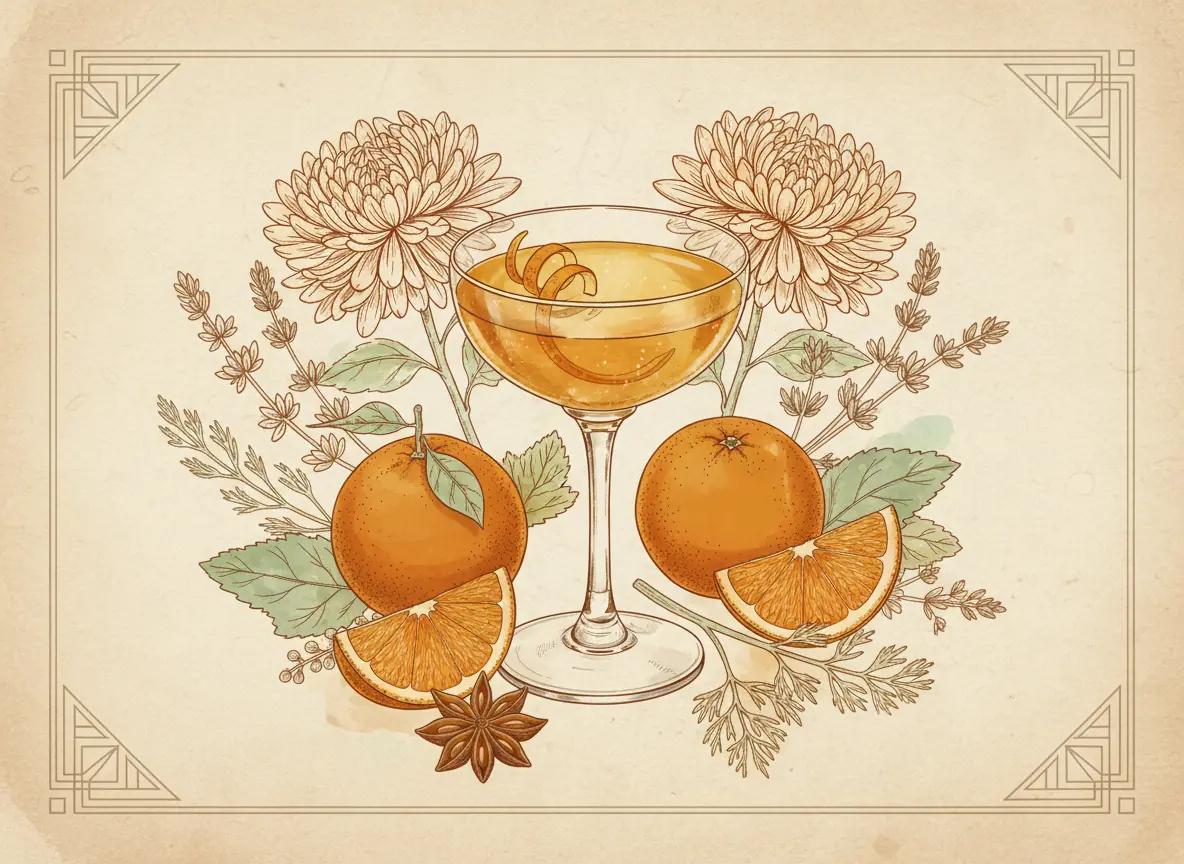
Chrysanthemum
A Chrysanthemum is 60ml of dry vermouth and 30ml of Bénédictine, stirred over ice for 20 to 30 seconds and strained into a chilled, absinthe-rinsed coupe, with orange peel expressed over the top. About 2.3 UK units. There is no base spirit, but 30ml of Bénédictine, 40% on its maker’s product page, makes it as strong as our Manhattan. Difford’s Guide reads a Chrysanthemum in Hugo Ensslin’s 1917 Recipes for Mixed Drinks, in equal parts Bénédictine and French vermouth with three dashes of absinthe, and says it may well have been in his 1916 first edition. Harry Craddock’s 1930 Savoy Cocktail Book, which the Oxford Companion says drew heavily on Ensslin, made it two to one, the ratio poured today, which keeps the liqueur from taking over. Many recipes stir two or three dashes of absinthe into the drink; we rinse the glass instead. The vermouth is two-thirds of the glass, so its freshness decides the drink. We keep the bottle in the fridge and finish it within a month.
Glassware: Coupe Glass
Garnish: Orange peel
Ingredients
60ml
At our working figure of about 18% ABV, two-thirds of the drink. We keep it in the fridge after opening and finish it inside a month; there is no spirit here to cover a stale bottle. Vermouth is a wine, so it contains sulphites.
30ml
At 40% ABV on its maker’s product page: honey, saffron and herbs, and most of the drink’s strength. Thirty millilitres gives sweetness and depth under the vermouth. There is no close substitute.
5ml, for the rinse
Our recipes assume 68% ABV, though the Oxford Companion says absinthe is typically bottled at 55 to 72%. Turned round the inside of the chilled coupe, then tipped out, leaving a film of anise. Many recipes stir two or three dashes into the drink instead, which makes the anise louder.
Instructions
Chill a coupe in the freezer or with ice and water.
Empty the coupe, pour in the absinthe, swirl to coat the inside and discard the excess.
Add the dry vermouth and Bénédictine to a mixing glass and fill with cubed ice.
Stir for 20 to 30 seconds.
Strain into the rinsed coupe.
Express a wide strip of orange peel over the surface and rest it on the rim.
Our version
Ensslin’s recipe, by Difford’s Guide, is equal parts; Craddock’s of 1930 is two parts dry vermouth to one of Bénédictine with dashes of absinthe stirred in. Ours is 60ml to 30ml, with the absinthe as a rinse.
Source: our own specification. Last checked 10 October 2026.
Expert Tip
Coat the whole glass, walls as well as base. Pour in the absinthe, tilt and turn the coupe so it reaches the rim all the way round, then tip out the rest. A pool left at the bottom makes the last sips taste of nothing else. Open a fresh bottle of dry vermouth if yours has stood at room temperature. At 60ml it is two-thirds of the drink, and a tired vermouth tastes flat and faintly medicinal however good the Bénédictine is. Stir for 20 to 30 seconds. Vermouth and Bénédictine need the dilution to knit together; under-stirred, they taste like two things side by side.
Behind the Chrysanthemum
Flavour Profile
The Origin
Hugo Ensslin published Recipes for Mixed Drinks in 1916 and an expanded second edition in 1917, the Oxford Companion says. Difford’s Guide reads the Chrysanthemum in the 1917 edition, which it says may well have been in the 1916 first edition, as “½ Benedictine ½ French Vermouth” with three dashes of absinthe.
Harry Craddock printed the drink in the Savoy Cocktail Book of 1930, which came after Ensslin; the Companion says Craddock plundered Ensslin’s book wholesale. Difford’s Guide gives Craddock’s recipe as one third Bénédictine and two thirds French vermouth, the ratio now usual, which keeps the Bénédictine from overwhelming the vermouth.
The Structure
Two parts dry vermouth to one of Bénédictine. The vermouth leads: dry, winey, lightly bitter and herbal. The Bénédictine sits under it with honey, saffron and warmth, and brings most of the alcohol. The absinthe ties them together, its anise touching the herbs in both.
The Rinse
A small measure of absinthe coats the chilled glass and the rest is tipped out. What clings is too little to measure or count in the units, but it scents each sip with anise.
Many printed recipes stir two or three dashes into the drink instead, which makes the absinthe a flavour rather than a scent. That is a fair choice, and a louder drink.
No Base Spirit, Full Strength
The Chrysanthemum is often listed as a low-alcohol drink because it has no base spirit. The numbers say otherwise. Thirty millilitres of Bénédictine at 40% ABV, its maker’s figure, is 1.2 units, and 60ml of dry vermouth at our working figure of 18% adds another 1.08, so the glass holds about 2.3 units, as much as our Manhattan.
The Bamboo and the Adonis, built on sherry and vermouth with no liqueur, are the light members of this family.
Three Wine-Led Classics
The Chrysanthemum beside the Bamboo and the Adonis; the units are our calculation at our working figures (dry vermouth 18%, sweet vermouth 16%, fino 15% per the Consejo Regulador, Bénédictine 40% on its maker’s product page)
Chrysanthemum
- Wine
- 60ml dry vermouth
- Liqueur
- 30ml Bénédictine
- Bitters or absinthe
- Absinthe rinse
- UK units
- About 2.3
Bamboo
- Wine
- 45ml fino sherry, 45ml dry vermouth
- Liqueur
- None
- Bitters or absinthe
- Orange bitters and Angostura
- UK units
- About 1.5
Adonis
- Wine
- 45ml fino or manzanilla, 30ml sweet vermouth
- Liqueur
- None
- Bitters or absinthe
- Orange bitters
- UK units
- About 1.2
| Drink | Wine | Liqueur | Bitters or absinthe | UK units |
|---|---|---|---|---|
| Chrysanthemum | 60ml dry vermouth | 30ml Bénédictine | Absinthe rinse | About 2.3 |
| Bamboo | 45ml fino sherry, 45ml dry vermouth | None | Orange bitters and Angostura | About 1.5 |
| Adonis | 45ml fino or manzanilla, 30ml sweet vermouth | None | Orange bitters | About 1.2 |
How to Serve It
Stirred, strained into the rinsed coupe, with orange peel expressed over the surface and rested on the rim. It does not hold, so drink it soon after straining, when it is at its coldest and the anise is clearest. Before a meal is its natural place.
For dry vermouth with fino sherry, make a Bamboo; for the same liqueur over rye whiskey, a Monte Carlo.
Make it at home
The Spirit
Dry VermouthDry vermouth is the pale, French style of vermouth, about 18% ABV, with herbs and a light bitterness; under Regulation (EU) 251/2014, a dry label means under 50g of sugar per litre. Our Martini takes 10ml of it with 60ml of gin, and it is half of a Bamboo, where it brings herbs and wine acidity without sweetening the drink.
Master the Techniques
More to explore
Frequently Asked Questions
What is a Chrysanthemum?
Is the Chrysanthemum a low-alcohol cocktail?
Where does the Chrysanthemum come from?
How does it differ from a Martini?
How does the absinthe rinse work?
Which dry vermouth should I use?
How strong is a Chrysanthemum?
Sources.
Checked between 18 October and 19 October 2026.
- The Oxford Companion to Spirits and Cocktails (David Wondrich), “Ensslin, Hugo Richard” (secondary source: Recipes for Mixed Drinks of 1916, expanded in 1917; Craddock plundered it wholesale for the 1930 Savoy Cocktail Book).
- Difford’s Guide, “Chrysanthemum” (secondary source: Ensslin 1917 text “½ Benedictine ½ French Vermouth”, 3 dashes absinthe; Craddock 1930 “1/3 Bénédictine, 2/3 French Vermouth”).
- Bénédictine, “Bénédictine D.O.M” (producer’s product page: 40% alc/vol; “a secret recipe of 27 herbs and spices”).
- The Oxford Companion to Spirits and Cocktails (Gwydion Stone), “absinthe” (secondary source: typically bottled at 55 to 72 percent ABV).
You Might Also Like
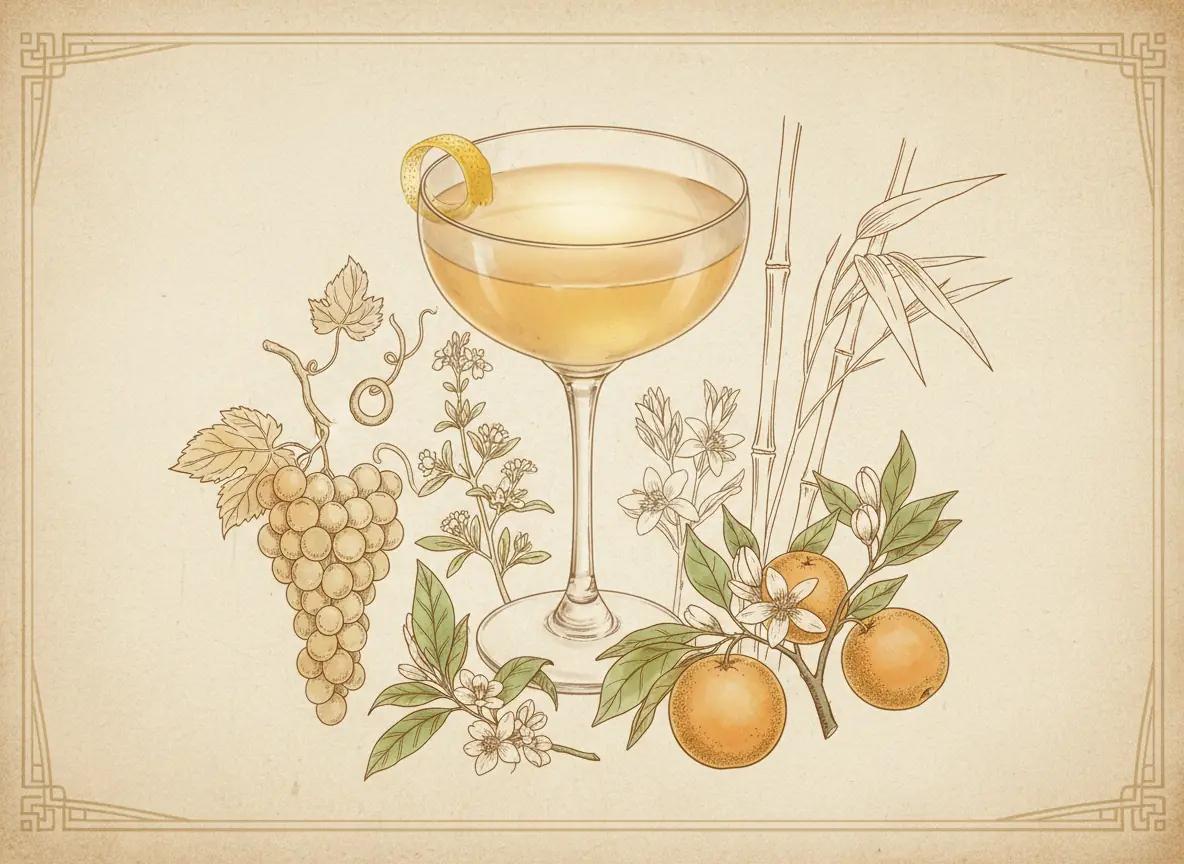
Bamboo
A Bamboo is 45ml fino sherry and 45ml dry vermouth with two dashes of orange bitters and one of Angostura, stirred over ice for 20 to 30 seconds and strained into a chilled coupe, with lemon peel expressed over the top. It is built like a Martini with no spirit in it: two fortified wines, about 1.5 UK units, and around 13% ABV in the glass. William Boothby’s 1908 book credits Louis Eppinger of the Grand Hotel in Yokohama, a German bartender brought to Japan in 1889, as Difford’s Guide, a secondary source, reports. Difford’s finds the drink in newspapers from 1886, three years before Eppinger reached Japan, and an early printed recipe, Thomas Stuart’s of 1904, uses Italian sweet vermouth, which makes the drink now called the Adonis. The sherry decides it. Fino or manzanilla, served cold from a bottle opened in the last few days, gives a dry, saline drink with a nutty edge. The Consejo Regulador gives an open bottle up to a week in the fridge, and one left open longer gives a flat drink, which is usually why a Bamboo disappoints.
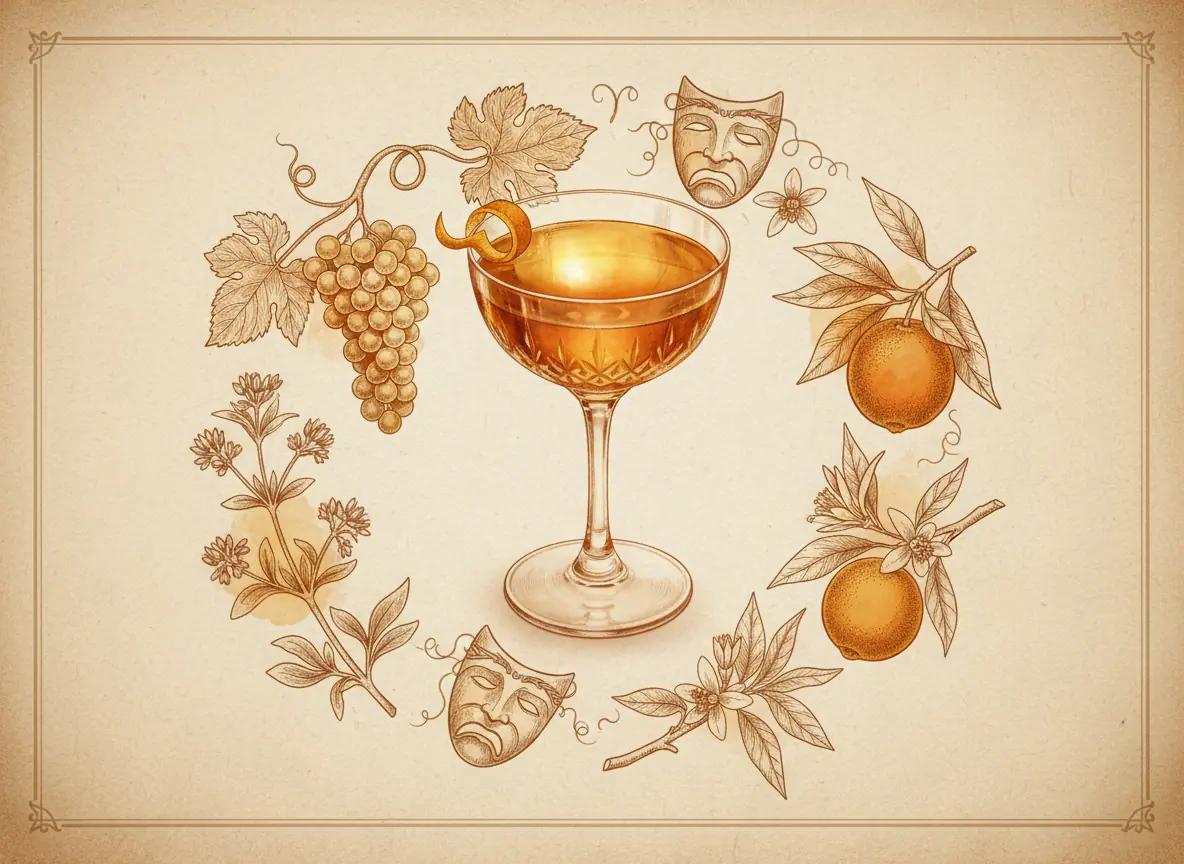
Adonis
An Adonis is 45ml of fino sherry and 30ml of sweet vermouth with two dashes of orange bitters, stirred over ice for 20 to 30 seconds and strained into a chilled coupe, with orange peel expressed over the top. It contains no spirit at all, and comes to about 1.2 UK units. It takes its name from Adonis, a Broadway burlesque of 1884, by VinePair’s account. Imbibe says the drink was named in honour of the first Broadway musical to run for more than 500 performances, and Australian Bartender names the Waldorf-Astoria or, by David Wondrich’s account, the Hoffman House as the bar that made it. It is the sweet-vermouth sibling of the Bamboo, which takes dry vermouth. Our ratio leans towards the sherry, so the dry, saline fino keeps the vermouth from turning the drink sticky.
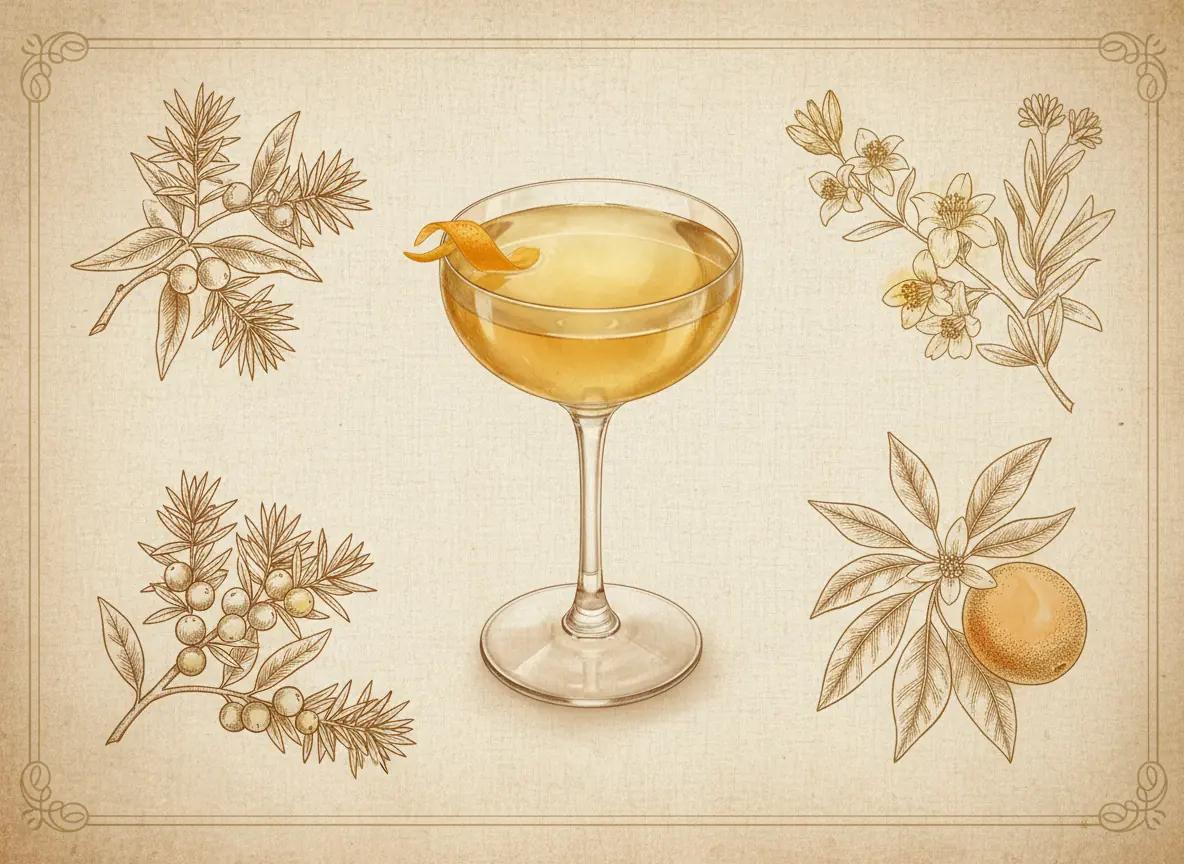
Alaska
An Alaska is 50ml of London Dry gin and 25ml of yellow Chartreuse with two dashes of orange bitters, stirred over ice for 30 seconds and strained into a chilled Nick & Nora, with a lemon twist. About 3.1 UK units, all of it spirit. It was in print by 1914, Punch says, when Jacques Straub’s Drinks listed it as Old Tom gin with a smaller measure of yellow Chartreuse and a dash of orange bitters, shaken. The gin-led ratio has held; the Old Tom and the shaking have not. The name is unexplained; Difford’s Guide offers only a conjecture about the Alaska gold rush and the drink’s golden colour. Yellow Chartreuse is the drink. Sweet and spicy at 43% ABV on Chartreuse’s own page, softer than green, it sweetens the gin and seasons it at once. A full 30-second stir is what turns two strong bottles into one smooth drink.
Where this one sits
Recipe by Jerry Can Spirits · Updated 19 October 2026