Japanese Cocktail
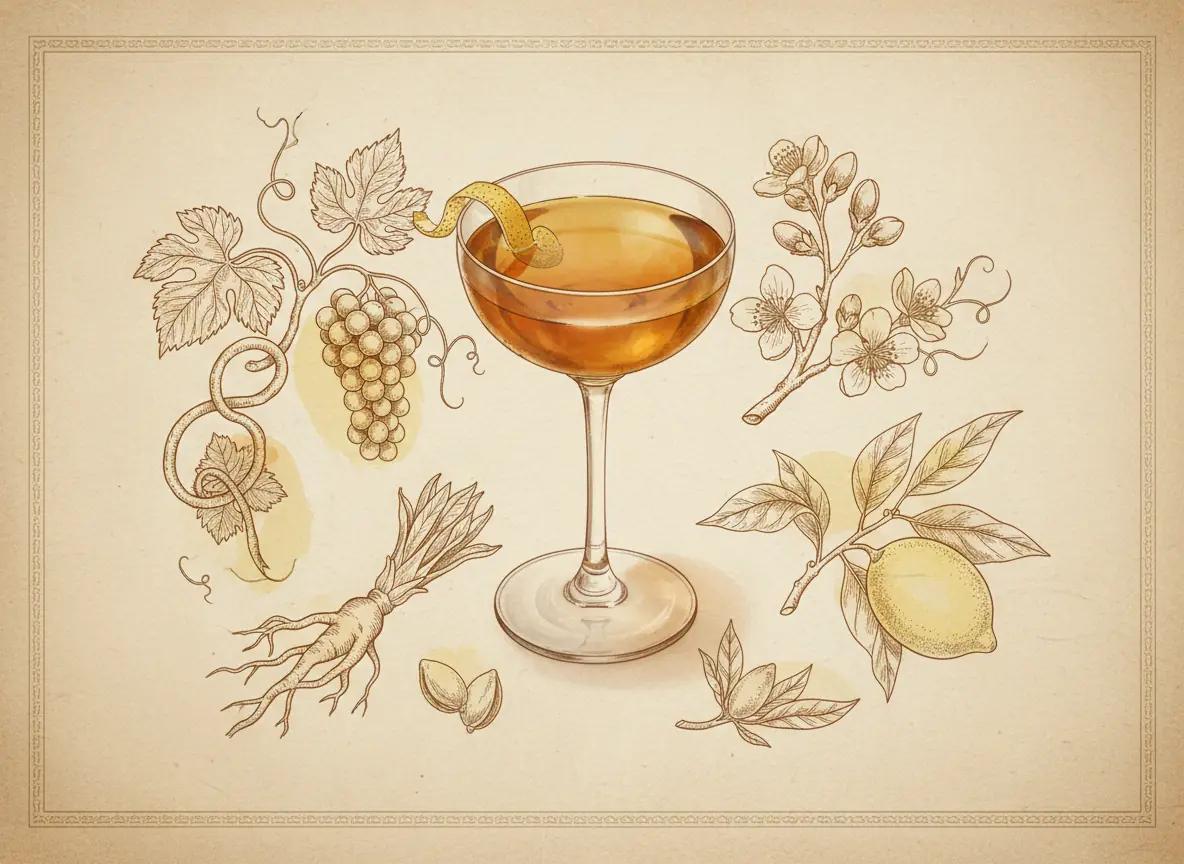
A Japanese Cocktail is 60ml of cognac, 15ml of orgeat and two dashes of Angostura bitters, stirred over ice for 20 to 30 seconds and strained into a chilled coupe, with lemon peel expressed over the top. About 2.5 UK units. Orgeat is made from almonds; keep this one away from anyone with a tree nut allergy. The recipe is Jerry Thomas’s. The Internet Archive’s scan of his 1862 How to Mix Drinks gives a table-spoonful of orgeat syrup, half a teaspoonful of Bogart’s bitters and a wine-glass of brandy, with one or two pieces of lemon peel. Punch, following David Wondrich, links the name to a member of the first Japanese diplomatic mission to America, which lodged near Thomas’s bar. Nothing Japanese goes in the glass. It is close to an Old Fashioned, with orgeat in place of sugar. That makes the orgeat the whole question: a good one tastes of almonds and has some weight; a thin one leaves sweet brandy.
Glassware: Coupe Glass
Garnish: Lemon peel expressed and rested on the rim
Ingredients
60ml
VS or VSOP at 40% ABV. Thomas wrote brandy; cognac is the usual choice now. A heavily oaked old cognac fights the almond.
15ml
Almond syrup with orange flower water. Pick one made from real almonds, which gives weight and a nutty dryness. A tree nut allergen.
2 dashes
Two dashes, where Thomas gave half a teaspoon of the bitters of his day. A third dash steadies a sweet orgeat.
Instructions
Chill a coupe.
Add the cognac, orgeat and Angostura bitters to a mixing glass.
Fill with ice and stir for 20 to 30 seconds.
Strain into the chilled coupe.
Express a strip of lemon peel over the surface and rest it on the rim.
Source: Jerry Thomas's Bar-Tender's Guide (Adapted from the 1862 Bar-Tender’s Guide: cognac for brandy, Angostura for the bitters of the day, measures in ml, peel expressed and rested on the rim; method ours). Last checked 9 October 2026.
Expert Tip
Everything depends on the orgeat. A real-almond orgeat is slightly cloudy, with weight and a trace of nutty dryness. Cheaper bottles are often sugar syrup with almond flavouring, and with three ingredients in the glass the gap is obvious at once. Stir for 20 to 30 seconds over plenty of cold, hard ice. There is no citrus to shake for, and the drink needs enough water to open the cognac without thinning it. If your orgeat runs sweet, add a third dash of Angostura before you change any measure.
Behind the Japanese Cocktail
Flavour Profile
The Origin
Punch says the Japanese Cocktail first appears in Jerry Thomas’s 1862 How to Mix Drinks. The Internet Archive’s scan gives his recipe: a table-spoonful of orgeat syrup, half a teaspoonful of Bogart’s bitters, a wine-glass of brandy and one or two pieces of lemon peel.
Punch, citing David Wondrich’s book on Thomas, suggests the name had something to do with visits to Thomas’s Broadway bar by a member of Japan’s first diplomatic mission to America, whose delegation lived nearby. The connection to Japan ends with the name.
Thomas Against Ours
The Japanese Cocktail in 1862, as the Internet Archive’s scan of How to Mix Drinks prints it, and as we make it
Spirit
- Thomas, 1862
- A wine-glass of brandy
- Ours
- 60ml cognac
Orgeat
- Thomas, 1862
- A tablespoon
- Ours
- 15ml
Bitters
- Thomas, 1862
- Half a teaspoon
- Ours
- Two dashes of Angostura
Lemon
- Thomas, 1862
- One or two pieces of peel
- Ours
- One strip, expressed and rested on the rim
| Element | Thomas, 1862 | Ours |
|---|---|---|
| Spirit | A wine-glass of brandy | 60ml cognac |
| Orgeat | A tablespoon | 15ml |
| Bitters | Half a teaspoon | Two dashes of Angostura |
| Lemon | One or two pieces of peel | One strip, expressed and rested on the rim |
A wine-glass in Thomas’s day is usually read as about two fluid ounces, close to our 60ml, and his tablespoon of orgeat is our 15ml. The proportions have hardly moved in more than 160 years.
The Structure
Spirit, sweetener, bitters: the shape of an Old Fashioned. The difference is the sweetener. Orgeat brings almond, body and a slight nutty dryness of its own, where sugar brings only sweetness.
At four parts cognac to one of orgeat the brandy leads, the almond rounds it, and the bitters keep it from tasting like dessert.
The Orgeat Question
Orgeat is where most versions go wrong. Made properly, it is almonds blended with water and sugar, often finished with orange flower water, and it is slightly cloudy and rich.
Many bottles are flavoured sugar syrup instead, and they make a thin, sweet drink. Look for almonds near the top of the ingredients, and we keep it in the fridge once opened.
Why It Is Stirred
There is no citrus, egg or cream here, so nothing needs the air a shaker adds. Stirring chills and dilutes the drink and keeps it clear.
Twenty to thirty seconds over cold, hard ice is enough. Less leaves it hot with alcohol; more turns three ingredients thin.
How to Serve It
In a chilled coupe, with lemon peel expressed over the surface and rested on the rim. The oil lifts the nose over the almond. Serve it after dinner.
Make it at home
The Spirit
CognacCognac is a grape spirit distilled twice from white wine in copper pot stills in the Cognac area of western France and, under INAO’s specification, aged at least two years in oak and sold at no less than 40% ABV. The letters on the label are minimum ages, by the BNIC’s account: VS at least two years, VSOP four, XO ten. A VS or VSOP is what our cocktails assume.
Master the Techniques
More to explore
Frequently Asked Questions
What is in a Japanese Cocktail?
Is there anything Japanese about it?
Does a Japanese Cocktail contain nuts?
Why does mine taste flat?
Should a Japanese Cocktail be shaken or stirred?
How strong is a Japanese Cocktail?
Sources.
Correct as of 19 October 2026.
- Internet Archive, “How to Mix Drinks, or The Bon-Vivant’s Companion (1862), scan” (primary source, read as text: 113. Japanese Cocktail, 1 table-spoonful of orgeat syrup, ½ teaspoonful of Bogart’s bitters, 1 wine-glass of brandy, 1 or 2 pieces of lemon peel; fill the tumbler one-third with ice and stir well).
- Punch, “Japanese Cocktail” (secondary source: first appears in Jerry Thomas’s 1862 How to Mix Drinks; Wondrich (Imbibe!) surmises a link with a member of Japan’s first diplomatic mission to America whose delegation lived near Thomas’s Broadway saloon).
You Might Also Like
Champs-Élysées
A Champs-Élysées is 45ml of cognac, 15ml of green Chartreuse, 20ml of fresh lemon juice, 10ml of sugar syrup and a dash of Angostura, shaken hard with ice for 10 to 12 seconds and double strained into a chilled coupe, finished with an expressed lemon twist. About 2.6 UK units. Difford’s Guide gives the earliest known recipe as the one in Drinks, Long and Short by Nina Toye and A. H. Adair, published in 1925: three parts brandy, one of Chartreuse and one and a half of sweetened lemon juice, with a dash of Angostura. Our measures keep the three to one of brandy to Chartreuse and split the sweetened lemon into fresh juice and syrup. It reads as a Sidecar with green Chartreuse in place of the orange liqueur. Chartreuse is 55% ABV on its own page and, in our view, intensely herbal, so even a small measure changes the whole drink: the cognac and lemon are still there, under a layer of mountain herbs.
Alaska
An Alaska is 50ml of London Dry gin and 25ml of yellow Chartreuse with two dashes of orange bitters, stirred over ice for 30 seconds and strained into a chilled Nick & Nora, with a lemon twist. About 3.1 UK units, all of it spirit. It was in print by 1914, Punch says, when Jacques Straub’s Drinks listed it as Old Tom gin with a smaller measure of yellow Chartreuse and a dash of orange bitters, shaken. The gin-led ratio has held; the Old Tom and the shaking have not. The name is unexplained; Difford’s Guide offers only a conjecture about the Alaska gold rush and the drink’s golden colour. Yellow Chartreuse is the drink. Sweet and spicy at 43% ABV on Chartreuse’s own page, softer than green, it sweetens the gin and seasons it at once. A full 30-second stir is what turns two strong bottles into one smooth drink.
Bijou
A Bijou is 40ml of London Dry gin, 20ml of green Chartreuse, 20ml of sweet vermouth and two dashes of orange bitters, stirred over cubed ice for 30 seconds and strained into a chilled Nick and Nora glass, with a lemon twist expressed over it and a cherry. About 3.0 UK units. The Oxford Companion says the drink appears to be Harry Johnson’s adaptation of a cocktail first recorded in St. Louis and Cincinnati in the spring of 1895, and that his version appeared in the 1900 edition of his Bartenders’ Manual. Bijou is French for jewel, and Difford’s Guide gives the explanation that each bottle stands for a stone by its colour: gin for diamond, vermouth for ruby, Chartreuse for emerald. At 55% ABV on Chartreuse’s own page, green Chartreuse is the force to manage. Many recipes pour the three in equal measures; ours doubles the gin so its juniper holds against the Chartreuse, with the vermouth giving body and the bitters tying the herbs together.
Where this one sits
Recipe by Jerry Can Spirits · Updated 19 October 2026