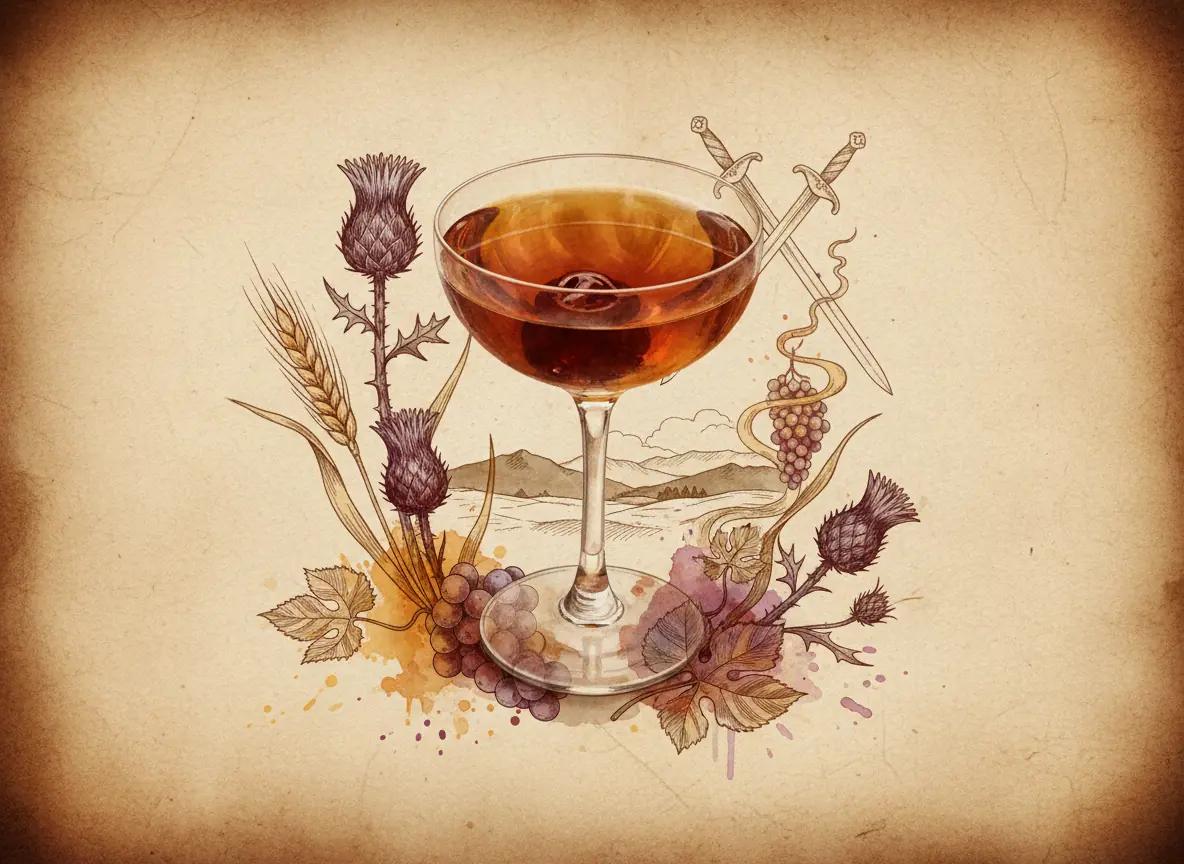
Rob Roy
A Rob Roy is 60ml of Scotch whisky, 30ml of sweet vermouth and two dashes of Angostura bitters, stirred over ice for 20 to 30 seconds and strained into a chilled coupe, with a cherry or a strip of lemon peel. About 2.9 UK units. It is the Manhattan’s Scotch relation. The Oxford Companion says there are several claims to its creation, the most creditable a letter of 1941 describing how the bartender Henry August Orphal made it at Duke’s House in Hoboken, New Jersey, for a salesman of the newly introduced Usher’s blended Scotch, and that it was in circulation by the end of 1895 and most likely named after the popular Broadway show of the time. The choice of Scotch decides the drink. A good blend gives a steady, rounded Rob Roy; a Highland or Speyside malt adds fruit and honey; a heavily peated Islay takes over the glass. If the vermouth and the whisky fight, split the vermouth into 15ml sweet and 15ml dry for a Perfect Rob Roy.
Glassware: Coupe Glass
Garnish: Luxardo maraschino cherry and Lemon peel
Ingredients
60ml
Around 40% ABV. A good blend is the dependable choice; a Highland or Speyside malt brings more fruit and honey. Heavily peated Islay whisky takes over the glass, so keep it for those who want smoke first.
30ml
A rich Italian style at our working 16% ABV. We keep it in the fridge once open and replace it within about four weeks; at a third of the glass, a tired bottle is obvious.
2 dashes
Two dashes tie the whisky to the vermouth. More and the spice starts competing with the malt.
Instructions
Chill a coupe in the freezer or with ice water.
Add the Scotch, sweet vermouth and Angostura to a mixing glass with cubed ice.
Stir for 20 to 30 seconds.
Empty the coupe and strain the drink into it.
Drop in a cherry, or express a strip of lemon peel over the surface and drop it in.
Our version
There is no current IBA specification. Ours is 60ml of Scotch, 30ml of sweet vermouth and two dashes of Angostura, stirred for 20 to 30 seconds and served up with a cherry or lemon peel.
Source: our own specification. Last checked 9 October 2026.
Expert Tip
Taste the Scotch beside the vermouth before you build. If the vermouth’s sweetness sits on top of the whisky’s fruit instead of meeting it, make a Perfect Rob Roy: 15ml each of sweet and dry vermouth in place of the 30ml of sweet. The check takes half a minute and saves a drink that does not work. We keep the vermouth in the fridge and finish it within about four weeks. At 30ml it is a third of the glass, and a stale bottle tastes flat and sour against the malt. Give the mixing glass all of the 20 to 30 seconds. A Rob Roy has no juice to soften it, and the dilution is what takes the heat off the whisky.
Behind the Rob Roy
Flavour Profile
The Origin
The Oxford Companion says there are several claims to its creation, the most creditable a letter of 1941 in G. Selmer Fougner’s column describing how the bartender Henry August Orphal made it at Duke’s House in Hoboken, New Jersey, for a salesman of the newly introduced Usher’s blended Scotch, and that it was in circulation by the end of 1895. A Manhattan made with Scotch is older: it appears in Charlie Paul’s London bar guide of 1884, which we read in the scan.
The Companion says the name most likely came from the popular Broadway show of the time. IMSLP lists Reginald De Koven’s Rob Roy, a romantic comic opera with a libretto by Harry B. Smith, as first performed at the Herald Square Theatre in New York on 29 October 1894. It takes its name from the Scottish outlaw Rob Roy MacGregor, born in 1671 and dead in 1734 according to Undiscovered Scotland, which adds that Walter Scott wrote a novel about him in 1818.
The Scotch Variable
Rye and bourbon sit fairly close together. Scotch runs from soft grain-led blends to heavily peated island malts, so the bottle moves a Rob Roy further than a change of whiskey moves a Manhattan.
A good blend gives a steady, rounded drink. A Highland or Speyside malt adds dried fruit and honey. A heavily peated Islay leads with smoke and pushes the vermouth into the background.
The Perfect Rob Roy
The Perfect version splits the vermouth: 15ml of sweet and 15ml of dry in place of 30ml of sweet. It is an alternative in its own right, not a lesser drink.
The dry vermouth adds a herbal, wine-like edge against the sweet vermouth’s fruit. It suits a fuller or peated Scotch, where extra dryness stops the sweetness crowding the malt; a light Speyside often reads better with the full sweet measure.
The Rob Roy and Its Relations
Scotch and vermouth, four ways; all four are our recipes and the units are our calculation
Rob Roy
- Scotch
- 60ml
- Vermouth
- 30ml sweet
- Seasoning
- Two dashes Angostura
- UK units
- About 2.9
Perfect Rob Roy
- Scotch
- 60ml
- Vermouth
- 15ml sweet, 15ml dry
- Seasoning
- Two dashes Angostura
- UK units
- About 2.9
Bobby Burns
- Scotch
- 45ml
- Vermouth
- 45ml sweet
- Seasoning
- 7.5ml Bénédictine
- UK units
- About 2.8
Affinity
- Scotch
- 30ml
- Vermouth
- 30ml sweet, 30ml dry
- Seasoning
- Two dashes Angostura
- UK units
- About 2.2
| Drink | Scotch | Vermouth | Seasoning | UK units |
|---|---|---|---|---|
| Rob Roy | 60ml | 30ml sweet | Two dashes Angostura | About 2.9 |
| Perfect Rob Roy | 60ml | 15ml sweet, 15ml dry | Two dashes Angostura | About 2.9 |
| Bobby Burns | 45ml | 45ml sweet | 7.5ml Bénédictine | About 2.8 |
| Affinity | 30ml | 30ml sweet, 30ml dry | Two dashes Angostura | About 2.2 |
For the American original, see the Manhattan; for a barspoon of Bénédictine in place of the bitters, the Bobby Burns; for equal thirds, the Affinity.
The Vermouth
At 30ml the vermouth is a third of the glass, and Scotch is less forgiving of a poor partner than bourbon is.
We keep it in the fridge once open, replace it within about four weeks, and choose a rich Italian style with enough body to hold its own against the malt.
How to Serve It
Stirred for 20 to 30 seconds, strained into a chilled coupe and finished with a cherry or a strip of lemon peel. A rocks glass over one large cube is a longer, cooler alternative.
At a Burns supper or on St Andrew’s Day it is the drink for guests who would rather not take their whisky neat, poured before the meal.
Make it at home
The Spirit
Whisky (Scotch)Scotch is whisky distilled and matured in Scotland, kept in oak for three years at the least, and bottled no weaker than 40% ABV. The Scotch Whisky Regulations 2009 allow only three ingredients, water, malted barley and whole grains of other cereals, and only water and plain caramel colouring may be added later. Fifteen recipes in our library call for it, from the Penicillin and Hot Toddy to the Rob Roy.
Master the Techniques
More to explore
Frequently Asked Questions
What is a Rob Roy?
How does a Rob Roy differ from a Manhattan?
Why is it called a Rob Roy?
What is a Perfect Rob Roy?
Which Scotch should I use in a Rob Roy?
Cherry or lemon peel?
How strong is a Rob Roy?
Sources.
Correct as of 19 October 2026.
- The Oxford Companion to Spirits and Cocktails (David Wondrich), “The Rob Roy” (secondary source: several claims to its creation, the most credible Henry August Orphal at Duke’s House, Hoboken (a letter of 1941); in circulation by the end of 1895; most likely named after the popular Broadway show of the time).
- Charlie Paul (1884), Internet Archive, “American and Other Drinks” (primary source: Manhattan Cocktail with half a wine glassful of Scotch whiskey, half a liqueur glass of vermouth, three or four drops of Angostura and plain syrup).
- Undiscovered Scotland, “Rob Roy MacGregor” (Scottish history site biography: born February 1671 at Glengyle, died 28 December 1734; Walter Scott’s novel Rob Roy of 1818).
- IMSLP, “Rob Roy (De Koven, Reginald)” (score library catalogue: a romantic comic opera, libretto by Harry Bache Smith, first performed 29 October 1894 at the Herald Square Theatre, New York; vocal score published by Schirmer, 1894).
You Might Also Like
Manhattan
The IBA specifies 50ml of rye whiskey, 20ml of sweet vermouth and a dash of Angostura bitters, strained into a chilled glass with a cocktail cherry; we stir it over ice for 20 to 30 seconds and serve it in a coupe. That is five parts whiskey to two of vermouth. About 2.3 UK units. The Oxford Companion says the most commonly told story puts it at New York’s Manhattan Club on 29 December 1874, at a testimonial dinner for Samuel J. Tilden, later retold with Jennie Jerome, Lady Randolph Churchill, as host or inspiration, and calls that story simply not true: she had given birth to Winston Churchill in Oxfordshire less than a month earlier. The Companion names O. H. Byron’s Modern Bartenders’ Guide among the bar books that printed the drink in 1884, and we read Byron’s and Charlie Paul’s books of that year in the Internet Archive scans. With so little in the glass, the vermouth decides it. Twenty millilitres is over a quarter of the drink, and a bottle opened months ago tastes flat and sour against the rye. We keep it in the fridge and replace it within about four weeks.
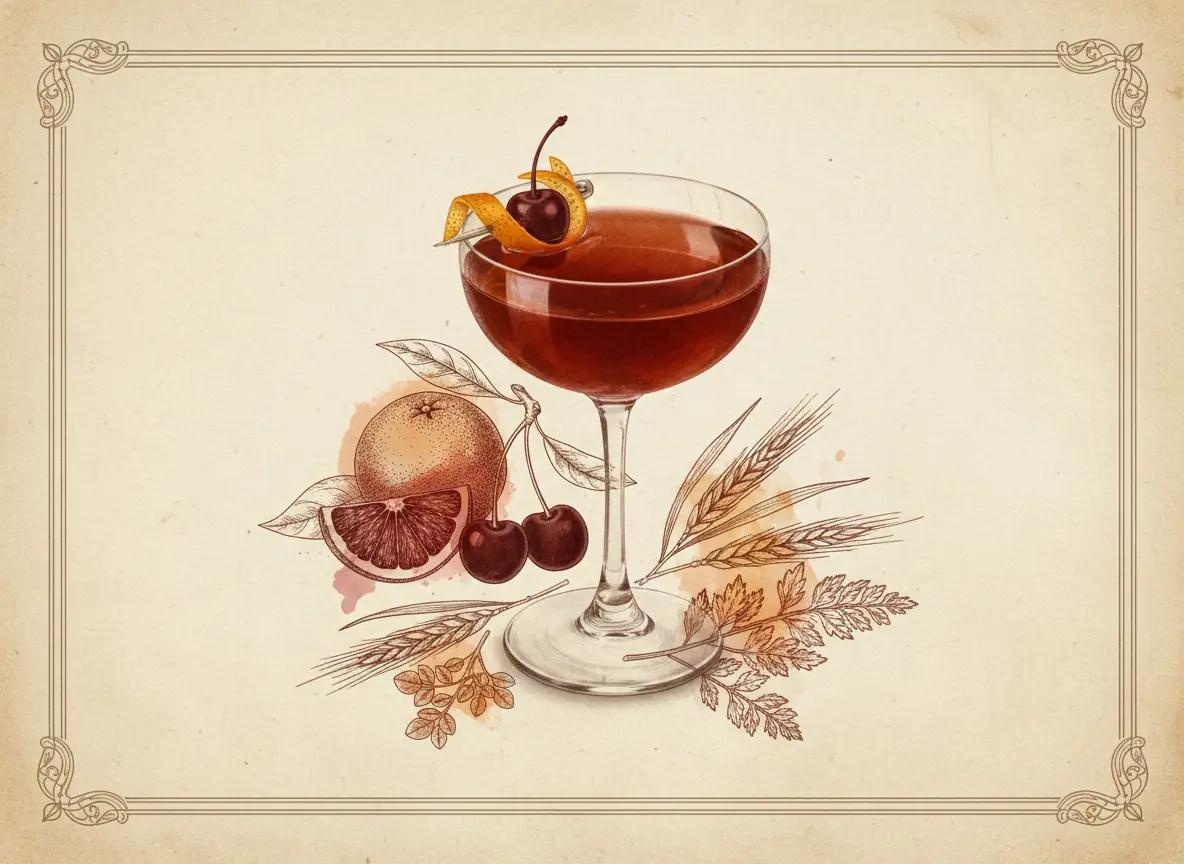
Blood & Sand
A Blood & Sand is equal parts Scotch whisky, sweet vermouth, Cherry Heering and fresh orange juice, 25ml of each, shaken hard and double strained into a chilled coupe. An expressed orange peel goes on top. No syrup goes in: the cherry liqueur and the vermouth do all the sweetening, and the glass holds about 2.0 UK units. It shares its name with Blood and Sand, the film that cast Rudolph Valentino as a bullfighter, first screened in 1922, and the Oxford Companion to Spirits and Cocktails says it first appears in Harry Craddock’s Savoy Cocktail Book of 1930. Nobody can be shown to have mixed it first. Scotch and orange juice sound like an odd pair. The vermouth and cherry join them, bridging malt and citrus with wine and dark fruit, so that no single ingredient leads.
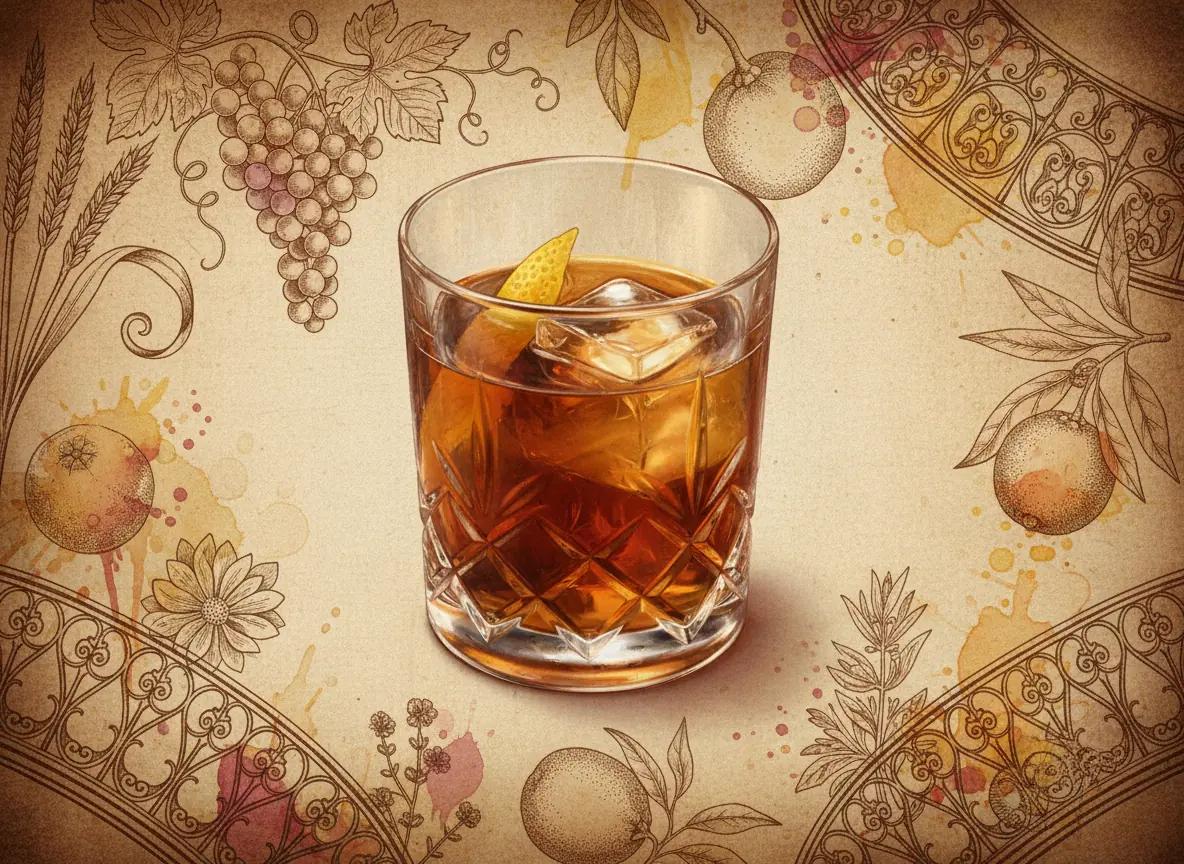
Vieux Carré
A Vieux Carré is 30ml each of rye whiskey, cognac and sweet vermouth, with 5ml of Bénédictine and two dashes of Peychaud’s bitters, stirred over ice for 20 to 30 seconds and strained over a large cube in a rocks glass, with lemon peel expressed over the top. About 3.1 UK units. Those are the IBA’s ingredients. The IBA serves it up, in a cocktail glass, finished with orange zest and a cherry; we keep the lemon peel of the recipe Stanley Clisby Arthur printed in Famous New Orleans Drinks and How to Mix ’Em, which Difford’s Guide dates to 1938, and serve it over ice. Difford’s Guide reproduces Arthur’s entry, in which Walter Bergeron, head bartender of the Hotel Monteleone cocktail lounge in New Orleans, says he originated the drink in honour of the Vieux Carré. Difford’s Guide dates it to 1938. Vieux carré means old square: the French Quarter, where the hotel stands.
Where this one sits
Recipe by Jerry Can Spirits · Updated 19 October 2026