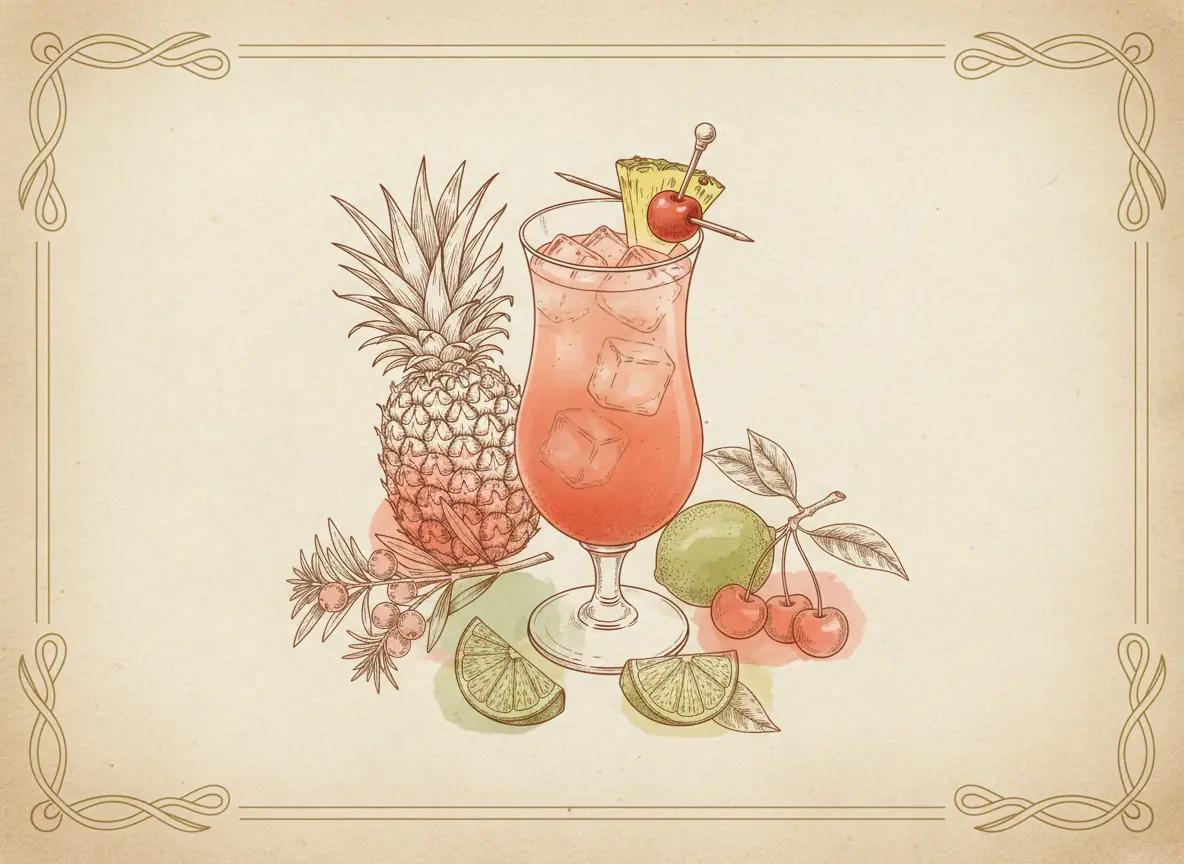
Singapore Sling
A Singapore Sling is 30ml gin, 15ml cherry liqueur, 7.5ml Cointreau, 7.5ml Bénédictine, 10ml grenadine, 120ml fresh pineapple juice, 15ml fresh lime juice and a dash of Angostura, shaken hard and strained over fresh ice in a sling or hurricane glass. That is the IBA specification, made here with Cherry Heering. It is a long, pink, fruit-led gin drink with more going on underneath than the colour suggests. It belongs to the Long Bar at the Raffles Hotel in Singapore, where Raffles, by its own account, credits its bartender Ngiam Tong Boon with creating it in 1915. The date is disputed, and the recipe first poured there is generally accepted to be lost. Fresh pineapple juice decides the result. There is 120ml of it, more than everything else in the glass combined, and juice pressed the same day gives the drink its light foam and its sharp edge. Carton juice gives a flat, sweet one.
Glassware: Sling Glass
Garnish: Pineapple slice and Luxardo maraschino cherry
Ingredients
30ml
A London Dry with clear juniper. At 30ml it is a small share of a 200ml drink, so a soft or floral gin disappears under the pineapple.
15ml
Cherry Heering, as here, or Luxardo Sangue Morlacco, which the IBA specification names. Both are true cherry liqueurs. Sweet, artificially coloured cherry brandy is not a substitute.
7.5ml
Clean orange and a little sweetness. At 7.5ml it lifts the pineapple rather than tasting of orange.
7.5ml
Herbal and honeyed, and it sits under the fruit rather than in front of it. There is no close substitute.
10ml
Made from pomegranate, not red sugar syrup. It brings the colour and a soft tartness; artificially coloured grenadine adds only sweetness.
120ml
Pressed the same day. Shaken, fresh juice throws a light foam; carton juice is heat-treated and gives neither the foam nor the sharpness.
15ml
Squeezed the same day. Against this much pineapple and liqueur it supplies the acid, and stale lime leaves the drink sweet.
1 dash
One dash. It seasons the fruit and ties the spice together; a second dash starts to taste of bitters.
Instructions
Juice the pineapple and squeeze the lime the same day, ideally just before you build.
Fill a sling or hurricane glass of 40cl or more with cubed ice to chill it.
Add the gin, Cherry Heering, Cointreau, Bénédictine, grenadine, pineapple juice, lime juice and Angostura to a shaker.
Fill the shaker with cubed ice and shake hard for 10 to 12 seconds.
Tip the ice out of the glass, refill it with fresh cubes and strain the drink over them.
Garnish with a pineapple slice and a Luxardo maraschino cherry, and serve with a straw.
Source: the IBA (Official IBA specification, with Cherry Heering for the IBA's Luxardo Sangue Morlacco; method ours). Last checked 9 October 2026.
Expert Tip
Measure the small pours. The Cointreau and Bénédictine at 7.5ml each are half a 15ml measure, and free-poured they double without anyone noticing; the drink then turns sticky and the herbal note takes over. A jigger with a 7.5ml line keeps them where they belong. Shake it hard. Ten to twelve seconds with a full shaker of ice gives the dilution a 200ml drink needs and whips the fresh pineapple into the pale foam that sits on top. That foam is part of the texture, so strain rather than pour. One pineapple gives far more juice than one drink needs. Strain it, keep it covered in the fridge and use it the same day. Better still, make the drink for several people at once.
Behind the Singapore Sling
Flavour Profile
The Raffles Story
The Singapore Sling belongs to the Long Bar of the Raffles Hotel, and the hotel, by its own account, names its creator: Ngiam Tong Boon, a bartender there, in 1915. The story attached to it is that he made the drink look like fruit juice so that women could drink alcohol in public without comment.
The date and the story come down through that tradition. Difford’s Guide, a secondary source, puts the drink between 1899, when Ngiam started work at the Raffles Hotel, and 1915, when he died, and says the weight of evidence favours him as its creator. The sling itself was already old by then: the Oxford Companion to Spirits and Cocktails records the sling in Maryland in 1778 and quotes David Wondrich dating the gin variety to 1800.
What is agreed is that the recipe first poured at Raffles is lost. Difford’s Guide says no record of Ngiam’s original survives, because the hotel was occupied in 1942, and that the only source for the recipe once touted as original is a note a visitor wrote in 1936 after asking a bartender how it was made. Published versions disagree even on the cherry spirit: Difford’s notes that Robert Vermeire’s 1922 Straits Sling calls for dry cherry brandy and David Embury’s 1948 recipe for kirschwasser, while Wondrich says only Bols and Cherry Heering turn up in local advertisements of the time. The IBA specification is the recognised modern reference, and it is the version here, with Cherry Heering as the cherry liqueur.
How the Eight Ingredients Fit
Pineapple is the body of the drink: 120ml of it against 30ml of gin. Everything else is seasoning, and each measure has one job.
Singapore Sling: what each ingredient does
Gin
- Measure
- 30ml
- Its job
- Juniper and structure under the fruit
Cherry Heering
- Measure
- 15ml
- Its job
- Dark cherry and depth of colour
Cointreau
- Measure
- 7.5ml
- Its job
- Orange that lifts the pineapple
Bénédictine
- Measure
- 7.5ml
- Its job
- A herbal, honeyed base
Grenadine
- Measure
- 10ml
- Its job
- The pink, and a little tartness
Fresh pineapple juice
- Measure
- 120ml
- Its job
- Body, length and the foam
Fresh lime juice
- Measure
- 15ml
- Its job
- The acid that keeps it from cloying
Angostura
- Measure
- One dash
- Its job
- Seasoning that ties the spice together
| Ingredient | Measure | Its job |
|---|---|---|
| Gin | 30ml | Juniper and structure under the fruit |
| Cherry Heering | 15ml | Dark cherry and depth of colour |
| Cointreau | 7.5ml | Orange that lifts the pineapple |
| Bénédictine | 7.5ml | A herbal, honeyed base |
| Grenadine | 10ml | The pink, and a little tartness |
| Fresh pineapple juice | 120ml | Body, length and the foam |
| Fresh lime juice | 15ml | The acid that keeps it from cloying |
| Angostura | One dash | Seasoning that ties the spice together |
The gin is a small share for a drink called a gin sling. It is there for juniper and backbone rather than strength, which is why a London Dry with clear juniper suits it better than a soft, floral gin the pineapple would bury.
Fresh Pineapple, and the Foam
Shaken hard, fresh pineapple juice throws a pale foam that settles on top of the drink. It comes from the juice itself, not from egg white, and it softens the first sip. Carton juice is heat-treated so that it keeps, which costs it the sharpness and the fresh aromatics, and the drink made with it is sweeter and flatter. A whole pineapple gives far more juice than one drink needs, so this is a drink to make for several people at once.
How to Serve It
Shaken, strained over fresh cubed ice in a sling or hurricane glass, with a pineapple slice and a cherry on the rim and a straw. Cubed ice, not crushed: the drink is meant to hold its balance for twenty minutes, and crushed ice would thin it within ten.
The Long Bar Premix
For years the Long Bar was widely reported to pour its Singapore Slings from a premix, and that is the version many visitors met: sweet, pink and with little going on underneath.
The bar has since reopened with a reimagined Sling. The premix years still explain why so many people think they do not like the drink. If that is how you met it, the drink made fresh is worth a second try.
Make it at home
The Spirit
GinGin is a spirit flavoured with juniper berries. Under the retained Regulation (EC) 110/2008, juniper must lead the taste, the floor is 37.5% ABV, and the route the flavour takes sets the grade: plain gin, distilled gin or London gin. Our recipes count it at 40%, and it carries the Martini, the Negroni and the Gin and Tonic.
More to explore
Frequently Asked Questions
What's in a Singapore Sling?
Who created the Singapore Sling?
What is the original Raffles recipe?
Which cherry liqueur should I use?
Can I use carton pineapple juice?
Was it made pink so women could drink in public?
How strong is a Singapore Sling?
What glass does a Singapore Sling go in?
Sources.
Checked between 18 October and 19 October 2026.
- Raffles Singapore, “Long Bar” (Ngiam Tong Boon, 1915; the fruit-juice disguise story).
- Difford’s Guide, “Singapore Sling” (secondary source: created between 1899 and 1915 by Ngiam Tong Boon at the Long Bar; the weight of evidence favours him; no record of the original recipe survives (1942 occupation; a note of 1936); Vermeire 1922 and Embury 1948 on the cherry spirit; Wondrich on Bols and Cherry Heering).
- Cointreau, “Cointreau Triple Sec” (40% Alc./Vol. in the page footer).
- Bénédictine, “Bénédictine D.O.M.” (40 % alc/vol).
- Difford’s Guide, “Cherry Heering Liqueur” (secondary source: alc./vol 24%).
- Oxford Companion to Spirits and Cocktails (spiritsanddistilling.com), “The sling” (secondary source: sling first recorded in Maryland in 1778; gin variety first attested in 1800 (Wondrich)).
You Might Also Like
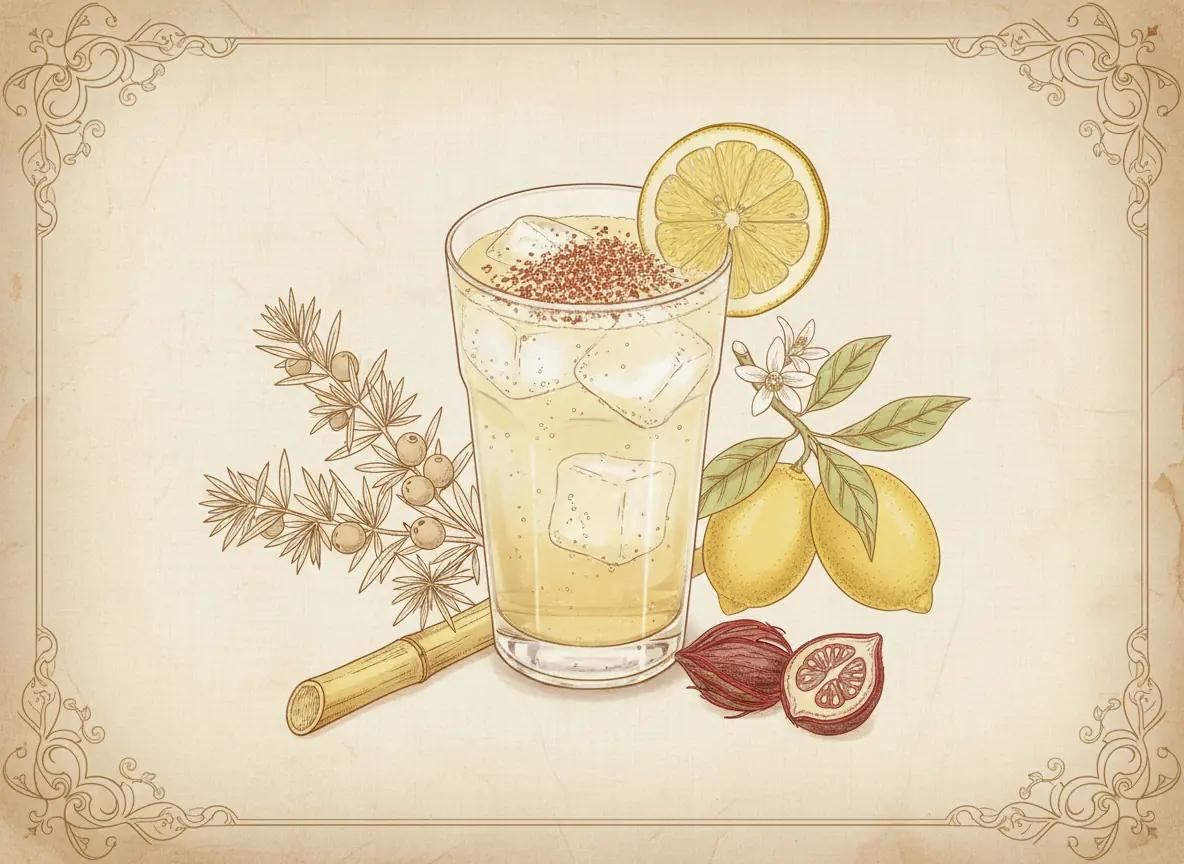
Gin Sling
A Gin Sling is 50ml London Dry gin, 25ml fresh lemon juice and 15ml sugar syrup, built over ice in a tall glass, topped with 60ml of cold soda and finished with nutmeg grated fresh over the top. The nutmeg is the part that makes it a sling. The sling is older than the cocktail. The Oxford Companion to Spirits and Cocktails, a secondary source, records the sling in Maryland in 1778 and says the first printed definition of the cocktail, in 1806, noted that it is vulgarly called bittered sling. Those early slings were spirit, sugar and water. Jerry Thomas, in his 1862 bar manual, separated the sling from the toddy by one detail: nutmeg grated on top. Lemon and soda came later, and they bring the modern Gin Sling close to the Tom Collins. The difference is in the proportions and the spice: less soda, so the gin stays in front, and a dusting of nutmeg the Collins never had.
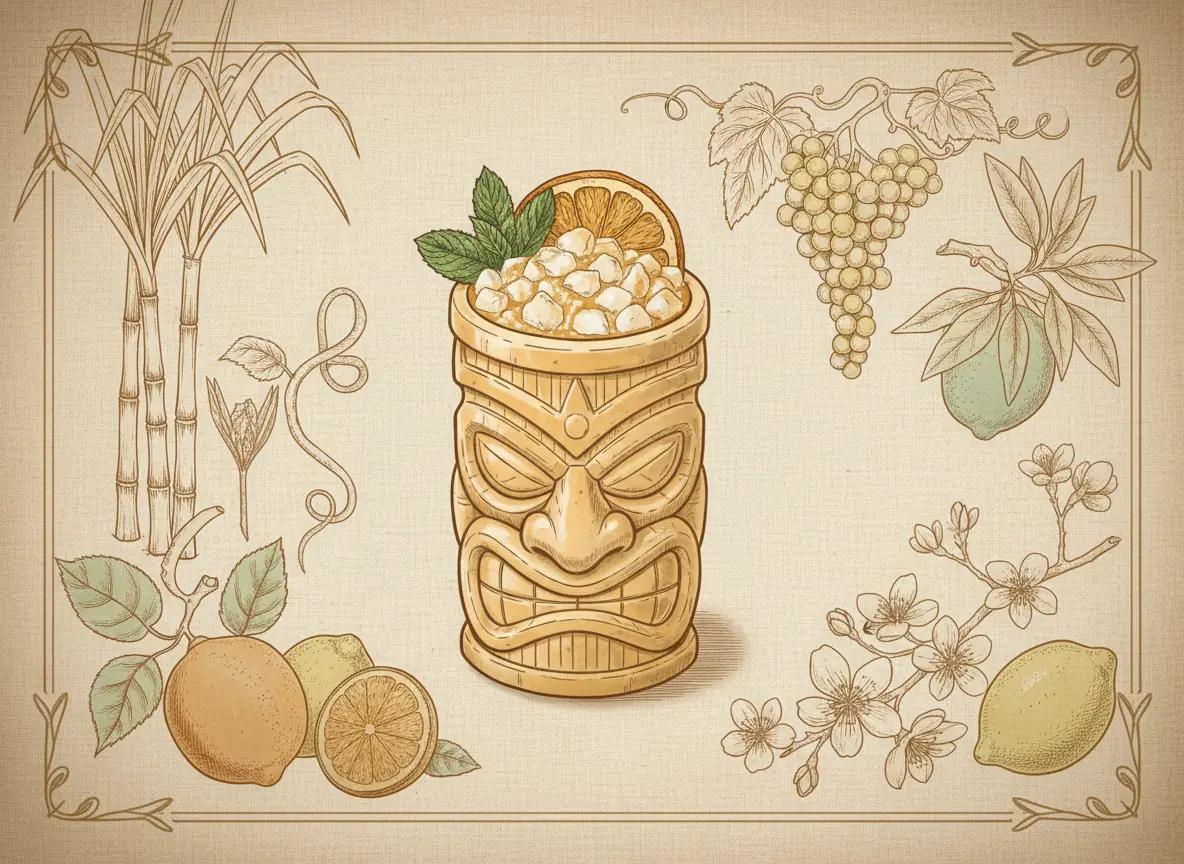
Scorpion
The Scorpion is Trader Vic’s rum and brandy sour: 45ml white rum, 22.5ml cognac, 50ml fresh orange juice, 30ml fresh lemon juice and 15ml orgeat, shaken hard and strained over crushed ice in a tiki mug or large rocks glass. The measures are adapted from Trader Vic’s Bartender’s Guide in its 1972 revised edition. Victor Bergeron, the Trader Vic of the restaurant chain, is credited with it; Punch dates his recipe to 1946, and Tasting Table traces the drink to a Honolulu punch in print by 1938. Difford’s Guide, citing Life magazine, has Vic serving the Scorpion in four-pint bowls made to serve four, and prints his 1972 recipes for a single glass and for a bowl for three or four. The single glass is the same drink at one person’s size. It comes out pale orange, almond-scented and drier than it looks, at about 2.7 UK units. Fresh orange and lemon and an orgeat made from almonds decide it. Orgeat contains nuts, which matters for anyone with an allergy.
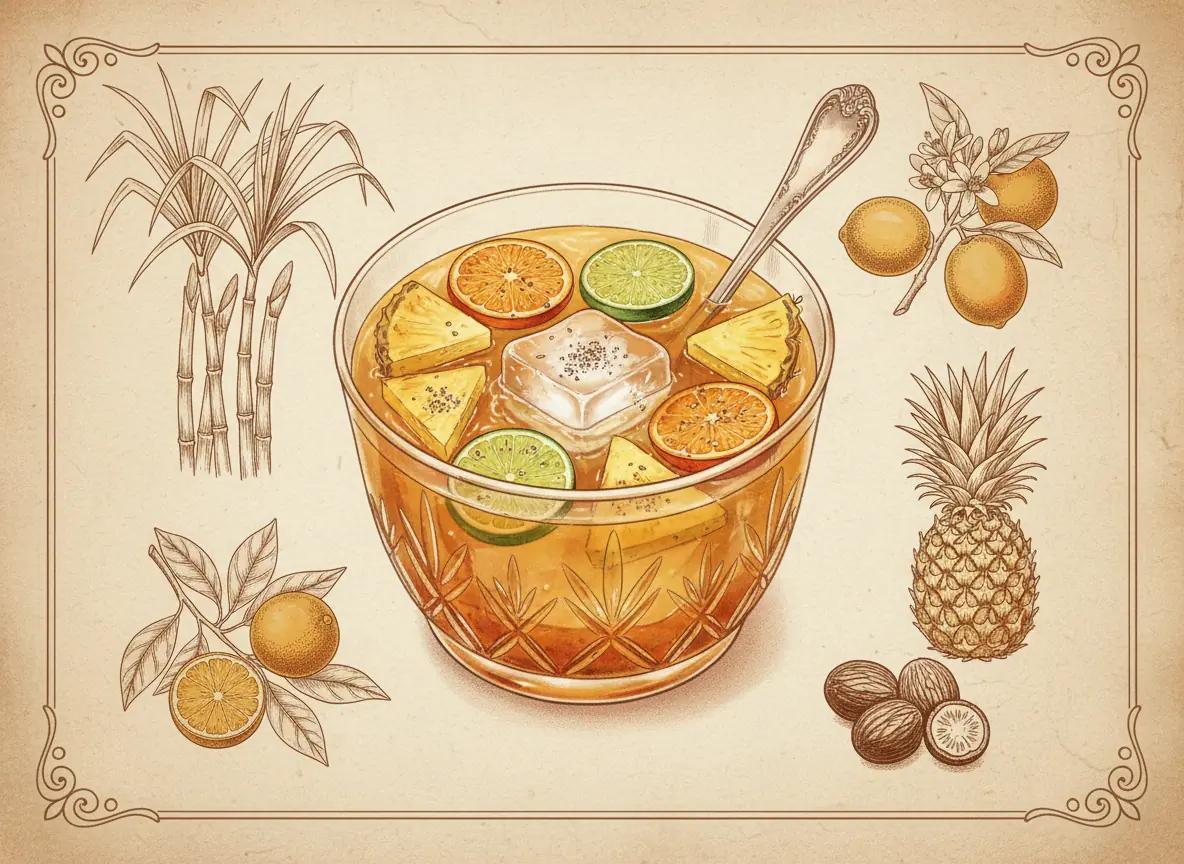
Tropical Punch
This Tropical Punch fills a bowl for eight to ten: 300ml aged rum, 150ml white rum, 300ml pineapple juice, 200ml fresh orange juice, 100ml fresh lime juice, 100ml simple syrup and six to eight dashes of Angostura, stirred over a large block of ice, with nutmeg grated over the top. About 18 UK units in the bowl, or roughly 1.8 a glass across ten. Punch began as a drink the English made in India. The word first appears in an East India Company letter of 1632, and John Fryer wrote in 1676 that it was “Indostan for Five”, for five ingredients, by the Oxford Companion’s account. This bowl keeps that shape, with the juices and the melting ice in place of the water. Two rums do different jobs: aged for body and barrel, white for lift. Build it a little tart, because the ice softens it over the evening.
Where this one sits
Recipe by Jerry Can Spirits · Updated 19 October 2026