Hawthorne Strainer
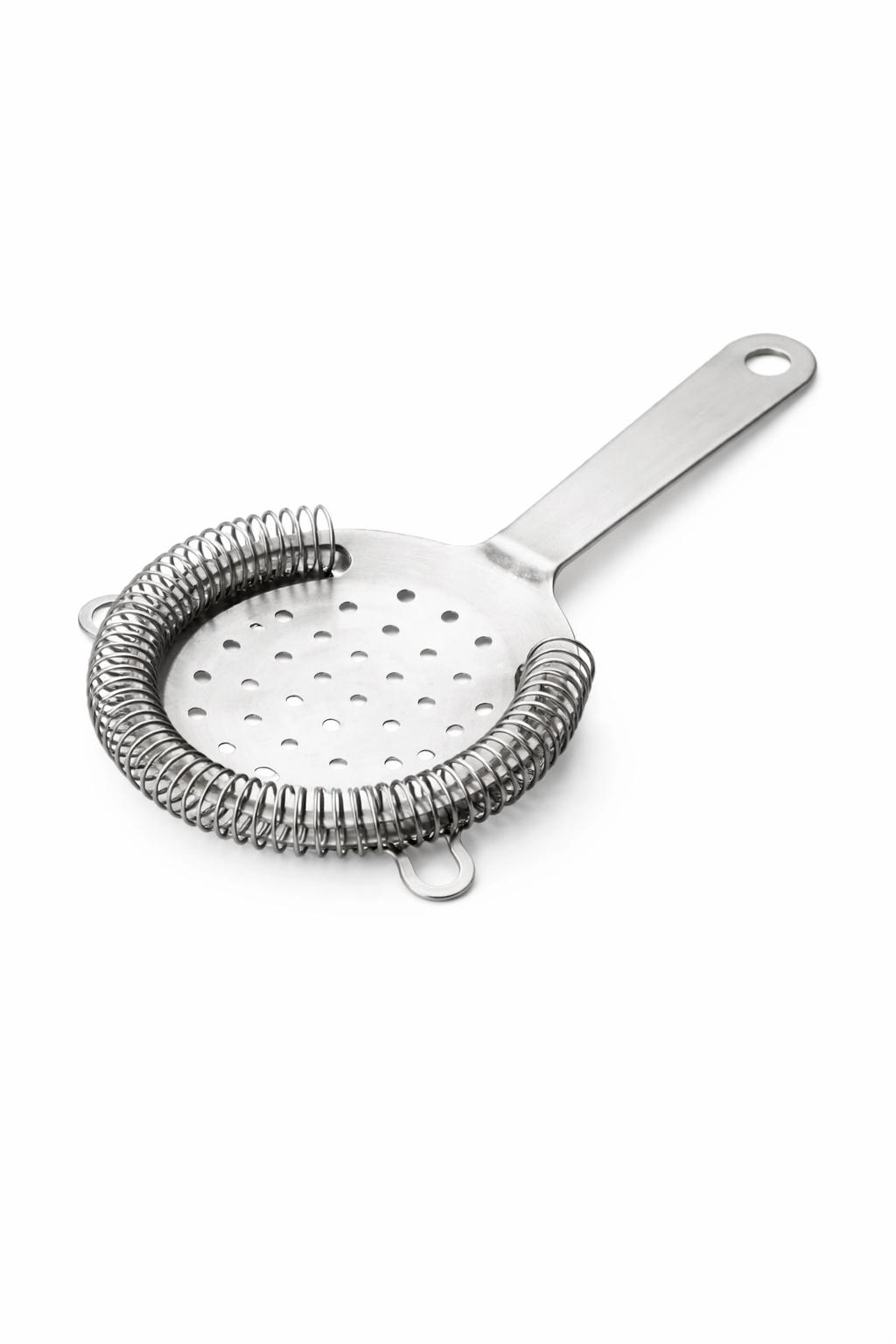
A Hawthorne strainer is a flat, perforated metal disc, about 8 to 10cm across on the ones we use, with a coiled spring round its edge and a handle. It sits on a shaker tin and holds the ice back as you pour, and the spring lets one strainer fit tins and mixing glasses of different sizes. It strains every shaken drink, from the Sidecar to the Whiskey Sour, and with a fine mesh strainer underneath it double strains them.
Essential Equipment
Recommended for every home bar
About the Hawthorne Strainer
The Spring Is a Filter
Liquid runs between the coils; ice, mint and fruit stay behind. Because the coil flexes, the same strainer sits snugly on a large tin, a small tin or a mixing glass.
It is not a seal. Press the spring firmly against the rim and the gaps close up; let the strainer lift and ice comes out with the drink.
Our Recipes Double Strain Shaken Drinks
Nearly every shaken drink in our library that is served without ice is double strained: the Hawthorne on the tin, a fine mesh strainer held underneath. The Paper Plane and the Sidecar go into a chilled coupe that way, and the Penicillin goes over one large cube.
The mesh traps the ice chips a hard shake produces, along with citrus pulp, ginger fibres and mint. In a drink served up, those chips float on the surface and keep melting into it.
Stirred drinks are different. A stir does not break the ice, so a Martini from a mixing glass needs one strainer only.
Hawthorne, julep and fine strainer
Hawthorne
- Fits
- Shaker tin or mixing glass
- Holds back
- Ice and large pieces
- Our use
- Every shaken drink
Julep
- Fits
- Inside a mixing glass
- Holds back
- Ice
- Our use
- Stirred drinks such as the Manhattan
Fine mesh
- Fits
- Held under the Hawthorne
- Holds back
- Ice chips, pulp, seeds
- Our use
- Double straining shaken drinks
| Strainer | Fits | Holds back | Our use |
|---|---|---|---|
| Hawthorne | Shaker tin or mixing glass | Ice and large pieces | Every shaken drink |
| Julep | Inside a mixing glass | Ice | Stirred drinks such as the Manhattan |
| Fine mesh | Held under the Hawthorne | Ice chips, pulp, seeds | Double straining shaken drinks |
One Finger Holds It Down
Grip the tin and press the top of the strainer with your forefinger. That finger keeps the spring against the rim and, on strainers that have a gate, slides it forward for a finer strain.
Pour into the fine strainer in one steady movement. Stopping and starting lets the ice shift, and shards follow.
Using the Hawthorne Strainer
Usage
Straining shaken drinks out of a tin, and stirred ones out of a mixing glass when there is no julep strainer. Our recipes double strain nearly every shaken drink served without ice, and many that go over fresh ice: the Hawthorne holds back the ice, and a fine mesh strainer held underneath catches chips, pulp and seeds.
Pro Tip
Strain with the tin tilted towards you so you can see the stream. If shards start to show, push the spring forward with your finger rather than slowing the pour.
Professional Tips
- Press the top of the strainer with a forefinger while you pour.
- Push the spring tight to the rim for a finer strain.
- Hold a fine mesh strainer under the stream when the recipe says double strain.
- Pour in one steady movement; a stop-start pour lets shards through.
Alternatives
Budget Alternative
A plain stainless Hawthorne with a tightly wound spring. Check the spring before buying; a loose one is the usual fault on cheap strainers.
Premium Option
A heavier strainer with a dense spring and a sliding gate. It sits steadier on the tin and strains no differently.
Specifications
Material
Stainless steel
Capacity
Not applicable; the heads on the ones we use are about 8 to 10cm across, and Urban Bar’s own hawthorne strainer is 20cm long overall
Details
Perforated disc ringed by a coiled spring, with a handle and two or more lugs that rest on the rim; some have a sliding tab, called a gate
More to explore
Common Questions
What is the spring on a Hawthorne strainer for?
What is double straining?
Hawthorne or julep strainer?
What does the gate on a strainer do?
Will a Hawthorne strainer fit my shaker?
Why are there ice chips in my drink?
How do you clean a Hawthorne strainer?
Sources.
Checked between 18 October and 19 October 2026.
- The Oxford Companion to Spirits and Cocktails (David Wondrich), “The cocktail strainer” (secondary source: julep strainer by name from 1860, “cocktail strainer” 1856; Lindley’s spring, 1889; Wright and Sullivan’s Hawthorne Café, 1892; prongs, two patents of 1907).
- Urban Bar, “Hawthorn Stainless Steel Cocktail Strainer 20cm”.
Master the Technique
Made with the Hawthorne Strainer
Used In These Cocktails
Related Equipment
Updated 19 October 2026