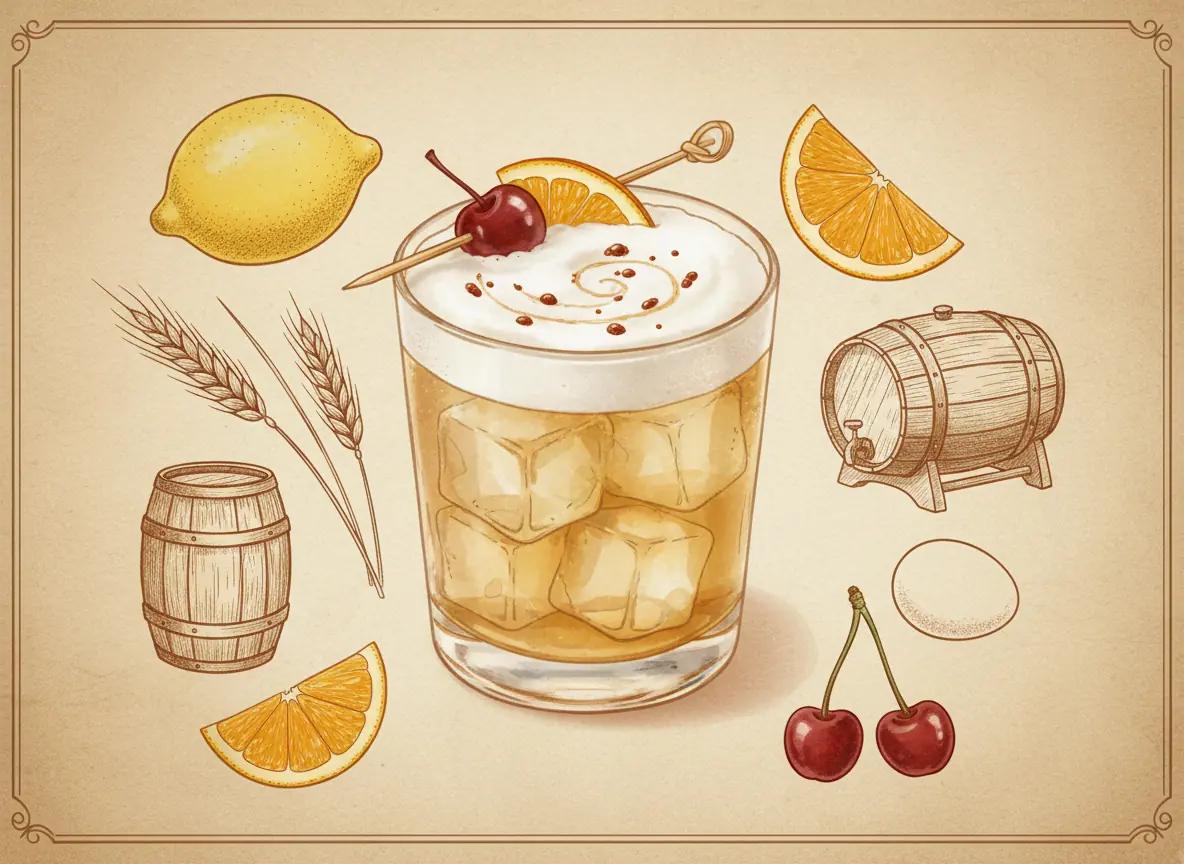
Whiskey Sour
A Whiskey Sour is 45ml of bourbon, 25ml of fresh lemon juice and 20ml of sugar syrup, shaken hard with ice, then poured through a strainer onto fresh cubes in a rocks glass, with half an orange slice and a cherry. Add 15ml of egg white, dry shaken first, and dot the foam with Angostura. About 1.8 UK units. The measures are the IBA’s. The IBA’s egg white is optional and only a few drops; we use 15ml, about half a white, because that is what a full foam takes. The bitters are not in the IBA recipe, and they only go on when there is foam to hold them. The name is in print by 1870, in a Wisconsin newspaper, and the sour is older still: Jerry Thomas printed brandy, gin and rum sours in 1862. Difford’s Guide lists a Boston Sour as bourbon soured with lemon juice and smoothed by egg white.
Variations
Glassware: Rocks Glass
Garnish: Maraschino cherry, Half an orange slice and Angostura bitters dotted on the foam when made with egg white
Ingredients
45ml
Bourbon bottled at 40 to 45% ABV, with plenty of vanilla and caramel. The IBA names bourbon; rye makes a drier, spicier sour at the same measure.
25ml
Juiced on the day. Lemon is the drink’s sole acid, and at 25ml against 20ml of syrup the drink sits just on the sharp side.
20ml
Sugar and water, 1:1 by weight. Measure it: a few millilitres over and the sour turns sweet.
15ml (optional)
About half a white, where the IBA calls for a few drops; 15ml is what builds a full foam. Raw. Following the FSA, British Lion-mark eggs are safe raw, including for vulnerable groups and in pregnancy; pasteurised carton white is the alternative. Eating out, where the mark cannot be checked, the FSA advises vulnerable people to have their eggs thoroughly cooked. Contains egg: leave it out, or use aquafaba, for anyone allergic.
3 drops (optional)
Three drops on the settled foam of the egg-white version, for aroma more than flavour.
Instructions
Squeeze the lemon juice the same day.
Add the bourbon, lemon juice, sugar syrup and egg white, if using, to a shaker.
If using egg white, dry shake without ice for 10 to 15 seconds.
Add cubed ice and shake hard for 10 to 12 seconds.
Strain onto fresh ice in a rocks glass, or double strain into a chilled coupe.
If using egg white, let the foam settle and dot three drops of Angostura on top.
Garnish with half an orange slice and a cherry.
Source: the IBA (Official IBA specification; 15ml egg white rather than a few drops, dry shaken first, with Angostura on the foam; method ours). Last checked 9 October 2026.
Expert Tip
Squeeze the lemon the same day. With nothing but syrup to soften it, stale juice tastes flat and faintly bitter, and no bourbon covers that. With egg white, dry shake without ice for 10 to 15 seconds first. The white whips into foam far more easily warm and undiluted. Then add ice and shake hard for 10 to 12 seconds to chill it. Dot the Angostura onto the foam just before serving, three or four drops. On foam they sit at the nose as a spice note; on a plain sour they sink and vanish, which is why we leave them off the version without egg.
Behind the Whiskey Sour
Flavour Profile
The Origin
Jerry Thomas’s 1862 bar guide gives brandy, gin and Santa Cruz rum sours, each its matching fix with the fruits left out but a small piece of lemon. Difford’s Guide gives the oldest known mention of a whiskey sour as the Waukesha Plain Dealer of 4 January 1870, and the Oxford Companion finds a whisky sour as early as 1826, in a list of ways that whisky could be drunk.
The IBA lists egg white as optional, a few drops. Difford’s Guide lists the Boston Sour as a bourbon sour smoothed by egg white.
The Sour Template
A sour is spirit, citrus and sugar, with the spirit leading. Here 45ml of bourbon sits on 25ml of lemon and 20ml of syrup, so the acid is a step ahead of the sugar and the drink finishes dry.
Change one part and you have a relation. Honey in place of syrup makes a Honey Sour; honey, ginger and a smoky float over Scotch make a Penicillin; rye with red wine floated on top makes a New York Sour.
Bourbon Versus Rye
Bourbon’s corn sweetness and vanilla meet the syrup halfway, so a bourbon sour tastes round and soft at the edges.
Rye’s pepper and drier grain push against the lemon instead. Use it when you want the whiskey to stay in front of the sugar.
The Foam and the Bitters
Egg white foam traps the bourbon’s aroma at the surface, so the drink smells of vanilla and grain before the lemon reaches you, and the acid lands softer.
The Angostura drops sit on that foam as a spice note at the nose. The IBA leaves them out. Without foam they sink into the drink and are lost, so the plain sour goes without.
Ours Against the IBA
Whiskey Sour as the IBA writes it and as we make it
Bourbon
- IBA
- 45ml
- Ours
- 45ml
Lemon juice
- IBA
- 25ml
- Ours
- 25ml, squeezed the same day
Sugar syrup
- IBA
- 20ml
- Ours
- 20ml
Egg white
- IBA
- A few drops, optional
- Ours
- 15ml, optional, dry shaken first
Bitters
- IBA
- None
- Ours
- Three or four drops of Angostura on the foam, with egg white only
Glass
- IBA
- Cobbler glass, or an old fashioned over ice
- Ours
- Rocks glass over fresh ice, or a chilled coupe
Garnish
- IBA
- Half an orange slice and a maraschino cherry
- Ours
- Half an orange slice and a cherry
| Element | IBA | Ours |
|---|---|---|
| Bourbon | 45ml | 45ml |
| Lemon juice | 25ml | 25ml, squeezed the same day |
| Sugar syrup | 20ml | 20ml |
| Egg white | A few drops, optional | 15ml, optional, dry shaken first |
| Bitters | None | Three or four drops of Angostura on the foam, with egg white only |
| Glass | Cobbler glass, or an old fashioned over ice | Rocks glass over fresh ice, or a chilled coupe |
| Garnish | Half an orange slice and a maraschino cherry | Half an orange slice and a cherry |
How to Serve It
Over fresh ice in a rocks glass, or straight up in a chilled coupe, with half an orange slice and a cherry.
The rocks glass is more forgiving: the ice keeps a plain sour cold to the last sip. The coupe shows off a foam, so use it when the egg white goes in.
Make it at home
The Spirit
Whiskey (Bourbon)Under the US standard 27 CFR 5.143, bourbon is an American whiskey whose mash is at least 51% corn, matured in fresh charred oak barrels and bottled at 40% ABV or higher, the figure our recipes use. The fresh charred wood gives it its vanilla, caramel and colour, and the corn gives a rounder, sweeter spirit than rye. It is the base of 26 of our recipes, more than any other whiskey.
Master the Techniques
More to explore
Frequently Asked Questions
What is in a Whiskey Sour?
What is a Boston Sour?
Do you need egg white in a Whiskey Sour?
Why dry shake a Whiskey Sour?
Bourbon or rye?
How strong is a Whiskey Sour?
Where does the Whiskey Sour come from?
Did Jerry Thomas print a Whiskey Sour in 1862?
Sources.
Correct as of 19 October 2026.
- Difford’s Guide, “History of sour cocktails” (secondary source: the first record of a sour in 1856 (Ackermann’s Saloon, Toronto); Jerry Thomas 1862 brandy, gin and Santa Cruz sours; the oldest known mention of a whiskey sour in the Waukesha Plain Dealer, 4 January 1870, quoted; a Boston Sour is a bourbon sour smoothed by egg white (Whiskey Sour page)).
- Jerry Thomas, 1862 (Internet Archive scan), “How to Mix Drinks, or The Bon-Vivant’s Companion” (primary source: 142. Brandy Sour and 143. Gin Sour, each “made with the same ingredients as” the fix, “omitting all fruits except a small piece of lemon”; a footnote: the Santa Cruz sour is made with Santa Cruz rum instead of gin; no whiskey sour in the index).
- The Oxford Companion to Spirits and Cocktails (Paul Clarke), “The Whisky Sour” (secondary source: first in print as early as 1826, in a list of ways that whisky could be drunk; egg white added from the 1920s).
- Difford’s Guide, “Whiskey Sour: history, styles and variations” (secondary source: the Boston Sour, bourbon soured with lemon juice and smoothed by egg white; the Greenwich and New York sours).
You Might Also Like
Honey Sour
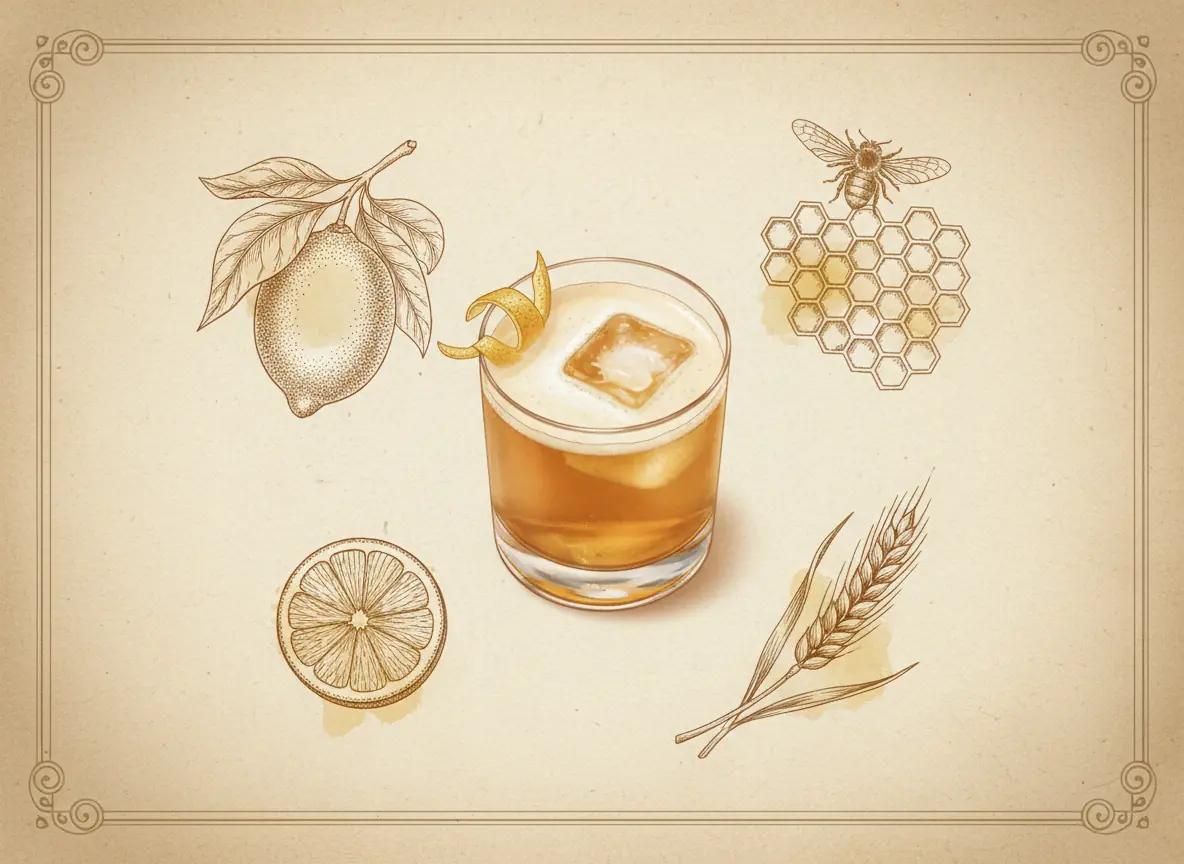
A Honey Sour is a Whiskey Sour sweetened with honey: 60ml bourbon, 25ml fresh lemon juice and 15ml honey syrup mixed at two parts honey to one of warm water, shaken hard and double strained over a large cube in a rocks glass. A 15ml egg white is optional and gives it a soft foam, with three drops of Angostura on top. Honey changes more than the sweetness. It adds a floral, waxy note on top of the bourbon’s vanilla and caramel, and more body than sugar syrup. The drink sits between the Whiskey Sour and the Gold Rush, the bourbon, lemon and honey drink that Punch credits to T. J. Siegal at Milk & Honey in New York, in 2000 by its account and 2001 by VinePair’s. The Honey Sour adds back the egg white and the bitters, with a little less syrup. No one is recorded as its inventor. It is a sweetener swap on a sour. Difford’s Guide dates the first written sour recipes to Jerry Thomas’s 1862 guide and the oldest known whiskey sour mention to a Wisconsin newspaper of 1870. A glass holds about 2.4 UK units.
Penicillin
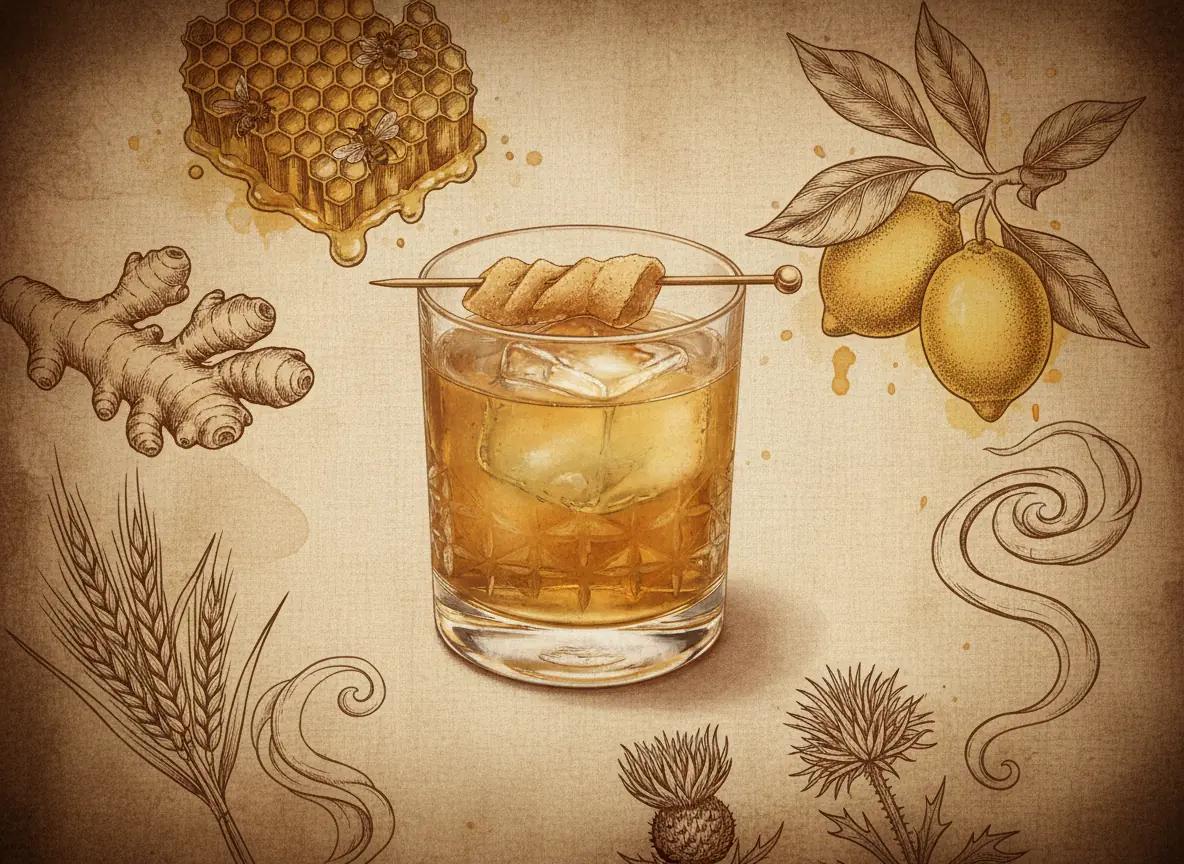
A Penicillin is 60ml blended Scotch, 22.5ml honey syrup, 22.5ml fresh lemon juice and two or three thin slices of fresh ginger, shaken hard and double strained over one large cube, with 7.5ml of Lagavulin 16 floated on top and candied ginger on the rim. That is the IBA specification, at about 2.7 UK units. Difford’s Guide, a secondary source, dates it to 2005 and credits Sam Ross with creating it at Milk & Honey in Manhattan; Chilled Magazine calls Ross an Australian bartender. Chilled says Ross described the name as a tongue-in-cheek reference to the drink’s cure-all properties, and that a nod to the antibiotic discovered by the Scottish scientist Alexander Fleming may have been a factor. It is a whisky sour in structure. The ginger gives it heat, and the smoky malt on top reaches the nose before the first sip.
Amaretto Sour
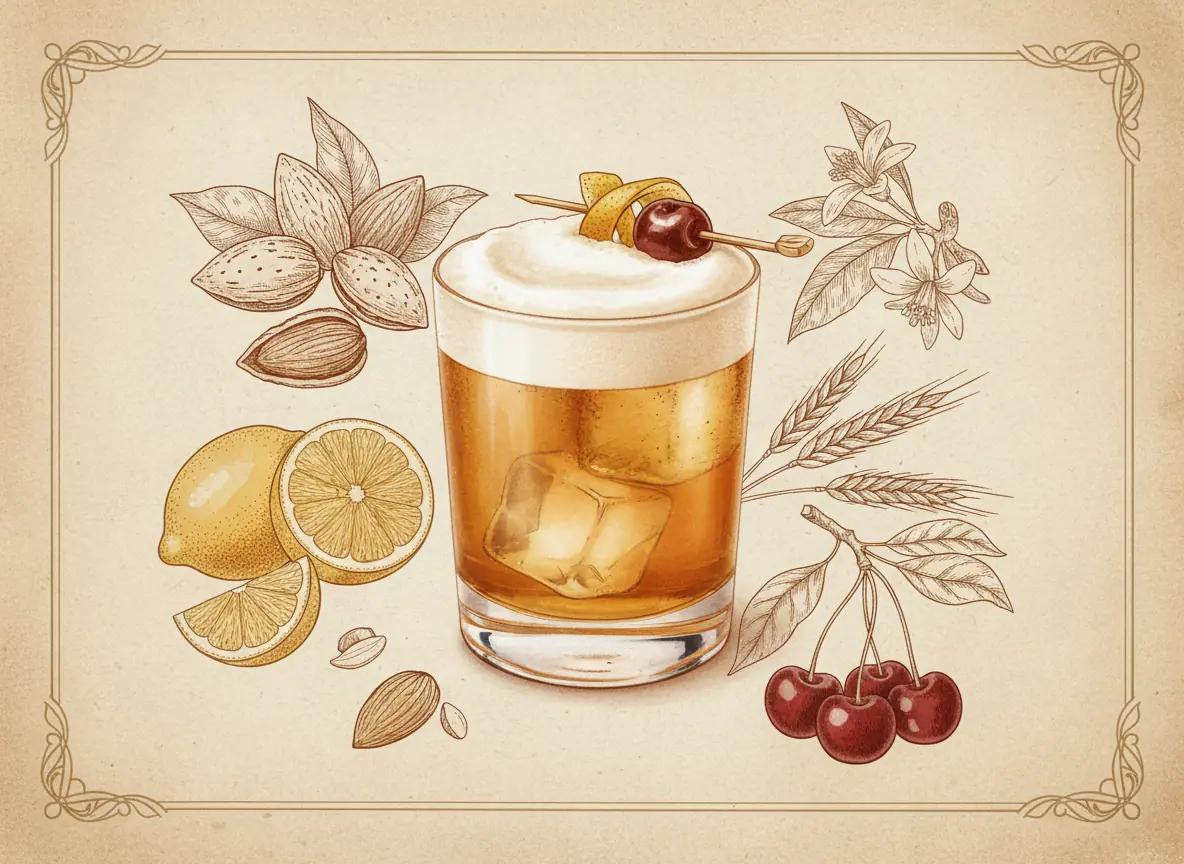
An Amaretto Sour made the way Jeffrey Morgenthaler published it in 2012, as Difford’s Guide records his formula, is 45ml amaretto, 22.5ml cask-strength bourbon, 30ml fresh lemon juice, 5ml rich sugar syrup and an optional 15ml egg white. It is shaken without ice, then with it, and strained onto a single large ice cube in a rocks glass, then finished with a lemon peel and a cherry. The bourbon is why it works. Amaretto is sweet and, at Disaronno’s 28% ABV on Drinkfinder’s listing, too light to carry a sour alone; Morgenthaler’s point was that it needs help. A small measure of cask-strength bourbon adds strength, oak and spice while the almond stays in front. The Oxford Companion to Spirits and Cocktails says amaretto is generally made from apricot kernels, though it is commonly thought of as almond-flavoured; anyone with a nut allergy should read the label. The egg white is raw egg. A glass holds about 2.6 UK units, taking the cask-strength bourbon at our working figure of 60% ABV and the amaretto at 28%, as Drinkfinder lists Disaronno.
Where this one sits
Recipe by Jerry Can Spirits · Updated 19 October 2026