Whiskey Cocktails
74 recipes, page 1 of 4
This Field Manual holds 74 recipes built on whiskey: 27 bourbon, 22 rye, 14 Scotch, 8 Irish and 3 Welsh. The spelling follows the country. Irish and American distillers write whiskey, Scotch writes whisky, and this page uses one word for all of them.
They are not interchangeable. Bourbon is sweet and broad, and it fills out a drink that needs body, which is why an Old Fashioned built on bourbon tastes rounder than the same drink built on rye. Rye is drier and peppery, and it keeps its edge against sweet vermouth, which is what a Manhattan is asking for. Scotch carries smoke or sea salt depending on where it was made, and a peated bottle will take over anything delicate. Irish whiskey is lighter than either American style and suits a long drink or a hot one.
What counts as whiskey here
Base Spirit
Difficulty Level
Affinity
The Affinity is Scotch and both vermouths in equal thirds, with Angostura. Thirty millilitres of each, stirred, up. Equal thirds is the part worth noticing. A Rob Roy is Scotch with a single vermouth at roughly half the spirit measure, and even a perfect Manhattan, which splits its vermouths, keeps whisky as the clear majority. Here two thirds of the glass is wine, and the whisky is a partner rather than the subject. That changes what the drink is for. It lands lighter, wetter and considerably lower in strength than any Rob Roy, closer in weight to an aperitif than to a Manhattan. It is a drink you can have before dinner rather than after. It comes from the Edwardian books, when splitting the vermouths was the fashionable way to make a drink look considered, and no creator is recorded. The name is the recipe's own description: an affinity is a natural attraction between things, and the claim is that these three have one.
Algonquin
The Algonquin carries the name of the hotel where the Round Table sharpened its knives. Dorothy Parker, Robert Benchley, Alexander Woollcott and the rest of the Vicious Circle lunched there through the 1920s, and the drink borrowed both the address and the literary pedigree, even though Prohibition means the hotel bar cannot have been openly pouring it at the time. Rye, dry vermouth and pineapple juice: a Manhattan gone tropical without leaving midtown. The pineapple is the surprise and the argument. Fresh juice against rye’s spice and dry vermouth’s herbs, with the fruit’s acidity doing the rounding work sweet vermouth would otherwise do, by considerably stranger means. It is shaken despite its stirred-drink bones, because the pineapple wants the foam, and it lands drier than the fruit promises. The Round Table would have enjoyed the joke: a cocktail named for the wits’ hotel that the wits themselves, drinking through the dry years, could only order in code.
Almond Old Fashioned
The Almond Old Fashioned is a bourbon Old Fashioned with amaretto in place of the sugar, and the swap does more than sweeten. Amaretto is built on apricot kernels rather than nuts, and kernel carries a genuine bitterness behind the marzipan, so the drink arrives drier than the word almond suggests. That bitterness is what qualifies it for the job. Sugar sweetens and says nothing; amaretto sweetens and seasons at the same time, which is why the bitters can stay at two dashes and still be heard. Bourbon's vanilla and oak meet the marzipan halfway. The measure is the whole discipline. A Godfather pours amaretto as a near-equal partner to the spirit and drinks like a dessert; fifteen millilitres against sixty of bourbon keeps it in the sweetener's role, where it belongs. No one owns the drink. It appeared wherever both bottles already stood, which is most back bars, once the revival taught drinkers to treat the Old Fashioned's sweetener as a variable rather than a fixed ingredient.
American Trilogy
The American Trilogy is an Old Fashioned with two spirits in it, and the split is doing more than adding flavour. Applejack was America's first spirit, distilled from orchards before anyone was making whiskey at scale. Rye was the grain that followed it. The sugar between them came up the same trade routes as everything else. Three ingredients, three eras, which is where the name comes from. Richard Boccato and Michael McIlroy built it at Little Branch in New York around 2008. The method is the 1806 formula performed properly: a brown sugar cube muddled in the glass with orange bitters and a little water, then the spirits over one large cube and a long stir. What it tastes like is an Old Fashioned with its edges rounded off by fruit. The applejack does not make the drink taste of apple so much as make the rye taste less severe, which is a subtler result than the concept leads you to expect.
Autumn Gold
The Autumn Gold is a Field Manual serve written for October: bourbon and apple brandy splitting the base, fresh lemon and maple syrup running the sour arithmetic, and two dashes of aromatic bitters pulling everything towards baking spice. Shaken hard, strained into a coupe, finished with a thin apple fan. The split base is the design. Bourbon provides the structure and the vanilla; apple brandy provides the orchard top note; neither would carry the drink alone. Maple stands where plain sugar would in a whiskey sour, trading neutral sweetness for an earthy depth that reads as harvest rather than confectionery, and the lemon keeps all that richness drinkable. It is a sour by grammar and an autumn drink by argument. The template is one your hands already know; the accent belongs to October. Make it when the first properly cold evenings arrive and the apples are in season, and cut the fan thin: the garnish is the drink announcing its subject.
Black Manhattan
The Black Manhattan asks a simple heretical question: what if the vermouth were replaced entirely by amaro? Todd Smith posed it at Bourbon and Branch in San Francisco in 2005, chose Averna, and produced one of the defining drinks of the modern era. Rye and Sicilian amaro at the classic ratio, both bitters, one cherry, and a drink the colour of its name. The swap works because Averna is built like a vermouth that kept going: wine-adjacent sweetness, herbs and citrus peel, but darker, denser and bittersweet where vermouth is fresh. The Manhattan’s architecture survives intact while every surface of it changes, and the two dashes of bitters now read as accents in an already bitter landscape. It sits with the Hanky Panky and the Toronto in the small family of drinks that taught amari to speak cocktail, and it has moved more bottles of Averna than any of them.
Blinker
The Blinker is rye, grapefruit juice and grenadine, and it is one of very few classic sours where grapefruit does the whole job on its own. Lemon is the default for a reason: it is sharp and neutral. Grapefruit is sharp and opinionated, bitter as well as sour, and putting it against rye produces something considerably drier and stranger than a whiskey sour. It comes from Patrick Gavin Duffy's Official Mixer's Manual of 1934 and then disappeared for most of a century. Its return is generally credited to Ted Haigh, whose Vintage Spirits and Forgotten Cocktails put a good many repeal-era specs back into circulation in the 2000s. The grenadine decides whether it works. Made from pomegranate, it brings a tart, slightly astringent fruit that meets the grapefruit halfway. Made from corn syrup and red dye, which is what most of the twentieth century sold, it turns the drink into cordial. That is most likely why nobody made it for seventy years.
Blood & Sand
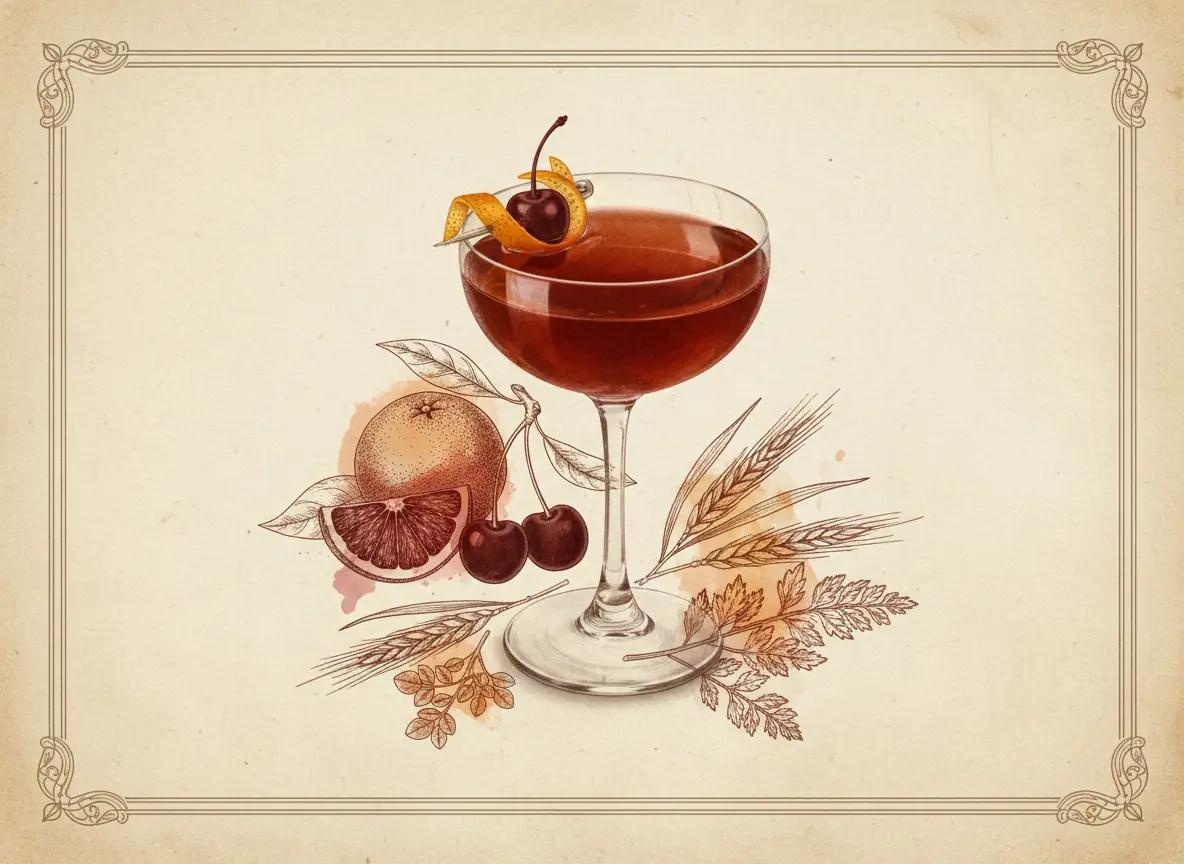
The Blood & Sand was created to coincide with the 1922 Rudolph Valentino film of the same name and appeared in Harry Craddock’s Savoy Cocktail Book in 1930. It is one of a very small number of classic cocktails that puts Scotch whisky against fresh citrus, a combination that sounds improbable and performs considerably better than it has any right to. The equal-parts structure is unforgiving. Scotch, sweet vermouth, cherry liqueur and fresh orange juice in identical measure, shaken and served cold, with every ingredient fully visible and no dominant spirit hiding the quality of the others. It is a drink that divides opinion, which is usually a sign of something genuinely interesting happening. Anyone who finds Scotch and orange juice an uneasy pairing has almost always met a poorly balanced version. Built correctly, the smoke sits against the cherry’s sweetness and the orange’s acid in a way that feels considered rather than accidental.
Blue Blazer
The Blue Blazer is the origin myth of bartending as performance. Jerry Thomas’s signature was blazing Scotch thrown in a flaming arc between two silver-plated mugs, the trick that made him the first celebrity bartender and gave his 1862 book its frontispiece. Whisky, hot water, sugar and fire: the Hot Toddy that joined the circus. The build is genuinely dangerous and it is worth saying so plainly. High-proof Scotch is warmed, ignited, and poured mug to mug in a lengthening blue ribbon until the two are mixed, then sweetened and finished with lemon oil. Thomas prescribed it for cold mornings and pneumonia weather. The modern recommendation adds a rehearsal with cold water first, a dim room, and nothing flammable within reach. It is theatre’s founding document. The drink underneath is a fine hot whisky punch, and the point was always the arc of fire between two steady hands. It has been that since 1862.
Bobby Burns
The Bobby Burns is the Rob Roy with a library card: Scotch and sweet vermouth as before, seasoned with a barspoon of Bénédictine, the honeyed herbal liqueur of the Norman abbeys, which rounds the drink into something warmer and more bookish than either parent. Harry Craddock, printing it in the Savoy Cocktail Book in 1930, called it one of the very best whisky cocktails ever made. Whether it honours Robert Burns the poet or a Robert Burns who sold cigars near the bar is one of those arguments the canon keeps for company. What is certain is the structure: a Manhattan template moved to Scotland, with the Bénédictine doing quietly what fernet does loudly in the Hanky Panky, its close cousin from the same hotel. It is also the rare classic with a date in its diary. Burns Night, the 25th of January, is its annual argument for existing, and a Bobby Burns after the haggis beats most speeches.
Boulevardier
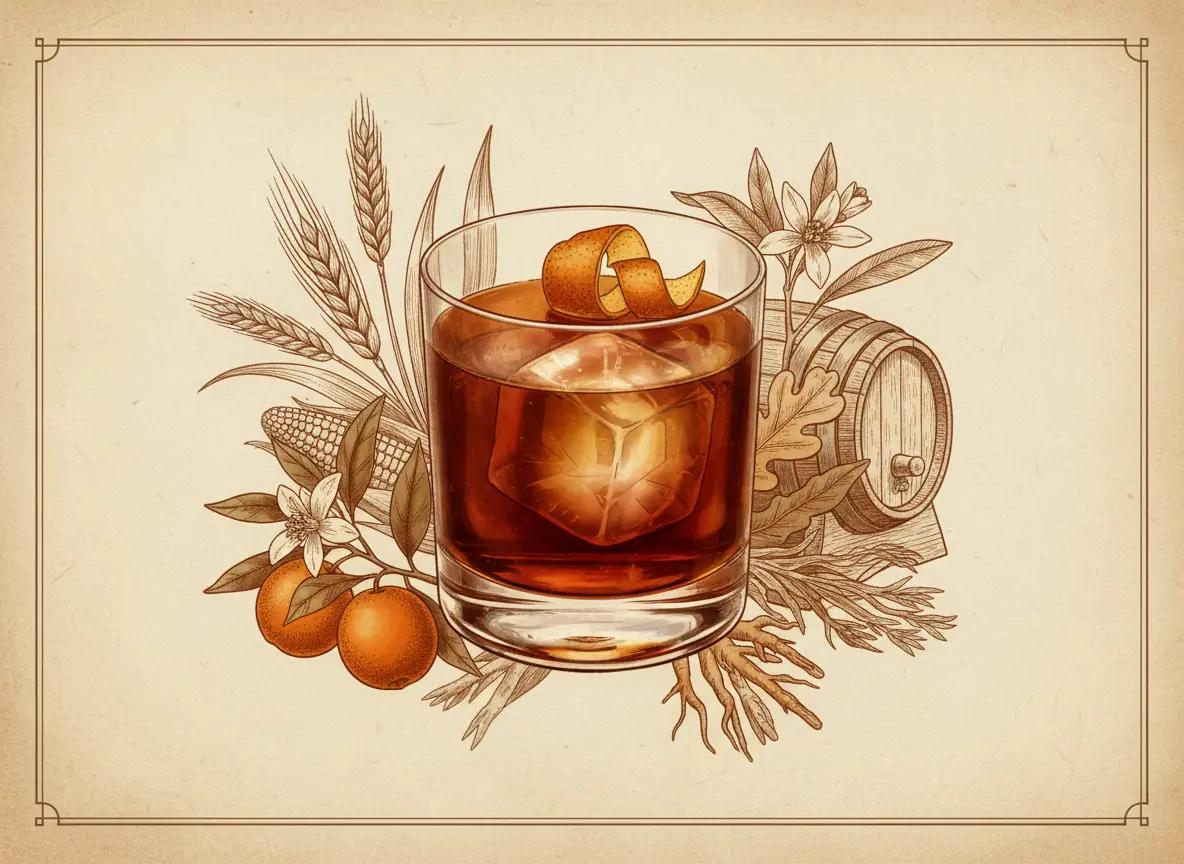
The Boulevardier was created by Erskine Gwynne, an American expatriate writer in 1920s Paris who published a monthly magazine of the same name for the city’s American community. Harry McElhone documented the drink in his 1927 book Barflies and Cocktails, attributing it to Gwynne. It is a Negroni with bourbon in place of gin, and that single substitution changes the drink more thoroughly than the swap suggests. Where the Negroni is botanical, precise and juniper-forward, the Boulevardier is warmer, rounder and more fruit-driven. Bourbon brings vanilla, caramel and a grain sweetness that gin does not carry, producing a richer balance that sits more naturally after a meal than before one. The ratio here runs slightly bourbon-forward at three to two to two rather than equal parts, because bourbon is heavier and sweeter than gin and equal measures can tip the drink toward cloying against a rich vermouth. It handles equal parts perfectly well too; adjust to the bottles in front of you.
Brooklyn
The Brooklyn is a dry Manhattan with two seasonings: a barspoon of maraschino and a barspoon of Amer Picon. Jacob Grohusko printed it in Jack's Manual in 1908, and it is the drink that gave the borough its cocktail identity, eventually producing the Red Hook, the Greenpoint, the Bensonhurst and a dozen more. The problem is the Picon. It was a French bitter orange aperitif at high proof, reduced and reformulated through the twentieth century, so the bottle the recipe assumed no longer exists in any obtainable form. Every modern Brooklyn is therefore a reconstruction, and it is more honest to say so than to pretend a substitution is the original. This version uses Averna with two dashes of orange bitters, which is the accessible route: the amaro supplies the bitterness and the body, the bitters supply the orange. Bigallet China-China is closer to the original voice if you can find a bottle of it.
Brown Derby
The Brown Derby is 1930s Hollywood in three ingredients. It was created at the Vendôme Club on Sunset Boulevard, the film colony’s lunch canteen, and named in neighbourly tribute to the Brown Derby restaurant across town, the one shaped like the hat. Bourbon, fresh grapefruit and honey: a drink engineered for a town that wanted its indulgences to photograph well. The structure is a sour that swapped both its standard parts for better ones. Grapefruit stands in for lemon, bringing bitterness along with its acid; honey stands in for sugar, bringing floral weight along with its sweetness. The two substitutions lean into each other, honey rounding exactly the bitter edge grapefruit brings, and the bourbon underneath gets to be entirely itself. It reads today as a period companion piece to the Hemingway Daiquiri, the same decade’s other great grapefruit drink, and as bourbon’s answer to it: drier than it looks, brighter than bourbon drinks are expected to be, and about ninety seconds of work from bottle to coupe.
Cameron’s Kick
Cameron's Kick is a sour that should not work twice over. The base is split between Scotch and Irish whiskey, a pairing neither island has ever requested, and the sweetener is orgeat, which puts marzipan against malt. Harry MacElhone printed it in Harry's ABC of Mixing Cocktails in 1922. The split is the interesting part. Scotch brings a dry cereal character and Irish brings a softer, orchardy one, and at equal measure they overlap into something that tastes like a third whisky neither bottle contains. Favour either island and the effect collapses, which is why the measures are equal rather than approximate. Nobody knows who Cameron was. MacElhone names the drink and keeps the secret, and a century of people looking has not produced an answer. What survives is a spec that reads considerably more modern than 1922 has any right to: a split base, an unexpected sweetener, and a result that is nutty, malty and improbably elegant.
Diamondback
The Diamondback is three strong bottles and nothing else: rye, calvados and yellow Chartreuse, stirred and served up. There is no citrus, no sugar and no soda. Whatever softening the drink gets, it gets from the ice. The structure is the Widow's Kiss with the hierarchy inverted. That 1895 drink leads on calvados with yellow Chartreuse behind it; here the rye takes the spine and the apple brandy drops to second, with the Chartreuse unchanged in its supporting role. Tasting the two in sequence is the clearest lesson available in how much a chord changes when you decide which note leads. What arrives is autumn with its collar up: orchard fruit and rye spice under the honeyed saffron of the Chartreuse, which supplies the drink's only sweetness and a good deal of its character. It is strong, and it is meant to be. This is a one-per-evening drink, and the snake it is named after is fair warning.
Dragon’s Breath
The Dragon’s Breath is our long drink for St David’s Day: Penderyn and honey syrup built over ice in a highball, topped with ginger beer and finished with a squeezed lime wedge. The name promises fire and the ginger delivers a manageable version of it, heat at the top of the sip, honey smoothing the edges underneath, whisky holding the middle. It is a house serve in the buck tradition, spirit lengthened with ginger beer and citrus, aimed squarely at early March weather. The build asks almost nothing. No shaker, no strainer, one gentle stir, which makes it the drink to hand a crowd on the first of March while the stirred serves take their turn. What it does ask is a proper ginger beer with real bite, because the whisky is light on its feet and a soft mixer leaves the drink without its dragon. Warming and refreshing at once is a strange promise for one glass to keep, but that is the trick of it: cold serve, warm spice, and a Welsh whisky quietly running the whole thing.
Dublin Mule
The Dublin Mule is the Irish reading of the Moscow Mule: Irish whiskey built over ice with fresh lime and simple syrup, topped with ginger beer and finished with mint and a lime wheel. Copper mug if you have one, highball if you do not. The swap is the whole argument. Vodka's job in a Moscow Mule is to disappear; a smooth Irish whiskey does something more useful, staying present under the ginger without dominating it. Triple distillation gives most Irish blends the softness to sit in a long drink, and the lime does the bridging work between grain and spice. It is a built drink with no technique to speak of, which is the point: the mule format has always been about assembly rather than ceremony. Buy a ginger beer with genuine heat, squeeze the lime fresh, and the drink largely makes itself. The mint on top brings the aromatic lift and, on the occasion it was designed for, a welcome touch of green.
Fancy Free
The Fancy Free is an Old Fashioned that uses maraschino liqueur instead of sugar. Rye, 15ml of maraschino, and two kinds of bitters. That is the entire drink. The swap does more than sweeten. Maraschino is made from whole marasca cherries, stones included, and the stones give it a dry almond note that has very little to do with the cherry flavour people expect. So the drink lands drier than the ingredient list suggests, with an aromatic, faintly nutty edge that plain sugar could not supply. The two bitters are not a flourish. Angostura sits at the back with its clove and cinnamon, orange bitters sit at the front with their peel, and dropping either one collapses the drink from stereo to mono. It appears in the mid-century American collections, usually cited to Albert Stevens Crockett's Old Waldorf-Astoria books. The name is the temperament: an Old Fashioned with its tie loosened.
Fireside Punch
The Fireside Punch is our batch answer to Bonfire Night: bourbon, apple cider, fresh lemon, maple syrup and water heated gently with cinnamon sticks, star anise and orange wheels, then held warm in a slow cooker for the whole evening. It appears in both our Bonfire Night and autumn guides, and it is a house recipe built for crowds rather than a recovered classic. The water is doing more than stretching the bottle. It tames the bourbon for long drinking, the way punch has always managed a crowd, and it lets the spices infuse as the pot sits. The batch genuinely improves with time; it tastes better an hour in than at the first ladle, which is the right property for a drink that has to last from dusk to the final sparkler. The format is the hospitality. Nobody mixes anything once the fireworks start. The pot holds on low while guests ladle for themselves, and the maple and lemon keep about fifteen servings in balance from first to last. For thirty guests, double the liquids and increase the spices by half rather than doubling them.
Ginger Snap
The Ginger Snap is warming spice in refreshing form: a bourbon highball where fresh lemon and cinnamon syrup sit under a fiery ginger beer, finished with a cinnamon stick. It is a house recipe written for Bonfire Night, built for the drinker who wants the season’s flavours without a hot mug in hand. The trick is that the warmth is sensory rather than thermal. Ginger provides the heat while the drink stays cold over ice, and the cinnamon syrup bridges autumn and winter drinking in a single 15ml measure. The lemon matters more than its volume suggests: 25ml holds the sweetness in check and keeps the drink sessionable across a long evening outdoors. The ginger beer decides the outcome. A properly fiery bottling gives the drink its name and its point; a mild one leaves it tasting of lemonade. Choose the hottest you can find, build it gently so the carbonation survives, and it reads like bonfire weather from the first sip.
Godfather
The Godfather is Scotch and amaretto over ice at two to one, and there is nothing else in it. It came out of the 1970s two-bottle wave along with the French Connection, which is the same formula with cognac, and the Godmother, which is the same formula with vodka. Three drinks, one liqueur, three different base spirits. The swap is what makes it interesting. Cognac's fruit meets amaretto's almond softly and the two settle together; Scotch's cereal dryness and its optional smoke give the almond something to argue with, and the drink lands drier and more angular than its French sibling, which is the more interesting of the two. The name came from the decade's biggest film with the era's usual paperwork, which is to say none. Marlon Brando's alleged fondness for it is the drink's one contested legend, and it has never been verified, which suits the subject rather well.
Gold Rush
The Gold Rush was invented at Milk and Honey, the Lower East Side bar that rewrote modern cocktail culture, when T.J. Siegal asked Sasha Petraske for a whiskey sour and got talked into honey instead of sugar. That was 2001, the drink went around the world with the bar’s alumni, and it is now as close to a canonical modern classic as the twenty-first century has produced: bourbon, lemon, honey, done. The honey is the entire intervention and it changes everything: floral weight where sugar is neutral, a waxy richness that rounds bourbon’s corners, and a golden colour that named the drink. Cut into syrup at two parts honey to one part water it integrates like sugar never quite does, and the drink lands somewhere between a whiskey sour and a warm afternoon. Its family tree runs in both directions: back to the Bee’s Knees, the Prohibition gin sour that proved honey and citrus belonged together, and sideways to the Penicillin, Milk and Honey’s other golden child, which is a Gold Rush that emigrated to Islay. Three ingredients, no technique beyond a hard shake, and no excuse for a bad one ever.
Green Batched Punch
The Green Batched Punch is a crowd solution written for parties where individual cocktails are impractical: Irish whiskey, fresh lime, simple syrup and blue curaçao over a base of apple juice, topped with sparkling water at the last moment. It serves about twelve, and it is unapologetically green. The apple juice is the quiet decision that makes it work. It bridges the whiskey to the citrus naturally, stretches the batch without thinning it, and keeps the sweetness in the orchard register rather than the confectionery one. The curaçao carries the colour along with an orange depth, and the sparkling water, added only when guests arrive, keeps the last cup as lively as the first. Punch is the oldest hospitality format there is: one vessel, many hands, and a host who is free to enjoy the party. This batch points that format at the one night of the year when the glass is expected to be green, and gets there without a drop of artificial colouring.
Harvest Mule
The Harvest Mule is autumn’s answer to the Moscow Mule: bourbon in place of vodka, apple cider syrup in place of plain sugar, fresh lime and a fiery ginger beer over ice in a copper mug. It is a house recipe built for early season gatherings outdoors, when the air is cold but the drinking is still long. The syrup is the seasonal engine. Apple cider reduced by half and sweetened with demerara concentrates orchard fruit into a 15ml measure, so the drink gets real apple depth without extra dilution. Against it, the bourbon brings caramel warmth for the ginger to grip, and 20ml of fresh lime keeps the whole thing honest. It refreshes while it warms, which is the mule format’s oldest trick: ginger heat rising through a cold drink. Choose a properly fiery ginger beer, and if you want it drier, cut the syrup to 10ml and let the ginger burn a little harder. The copper mug is tradition rather than necessity; a highball glass does the job without apology.