Cameron’s Kick
Cameron’s Kick is 30ml of blended Scotch, 30ml of Irish whiskey, 22.5ml of fresh lemon juice and 15ml of orgeat, shaken hard with ice for 10 to 12 seconds and double strained into a chilled coupe, with a lemon twist if you like. About 2.4 UK units. The orgeat is made from almonds. Punch says it first appeared in Harry MacElhone’s 1922 book Harry of Ciro’s ABCs of Mixing Cocktails and again in his Barflies and Cocktails of 1927; Difford’s Guide says Harry Craddock’s Savoy Cocktail Book repeated it in 1930. Neither says who Cameron was. In shape it is a whisky sour with two changes: the base is split between Scotland and Ireland, and orgeat takes the place of sugar. The Savoy Cocktail Book’s version, as Difford’s Guide prints it, takes a sixth each of lemon juice and orgeat, so equal parts. We use a little less orgeat, which keeps the finish sharp.
Glassware: Coupe Glass
Garnish: Lemon twist (optional)
Ingredients
30ml
An unpeated blended Scotch at 40% ABV. Smoke would sit on top of the Irish whiskey instead of meeting it.
22.5ml
Squeezed the same day. A little more lemon than orgeat, so the drink finishes sharp.
15ml
A real almond orgeat. It sweetens and adds marzipan and body, and it contains nuts. The Savoy’s version, as Difford’s Guide prints it, uses as much orgeat as lemon; 15ml keeps ours drier.
Instructions
Chill a coupe.
Add both whiskies, the lemon juice and the orgeat to a shaker.
Fill with cubed ice and shake hard for 10 to 12 seconds.
Double strain into the chilled coupe.
Express a lemon twist over the top if you like.
Our version
The split of Scotch and Irish whiskey with lemon and orgeat that Punch dates to MacElhone’s 1922 book, made with less orgeat than lemon, 15ml to 22.5ml, where the Savoy’s version as Difford’s Guide prints it uses equal parts, for a drier finish.
Source: our own specification. Last checked 10 October 2026.
Expert Tip
Use an unpeated blended Scotch. Peat smoke sits on top of the Irish whiskey instead of merging with it, and the drink turns into a smoky sour. Keep the two whiskies level. At 30ml each neither leads, and the Scotch’s dry grain and the Irish whiskey’s softer fruit run together. Choose an orgeat whose label lists almonds. It brings body as well as sweetness, which is why the drink needs no egg white. It contains nuts, so check before serving it to anyone with an allergy.
Behind the Cameron’s Kick
Flavour Profile
MacElhone, 1922
Punch says Cameron’s Kick first appeared in Harry MacElhone’s Harry of Ciro’s ABCs of Mixing Cocktails, published in 1922, and again in his Barflies and Cocktails of 1927. Difford’s Guide says Harry Craddock’s Savoy Cocktail Book of 1930 repeated it, with a sixth each of lemon juice and orgeat.
The Oxford Companion has MacElhone, born in Dundee, working at Ciro’s Club in London, publishing his ABC of Mixing Cocktails there in 1922, and buying the New York Bar in Paris in 1923.
Scotland and Ireland, Half Each
Blended Scotch brings dry grain and a little malt. Irish whiskey is softer and fruitier. Even measures stop either one taking over, and the drink tastes of whisky in general more than of either country.
Peat would spoil that. Smoke does not blend; it sits on top. An unpeated blend keeps the two halves even.
Orgeat in a Whisky Sour
The Oxford Companion describes orgeat as a sweet, usually nonalcoholic almond syrup flavoured with orange flower water, its taste often compared to marzipan. Used instead of sugar syrup it adds marzipan and a rounder body, which is why the drink feels silky without egg white.
The Savoy’s version, as Difford’s Guide prints it, uses equal lemon and orgeat. We use 22.5ml of lemon to 15ml of orgeat, which keeps the almond present and the finish dry. For the Savoy’s balance, take both to 20ml.
MacElhone’s Recipe, Ours and the Whiskey Sour
Cameron’s Kick as the Savoy Cocktail Book of 1930 prints it (Difford’s Guide) and ours, beside our Whiskey Sour
Whisky
- MacElhone, 1922
- Scotch and Irish, equal
- Ours
- 30ml Scotch, 30ml Irish
- Whiskey Sour (ours)
- 45ml bourbon
Lemon juice
- MacElhone, 1922
- Equal to the orgeat
- Ours
- 22.5ml
- Whiskey Sour (ours)
- 25ml
Sweetener
- MacElhone, 1922
- Orgeat, equal to the lemon
- Ours
- 15ml orgeat
- Whiskey Sour (ours)
- 20ml sugar syrup
Egg white
- MacElhone, 1922
- None
- Ours
- None
- Whiskey Sour (ours)
- Optional, 15ml
Contains nuts
- MacElhone, 1922
- Yes, almond
- Ours
- Yes, almond
- Whiskey Sour (ours)
- No
UK units
- MacElhone, 1922
- Not stated
- Ours
- About 2.4
- Whiskey Sour (ours)
- About 1.8
| Element | MacElhone, 1922 | Ours | Whiskey Sour (ours) |
|---|---|---|---|
| Whisky | Scotch and Irish, equal | 30ml Scotch, 30ml Irish | 45ml bourbon |
| Lemon juice | Equal to the orgeat | 22.5ml | 25ml |
| Sweetener | Orgeat, equal to the lemon | 15ml orgeat | 20ml sugar syrup |
| Egg white | None | None | Optional, 15ml |
| Contains nuts | Yes, almond | Yes, almond | No |
| UK units | Not stated | About 2.4 | About 1.8 |
How to Serve It
Shaken hard and double strained into a cold coupe, with a lemon twist or nothing at all. It is short and strong, a drink for before dinner.
For bourbon with lemon and sugar, make a Whiskey Sour; for gin with lemon and orgeat, an Army & Navy; for Scotch with honey, ginger and a smoky float, a Penicillin.
Make it at home
The Spirit
Whisky (Scotch)Scotch is whisky distilled and matured in Scotland, kept in oak for three years at the least, and bottled no weaker than 40% ABV. The Scotch Whisky Regulations 2009 allow only three ingredients, water, malted barley and whole grains of other cereals, and only water and plain caramel colouring may be added later. Fifteen recipes in our library call for it, from the Penicillin and Hot Toddy to the Rob Roy.
Master the Techniques
More to explore
Frequently Asked Questions
What is in a Cameron’s Kick?
Who was Cameron?
Where does Cameron’s Kick come from?
Can I use a peated Scotch?
Does Cameron’s Kick contain nuts?
Why Scotch and Irish together?
How strong is a Cameron’s Kick?
Sources.
Correct as of 19 October 2026.
- Punch, “Bring Back the Cameron’s Kick” (secondary source: first appeared in MacElhone’s 1922 Harry of Ciro’s ABCs of Mixing Cocktails and again in Barflies and Cocktails (1927); he brought the drink from Ciro’s Club, London, to the New York Bar in Paris, bought in 1923).
- Difford’s Guide, “Cameron’s Kick” (secondary source: first appears in MacElhone’s 1922 ABC of Mixing Cocktails, repeated in Craddock’s 1930 Savoy Cocktail Book: 1/3 Scotch, 1/3 Irish whisky, 1/6 lemon juice, 1/6 orgeat).
- The Oxford Companion to Spirits and Cocktails (Fernando Castellon and David Wondrich), “McElhone, Henry “Harry”” (secondary source: 1890 to 1958; born in Dundee; head bartender at Ciro’s Club, London; published his ABC of Mixing Cocktails at the end of 1922; bought the New York Bar in Paris in 1923).
- The Oxford Companion to Spirits and Cocktails (Robert Simonson), “orgeat” (secondary source: a sweet, usually nonalcoholic almond syrup flavoured with orange flower water; its taste often compared to marzipan).
You Might Also Like
Army & Navy
An Army & Navy is 60ml of London Dry gin, 22.5ml of fresh lemon juice, 15ml of orgeat and a dash of Angostura, shaken hard and double strained into a chilled coupe, with a lemon twist. About 2.4 UK units. Orgeat is an almond syrup, so the drink contains nuts. It is a gin sour with orgeat in place of sugar. The almond adds body and a marzipan note that plain syrup lacks, and the orange flower water in a good orgeat adds a floral edge. Difford’s Guide gives the earliest printed recipe as David Embury’s The Fine Art of Mixing Drinks of 1948. He gave what he called the original, two parts gin to one each of lemon and orgeat, said it was horrible, and preferred eight parts gin to two of lemon and one of orgeat. Ours sits between the two. Where the name came from is not recorded.
Whiskey Sour
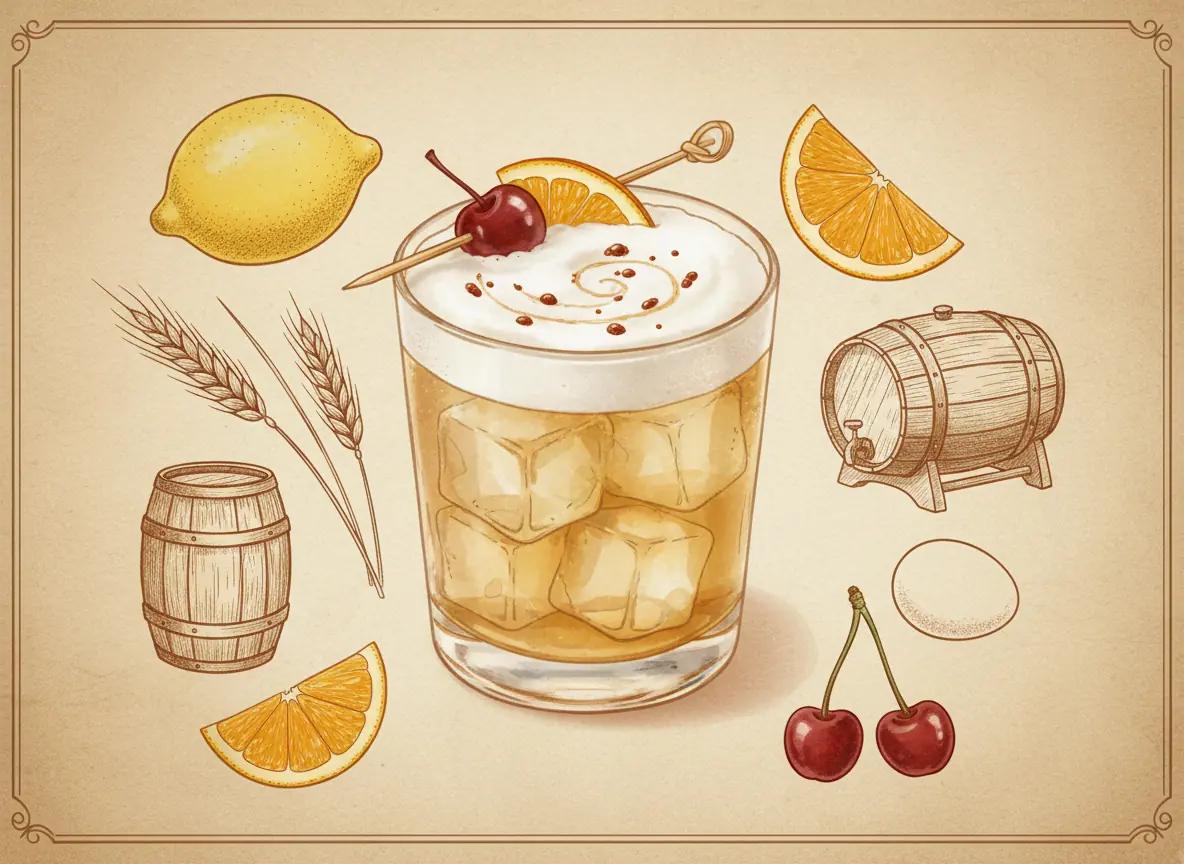
A Whiskey Sour is 45ml of bourbon, 25ml of fresh lemon juice and 20ml of sugar syrup, shaken hard with ice, then poured through a strainer onto fresh cubes in a rocks glass, with half an orange slice and a cherry. Add 15ml of egg white, dry shaken first, and dot the foam with Angostura. About 1.8 UK units. The measures are the IBA’s. The IBA’s egg white is optional and only a few drops; we use 15ml, about half a white, because that is what a full foam takes. The bitters are not in the IBA recipe, and they only go on when there is foam to hold them. The name is in print by 1870, in a Wisconsin newspaper, and the sour is older still: Jerry Thomas printed brandy, gin and rum sours in 1862. Difford’s Guide lists a Boston Sour as bourbon soured with lemon juice and smoothed by egg white.
Irish Coffee
An Irish Coffee is 50ml of Irish whiskey and a teaspoon of demerara sugar stirred into 120ml of hot filter coffee in a warmed glass, with 50ml of cream whipped to the texture of cold pouring custard and floated on top over the back of a warm spoon. Nothing goes on the cream, ever. About 2.0 UK units. The Foynes Flying Boat Museum dates it to the winter of 1943 at the Foynes flying-boat terminal, when the chef Joe Sheridan put Irish whiskey into the coffee of passengers whose flight had turned back; the Oxford Companion dates it to late 1944 or early 1945. KQED tells the Buena Vista Cafe’s story that its owner and the travel writer Stanton Delaplane set about copying the drink in San Francisco on 10 November 1952; the Companion gives 1953. It is drunk through the cream: hot, sweet coffee and whiskey under a cold layer, so every sip arrives warm and cool at once. The cream is dairy, so make it for milk drinkers only.
Where this one sits
Recipe by Jerry Can Spirits · Updated 19 October 2026