Army & Navy
An Army & Navy is 60ml of London Dry gin, 22.5ml of fresh lemon juice, 15ml of orgeat and a dash of Angostura, shaken hard and double strained into a chilled coupe, with a lemon twist. About 2.4 UK units. Orgeat is an almond syrup, so the drink contains nuts. It is a gin sour with orgeat in place of sugar. The almond adds body and a marzipan note that plain syrup lacks, and the orange flower water in a good orgeat adds a floral edge. Difford’s Guide gives the earliest printed recipe as David Embury’s The Fine Art of Mixing Drinks of 1948. He gave what he called the original, two parts gin to one each of lemon and orgeat, said it was horrible, and preferred eight parts gin to two of lemon and one of orgeat. Ours sits between the two. Where the name came from is not recorded.
Glassware: Coupe Glass
Garnish: Lemon twist
Ingredients
60ml
A London Dry with clear juniper, at 40% ABV or more. A soft gin leaves the drink tasting mostly of almond and lemon.
22.5ml
Squeezed the same day. At 22.5ml it is a little under a full sour measure, because orgeat brings body as well as sugar and needs less acid to balance it.
15ml
An almond syrup, usually with orange flower water, so it contains nuts. Choose one made from almonds rather than flavoured sugar; it decides whether the drink works.
1 dash
One dash, at 44.7% ABV on a DrinkSupermarket listing. It dries the finish and keeps the almond on the drier side of sweet.
Instructions
Chill a coupe.
Add the gin, lemon juice, orgeat and Angostura to a shaker.
Fill with cubed ice and shake hard for 10 to 12 seconds.
Double strain into the chilled coupe.
Express a lemon twist over the surface and drop it in.
Our version
Embury printed two ratios in 1948: an original of two parts gin to one each of lemon and orgeat, and his own eight to two to one. Ours, 60ml of gin, 22.5ml of lemon and 15ml of orgeat, sits between them and adds a dash of Angostura.
Source: our own specification. Last checked 10 October 2026.
Expert Tip
Use an orgeat made from almonds. A good one has body, a faint bitterness from the skins and a floral note from orange flower water; a cheap one is sugar with almond flavouring, and with so few ingredients the difference is plain. Anyone with a nut allergy should not drink it. Measure the orgeat. At 15ml the drink is silky and dry; much more and it turns syrupy, because orgeat brings body as well as sugar. One dash of Angostura is enough. It dries the finish and keeps the almond from tasting of sweets.
Behind the Army & Navy
Flavour Profile
Where It Comes From
Difford’s Guide gives the earliest printed recipe as David Embury’s The Fine Art of Mixing Drinks of 1948, though Bar Vademecum, a secondary source, lists an equal-parts Army and Navy in R. M. Barrows and Betty Stone’s 300 Ways to Mix Drinks of 1945. The Oxford Companion calls Embury a New York tax attorney who never worked in the beverage or restaurant industry; he wrote about proportion at length and did not hide his opinions.
He printed what he called the original Army & Navy, two parts gin to one each of lemon and orgeat, and said it was horrible. His own version was eight parts gin to two of lemon and one of orgeat, a much drier drink. Our 60ml, 22.5ml and 15ml sits between them.
VinePair says the exact origins are unknown, with two running theories: the annual football match between the U.S. Army and Navy, or the Army and Navy Club in Washington, where the Daiquiri was reportedly first introduced in the United States. The club has no recorded history of coining the drink.
Orgeat Instead of Sugar
The Oxford Companion describes orgeat as a sweet, usually nonalcoholic almond syrup flavoured with orange flower water. Swapped for sugar syrup in a gin sour, it brings body, a faint bitterness from the almond skins and a floral top note.
The result is silkier than a plain Gin Sour, with no egg white involved. The Oxford Companion’s Mai Tai recipe lists orgeat against rum, curaçao and lime.
The Bottle Decides It
With three main ingredients, the quality of the orgeat sets the drink. An almond orgeat has texture and depth; a flavoured syrup leaves it tasting of sweetened lemon and gin.
The Bitters Dash
Embury’s ratios list no bitters. A dash of Angostura is a common modern addition, and it does a job: almond and sugar drift toward confectionery as the drink warms, and the bitters dry the finish.
The Fitzgerald does the same for a plain gin sour, with Angostura shaken in.
Embury’s Two Ratios and Ours
The Army & Navy in three proportions
The original, as Embury printed it
- Gin
- Two parts
- Lemon
- One part
- Orgeat
- One part
- Bitters
- None given
Embury’s preferred
- Gin
- Eight parts
- Lemon
- Two parts
- Orgeat
- One part
- Bitters
- None given
Ours
- Gin
- 60ml
- Lemon
- 22.5ml
- Orgeat
- 15ml
- Bitters
- One dash Angostura
| Version | Gin | Lemon | Orgeat | Bitters |
|---|---|---|---|---|
| The original, as Embury printed it | Two parts | One part | One part | None given |
| Embury’s preferred | Eight parts | Two parts | One part | None given |
| Ours | 60ml | 22.5ml | 15ml | One dash Angostura |
How to Serve It
Shaken hard for 10 to 12 seconds, double strained into a chilled coupe, with a lemon twist expressed over the top and dropped in. Before dinner, and cold.
For the plain version with sugar syrup, make a Gin Sour; for the same sour with Angostura shaken in, a Fitzgerald; for orgeat against rum and lime, a Mai Tai.
Make it at home
The Spirit
GinGin is a spirit flavoured with juniper berries. Under the retained Regulation (EC) 110/2008, juniper must lead the taste, the floor is 37.5% ABV, and the route the flavour takes sets the grade: plain gin, distilled gin or London gin. Our recipes count it at 40%, and it carries the Martini, the Negroni and the Gin and Tonic.
Master the Techniques
More to explore
Frequently Asked Questions
What is an Army & Navy cocktail?
Does an Army & Navy contain nuts?
Where does the name come from?
What did Embury say about it?
Does the orgeat brand matter?
How does it compare with a Gin Sour?
How strong is an Army & Navy?
Sources.
Checked between 18 October and 19 October 2026.
- Difford’s Guide, “Army & Navy” (secondary source: first appears in Embury’s 1948 The Fine Art of Mixing Drinks; original 2:1:1, “horrible”, Embury’s own 8:2:1; folk link to the Army and Navy Club in Washington, D.C., where the Daiquiri was introduced to the United States).
- VinePair, “The Story Behind The Army & Navy” (secondary source: origins unknown; two theories, the Army-Navy football match and the Army & Navy Club in Washington; the club has no recorded history of coining the drink).
- Bar Vademecum, “Army and Navy” (secondary source: lists a 1945 Barrows and Stone recipe of equal parts gin, orgeat and lemon juice).
- The Oxford Companion to Spirits and Cocktails (Audrey Saunders and Robert Hess), “Embury, David A.” (secondary source: author of The Fine Art of Mixing Drinks (1948); a New York tax attorney who never worked in the beverage or restaurant industry).
- The Oxford Companion to Spirits and Cocktails (Robert Simonson), “orgeat” (secondary source: a sweet, usually nonalcoholic almond syrup flavoured with orange flower water; essential to the Mai Tai).
- The Oxford Companion to Spirits and Cocktails (Jeff Berry), “The Mai Tai” (secondary source: rum, lime juice, curaçao and orgeat syrup).
- Naval Historical Foundation (U.S. Naval Institute), “CHOW: The (Navy) Daiquiri” (museum-style naval history: Lucius W. Johnson, a junior medical officer, met Jennings Cox in Cuba in 1909 and introduced the Daiquiri to the Army and Navy Club in Washington, D.C.).
- DrinkSupermarket, “Angostura Aromatic Bitters 20cl” (UK retailer listing: 44.7% ABV).
You Might Also Like
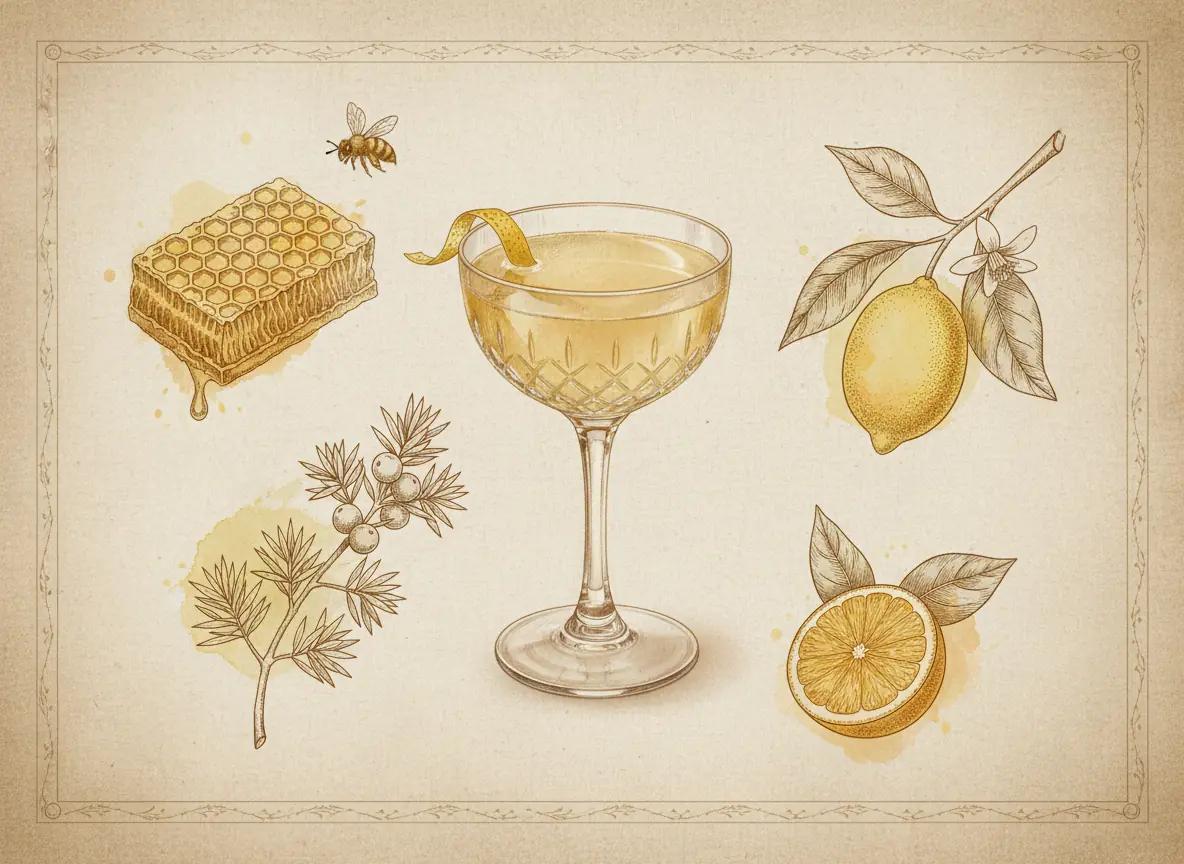
Bee’s Knees
A Bee’s Knees is 52.5ml of London Dry gin, 22.5ml each of fresh lemon and orange juice and two teaspoons (10ml) of honey syrup, made with two parts honey to one of warm water. Shake it hard for 10 to 12 seconds and double strain it into a chilled coupe, with a strip of lemon peel. About 2.1 UK units. The measures are the IBA’s. The orange is the part most recipes leave out. The oldest printings are gin, lemon and honey alone; David Embury suggested a little orange juice as a variation in 1948, and the IBA built it in. Orange softens the lemon, which is why two teaspoons of honey syrup are enough. The drink is often filed under American Prohibition, with honey and lemon covering for bathtub gin. Difford’s Guide, a secondary source, says the earliest printing tells a different story: Cocktails de Paris, published in 1929, credits it to Frank Meier of the Ritz in Paris, and Meier claimed it again in his own book in 1936.
Gin Sour
A Gin Sour is 60ml of London Dry gin, 25ml of fresh lemon juice and 20ml of sugar syrup, shaken hard with ice for 10 to 12 seconds and strained over fresh ice in a rocks glass, with a lemon wheel and a cherry. About 2.4 UK units. Add 15ml of egg white for a silkier version, dry shaken first; it is raw, so leave it out for anyone allergic to egg. It is the plain sour with gin as the spirit. Difford’s Guide says Jerry Thomas’s 1862 bar guide has a Gin Sour, and the frame of spirit, citrus and sugar runs under most gin classics since: the White Lady sweetens it with orange liqueur, the Bee’s Knees with honey, the Clover Club with raspberry. With only three ingredients the gin has nowhere to hide. A juniper-led London Dry gives the classic reading; a citrus or floral gin changes the drink more than any change of measure.
Fitzgerald
A Fitzgerald is 60ml of London Dry gin, 25ml of fresh lemon juice, 20ml of sugar syrup and two dashes of Angostura, shaken hard with ice for 10 to 12 seconds and strained over fresh ice in a rocks glass, with a lemon wheel or wedge. About 2.5 UK units. It is our Gin Sour with the bitters shaken in. Difford’s Guide credits the drink to Dale DeGroff at the Rainbow Room in New York in the early 1990s, and DeGroff says he came up with it on a busy shift at the Promenade Bar. Two dashes change more than the measure suggests. Shaken through, the Angostura darkens the middle with clove and dries the finish, and a bright daytime sour becomes an evening one.
Where this one sits
Recipe by Jerry Can Spirits · Updated 19 October 2026