Algonquin
An Algonquin is 60ml of rye whiskey, 22.5ml of dry vermouth and 22.5ml of fresh pineapple juice, shaken hard for 10 to 12 seconds and double strained into a chilled coupe, with a pineapple wedge or a lemon twist. About 2.8 UK units. It looks like a Manhattan and behaves like a sour. Dry vermouth takes the place of sweet, bitters go altogether, and pineapple does the softening, with acid as much as sugar. Fresh juice also foams under a hard shake, so the drink arrives with a fine head that no stirred whiskey drink has. The name is the Algonquin Hotel’s, at 59 West 44th Street in New York, where, the hotel says on its own page, the Round Table of Dorothy Parker and her circle gathered every day from 1919 to 1929. VinePair finds the first printing in G. Selmer Fougner’s Along the Wine Trail of 1935, as the “New Algonquin”: two parts rye to one each of French vermouth and pineapple juice. Difford’s Guide calls it one of several 1930s classics attributed to the hotel.
Glassware: Coupe Glass
Garnish: Pineapple wedge and Lemon twist
Ingredients
60ml
A straight rye at 40 to 50% ABV. Its pepper keeps the pineapple in check; bourbon makes a rounder, sweeter drink with less edge.
22.5ml
French-style dry vermouth at about 18% ABV, opened within the month and kept in the fridge. Sweet vermouth would add sugar to fruit that already brings its own.
22.5ml
Pressed or blended from a ripe pineapple and strained the same day. Its acid balances the drink and its proteins make the foam; carton juice loses both to heat treatment.
Instructions
Chill a coupe.
Add the rye, dry vermouth and fresh pineapple juice to a shaker.
Fill with cubed ice and shake hard for 10 to 12 seconds.
Double strain into the chilled coupe.
Garnish with a pineapple wedge on the rim, or express a lemon twist over the top.
Our version
Rye, dry vermouth and fresh pineapple at 60ml, 22.5ml and 22.5ml, shaken. The first printing VinePair finds, G. Selmer Fougner’s Along the Wine Trail (1935), gives two parts rye to one each of French vermouth and pineapple juice; we pour less vermouth and juice so the rye leads.
Source: our own specification. Last checked 10 October 2026.
Expert Tip
Use fresh pineapple juice, pressed or blended and strained the same day. Juice from a carton has been heat-treated, which flattens its acidity and takes away most of the foam the shake is meant to raise. Shake harder than you would for a lemon sour. The head is part of the drink, and a lazy shake leaves a thin, watery layer instead of a fine one. Double strain to catch the pulp. We keep the dry vermouth in the fridge and finish it within a month of opening. At 22.5ml it is a fifth of the drink, and a tired bottle tastes flat and faintly sour against the rye.
Behind the Algonquin
Flavour Profile
A Hotel Name and a 1935 Recipe
The hotel’s own page says the Round Table gathered at the Algonquin every day from 1919 to 1929. Its members included Dorothy Parker, Robert Benchley and Alexander Woollcott, and the hotel, at 59 West 44th Street, still carries that literary weight.
The drink is harder to place. VinePair finds the first printing in G. Selmer Fougner’s Along the Wine Trail, published in 1935, listed as the “New Algonquin”: two parts rye, one part French vermouth, one part pineapple juice. Difford’s Guide says Stanley Jones repeated the recipe in 1977, and that Ted Haigh featured the drink in his 2004 Vintage Spirits and Forgotten Cocktails.
Pineapple Does the Softening
In a Manhattan, sweet vermouth and bitters round the whiskey. The Algonquin drops both. Dry vermouth brings herbs and a little wine, and pineapple brings the sugar and acid that make rye easy to drink.
Pineapple is sharp as well as sweet, which is why it works where orange or apple would make the drink cloying. The acid meets the rye’s pepper and the vermouth’s bitterness, and the drink finishes drier than its fruit suggests.
The Shake Makes the Head
Convention says spirit and vermouth are stirred. Fresh pineapple overrides it. The juice carries proteins that trap air under a hard shake, and the drink pours with a fine, pale head, much as a sour with egg white does, though no egg is involved.
That head is why the juice has to be fresh. Heat-treated juice from a carton barely foams, and its acid is duller, so the drink loses its texture and its balance together.
Our Measures, the 1935 Measures and a Manhattan
The Algonquin as Fougner printed it, as Difford’s Guide reproduces him, as we make it, and our Manhattan; the units are our calculation at our working figures of 40% for rye, 18% for dry vermouth and 16% for sweet
Whiskey
- Fougner, 1935
- Two parts rye
- Our Algonquin
- 60ml rye
- Our Manhattan
- 50ml rye
Vermouth
- Fougner, 1935
- One part French (dry)
- Our Algonquin
- 22.5ml dry
- Our Manhattan
- 20ml sweet
Pineapple juice
- Fougner, 1935
- One part
- Our Algonquin
- 22.5ml, fresh
- Our Manhattan
- None
Bitters
- Fougner, 1935
- None
- Our Algonquin
- None
- Our Manhattan
- One dash Angostura
Method
- Fougner, 1935
- Not stated
- Our Algonquin
- Shaken 10 to 12 seconds
- Our Manhattan
- Stirred 20 to 30 seconds
UK units
- Fougner, 1935
- Not stated
- Our Algonquin
- About 2.8
- Our Manhattan
- About 2.3
| Element | Fougner, 1935 | Our Algonquin | Our Manhattan |
|---|---|---|---|
| Whiskey | Two parts rye | 60ml rye | 50ml rye |
| Vermouth | One part French (dry) | 22.5ml dry | 20ml sweet |
| Pineapple juice | One part | 22.5ml, fresh | None |
| Bitters | None | None | One dash Angostura |
| Method | Not stated | Shaken 10 to 12 seconds | Stirred 20 to 30 seconds |
| UK units | Not stated | About 2.8 | About 2.3 |
Our measures pull the vermouth and juice back from Fougner’s equal halves. At 60ml, 30ml and 30ml the drink is longer and fruitier; at 22.5ml each, the rye stays in front and the pineapple reads as acid before sweetness.
How to Serve It
Straight up, in a coupe from the freezer, as soon as it is strained, while the head is still standing. A pineapple wedge on the rim says what is in the glass; a lemon twist gives a sharper nose and suits a drier rye.
For the sweet-vermouth original, make a Manhattan; for rye with dry vermouth and maraschino, a Brooklyn.
Make it at home
The Spirit
Whiskey (Rye)Rye whiskey, under the US standard 27 CFR 5.143, takes at least 51% of its grain from rye and its colour from new charred oak, and goes into bottle at a 40% ABV minimum; our recipes take 40% as the figure. Rye makes a drier, spicier, more peppery spirit than corn, which is why stirred classics such as the Manhattan, Vieux Carré and Brooklyn are written for it. It appears in 23 of our recipes.
Master the Techniques
More to explore
Frequently Asked Questions
What is in an Algonquin?
Was the Algonquin made for the Round Table?
Why is it shaken when it looks like a Manhattan?
Can I use tinned or carton pineapple juice?
Why dry vermouth rather than sweet?
Should I use the 1935 proportions?
How strong is an Algonquin?
Sources.
Correct as of 19 October 2026.
- VinePair, “The Story Behind The Algonquin” (secondary source: first in print in G. Selmer Fougner’s 1935 Along the Wine Trail, listed as the “New Algonquin” under “Gin Cocktails”: two parts rye, one part French vermouth, one part pineapple juice).
- Difford’s Guide, “Algonquin” (secondary source: adapted from Fougner’s 1935 recipe (NEW ALGONQUIN: two parts rye, one part French vermouth, one part pineapple juice), “one of several 1930s classics attributed to New York City’s Algonquin Hotel”; repeated in Stanley M. Jones’ 1977 Complete Barguide; Ted Haigh’s 2004 Vintage Spirits and Forgotten Cocktails).
- Algonquin Hotel, “The Round Table at The Algonquin Hotel” (the hotel’s own page: the Round Table gathered every day from 1919 to 1929; Dorothy Parker, Robert Benchley and Alexander Woollcott).
- Algonquin Hotel, “The Algonquin Hotel” (the hotel’s own site: 59 West 44th Street, between Fifth and Sixth Avenues, New York).
You Might Also Like
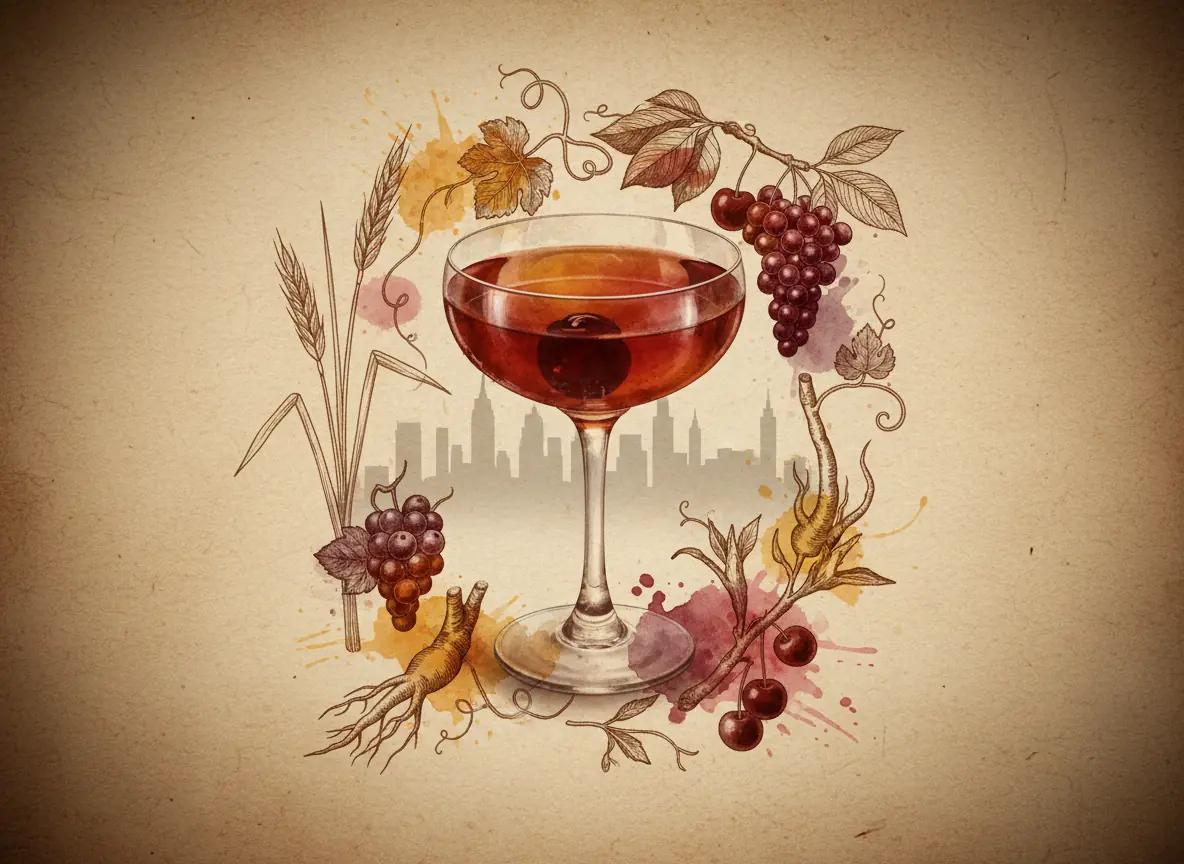
Manhattan
The IBA specifies 50ml of rye whiskey, 20ml of sweet vermouth and a dash of Angostura bitters, strained into a chilled glass with a cocktail cherry; we stir it over ice for 20 to 30 seconds and serve it in a coupe. That is five parts whiskey to two of vermouth. About 2.3 UK units. The Oxford Companion says the most commonly told story puts it at New York’s Manhattan Club on 29 December 1874, at a testimonial dinner for Samuel J. Tilden, later retold with Jennie Jerome, Lady Randolph Churchill, as host or inspiration, and calls that story simply not true: she had given birth to Winston Churchill in Oxfordshire less than a month earlier. The Companion names O. H. Byron’s Modern Bartenders’ Guide among the bar books that printed the drink in 1884, and we read Byron’s and Charlie Paul’s books of that year in the Internet Archive scans. With so little in the glass, the vermouth decides it. Twenty millilitres is over a quarter of the drink, and a bottle opened months ago tastes flat and sour against the rye. We keep it in the fridge and replace it within about four weeks.
Brooklyn
A Brooklyn is 60ml of rye whiskey and 22.5ml of dry vermouth, with 7.5ml each of maraschino liqueur and Averna and two dashes of orange bitters, stirred over ice for 20 to 30 seconds and strained into a chilled Nick and Nora glass with a cherry. About 3.3 UK units. The Averna and orange bitters stand in for Amer Picon, the French bitter orange aperitif the old recipes call for. The Oxford Companion says Picon’s strength fell from about 40% ABV to 38% in the 1920s, 27% in the 1970s and 18% in 1989, and Punch says it is still largely unavailable in the United States; in our view any Brooklyn poured now is a reconstruction. Difford’s Guide says the Brooklyn as we know it first appears in print in Jacob Grohusko’s Jack’s Manual, 1908, as equal parts rye and Italian vermouth with a dash each of Picon and maraschino. In 1913 Jacques Straub’s manual, as Difford’s Guide reproduces it, made it with French, or dry, vermouth.
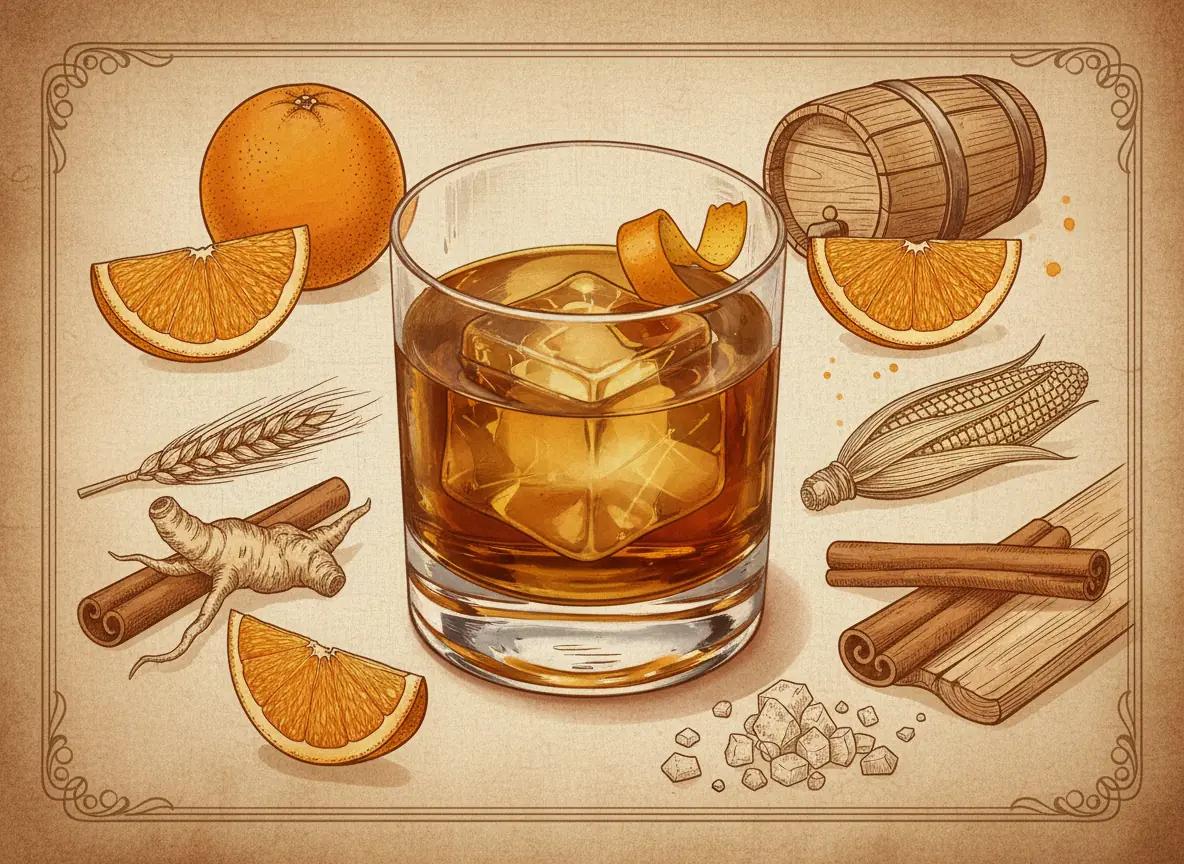
Old Fashioned
The IBA’s Old Fashioned is 45ml of bourbon or rye whiskey, one sugar cube, a few dashes of Angostura bitters and a few dashes of water; we use bourbon and two dashes. The sugar and bitters are muddled in a rocks glass until the cube dissolves, then ice goes in, the bourbon goes over it and the drink is stirred for 15 to 20 seconds. Orange peel is expressed over the top. About 1.9 UK units. Only the sugar and bitters are muddled: no orange flesh, no cherry. The recipe predates the name. The Oxford Companion says that when a newspaper in Hudson, New York, defined the cocktail in 1806, it described “spirits of any kind, sugar, water, and bitters”. The name came later in the century: the Companion has people ordering Old-Fashioneds in Chicago in 1880, as bartenders added liqueurs to the format and drinkers who wanted it plain asked for one made the old-fashioned way.
Where this one sits
Recipe by Jerry Can Spirits · Updated 19 October 2026