Fireside Punch
Fireside Punch serves about fifteen: 750ml of bourbon, 500ml of cloudy apple juice, 250ml of fresh lemon juice, 250ml of maple syrup and 500ml of water, warmed in a slow cooker with four cinnamon sticks, three star anise and an orange cut into wheels, kept at a steam and never boiled, then served by the ladle in cups of about 150ml. Each cup is about 2.0 UK units, and the pot about 30 in all. The apple is juice, not alcoholic cider. The recipe uses cider in the American sense, fresh pressed apple, which Dictionary.com defines as the juice pressed from apples, as against hard cider, the fermented kind; the cloudy apple juice in the pot is that juice. Dry cider in its place makes a stronger pot, at about 2.2 units a cup. We wrote it for Bonfire Night. The water takes a full bottle of bourbon down to a strength that lasts an evening, and the lemon keeps the maple from sitting heavy as the pot holds.
Glassware: Punch Cup
Garnish:
Ingredients
750ml
A standard bourbon at our working 40% ABV, with enough vanilla and oak to show through apple and maple. A British bottle holds 700ml, so 750ml is a bottle plus a 50ml measure; the bottle alone makes a slightly softer pot.
500ml
Cloudy pressed apple juice, which is alcohol-free: what American recipes call cider. For a stronger pot use dry cider at about 5% ABV, which adds about 2.5 units across the batch.
250ml
Squeezed the same day, about six lemons. Without it the maple and apple sit heavy in the cup by the second hour.
250ml
Pure maple syrup rather than maple-flavoured syrup, which in our experience is mostly glucose. It brings a woody sweetness plain sugar lacks.
500ml
Cold tap water. By our calculation it takes the pot from about 17% ABV down to about 13%, close to a glass of wine, which is what lets fifteen cups last an evening.
4 sticks
Whole sticks, not ground. Ground cinnamon clouds the punch and leaves grit in the last cups.
3 whole
Three is enough. The aniseed grows stronger as the pot sits, and more takes over the apple.
1 orange, in wheels
Cut about half a centimetre thick and added at the start for their oil. Lift them out after about two hours, before the pith turns bitter.
Instructions
Pour the bourbon, cloudy apple juice, lemon juice, maple syrup and water into a slow cooker or large pan.
Add the cinnamon sticks, star anise and orange wheels.
Warm gently, lid on, for about an hour, until it steams. Never let it boil.
Hold on low or keep-warm for the evening, lifting out the orange wheels after about two hours.
Ladle into heatproof cups of about 150ml.
Our version
A house recipe with no published original that we have found, written for Bonfire Night: 750ml of bourbon to 500ml each of cloudy apple juice and water, with 250ml each of lemon juice and maple syrup, for about fifteen cups.
Source: our own specification. Last checked 10 October 2026.
Expert Tip
Never let it boil. Steaming is hot enough to serve; a simmer flattens the maple, cooks the lemon and lets the spice escape as vapour. A slow cooker on low with the lid on holds it there, and if yours runs hot, switch it to keep-warm once the pot is up to heat. Warm it for an hour before anyone arrives. The cinnamon, star anise and orange need that long to reach the liquid, and the punch tastes rounder an hour in than at the first ladle. Lift the orange wheels out after about two hours. Left in the heat longer, the pith turns the pot bitter.
Behind the Fireside Punch
Flavour Profile
A Bonfire Night Pot
Fireside Punch was written for a Bonfire Night garden where nobody wants to mix drinks in the dark. It takes the punch format, spirit, citrus, sugar, water and spice in one vessel, and serves it hot.
The pot stays on through the display, guests ladle for themselves, and the host gets to watch the fireworks.
What Each Part Does
Bourbon gives the pot its weight, with vanilla and oak that survive the heat. Apple juice brings fruit and body, maple a woody sweetness, and lemon the acid that keeps the sweetness in check. Water sets the strength.
That last job matters most. Without the water the pot would sit at about 17% ABV; with it, about 13%, which is why fifteen cups of it can last an evening rather than an hour.
Juice, Not Cider
Cider means two things. Dictionary.com defines the American sense as the juice pressed from apples, with the fermented kind called hard cider, and that is what goes in this pot. Dictionary.com’s British definition is an alcoholic drink made from the fermented juice of apples.
Swap in 500ml of dry cider at about 5% and the pot gains about 2.5 units and a drier, sharper apple. Taste before serving, because the cider brings less sugar than the juice and the maple may want a little more.
The Batch Maths
The pot holds about 2.25 litres, fifteen cups of about 150ml. Each cup carries 50ml of bourbon, about 2.0 UK units, and the whole pot about 30.
Fireside Punch for fifteen, by the cup and for thirty; our recipe and our calculation
Bourbon, 40% ABV
- Pot for fifteen
- 750ml
- In each 150ml cup
- 50ml
- Pot for thirty
- 1.5 litres
Cloudy apple juice
- Pot for fifteen
- 500ml
- In each 150ml cup
- About 33ml
- Pot for thirty
- 1 litre
Fresh lemon juice
- Pot for fifteen
- 250ml
- In each 150ml cup
- About 17ml
- Pot for thirty
- 500ml
Maple syrup
- Pot for fifteen
- 250ml
- In each 150ml cup
- About 17ml
- Pot for thirty
- 500ml
Water
- Pot for fifteen
- 500ml
- In each 150ml cup
- About 33ml
- Pot for thirty
- 1 litre
Cinnamon sticks and star anise
- Pot for fifteen
- 4 and 3
- In each 150ml cup
- In the pot
- Pot for thirty
- 6 and 4 or 5
UK units
- Pot for fifteen
- About 30
- In each 150ml cup
- About 2.0
- Pot for thirty
- About 60
| Ingredient | Pot for fifteen | In each 150ml cup | Pot for thirty |
|---|---|---|---|
| Bourbon, 40% ABV | 750ml | 50ml | 1.5 litres |
| Cloudy apple juice | 500ml | About 33ml | 1 litre |
| Fresh lemon juice | 250ml | About 17ml | 500ml |
| Maple syrup | 250ml | About 17ml | 500ml |
| Water | 500ml | About 33ml | 1 litre |
| Cinnamon sticks and star anise | 4 and 3 | In the pot | 6 and 4 or 5 |
| UK units | About 30 | About 2.0 | About 60 |
How to Serve It
From the slow cooker, with a ladle, into heatproof cups. Outdoors, use metal or paper cups rather than glass, and keep the pot and its cable well away from the bonfire and from children. For a walk to a public display, a flask warmed with hot water first keeps it hot through the fireworks.
For a sweeter pot of dark rum, honey and butterscotch, the Guy Fawkes Grog; for an alcohol-free pot, Hot Spiced Cider.
Make it at home
The Spirit
Whiskey (Bourbon)Under the US standard 27 CFR 5.143, bourbon is an American whiskey whose mash is at least 51% corn, matured in fresh charred oak barrels and bottled at 40% ABV or higher, the figure our recipes use. The fresh charred wood gives it its vanilla, caramel and colour, and the corn gives a rounder, sweeter spirit than rye. It is the base of 26 of our recipes, more than any other whiskey.
More to explore
Frequently Asked Questions
What is in Fireside Punch?
Is the cider in Fireside Punch alcoholic?
How do I keep it hot without boiling it?
Can I double it for thirty?
Can I make it ahead?
What can I serve to guests who are not drinking?
How strong is Fireside Punch?
Sources.
Correct as of 19 October 2026.
- Dictionary.com, “cider” (dictionary entry: American, the juice pressed from apples, before fermentation sweet cider or after fermentation hard cider; British, an alcoholic drink made from the fermented juice of apples, also called (US) hard cider; also an unfermented drink made from apple juice).
You Might Also Like
Fish House Punch
Fish House Punch is dark rum, cognac and peach over lemon and sugar, lengthened with cold tea: 45ml of dark rum, 30ml of cognac, 15ml of peach liqueur, 25ml of fresh lemon juice, 15ml of demerara syrup and 60ml of weak black tea for one drink, multiplied by ten for a bowl rested over one large block of ice and ladled into small cups. About 2.6 UK units in a 150ml cup, which is why the cups are small. It began as the house drink of the Colony in Schuylkill, later the State in Schuylkill, a Philadelphia club that has met from 1732 at its fish house on the Schuylkill river, by the Oxford Companion’s account. The punch is traditionally dated to the club’s first year, but the Companion calls that unlikely and dates the earliest recipes to 1793 and 1795; Jerry Thomas published it in 1862. The rest is what makes it. An hour over the block rounds the three spirits into one, and the slow melt adds the last of the water.
The Expedition Punch
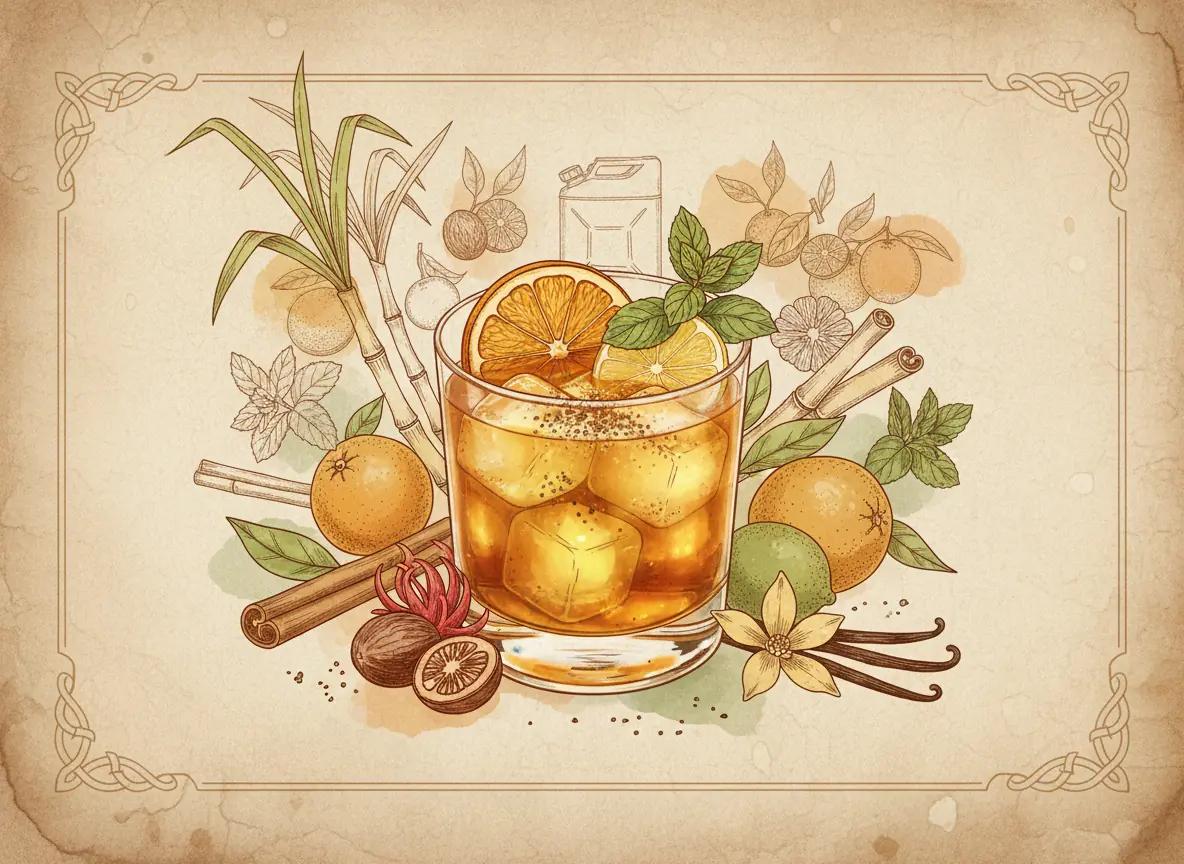
The Expedition Punch is 60ml of Expedition Spiced Rum, 20ml of fresh lemon juice, 40ml of sugar syrup and 80ml of water or cooled weak black tea, stirred gently over large cubed ice in a double rocks glass and finished with orange and lemon wheels, a mint sprig and freshly grated nutmeg. About 2.4 UK units in 200ml of drink. It follows the old punch formula of five parts: spirit, citrus, sugar, water and spice. Punch is older than the cocktail; the Oxford Companion dates the first mention of punch by name to a 1632 letter in the papers of the English East India Company. Here the rum carries much of the spice already, and the nutmeg on top completes the fifth part. The choice that changes the drink is water or tea. Water keeps it clean and lets the rum lead. Weak black tea, brewed at half strength and cooled, adds tannin and a drier edge beneath the sugar. Either way it scales from one cup to a bowl for ten without adjustment.
Where this one sits
Recipe by Jerry Can Spirits · Updated 19 October 2026