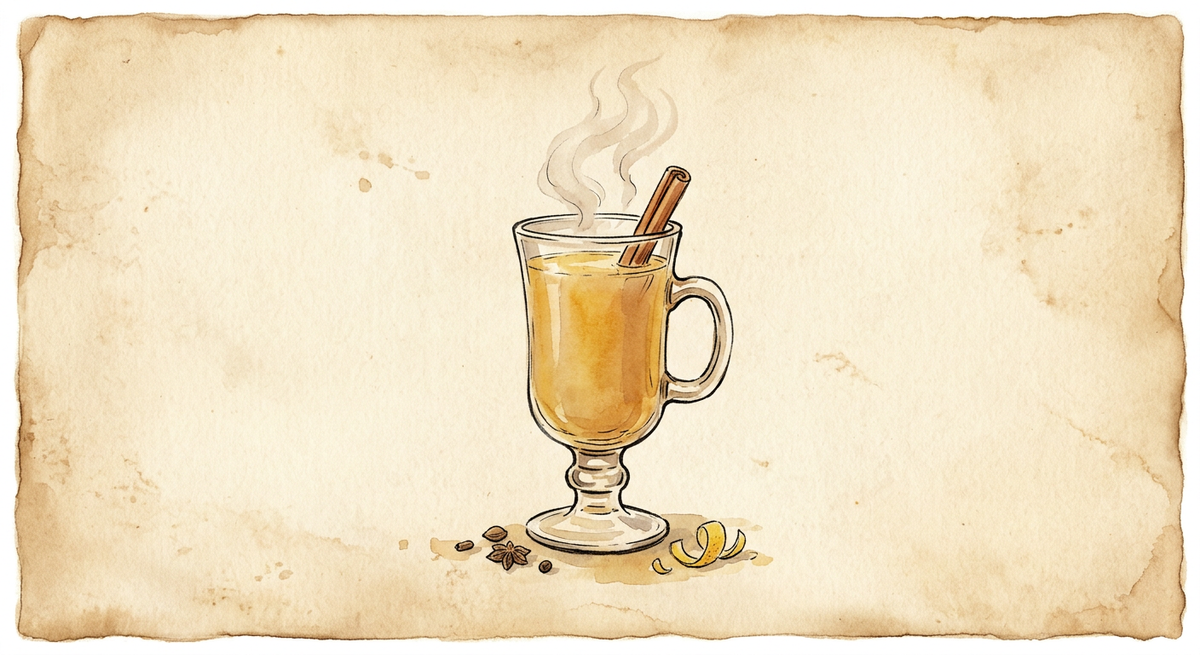
Guy Fawkes Grog
Guy Fawkes Grog is a hot rum punch for about twelve: 150ml of honey dissolved in a litre of hot water, then 500ml of dark rum, 300ml of butterscotch liqueur and 150ml of fresh lemon juice, kept hot but never boiled and ladled into mugs with a cinnamon stick in each. About 2.2 UK units a mug. It is our own recipe, written for Bonfire Night. The name borrows the Royal Navy’s grog, rum cut with water, and nothing else from it. The honey and butterscotch are modern, and they are there because the fifth of November tastes of bonfire toffee. Lemon keeps it a punch rather than a pudding. It drinks sweeter than our Fireside Punch, so it suits the later, colder end of the evening.
Glassware: Heatproof Mug
Garnish: Cinnamon stick in each mug
Ingredients
150ml
Runny honey, stirred into the hot water first so it disperses. It gives a rounder sweetness than sugar and softens the join between the rum and the butterscotch.
1 litre
Just off the boil when the honey goes in. It is the grog half of the name, and it brings each mug close to the strength of a glass of wine.
500ml
A full-bodied dark rum at our working 40% ABV. A light rum vanishes under the butterscotch, and the pot ends up tasting of sauce.
300ml
Strengths vary by brand, and the units here take our working 20%. It brings the toffee. Some are cream liqueurs and contain milk, so check the label. Use a clear, non-cream bottle: the lemon would curdle cream.
150ml
Squeezed the same day, from five or six lemons. It cuts through the honey and butterscotch; without it the pot tastes like dessert.
Instructions
Pour 1 litre of hot water into a large pan or slow cooker and stir in the honey until it dissolves.
Add the dark rum, butterscotch liqueur and lemon juice, and stir.
Warm gently until it steams, and hold it there without letting it boil.
Ladle into heatproof mugs and stand a cinnamon stick in each.
Our version
Our own Bonfire Night pot, borrowing only the name and the rum-and-hot-water frame of naval grog.
Source: our own specification. Last checked 10 October 2026.
Expert Tip
Dissolve the honey first. Stir it into the hot water until no streaks are left, then add the rum, butterscotch and lemon. Honey poured into cold spirit sinks and sticks. Keep it hot, never boiling. In our experience a boil drives off alcohol and aroma and cooks the honey flat. A slow cooker on low is the easy way; on a hob, use the smallest ring and stir now and then. The surface should steam, not bubble. Some butterscotch liqueurs are cream liqueurs and contain milk. Read the label if anyone at the fire avoids dairy, and say so beside the pot.
Behind the Guy Fawkes Grog
Flavour Profile
Grog, and Where the Name Comes From
Grog was the Navy’s daily rum, diluted with water. The Oxford Companion says it was introduced to the British Navy in 1740 by Admiral Edward Vernon, who had the daily ration issued diluted with four parts of water to one of rum and served twice a day; his overcoat of grogram cloth gave him the nickname Old Grogram. The Royal Museums Greenwich say the daily tot ended on 31 July 1970, which became known as Black Tot Day.
This pot borrows the frame and the name. Everything else in it, the honey, the butterscotch and the cinnamon, belongs to a back garden on the fifth of November.
Why It Works
A litre of water carries 500ml of rum, so the pot is strong but drinkable. The honey softens the rum, the butterscotch brings toffee, and 150ml of lemon puts a sharp edge on all that sugar. Take the lemon out and it tastes of sauce.
Dark rum matters because it has the body to stand up to the liqueur. A light white rum disappears under the butterscotch.
Hot, Never Boiling
The rule for any hot punch is heat without a boil. the NIST Chemistry WebBook gives the boiling point of ethanol as about 78°C, well short of water, and in our experience a rolling boil takes alcohol and aroma off with the steam. Keep the surface steaming and still. A slow cooker on low holds it there without attention; a pan wants the smallest ring and a lid half on.
Three Hot Drinks for a Cold Night
Guy Fawkes Grog beside the Hot Toddy and Hot Buttered Rum; all three are our recipes and the units are our calculation
Guy Fawkes Grog (ours)
- Spirit
- 500ml dark rum, 300ml butterscotch liqueur
- Sweetener
- 150ml honey
- Citrus
- 150ml lemon
- Hot water
- 1 litre
- Made as
- A pot for about 12
- UK units a serve
- About 2.2
Hot Toddy
- Spirit
- 60ml Scotch
- Sweetener
- 15ml honey syrup
- Citrus
- 15ml lemon
- Hot water
- 120ml
- Made as
- One mug
- UK units a serve
- About 2.4
Hot Buttered Rum
- Spirit
- 60ml dark rum
- Sweetener
- Butter and brown sugar batter
- Citrus
- None
- Hot water
- 150ml
- Made as
- One mug
- UK units a serve
- About 2.4
| Drink | Spirit | Sweetener | Citrus | Hot water | Made as | UK units a serve |
|---|---|---|---|---|---|---|
| Guy Fawkes Grog (ours) | 500ml dark rum, 300ml butterscotch liqueur | 150ml honey | 150ml lemon | 1 litre | A pot for about 12 | About 2.2 |
| Hot Toddy | 60ml Scotch | 15ml honey syrup | 15ml lemon | 120ml | One mug | About 2.4 |
| Hot Buttered Rum | 60ml dark rum | Butter and brown sugar batter | None | 150ml | One mug | About 2.4 |
How to Serve It
Ladle it into heatproof mugs with a cinnamon stick standing in each, to stir with and to smell. Serve it hot rather than scalding. For a public display, carry it in flasks warmed first with boiling water. Put alcohol-free drinks beside it and label the pots.
For the bourbon pot to serve first, a Fireside Punch; for a cold rum drink served round an ice cone, a Navy Grog.
Make it at home
The Spirit
Dark RumDark rum is a heavy, deep-coloured rum, counted at 40% ABV in our recipes, whose colour may come from years in oak, from blending or from added caramel, which Regulation (EC) 110/2008 allows. It brings weight and a burnt-sugar note to punches, hot drinks and tiki builds: the Rum Runner, the Hurricane and the Planter’s Punch.
More to explore
Frequently Asked Questions
What is in Guy Fawkes Grog?
Is it an old naval recipe?
Can I let it boil?
Can I make it ahead?
How sweet is it?
What about the children and drivers?
How strong is a mug of Guy Fawkes Grog?
Sources.
Correct as of 19 October 2026.
- The Oxford Companion to Spirits and Cocktails (Wayne Curtis), “grog” (secondary source: grog introduced to the British Navy in 1740 by Admiral Edward Vernon, four parts water to one of rum, served twice daily; his grogram overcoat and the nickname Old Grogram; the ration ended in 1970).
- Royal Museums Greenwich, “A rum deal: the origins of Nelson’s blood” (primary source (museum): the daily tot ended on 31 July 1970; the day became known as Black Tot Day).
- NIST Chemistry WebBook, “Ethanol” (primary reference data: normal boiling point 351.5 ± 0.2 K, about 78 °C).
You Might Also Like
Navy Grog
A Navy Grog is 30ml each of dark, aged and white rum, 22.5ml each of fresh lime and white grapefruit juice and 30ml of honey syrup, shaken hard for 10 to 12 seconds and strained into a double rocks glass around an ice cone, then topped with 60ml of soda water and drunk through the straw frozen into the cone. About 3.6 UK units. Donn Beach created it at Don the Beachcomber in Hollywood, and an early menu dedicated it to the gallant men of the American navy. The name reaches back to the Royal Navy: in 1740 Admiral Edward Vernon ordered his sailors’ rum ration mixed with water, and the mixture took his nickname, Old Grogram, from the grogram coat he reportedly wore, by the Oxford Companion’s account. Three rums give it a depth one bottle cannot, and grapefruit and honey keep it drier than most tiki drinks. The ice cone is the theatre, and it keeps the glass very cold.
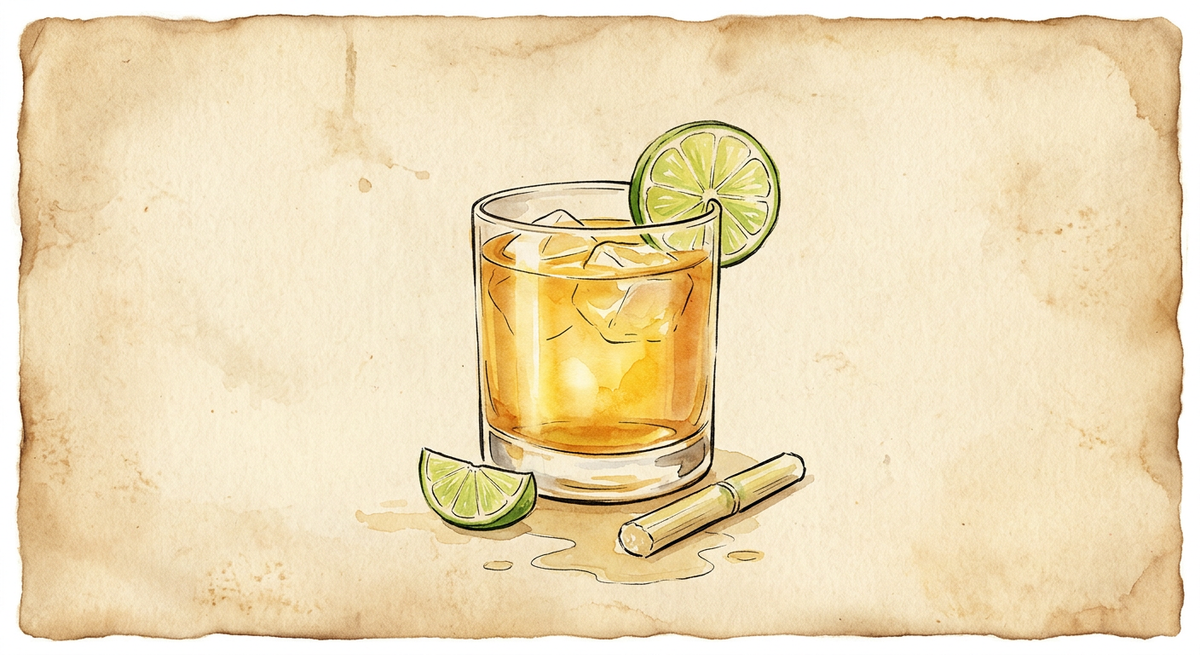
Canchánchara
A Canchánchara is 60ml Cuban aguardiente, 15ml raw honey, 15ml fresh lime juice and 50ml water. Mix the honey, lime and water in the glass until the honey dissolves and coat the base and sides with it, add cracked ice, pour in the aguardiente and stir hard from the bottom up. About 2.4 UK units, taking the spirit at 40% ABV. Those are the IBA’s measures and method. Punch places its creation in the Valle de los Ingenios near Trinidad, in central Cuba, and attributes it to the mambises, guerrilla fighters in the Ten Years’ War (1868 to 1878) and the War of Independence (1895 to 1898). Punch quotes the bartender Julio Cabrera saying they drank it before battle and as a morning toddy against cold, hunger and fatigue. The formula is the Daiquiri’s in its roughest form: cane spirit, sweetness and lime. Honey and water make it softer and longer, and the young spirit keeps a green, grassy edge that a white rum lacks.
Where this one sits
Recipe by Jerry Can Spirits · Updated 19 October 2026