Punches
19 recipes
This Field Manual holds 19 recipes in the punch family. Punch predates the cocktail by more than a century and works to a ratio rather than a recipe: one of sour, two of sweet, three of strong, four of weak.
The ratio is what makes it scale. Every quantity moves together, so a bowl for twelve is the same arithmetic as a glass for one. Dilution is built in through the weak, which is water or tea, and that is why a punch can sit on a table without collapsing the way a shaken drink would. A large block of ice melts slowly enough to hold the balance for an evening, and cubes do not.
Base Spirit
Difficulty Level
Brandy Milk Punch
The Brandy Milk Punch is New Orleans keeping the eighteenth century's breakfast habit: brandy shaken cold through sweetened vanilla milk and crested with nutmeg. Milk punch travelled the colonial world as a drink of hospitality and, in most places, quietly died. New Orleans never stopped pouring it, and the grand hotels still serve it at brunch beside the Ramos Gin Fizz as the morning's other dairy answer. The build is lighter than the name suggests. Whole milk rather than cream is the whole argument: it carries the brandy and the vanilla without turning the glass into dessert, which is what makes a second one reasonable before noon. Fifteen millilitres of simple syrup stands in for the powdered sugar of the older specs, and the vanilla arrives in drops rather than pours. What comes out is liquid comfort with a spirit floor under it: the eggnog's lighter, year-round sibling, and the drink that settles a brunch argument the way an Irish Coffee settles a winter one.
Cauldron Punch
The Cauldron Punch is the Halloween answer to a practical problem: fifteen guests, one host, and no appetite for shaking drinks all night. Dark rum and blackberry liqueur give it depth and a bruised purple-black colour, pomegranate juice pulls it towards blood red, and lime with simple syrup keeps the whole thing balanced rather than merely strong. Sparkling water, added just before the doorbell, lifts it out of syrup territory. Everything except the fizz can be mixed in the bowl and refrigerated hours ahead, which is the entire argument for punch as a format. The recipe scales in straight lines: double it for thirty, halve it for a quiet gathering, and the balance holds. The presentation does the costume work. A dark bowl, a ladle, gummy worms draped over the rim of each cup and, if the theatre demands it, a small piece of food-grade dry ice fogging the surface. Let dry ice sublimate completely before anyone drinks, and never let it near a glass. The punch underneath is a proper rum drink, dark fruit over Caribbean warmth, and it deserves to outlast the decorations.
Champagne Punch
The Champagne Punch is a celebration batch for gatherings where elegance matters more than warmth: a chilled base of cognac, orange liqueur, fresh orange juice and lemon, with two bottles of champagne added at the last possible moment. A ladle, a row of flutes, and a bowl full of colour. The staging is the recipe. The base is combined and chilled well ahead, so the only job at service is the pour, and the champagne goes in just before guests reach the bowl, because carbonation spent early is carbonation wasted. If the party runs across hours, add the bottles in stages, one at a time, and the fizz lasts as long as the evening does. The cognac is doing real work down there, putting depth and dried fruit under the sparkle while the orange liqueur and juice keep the bowl bright. The format also scales down: the same drink sized to a 187ml bottle and a shared carafe makes a punch for two.
Coquito
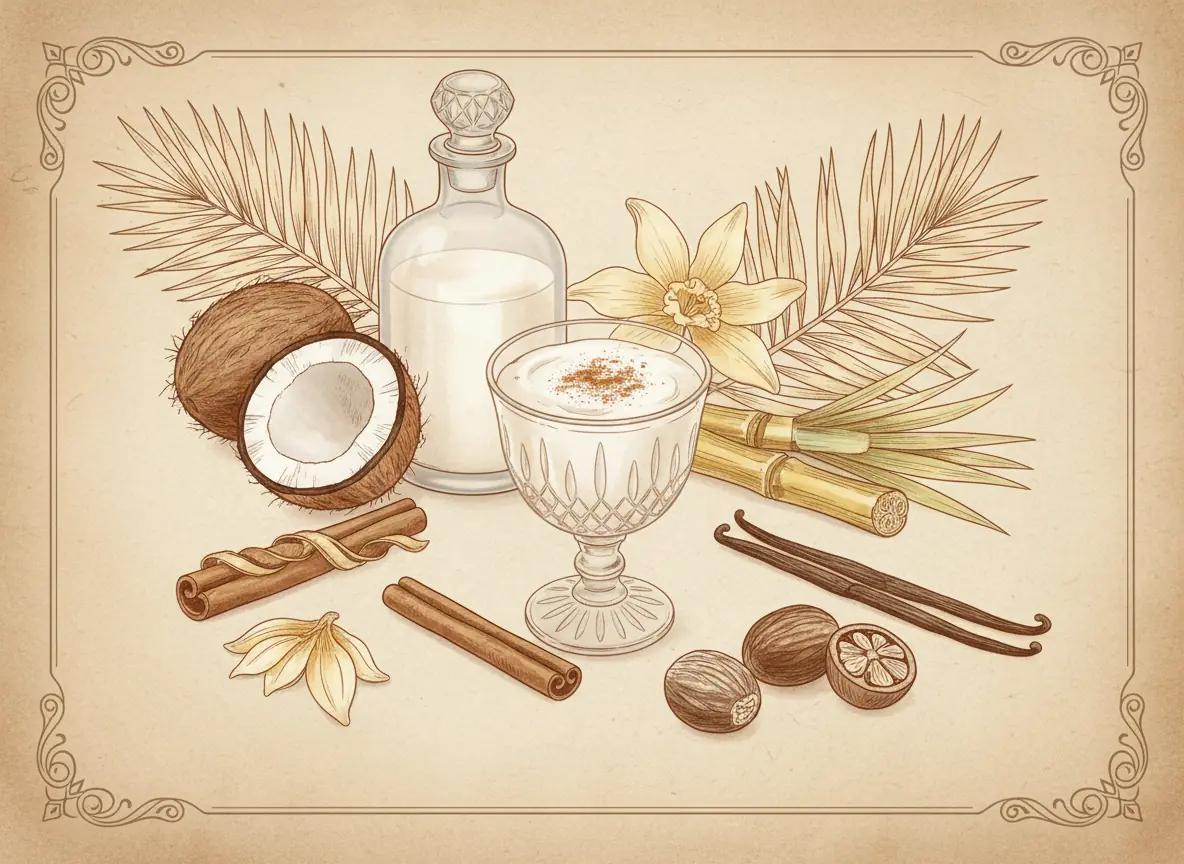
Coquito is Puerto Rico’s most celebrated festive drink, a creamy, spiced coconut and rum punch that has been a fixture of Christmas and New Year across the island and in Puerto Rican communities worldwide for generations. The name translates as little coconut. It is mixed in batches, chilled overnight and shared generously, which is entirely consistent with the culture that produced it. Four coconut and dairy elements combine with white rum, vanilla and warm spice. Cream of coconut provides the structural sweetness and body, coconut milk a lighter character that stops the drink becoming one-dimensional, condensed milk a caramel depth, and evaporated milk a dairy richness that rounds everything together without the weight of cream. Blended and refrigerated overnight, the spices migrate into the coconut base and the rum integrates far more completely than in a fresh batch. Making it the day before is not an optional refinement. It is the standard the drink is built around.
Eggnog
Eggnog is the milk punch that armoured up for winter: whole eggs whisked through milk, cream and sugar over a brandy-and-rum floor, the medieval posset’s descendant that colonial America adopted and December has never released. The carton version is a different and lesser species. The build works yolk and white in concert. Yolks give the custard richness, whisked with the sugar first as a custard would be; whites are optionally whipped and folded for the cloud, or simply shaken through for the simpler reading. The two-spirit floor is the colonial standard, with brandy’s fruit and rum’s molasses sharing the warmth between them, and nutmeg grated over the top as it is over the whole dairy family. Made by the glass it is a revelation to anyone whose only reference is a carton. Aged by the bottle, spending weeks maturing in the fridge before it is opened, it is the holiday’s deepest and least known secret.
Fireside Punch
The Fireside Punch is our batch answer to Bonfire Night: bourbon, apple cider, fresh lemon, maple syrup and water heated gently with cinnamon sticks, star anise and orange wheels, then held warm in a slow cooker for the whole evening. It appears in both our Bonfire Night and autumn guides, and it is a house recipe built for crowds rather than a recovered classic. The water is doing more than stretching the bottle. It tames the bourbon for long drinking, the way punch has always managed a crowd, and it lets the spices infuse as the pot sits. The batch genuinely improves with time; it tastes better an hour in than at the first ladle, which is the right property for a drink that has to last from dusk to the final sparkler. The format is the hospitality. Nobody mixes anything once the fireworks start. The pot holds on low while guests ladle for themselves, and the maple and lemon keep about fifteen servings in balance from first to last. For thirty guests, double the liquids and increase the spices by half rather than doubling them.
Fish House Punch
Fish House Punch is America’s oldest named drink still in service: brewed since 1732 at the Schuylkill Fishing Company of Philadelphia, the colonial angling club that counted Washington among its guests and, by cherished legend, among its casualties, his diary reportedly blank for the days after a visit. Rum, cognac and peach brandy over lemon and long dilution: the eighteenth century, decanted. The build is punch doctrine at its purest. Dark rum leading, cognac deepening, peach brandy perfuming, with lemon and sugar in the old proportions and cold water or tea carrying the length that lets an afternoon survive it. The peach is the signature, a thread of stone-fruit gold running through the whole bowl. Made properly and rested it is not a historical exercise but simply one of the best drinks a bowl has ever held, which is how it outlived the nation it predates by a considerable margin.
Green Batched Punch
The Green Batched Punch is a crowd solution written for parties where individual cocktails are impractical: Irish whiskey, fresh lime, simple syrup and blue curaçao over a base of apple juice, topped with sparkling water at the last moment. It serves about twelve, and it is unapologetically green. The apple juice is the quiet decision that makes it work. It bridges the whiskey to the citrus naturally, stretches the batch without thinning it, and keeps the sweetness in the orchard register rather than the confectionery one. The curaçao carries the colour along with an orange depth, and the sparkling water, added only when guests arrive, keeps the last cup as lively as the first. Punch is the oldest hospitality format there is: one vessel, many hands, and a host who is free to enjoy the party. This batch points that format at the one night of the year when the glass is expected to be green, and gets there without a drop of artificial colouring.
Guy Fawkes Grog
The Guy Fawkes Grog is rich, rum-forward and built for a crowd: honey dissolved in hot water, then dark rum, butterscotch liqueur and fresh lemon, held warm and ladled into mugs with cinnamon sticks. It serves about twelve, and it is a house recipe written for Bonfire Night rather than anything recovered from a ship’s log. The name is borrowed honestly. Grog is the Royal Navy’s old frame of rum cut with water, a daily ration that ran until 1970, and this keeps only that frame. The butterscotch and honey are entirely modern, and entirely the point on the fifth of November, when the flavour memory of the evening runs to bonfire toffee. It drinks sweeter than a Fireside Punch, with the butterscotch meeting the rum’s molasses depth and the honey rounding the join between them, so plan it as the second half of the evening rather than the first.
Hot Spiced Cider
The Hot Spiced Cider is a spiced cider base for eight, held warm on the stove, with the spirit added one mug at a time. Fifty millilitres of bourbon or dark rum goes in at the pour, which means every guest chooses their own measure or skips it entirely. The base does two jobs, and that is the whole design. Left alone it is a complete alcohol-free drink rather than a compromise; spiked, it becomes the adult serve without a second pot. On a family occasion, one pan that serves drivers, children and drinkers is worth more than a better recipe that only serves one of them. Adding the spirit per mug is also temperature management. The base holds warm for hours without harm, but spirit held hot loses its aromatics steadily, so it goes in fresh at the moment of serving. Bourbon reads as caramel against the apple; dark rum reads as molasses. Set both bottles beside the pot.
Mulled Wine
Mulled wine predates the cocktail by the better part of two millennia. The Romans warmed wine with honey and spice in the pages of Apicius, medieval kitchens ran it through a spice bag and called it hippocras, and every century since has kept a version on the stove. This build is the British reading: a bottle of red warmed with brandy, fresh orange, honey and whole spices. The method is the recipe. Heat strips wine of its edges and lifts the spice into the room, but a boil takes the alcohol with it and turns cinnamon and clove tannic. The pan should steam gently for a quarter of an hour, the honey dissolving into the wine, the brandy keeping the spine the heat would otherwise soften. It serves six to eight from one pan, which is rather the point. Glögg in Sweden, Glühwein on the German market square, wassail in the English orchard: the same instinct, dressed for different winters.
Pisco Punch
The Pisco Punch is San Francisco's lost masterpiece: the house drink of the Bank Exchange saloon through the Gold Rush decades, perfected by Duncan Nicol, who served it to Mark Twain's city and drew Kipling's praise, then took the full recipe to his grave in 1926 with Prohibition having closed the bar around him. What survives is the frame: pisco, pineapple, citrus and gum. The modern reconstruction is honest about being one. Pisco over pineapple macerated in gomme's silk, lemon brightening, and the gum arabic texture that is the recipe's one agreed secret. Scholars argue about the rest, and the drink argues for itself. It pours as history's smoothest punch, deceptively gentle in exactly the way that built its legend in the first place. Kipling called it the highest and noblest product of the age, and the age broadly agreed with him until the Volstead Act outvoted them both. Nothing else in the American canon was lost quite so completely while staying quite so famous.
Planters Punch
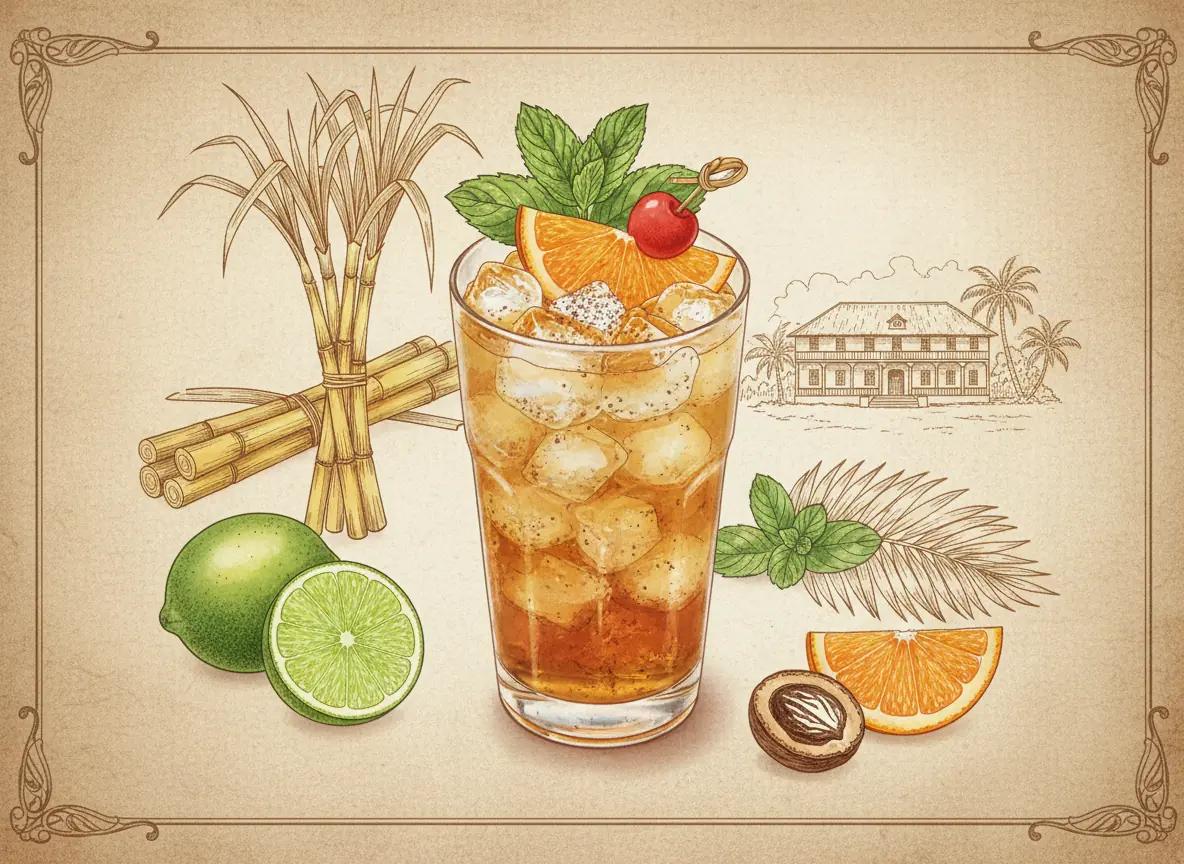
Planter’s Punch is one of the oldest rum drinks in the English-speaking Caribbean tradition, with documented references stretching back to the late nineteenth century and a formula that predates most of the tiki canon it gets grouped with. The most commonly cited origin places it at the Myers’s Rum distillery in Jamaica, through a 1908 advertisement in the New York Times, though the drink is older than that and the association is commercial rather than definitive. The formula that has circulated most reliably is a rhyme from Caribbean bartending culture: one of sour, two of sweet, three of strong, four of weak. Lime, sugar syrup, rum and water in those proportions are the foundational structure, and every version since is a variation on that ratio. The build here adds grenadine for colour and a finishing dash of Angostura, with dark Jamaican rum as the base: funky, full-bodied and molasses-rich. That rum is the decision the drink turns on, because the rhyme will balance almost any spirit and only a Jamaican one makes it taste like this.
Reggae Rum Punch
The Reggae Rum Punch is Jamaica’s actual daily pour: the island’s most popular punch, sold under a dozen names from beach shacks to hotel bars, always on the same chassis of overproof white rum, pineapple, orange and something red. Strawberry syrup carries the red flag here. The build is the island’s answer to the planter’s rhyme: juices for the length, strawberry for the sweet, lime for the sour, and unaged Jamaican overproof for the strong, its funky fire being the ingredient every version agrees on. The rum is the passport and everything else is negotiable by parish. It drinks brighter and louder than the old-school punches, a beach drink with genuine horsepower behind it and none of the ceremony the older ones carry. One bottle, one island’s afternoons, and a great deal more strength than the fruit ever lets on until afterwards. Overproof rum does that quietly, which is the oldest trick in punch and the reason the format has never needed improving.
Rum Punch
Rum Punch is one of the oldest recipes anywhere and the only one that rhymes: one of sour, two of sweet, three of strong, four of weak. The Caribbean planter's formula predates the cocktail by a century, descends from the punches the East India trade carried west, and survives because a recipe you can remember after two glasses of it is a recipe that lasts. The rhyme is a ratio, not a shopping list: lime for sour, syrup or grenadine for sweet, rum for strong, and juice, tea or simply water and ice for weak. Every island, bar and grandmother fills the four slots differently, which is why no two rum punches match and none of them is wrong. The version here is a balanced starting point, with orange and pineapple carrying the weak slot and a blend of rums carrying the strong. It is equally at home as a single glass or a bowl, and the bowl is the truer reading: punch is drinking's oldest social technology, made ahead, served shallow and often, and designed to keep a gathering circulating rather than anchored to a bartender.
Sangria
Sangria is red wine lengthened with fruit, brandy and a little sugar, rested until the flavours marry, and served from a pitcher over ice. The name comes from sangre, blood, for the colour of it. It is not really a recipe. It is a set of slots, wine and spirit and citrus and sugar and fruit and time, and every house in Spain and Portugal fills them differently. Catalonia makes it with cava. The south drinks tinto de verano, which is wine and lemon soda and barely qualifies. Peaches turn up wherever the orchards do. The measures here are common ground rather than doctrine, and they claim only the proportions. The one thing that is not negotiable is the rest. An hour in the fridge is the minimum and overnight is better, because maceration is what turns wine with fruit in it into sangria. Poured young it tastes exactly like what it is, which is a bottle of red with some oranges floating in it.
Spiced Rum Punch
The Spiced Rum Punch is our warming Christmas batch: spiced rum heated gently with apple juice, orange juice, fresh lemon and honey, while cinnamon sticks, star anise and cloves work into the pot as it warms. It serves about ten, and unlike most winter punches it is planned to work cold as well as hot. Rum is the design decision. Where mulled wine ties the season to grape, a spiced rum base gives the punch fuller room for cinnamon, baking spice and rich sweetness, which is the register Christmas actually operates in. Honey rather than sugar keeps that sweetness rounded, and the full 100ml of lemon is what stops the batch settling into syrup. Heat it gently until the honey dissolves, hold it low for the evening, and taste as you go, adjusting sweetness and citrus to the room. For a party of mixed preferences, the cold version is the same recipe refrigerated overnight and served over ice, so one batch covers every guest.

Tropical Punch
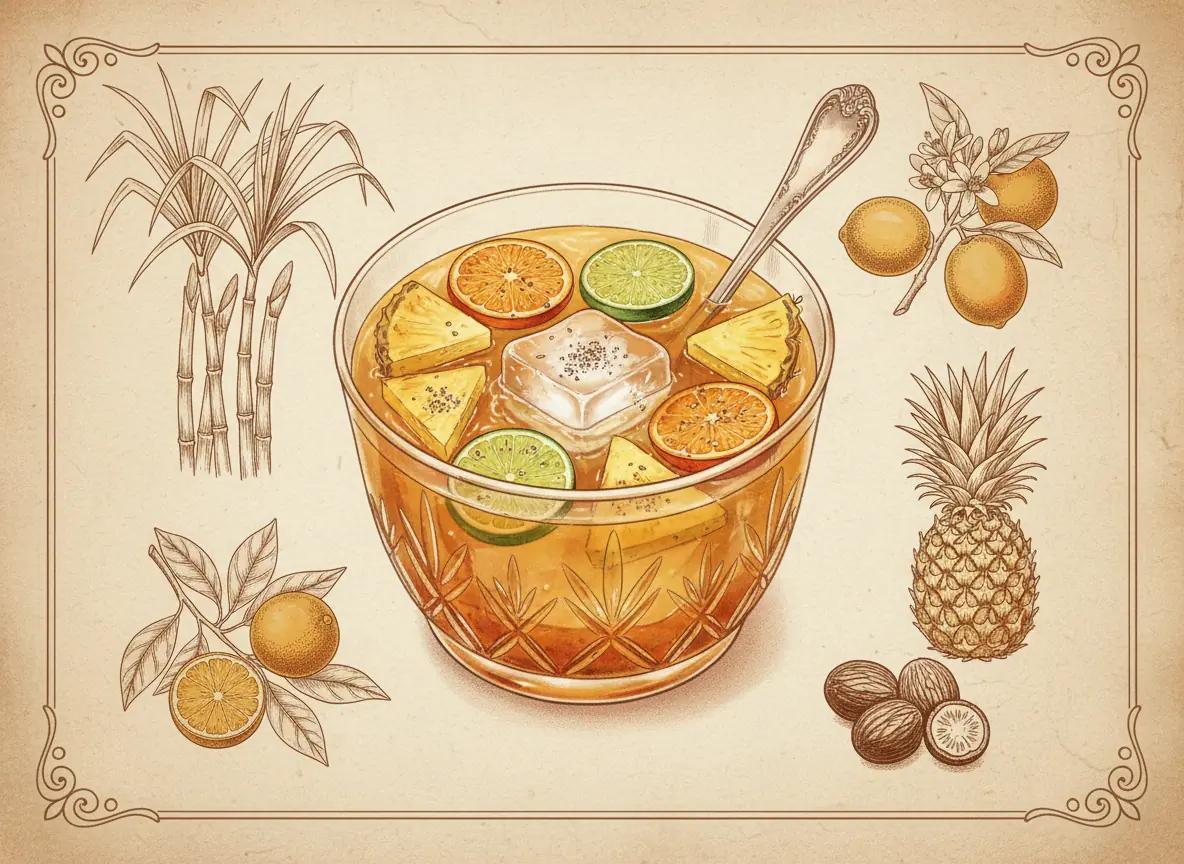
Punch is the oldest cocktail format in the world. Long before the shaker, the coupe, and the measuring jigger, there was the bowl: a communal vessel built for sharing, designed for occasions, and mixed in quantities that made the single-serve cocktail look like an afterthought. The word punch almost certainly derives from the Hindi panch, meaning five, a reference to the five original components of spirit, citrus, sugar, water, and spice that defined the format from its origins in seventeenth-century India. This version stays true to that architecture. Aged rum brings depth and barrel character. White rum brings lift and clean spirit backbone. Fresh citrus and pineapple juice provide the fruit and the tartness. Sugar syrup balances. Spice and bitters tie it together. Made properly and served cold over a large block of ice, it is one of the most satisfying things you can put in front of a group of people. It is not a classic in the way the Manhattan or the Negroni are classics. It is something older than both of them.
Wassail
Wassail is older than almost anything else in the canon by several centuries, and its name is the toast itself: the Old English wæs hæil, be in good health. The appointed reply was drinc hæl, and between the two phrases sat a communal bowl of ale or cider, hot with spice, passed hand to hand through the medieval midwinter. It came in two traditions. Households carried the bowl from door to door through the Twelfth Night season, drinking the year’s health into their neighbours, while the apple counties took it to the trees themselves, pouring cider at the roots and laying toast in the branches to sing the next harvest home. This is the cider-house reading of the bowl: cloudy apple juice and dry cider heated gently with the spice drawer and a clove-studded orange, sweetened in stages, stiffened off the heat with brandy or calvados for anyone who wants stiffening. It serves eight to ten, which is not a serving suggestion but the drink’s nature.