Fish House Punch
Fish House Punch is dark rum, cognac and peach over lemon and sugar, lengthened with cold tea: 45ml of dark rum, 30ml of cognac, 15ml of peach liqueur, 25ml of fresh lemon juice, 15ml of demerara syrup and 60ml of weak black tea for one drink, multiplied by ten for a bowl rested over one large block of ice and ladled into small cups. About 2.6 UK units in a 150ml cup, which is why the cups are small. It began as the house drink of the Colony in Schuylkill, later the State in Schuylkill, a Philadelphia club that has met from 1732 at its fish house on the Schuylkill river, by the Oxford Companion’s account. The punch is traditionally dated to the club’s first year, but the Companion calls that unlikely and dates the earliest recipes to 1793 and 1795; Jerry Thomas published it in 1862. The rest is what makes it. An hour over the block rounds the three spirits into one, and the slow melt adds the last of the water.
Glassware: Punch Cup
Garnish: Lemon wheels riding the bowl’s ice block
Ingredients
45ml
A dark rum at around 40% ABV, with enough weight to stand up to an hour of melting ice. It leads the bowl, so use one you would drink on its own.
30ml
Around 40% ABV. Its grape and oak sit under the rum and round it; a VS is plenty, because the peach and lemon cover anything finer.
15ml
The stand-in for peach brandy, the dry peach spirit the old recipes name, which is now hard to buy. Liqueurs run from about 15 to 25% ABV and are sweet, so the measure stays small. A true peach brandy can go in at the same measure.
25ml
Squeezed the same day and strained. It is the only acid in a long, strong drink, so stale or bottled juice shows at once.
15ml
Demerara sugar dissolved in half its weight of water. It sweetens and adds a darker, toffee edge that plain white syrup leaves out, which suits the rum.
60ml
Brewed weak and cooled. It lengthens the bowl, and its tannin gives the finish a little grip so the punch tastes long rather than watered. Cold water works too.
Instructions
Stir the demerara syrup and lemon juice together in a jug or bowl until combined.
Add the dark rum, cognac, peach liqueur and cold tea, and stir.
For one, pour over cubed ice in a double rocks glass and add a lemon wheel.
For a bowl of about twelve 150ml cups, multiply each measure by ten (450ml rum, 300ml cognac, 150ml peach liqueur, 250ml lemon, 150ml syrup, 600ml tea), chill, then rest for an hour over one large block of ice in a punch bowl.
Float lemon wheels on the bowl and ladle into small cups.
Our version
The club has never officially published its formula; versions agree on rum, cognac and peach brandy lengthened with water, tea or lemonade. Ours is 45ml dark rum, 30ml cognac, 15ml peach liqueur, 25ml lemon, 15ml demerara syrup and 60ml weak tea for one drink.
Source: our own specification. Last checked 9 October 2026.
Expert Tip
Give it the hour. Mixed and served at once, the rum, cognac and peach still taste like three bottles poured into one bowl. An hour over the block rounds them together and takes the edge off the lemon. Use one large block, not cubes. Cubes melt fast and thin the bowl inside half an hour; water frozen overnight in a loaf tin or a plastic tub melts slowly enough to last the afternoon. Pour it into small cups and tell people what is in it. At about 2.6 units a 150ml cup it carries more alcohol than a 175ml glass of wine, and the tea and lemon hide that well.
Behind the Fish House Punch
Flavour Profile
The Origin
The Oxford Companion says the club began in 1732 as the Colony in Schuylkill, a club of wealthy and prominent Philadelphians who met at their fish house on the river outside the city to fish, eat and drink. After the Revolution it renamed itself the State in Schuylkill, and it still exists.
The Oxford Companion says it has often been claimed that the punch dates back to the club’s founding, and calls that unlikely. It dates the punch to the recipes of 1793 and 1795 that were published around 1900 as transcripts of club documents, adds that the club has never officially published the formula though members have let it out since at least 1850, and says Jerry Thomas printed it in 1862..
Washington was among the club’s guests, as the Companion records. The story that a bowl kept him from his diary for three days is told often and is not confirmed.
Rum, Cognac and Peach
Rum leads and cognac rounds it: the grape and oak sit under the rum and soften it without hiding it. Peach gives the bowl its signature, a stone-fruit note that runs through the whole afternoon.
The recipes name peach brandy, a dry spirit made from peaches that is now hard to buy. Peach liqueur is the usual stand-in. It is sweeter, so it goes in at 15ml and the syrup stays modest; a true peach brandy can take the same measure, with a little more sugar if the bowl tastes sharp.
Tea, Water or Lemonade
The spirits are too strong to serve on their own, so the punch has always been lengthened. Cold water, cold black tea and lemonade have all been used, and soda water once it became available in the nineteenth century.
We use weak black tea. Its tannin gives the finish a slight grip, so the bowl tastes long rather than watered, and it adds no sugar. At 60ml a drink it is the largest single measure in the recipe.
What Goes in the Bowl
Fish House Punch for one drink and for the bowl
Dark rum
- One drink
- 45ml
- The bowl
- 450ml
- UK units for one
- 1.8
Cognac
- One drink
- 30ml
- The bowl
- 300ml
- UK units for one
- 1.2
Peach liqueur
- One drink
- 15ml
- The bowl
- 150ml
- UK units for one
- About 0.3
Fresh lemon juice
- One drink
- 25ml
- The bowl
- 250ml
- UK units for one
- None
Demerara syrup
- One drink
- 15ml
- The bowl
- 150ml
- UK units for one
- None
Weak black tea, cold
- One drink
- 60ml
- The bowl
- 600ml
- UK units for one
- None
In all
- One drink
- About 190ml
- The bowl
- About 1.9 litres
- UK units for one
- About 3.3
| Ingredient | One drink | The bowl | UK units for one |
|---|---|---|---|
| Dark rum | 45ml | 450ml | 1.8 |
| Cognac | 30ml | 300ml | 1.2 |
| Peach liqueur | 15ml | 150ml | About 0.3 |
| Fresh lemon juice | 25ml | 250ml | None |
| Demerara syrup | 15ml | 150ml | None |
| Weak black tea, cold | 60ml | 600ml | None |
| In all | About 190ml | About 1.9 litres | About 3.3 |
For a single-rum Jamaican punch, try the Planter’s Punch; for a bowl built for fifteen, the Cauldron Punch.
The Rest Hour
An hour over the block before the first ladle is part of the recipe. The spirits round into one another, the peach spreads through the bowl, and the melt adds water slowly and evenly.
Use one block rather than cubes. Cubes have far more surface, melt fast and leave the bowl thin within half an hour. Freeze water in a loaf tin or a tub the night before.
How to Serve It
In a punch bowl over its block, with lemon wheels floating, ladled into small cups. The cups matter: the bowl fills about twelve of 150ml at about 2.6 units each, and an ordinary glass of this is a great deal of drink.
For one, build it over cubed ice in a double rocks glass. It is brighter and sharper without the rest hour.
Make it at home
The Spirit
Dark RumDark rum is a heavy, deep-coloured rum, counted at 40% ABV in our recipes, whose colour may come from years in oak, from blending or from added caramel, which Regulation (EC) 110/2008 allows. It brings weight and a burnt-sugar note to punches, hot drinks and tiki builds: the Rum Runner, the Hurricane and the Planter’s Punch.
More to explore
Frequently Asked Questions
How old is Fish House Punch?
What is in Fish House Punch?
What can I use instead of peach brandy?
Did George Washington really drink it?
Does it have to rest before serving?
How do I scale Fish House Punch for a party?
How strong is Fish House Punch?
Sources.
Correct as of 19 October 2026.
- The Oxford Companion to Spirits and Cocktails (David Wondrich), “Fish House Punch” (secondary source: house drink of the Colony in Schuylkill (later State in Schuylkill), a club meeting from 1732; the founding-year claim unlikely; recipes of 1793 and 1795; first published by Jerry Thomas in 1862; guests including Washington and Chester Arthur).
You Might Also Like
Rum Punch
Rum Punch follows the old rhyme, one of sour, two of sweet, three of strong, four of weak, and ours keeps it to the letter in 15ml parts: 15ml fresh lime juice; 15ml grenadine and 15ml demerara syrup; 30ml aged rum and 15ml dark rum; 30ml each of fresh orange and pineapple juice. Two dashes of Angostura go in as well. Shake it hard and pour it over fresh ice in a highball, then top it with an orange slice and grated nutmeg. Punch began as a drink the English made in India, and the word first appears in an East India Company letter of 1632, by the Oxford Companion’s account. The rhyme has more than one printed form. Read it as a ratio: islands, bars and families fill each part differently, and the weak part can be juice, tea or plain water. Multiply the parts by the number of guests and the same proportions fill a bowl. A glass holds about 1.9 UK units.
Planter’s Punch
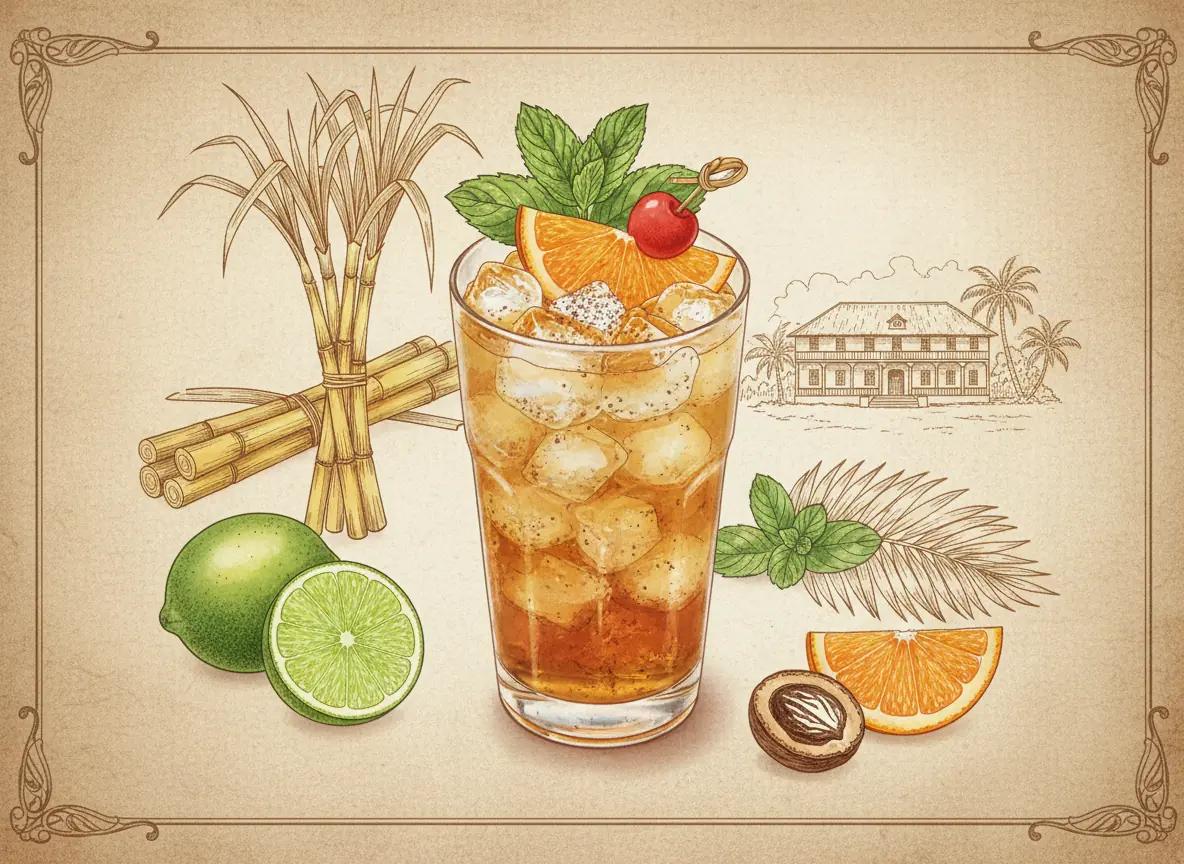
Planter’s Punch is 45ml of Jamaican rum, 15ml of fresh lime juice and 30ml of sugar cane juice, poured into a small tumbler, diluted to taste with water, ice or fresh juice, and finished with orange zest. The measures follow the IBA. About 1.8 UK units. It belongs to the punch family of the old rhyme, one of sour, two of sweet, three of strong, four of weak, and it is the Jamaican member: a dark, full-flavoured island rum, lime and sugar. The IBA writes it short and leaves the weak part to you; a longer build that follows the rhyme to the letter is our variation. The Oxford Companion calls it the unofficial drink of Jamaica since the late nineteenth century, and the Charleston City Paper prints a verse from the London magazine Fun of September 1878 that gives the same proportions. Cane juice is the IBA’s sweetener: sweeter than water, far less sweet than syrup, with a green, grassy taste.
Knickerbocker
A Knickerbocker is 60ml of aged rum, 20ml of fresh lime juice, 15ml of raspberry syrup and 5ml of orange curaçao, shaken hard for 10 to 12 seconds and strained over fresh ice in a rocks glass, dressed with berries and an orange slice. About 2.6 UK units. Jerry Thomas printed it in 1862 among his fancy drinks: half a lime or lemon, juice and rind in the glass, two teaspoons of raspberry syrup, a wine-glass of Santa Cruz rum and half a teaspoon of curaçao, shaken with shaved ice and ornamented with berries in season. The scan names no inventor. The name points to New York: the Oxford Companion says Knickerbocker is a nickname for a New Yorker, and that the drink’s first known appearance is in 1843, on Peter Brigham’s list of drinks at the Concert Hall in Boston. The raspberry syrup is the only sweetener. Fifteen millilitres against 20ml of lime keeps the drink dry, with the berry as flavour rather than sugar, and the curaçao seasons it with bitter orange.
Where this one sits
Recipe by Jerry Can Spirits · Updated 19 October 2026