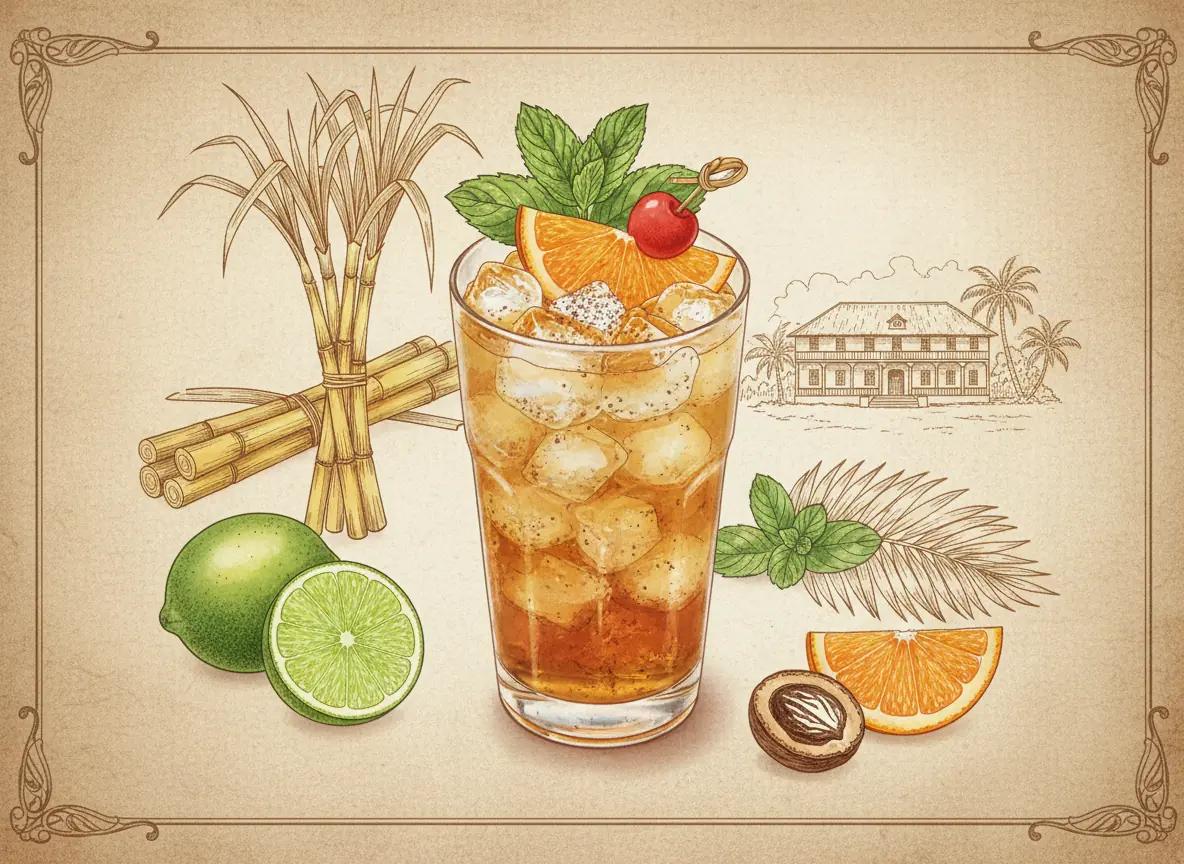
Planter’s Punch
Planter’s Punch is one of the oldest rum drinks in the English-speaking Caribbean tradition, with documented references stretching back to the late nineteenth century and a formula that predates most of the tiki canon it gets grouped with. The most commonly cited origin places it at the Myers’s Rum distillery in Jamaica, through a 1908 advertisement in the New York Times, though the drink is older than that and the association is commercial rather than definitive. The formula that has circulated most reliably is a rhyme from Caribbean bartending culture: one of sour, two of sweet, three of strong, four of weak. Lime, sugar syrup, rum and water in those proportions are the foundational structure, and every version since is a variation on that ratio. The build here adds grenadine for colour and a finishing dash of Angostura, with dark Jamaican rum as the base: funky, full-bodied and molasses-rich. That rum is the decision the drink turns on, because the rhyme will balance almost any spirit and only a Jamaican one makes it taste like this.
Variations
Glassware: Rocks Glass
Garnish: Orange Slice, Lime Wheel Luxardo and Maraschino Cherry
Ingredients
45ml
A full-bodied Jamaican rum with genuine funky, molasses-rich character is the correct choice. A neutral or light rum produces a flat, one-dimensional result.
15ml
Squeezed immediately before use, and the sour element of the formula. It is the acid backbone keeping the sugar and grenadine in check across the drink’s full volume.
30ml
Fresh cane juice rather than syrup, and the distinction is the whole drink. At around fifteen per cent sugar it lengthens and sweetens gently where a syrup at the same measure would flatten everything, and it brings a green, grassy note that meets the rum’s molasses from the opposite direction.
Instructions
Squeeze the lime juice immediately before building the drink.
Pour the rum, lime juice and sugar cane juice directly into a small tumbler or a terracotta cup.
Stir briefly to combine.
Add water, ice or a little fresh juice to taste. The specification leaves the dilution to you.
Garnish with orange zest.
Source: the IBA (Official IBA specification; method ours). Last checked 13 August 2026.
Expert Tip
The official build is three ingredients and no dilution: Jamaican rum, lime and fresh sugar cane juice, poured into a small tumbler and adjusted to taste with water, ice or juice as you like it. That last instruction is not vagueness. A punch is a set of proportions rather than a fixed recipe, and the specification is telling you where to start rather than where to stop. Use cane juice rather than cane syrup. At around fifteen per cent sugar the juice lengthens the drink and sweetens it gently; a syrup at the same measure is several times sweeter and flattens everything under it. Frozen cane juice from a Caribbean or South Asian grocer is the realistic source and a good one. The longer one-two-three-four build below is the version most people have been served, and it is the one to batch. Dashing the Angostura over the surface rather than stirring it through is the detail that version most often loses: applied on top, the bitters are met at the nose before they are tasted at all.
Behind the Planter’s Punch
Flavour Profile
The Origin
The punch tradition that produced this drink predates its documented name by several centuries. Punch arrived in Britain from India in the early seventeenth century, built on five elements whose name in some accounts derives from the Hindi word for five: spirit, citrus, sugar, water and spice.
The British Navy carried the format into the Caribbean trade routes, where rum, made abundant by Caribbean sugar production, replaced the original arrack base. Planter’s Punch emerged as a specific formulation, named for the plantation culture in which Caribbean rum was produced. The 1908 Myers’s advertisement is a commercial appropriation of a formula that had circulated for considerably longer.
The Foundational Formula
One of sour, two of sweet, three of strong, four of weak is one of the most elegant encoding devices in the history of food and drink. It specifies ratios rather than ingredients, so it can be applied to any spirit and any sour and sweet element available and still balance.
The lime is the sour. The sugar syrup is the sweet, at double the lime. The rum is the strong, at triple. The soda water is the weak, extending it into a long serve at four times. The grenadine and the bitters sit outside the formula as additions rather than substitutions, which is why the balance still holds with them in.
The Rum Requirement
The choice of rum matters more here than in tiki drinks with more complex structures, where fruit juice and liqueur partly absorb the spirit’s character.
This is a relatively direct drink: rum, lime and sugar are the foundations, and the rum is clearly present in every sip. A full-bodied Jamaican rum with the funky, ester-rich, molasses-forward character that defines the style is robust enough to lead rather than simply supply the alcohol. A lighter or more neutral rum produces something that tastes of sweetened lime juice with a rum note somewhere behind it.
Batching
This is one of the most naturally batchable drinks there is, because the formula scales linearly: multiply every ingredient by the number of servings and the balance holds without adjustment.
For ten drinks, combine 600ml of rum, 200ml of fresh lime, 400ml of sugar syrup and 150ml of grenadine, stir, and refrigerate until needed. Add the soda per glass at the point of serving rather than into the batch, which would flatten the carbonation long before the drinks are poured, and dash the bitters per glass for exactly the same reason.
How to Serve It
Built over ice in a highball or hurricane glass, soda poured gently down the inside wall, bitters dashed over the surface, and fruit on the rim. Serve immediately with a straw.
This is a warm weather drink in character and in origin, suited to outdoor drinking, long afternoons and the kind of unhurried hospitality the punch tradition was built around: easy to build, easy to batch and easy to drink. Give it the rum it deserves and it performs accordingly.
Make it at home
The Spirit
Dark RumA style defined by colour rather than by law. No rule anywhere says what dark rum has to be, and the colour can arrive from long ageing, from blending or from a dose of caramel, with no requirement to tell you which of the three it was.
Master the Techniques
More to explore
Frequently Asked Questions
What is a Planter’s Punch?
What is the sour, sweet, strong, weak formula?
Which rum should I use?
Why dash the bitters on top?
You Might Also Like
Hurricane
The Hurricane is Pat O'Brien's New Orleans drink from the 1940s: dark and white rum, passion fruit syrup, fresh lime and orange, and grenadine, over crushed ice in a glass shaped like a hurricane lamp. It exists because of a wartime supply problem. Whiskey was scarce, and distributors required bar owners to buy large allocations of rum, plentiful from Caribbean producers, before releasing any whiskey at all. O'Brien's answer was a drink strong enough, fruity enough and visually striking enough that people would order rum deliberately rather than as a substitute. It worked completely, and then its own fame ruined it. As the drink became attached to New Orleans tourism, premixed concentrate in souvenir glasses became the standard serve. What is documented here is the original structure: two rums, fresh juice squeezed to order, passion fruit syrup with real fruit in it. The Hurricane is a serious drink that has been treated carelessly for a very long time.
Rum Runner
The Rum Runner was born from necessity and named for outlaws. In the early 1970s, John "Tiki John" Elber, manager of the Tiki Bar at the Holiday Isle in Islamorada, Florida Keys, faced a bartender's dilemma: too much stock and a new shipment on the way. Rather than let good booze go to waste, he threw together what he had, rum, blackberry brandy, banana liqueur, grenadine, and lime juice, and created what would become the signature drink of the Keys. He named it after the region's real rum runners: the smugglers who used the maze of Florida waterways to transport Caribbean rum to thirsty speakeasies during Prohibition. The original recipe contained no fruit juices, just spirits, liqueurs, and lime. Over the decades, pineapple and orange juice crept in, transforming it into the tropical fruit bomb most bars serve today. Served over crushed ice or blended frozen, the Rum Runner is unapologetically sweet, fruity, and dangerously easy to drink. It tastes like vacation: messy, fun, and best enjoyed with sand between your toes.
Tropical Punch
Punch is the oldest cocktail format in the world. Long before the shaker, the coupe, and the measuring jigger, there was the bowl: a communal vessel built for sharing, designed for occasions, and mixed in quantities that made the single-serve cocktail look like an afterthought. The word punch almost certainly derives from the Hindi panch, meaning five, a reference to the five original components of spirit, citrus, sugar, water, and spice that defined the format from its origins in seventeenth-century India. This version stays true to that architecture. Aged rum brings depth and barrel character. White rum brings lift and clean spirit backbone. Fresh citrus and pineapple juice provide the fruit and the tartness. Sugar syrup balances. Spice and bitters tie it together. Made properly and served cold over a large block of ice, it is one of the most satisfying things you can put in front of a group of people. It is not a classic in the way the Manhattan or the Negroni are classics. It is something older than both of them.
Where this one sits
Recipe by Jerry Can Spirits