Blinker
A Blinker is 60ml of rye whiskey, 30ml of fresh grapefruit juice and 15ml of raspberry syrup, shaken hard for 10 to 12 seconds and double strained into a chilled coupe. A grapefruit twist goes on top. About 2.4 UK units. Punch dates the recipe to Patrick Gavin Duffy’s 1934 book The Official Mixer’s Manual, which it gives as three parts grapefruit juice to two of rye to one of grenadine. Ted Haigh revived it in Vintage Spirits and Forgotten Cocktails in 2004, in Punch’s words two parts rye to one of grapefruit with a teaspoon of raspberry syrup. Raspberry has since become the usual sweetener, and ours follows Haigh. Grapefruit is the reason to make it. It is bitter as well as sour, and against rye’s pepper it makes a drier, sharper drink than a Whiskey Sour. Raspberry brings fruit that meets the bitterness rather than simply sweetening over it.
Glassware: Coupe Glass
Garnish: Grapefruit twist
Ingredients
60ml
Rye at 40% ABV or a little more. Its dry pepper meets grapefruit’s bitterness; bourbon’s sweetness makes a rounder, flatter drink.
30ml
Squeezed the same day, and tasted. Grapefruit varies more through the year and between varieties than any other common citrus.
15ml
Made from raspberries. Haigh’s swap for Duffy’s grenadine, tart enough to meet the grapefruit. Drop toward 10ml if the fruit is sweet.
Instructions
Squeeze the grapefruit juice the same day and chill a coupe.
Add the rye, grapefruit juice and raspberry syrup to a shaker.
Fill with cubed ice and shake hard for 10 to 12 seconds.
Double strain into the chilled coupe.
Express a grapefruit twist over the surface and drop it in.
Our version
Ted Haigh’s 2004 proportions, 60ml rye to 30ml grapefruit, with raspberry syrup raised from his teaspoon to 15ml so the drink sits at the balance of a standard sour; drop it toward 10ml if you like it drier. Punch reports that Duffy’s 1934 original used grenadine.
Source: our own specification. Last checked 10 October 2026.
Expert Tip
Taste the grapefruit first. Pink and ruby fruit can be close to sweet, while white grapefruit is sharp and bitter. Move the raspberry syrup between 10ml and 15ml to match it. Choose a raspberry syrup made from fruit. One flavoured without fruit tastes of boiled sweets against the grapefruit. Double strain. Grapefruit throws a lot of fine pulp.
Behind the Blinker
Flavour Profile
Duffy’s Drink, Haigh’s Revival
Punch says the Blinker first appeared in Patrick Gavin Duffy’s 1934 book The Official Mixer’s Manual, calling for three parts grapefruit juice to two parts rye to one part grenadine, served in a footed highball glass. That is far more grenadine than a modern Blinker.
Ted Haigh revived it in Vintage Spirits and Forgotten Cocktails in 2004. He doubled the rye against the grapefruit and replaced the grenadine with a teaspoon of raspberry syrup, which made it a short, dry sour. Raspberry has since become the usual sweetener.
Grapefruit Doing Lemon’s Job
Most sours use lemon or lime, which are sharp and fairly neutral. Grapefruit carries less acid than either and brings bitterness with it, so the citrus becomes one of the flavours rather than only the frame.
That changes what the sweetener has to do. It has to meet bitterness as well as acid, and a fruit syrup does that better than plain sugar.
Why Raspberry
Raspberry is tart and bright, and its fruit sits alongside grapefruit’s bitterness instead of covering it. Grenadine made from pomegranate does a similar job with a darker, more astringent edge, which is why both versions work.
What does not work is a red syrup with no fruit in it. Against grapefruit it gives sugar and colour and nothing to meet the bitterness, and the drink tastes like sweetened juice with whiskey added.
Three Versions
The Blinker as Duffy printed it, as Haigh revived it, and ours
Rye to grapefruit
- Duffy, 1934
- More juice than modern versions; accounts differ
- Haigh, 2004
- Two parts rye to one of grapefruit
- Ours
- 60ml rye to 30ml grapefruit
Sweetener
- Duffy, 1934
- Grenadine, a generous measure
- Haigh, 2004
- A teaspoon of raspberry syrup
- Ours
- 15ml raspberry syrup
Style
- Duffy, 1934
- Longer and fruitier
- Haigh, 2004
- Short and very dry
- Ours
- Short, dry and fruity
| Element | Duffy, 1934 | Haigh, 2004 | Ours |
|---|---|---|---|
| Rye to grapefruit | More juice than modern versions; accounts differ | Two parts rye to one of grapefruit | 60ml rye to 30ml grapefruit |
| Sweetener | Grenadine, a generous measure | A teaspoon of raspberry syrup | 15ml raspberry syrup |
| Style | Longer and fruitier | Short and very dry | Short, dry and fruity |
Balancing It
Grapefruit is the most variable common citrus behind a bar. Pink and ruby varieties are noticeably sweeter and less bitter than white ones, and any fruit changes through its season.
Taste the juice and move the syrup between 10ml and 15ml. At Haigh’s teaspoon the drink is very dry; at 15ml it sits closer to a standard sour.
How to Serve It
Up, in a chilled coupe, with a grapefruit twist expressed over the surface. The bitterness makes it a drink for before food rather than after.
For bourbon, grapefruit and honey, make a Brown Derby; for raspberry with gin and egg white, a Clover Club.
Make it at home
The Spirit
Whiskey (Rye)Rye whiskey, under the US standard 27 CFR 5.143, takes at least 51% of its grain from rye and its colour from new charred oak, and goes into bottle at a 40% ABV minimum; our recipes take 40% as the figure. Rye makes a drier, spicier, more peppery spirit than corn, which is why stirred classics such as the Manhattan, Vieux Carré and Brooklyn are written for it. It appears in 23 of our recipes.
Master the Techniques
More to explore
Frequently Asked Questions
What is in a Blinker cocktail?
Where does the Blinker come from?
Grenadine or raspberry syrup?
Why rye rather than bourbon?
How is it different from a Brown Derby?
How strong is a Blinker?
Sources.
Correct as of 19 October 2026.
- Punch, “A Forgotten Rye Whiskey Cocktail Makes a Comeback” (secondary source: Duffy’s The Official Mixer’s Manual (1934): three parts grapefruit juice to two parts rye to one part grenadine, footed highball glass; Haigh’s Vintage Spirits and Forgotten Cocktails (2004): two parts rye to one part grapefruit, a teaspoon of raspberry syrup; Haigh’s reasoning that grenadine and raspberry syrup were used interchangeably in old drinks).
You Might Also Like
Brown Derby
A Brown Derby is 60ml of bourbon, 30ml of fresh grapefruit juice and 22.5ml of honey syrup made with two parts honey to one of warm water, shaken hard for 10 to 12 seconds and double strained into a chilled coupe, with a grapefruit twist. About 2.4 UK units. It is a bourbon sour with both standard parts swapped. Grapefruit replaces lemon and brings bitterness along with its acid. Honey replaces sugar and brings a floral, waxy weight. Each softens what the other adds, and the bourbon’s vanilla sits underneath both. The Oxford Companion, in an entry by Robert F. Moss, says the Hollywood link comes from a single source, George Buzza Jr.’s Hollywood Cocktails of 1933, which copied the De Rigueur from the Savoy Cocktail Book and renamed it the Brown Derby, and that there is no evidence it was ever served at the Brown Derby restaurant, whose original building was shaped like a derby hat. The Savoy Cocktail Book of 1930, in the Internet Archive’s scan, prints the De Rigueur of whisky, grapefruit juice and honey.
Hemingway Daiquiri
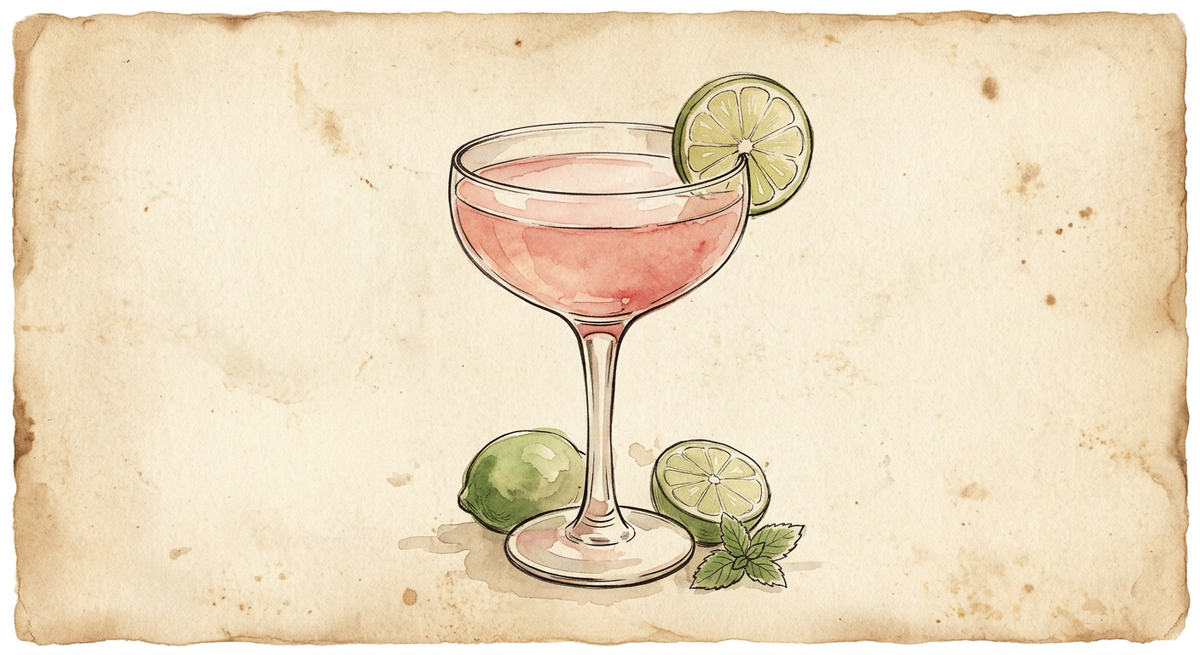
A Hemingway Daiquiri is 60ml white rum, 40ml fresh grapefruit juice, 15ml fresh lime juice and 15ml maraschino liqueur, shaken hard and double strained into a chilled coupe, with a lime wheel. The measures follow the IBA, which lists it as the Hemingway Special. There is no sugar syrup: the maraschino is the only sweetness. About 2.9 UK units. The Oxford Companion to Spirits and Cocktails says it is a version of the Daiquiri No. 3 from Havana’s Floridita bar, named for the writer who downed them there in volume. Difford’s Guide has Hemingway trying the Floridita’s standard frozen Daiquiri and saying he preferred it without sugar and with double rum, which became the Papa Doble, and says the head bartender Antonio Meilan later added maraschino and grapefruit juice to make the Hemingway Special. It is drier and more bitter than a classic Daiquiri, and the grapefruit decides how it tastes.
Sazerac
The IBA’s Sazerac is 50ml of cognac stirred with a sugar cube and two dashes of Peychaud’s bitters, then strained, with no ice, into a chilled rocks glass rinsed with absinthe, and finished with lemon zest. About 2.1 UK units. New Orleans more often makes it with rye whiskey. The Sazerac Company’s own history places Aaron Bird at the Sazerac House beside the Merchants Exchange from 1852 and dates the switch to rye to 1885. The Oxford Companion says the Sazerac cocktail was first mentioned in print only in 1899, and that the company’s account, which follows the historian Stanley Clisby Arthur, is undercut by numerous errors. The absinthe never goes into the mixing glass. It coats the glass and is poured away, leaving anise on the nose of every sip.
Where this one sits
Recipe by Jerry Can Spirits · Updated 19 October 2026