
Whiskey Cocktails, page 3

74 recipes, page 3 of 4

Base Spirit

Difficulty Level

Port Old Fashioned

The Port Old Fashioned splits the base: bourbon leading, tawny port second, and the port doing work that sugar and vermouth would do elsewhere. It is a whiskey drink with a wine underneath it. Tawny is the specific requirement, and it is not a preference. Tawny port spends years in cask with air reaching it, which turns it nutty and dried-fruited, closer to an old sherry than to grape juice. That oxidative character sits alongside bourbon's oak instead of fighting it. Ruby port is bottled young and sealed, stays bright and jammy, and in this frame tastes like fruit squash beside the whiskey. Because the port arrives sweet, the syrup shrinks to a whisper. Five millilitres is correcting rather than sweetening, and two different bitters bridge the gap between the whiskey's grain and the wine's fruit. No single specification owns this drink. Bourbon-led splits, low-proof all-port versions and maple-sweetened readings all circulate. These are our proportions and only our proportions.

Presbyterian

The Presbyterian is whiskey topped with equal parts ginger ale and soda water, and the split is the entire recipe. Ginger ale on its own makes a sweet highball. Soda on its own makes a plain one. Half and half puts the ginger at seasoning strength while keeping the drink dry and the bubbles sharp. It has been in American bar books since the 1890s and nobody has ever settled where the name came from. Temperance-adjacent wit is the usual guess, on the basis that it is a notably restrained way to drink whiskey. A Scottish reference and a private club joke are the other candidates. The books do not say and probably never did. What survives is a genuinely good drink and about thirty seconds of work. It is the highball for people who find a whisky and ginger too sweet, which is most people who have had more than one.

Raspberry Lynchburg

The Raspberry Lynchburg is a Lynchburg Lemonade with Chambord taking half the triple sec's measure. Tennessee whiskey, black raspberry liqueur, a little orange, fresh lemon and sparkling lemonade over ice: a long, easy summer highball with a blush on it. The parent drink is Tennessee whiskey, triple sec, lemon and lemonade, named after the town where Jack Daniel's is distilled. This version came out of the UK bar circuit, where the Lynchburg Lemonade became a menu fixture and Chambord was on every back bar anyway. On a good many of those menus the variation now outsells the original. The swap is a halving rather than an addition, and that is the whole discipline of it. Chambord brings its own sugar, so fifteen millilitres of it replaces half the orange liqueur rather than joining it. Get that wrong and the drink stops being a highball and becomes a cordial with whiskey in it.

Rattlesnake

The Rattlesnake arrives with the best joke in the Savoy Cocktail Book attached to it. Harry Craddock printed the spec in 1930 with a note that it is “so called because it will either cure Rattlesnake bite, or prevent Rattlesnake bite, or make you see Rattlesnakes”, and the line has travelled with the drink ever since. Underneath the joke is a whiskey sour with the Sazerac’s trick played on it. Rye, lemon and sugar in standard proportions, an egg white for the crown, and three dashes of absinthe that are not rinsed around the glass, as a Sazerac would have it, but shaken through with everything else. That single decision is what makes the drink. A rinse puts the anise on the nose, met once and then gone. Shaken into the foam it diffuses through the texture instead, so every sip carries the same herbal shadow underneath the lemon. It is the sour for people who order Sazeracs, and it is far better than a novelty name deserves.

Red Hook

The Red Hook is a Brooklyn that can actually be made. The original calls for Amer Picon, a French bitter orange aperitif that stopped reaching America decades ago and was reformulated at home as well, so every Brooklyn recipe arrives with an argument attached about what to use instead. Enzo Errico's answer, built at Milk & Honey in 2003, was to stop substituting and start rebuilding. Punt e Mes is a sweet vermouth with a bitter edge already in it, so it covers the vermouth and the missing amer in one bottle. The maraschino then doubles from the Brooklyn's barspoon to a full fifteen millilitres, which gives the cherry something to say rather than leaving it as a trace. Three bottles, one stir, no arguments. It also started a genre: Greenpoint, Bensonhurst, Carroll Gardens and a dozen more take this frame and change one bottle, and the borough-naming habit of the 2000s begins here.

Remember the Maine

Remember the Maine comes with a war correspondent attached. Charles H. Baker Jr. recorded it in The Gentleman’s Companion in 1939, having drunk it in Havana in 1933 with machine-gun fire in the streets outside, and his instruction survives alongside the spec: stir it briskly, and treat it “with the respect it deserves”. The name reaches back further still, to the battleship Maine, whose sinking in Havana harbour in 1898 lit the Spanish-American War under the headline the drink borrows. What Baker wrote down is a Manhattan that has been somewhere. Rye and sweet vermouth as expected, then cherry liqueur deepening the vermouth’s fruit into something darker, and a quarter-teaspoon of absinthe threading anise through all of it. Baker’s books are better literature than they are bartending, and a good many of his recipes need editing before they are drinkable. This one he transcribed straight, and it needs no correction: one of the great named Manhattans, with the rare quality of tasting like its own history.

Revolver

The Revolver is a modern classic with an unusually precise birth certificate: Jon Santer, behind the bar at Bruno’s in San Francisco in the early 2000s, building a drink around a pun on the bourbon he was pouring. Bulleit, a revolver, and a spec of bourbon, coffee liqueur and orange bitters, stirred cold and finished with a flamed orange twist. It is the stirred answer to the Espresso Martini. The same marriage of coffee and spirit, translated out of shaken vodka theatre into something slower and darker: the coffee liqueur turns the bourbon’s toffee after-hours, and the orange bitters keep the finish from sliding into dessert. The flame is not decoration. Expressing the orange coin through a lit match toasts the oils in mid-air, and they land caramelised and faintly smoky on a surface that is already coffee and oak. Unflamed it is a good drink. Flamed it is the Revolver, and the difference shows up in the first sip.
Rob Roy

Rob Roy

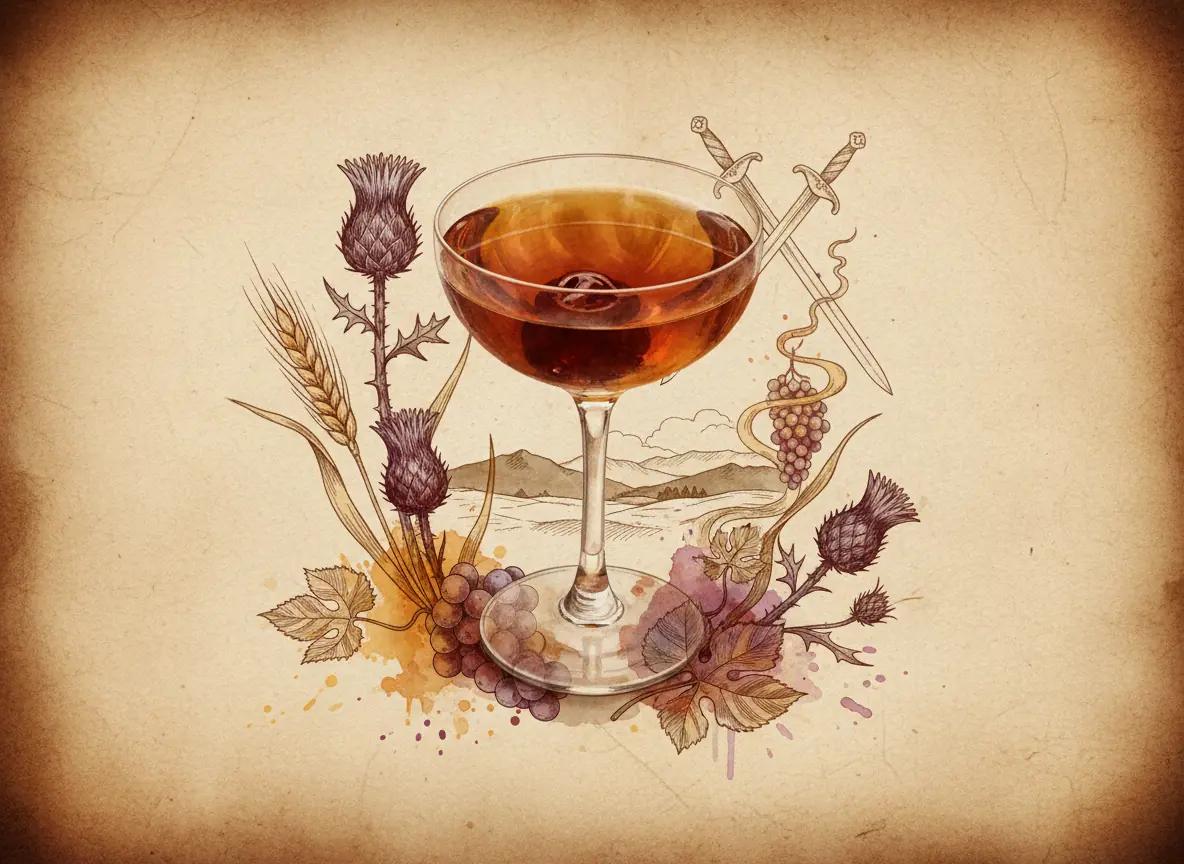
The Rob Roy was created at the Waldorf Astoria in New York in 1894, named after the premiere of a comic opera based on the life of the Scottish folk hero Robert Roy MacGregor. It is a Manhattan built on Scotch rather than rye or bourbon, and that single substitution changes the drink more thoroughly than the swap suggests. The choice of Scotch matters more here than in a Manhattan, because Scotch encompasses a far wider range of styles than either American whiskey category. A lightly peated Highland or Speyside malt produces something elegant and fruit-forward. A heavily peated Islay malt produces something aggressive and divisive. A well-chosen blend produces a consistent, approachable result without sacrificing quality. The Perfect Rob Roy, splitting the vermouth between sweet and dry, suits the more assertive expressions particularly well. Both versions are correct, and the choice properly belongs to the bottle in front of you rather than to habit.

Rusty Nail

The Rusty Nail is two Scotches talking to each other: whisky neat, and whisky that went to finishing school as Drambuie, honey and herbs smoothing the same spirit into a liqueur. Versions of the pairing drifted around under various names from the 1930s, but the drink found its identity in mid-century New York, where the 21 Club poured it for the Rat Pack era and the name finally stuck somewhere around 1963. It is the definitive two-bottle cocktail: no citrus, no bitters, no technique beyond ice and a stir, which made it the house drink of an era that liked its glamour unfussy. The whole recipe is a ratio, and the ratio is a conversation. Heavy on the Drambuie it is a honeyed after-dinner drink; dried out toward four-to-one it becomes a Scotch drinker’s Scotch drink with a Highland accent. Fashion abandoned it along with the rest of the liqueur-led canon, and the cocktail revival quietly took it back: a drink this simple lives and dies on the quality of its two bottles, and the bottles got better. Made with a Scotch you would drink neat, it remains what it always was: the easiest serious drink in the cabinet.
Sazerac

Sazerac

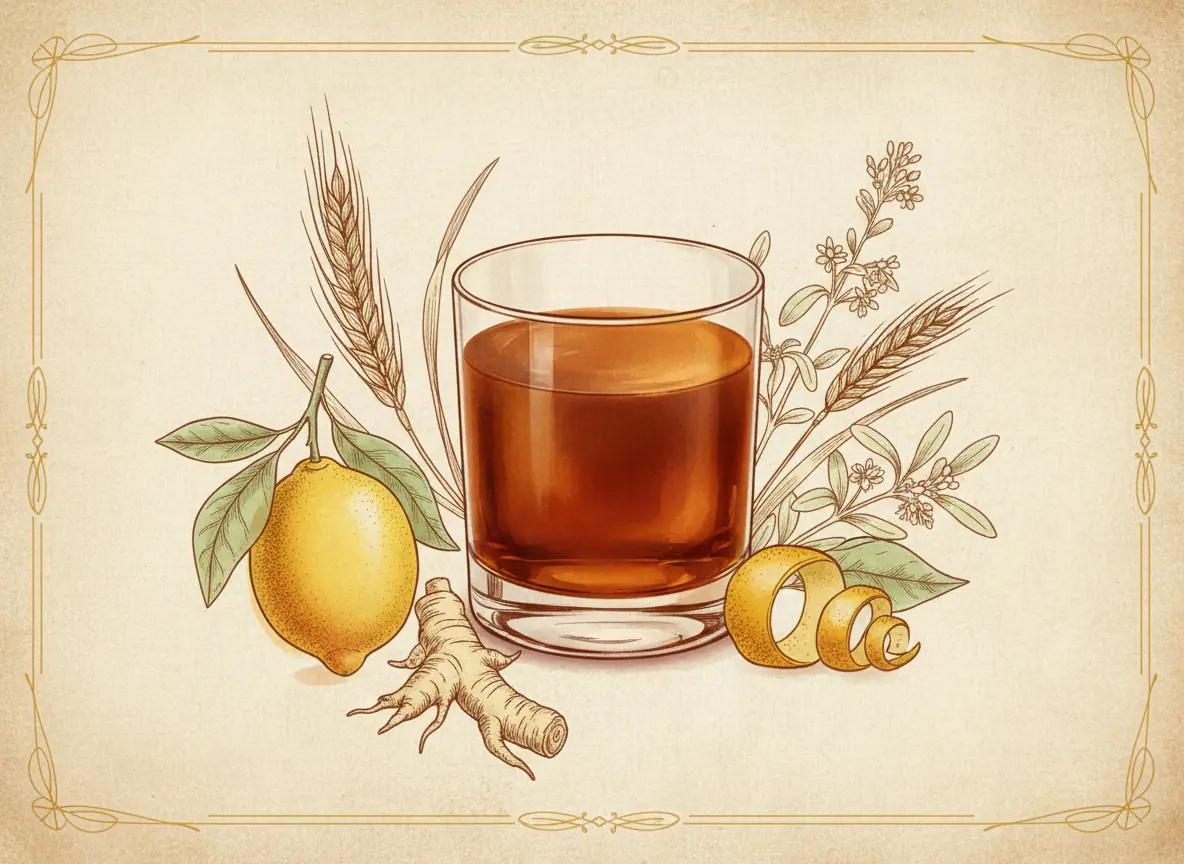
The Sazerac is one of the oldest documented cocktails in American history, originating in New Orleans in the mid-nineteenth century and taking its name from the Sazerac de Forge et Fils cognac that formed its original base. The switch from cognac to rye came gradually, accelerated by the phylloxera epidemic that devastated French vineyards in the 1870s and made cognac scarce across the American market. By the time cognac returned, rye had become the standard and has remained so ever since. It is a three-ingredient drink dressed with an absinthe rinse and a lemon peel expressed and discarded. The absinthe coats the glass, the lemon oils land on the surface, and neither remains in the drink in any measurable volume, yet both are present in every sip in a way that adding them directly cannot replicate. That indirection is the technique. New Orleans has argued about the correct build for as long as the drink has existed. The version here uses rye, Peychaud's with a single dash of Angostura, and a sugar cube.

Seelbach

The Seelbach has the best origin story in the modern canon, twice over. As first told: a pre-Prohibition house cocktail of Louisville’s grand Seelbach Hotel, lost when the Volstead Act closed the bar, and rediscovered in 1995 by restaurant director Adam Seger in an old ledger. Bourbon, orange liqueur, champagne and a frankly outrageous fourteen dashes of bitters. As finally told: in 2016 Seger confessed to Robert Simonson of the New York Times that he had invented the whole thing, recipe and provenance alike, because a grand hotel deserved a signature drink and nobody buys a new one. The hoax had by then spent two decades in respectable cocktail books, and the confession did something remarkable, which was nothing at all. The drink stayed on the lists. It stayed because it is genuinely good, and because the bitters are a genuine idea: seven dashes each of Angostura and Peychaud’s turn a bourbon champagne cocktail into something spiced, rosy and completely distinctive.

Shamrock Sour

The Shamrock Sour is a house serve built for the one night a year that expects the glass to be green: Irish whiskey shaken with fresh lime, honey syrup, blue curaçao and a splash of orange juice, strained into a coupe. The colour is achieved honestly. Blue curaçao lands on the citrus yellows and the glass comes up green, with no artificial colouring anywhere near it. Underneath the colour it is a proper sour. The whiskey’s smoothness leads, honey syrup rounds the lime where plain sugar would leave it sharp, and the curaçao contributes real orange depth alongside the optics. The splash of orange juice warms the green by a shade and softens the acid. That is the brief in full: a drink that photographs like a party and holds together in the mouth like a whiskey sour. Make it properly, because the guests who arrive sceptical are the ones it was written for.

Snowdonia Sour

The Snowdonia Sour is our whisky sour rebuilt around Welsh ingredients: Penderyn shaken with fresh lemon, elderflower liqueur, a short measure of syrup and an optional egg white, strained into a coupe under a lemon wheel. It is a house serve with a working logic rather than a history. The sour template is the most forgiving balance in mixed drinks, and Penderyn's lighter body suits it, the honeyed malt showing through the citrus instead of fighting past it. The elderflower is what makes it Welsh twice over. The liqueur's floral depth stands in for part of the sugar, and elderflower grows wild across the Welsh countryside, so the drink's second flavour is also its second flag. Lemon does the sharpening, ten millilitres of simple syrup trues the balance, and the egg white, if you use it, turns the surface to silk. Dry shake first when the white goes in, and the foam will hold the lemon wheel. Skip it and the drink still works, quicker to make and cleaner-edged.

Stone Fence

The Stone Fence is as old as American drinking: spirit poured into cider and handed across a tavern bar. The colonial original was rum into hard cider, and legend has Ethan Allen’s Green Mountain Boys drinking exactly that at a Castleton tavern in May 1775, hours before they took Fort Ticonderoga without firing a shot. The story may be folklore; the drink is not. This build is the modern American reading: bourbon or rye over ice, cold pressed apple and two dashes of Angostura, built in the glass in under a minute. Fresh cloudy apple juice keeps it soft and sessionable, while a dry hard cider pulls it back toward the 1770s. The name is the drink’s own warning label. After a couple, the story goes, the stone fence between the tavern and home finds you rather than the other way round. Built long and unhurried, this version keeps the walk home honest.

The Emerald

The Emerald is the Manhattan carried across the Atlantic: Irish whiskey over sweet vermouth with orange bitters, stirred cold and strained into a coupe under a lemon twist. It was in print by 1914, when Jacques Straub listed it in his pocket manual Drinks, and the name follows the Manhattan’s own logic. If the original is named for an island, the Irish reading takes the Emerald Isle. The swap changes more than the flag. Rye’s pepper and bourbon’s char step aside for Irish whiskey’s soft orchard fruit, and the drink turns gentler without turning slack. The bitters do the second half of the work: where Angostura pulls a Manhattan toward clove and cinnamon, orange lifts the citrus peel already sitting in the vermouth and lets the whiskey’s honeyed edge through. Sixty millilitres of whiskey, half that of vermouth, three dashes of bitters. The ratio is the family’s; the accent is Ireland’s.

Tipperary

The Tipperary is Irish whiskey, sweet vermouth and green Chartreuse, and it is the boldest thing Irish whiskey does anywhere in the classic canon. Everything else the spirit appears in trades on its gentleness. This one puts it in front of a hundred and thirty herbs at 55 per cent and asks it to hold its ground. Hugo Ensslin printed it in Recipes for Mixed Drinks in 1916, by which point It's a Long Way to Tipperary had been the marching song of the war for two years and was playing on both sides of the Atlantic. The name needed no explaining to anyone reading the book. Ensslin's version is equal thirds, which is a genuinely fierce drink. Most modern specs pull the Chartreuse back to fifteen millilitres so that it seasons rather than leads, and that is the version worth learning first. The original is worth one respectful visit afterwards.

Toffee Apple Sour

The Toffee Apple Sour is the cold answer to Bonfire Night’s signature flavour: a bourbon sour carrying cloudy apple juice and caramel syrup, dry shaken with egg white for a foam that will hold a drizzle of extra caramel. It is a house recipe, written for the drinker who prefers a cold glass whatever the weather is doing outside. The balance is the point. Fresh lemon keeps the caramel honest, the apple juice brings orchard character without heaviness, and the bourbon’s vanilla does the toffee work from underneath before the syrup arrives. Sweet and tart sit level, nothing cloys, and at 45ml of spirit it stays a proper sour rather than a soft one. The dry shake matters more here than the ingredient list suggests. Shaking the egg white without ice first builds the foam that defines the drink’s texture, and the second shake with ice then chills and dilutes it into its final shape.

Toronto

The Toronto is the drink that taught fernet manners. It appears in the bar manuals of 1922 as the Fernet Cocktail, whisky sweetened and seasoned with Milan’s most feared amaro, and acquired its city and its name via Robert Vermeire’s note that it was a favourite of the Canadians of Toronto. Canadian whisky being historically rye-led, the drink settled into its modern form. Structurally it is an Old Fashioned with the fear turned up: the sugar and bitters of the template, with Fernet Branca supplying the aromatic register a twist and a dash normally would. The fernet’s menthol and bitter roots run straight through the rye’s spice, the demerara rounds the collision, and the result is darker and more bracing than any standard Old Fashioned. It has become the standard second step in a fernet education, after the neat shot and before the deep end: enough Branca to taste the point of it, and enough structure around it to stay civilised.
Vieux Carré

Vieux Carré

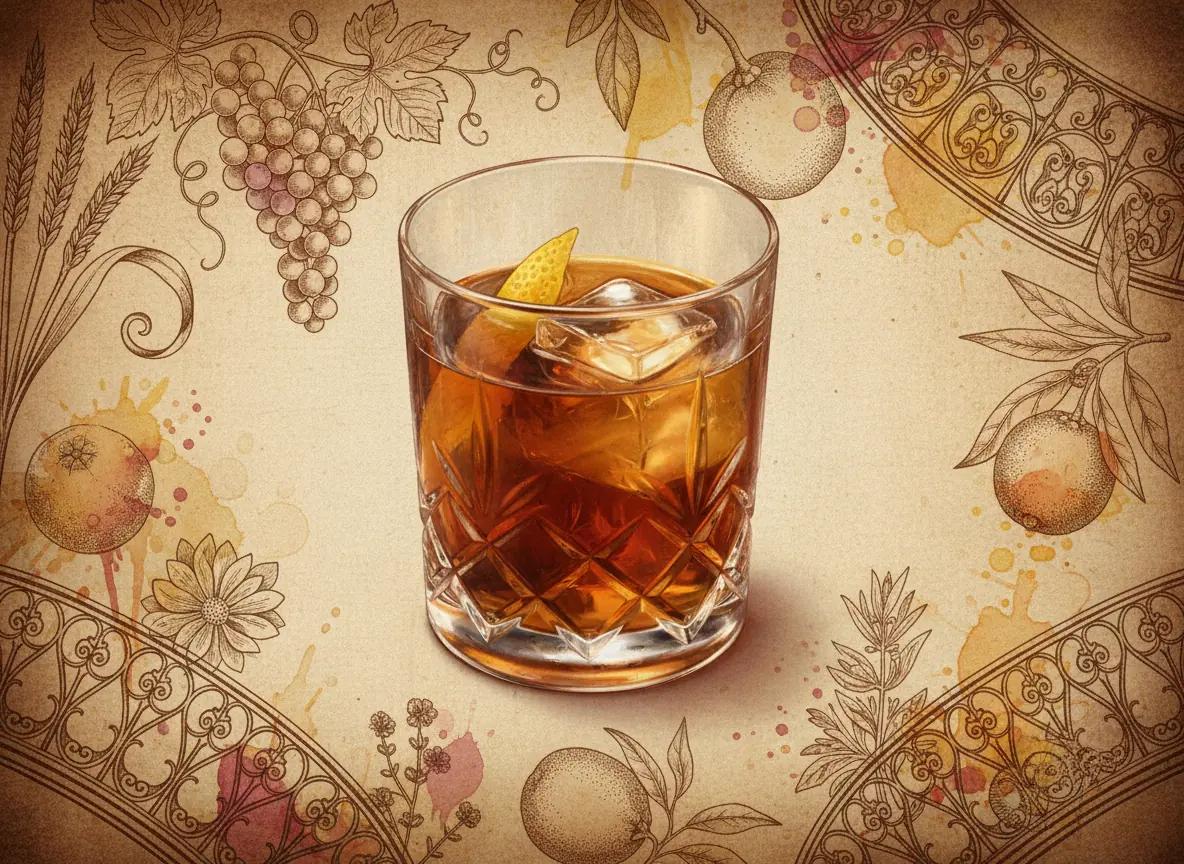
The Vieux Carré was created by Walter Bergeron, head bartender at the Hotel Monteleone in New Orleans, in the 1930s. The name means old square in French, for the French Quarter in which the hotel has sat since 1886. It is one of the most complex stirred drinks in the classical canon, built on a split base of rye whiskey and cognac with sweet vermouth and Bénédictine. That it is less widely known than the Sazerac or La Louisiane is a question of exposure rather than quality. The split spirit base is the structural decision that most defines the drink. Rye provides spice, grip, and a dry backbone; cognac provides dried fruit, warmth, and a roundness the rye alone could not achieve; at equal parts they produce a base more layered than either spirit at full volume. The bitters are where the versions part company. The official specification lists Peychaud's alone, where its anise and floral character sit directly against the Bénédictine. Bergeron's own build carried Angostura alongside it, in the New Orleans split-bitters tradition that also produced the Sazerac, and that version is below.
Ward Eight

Ward Eight

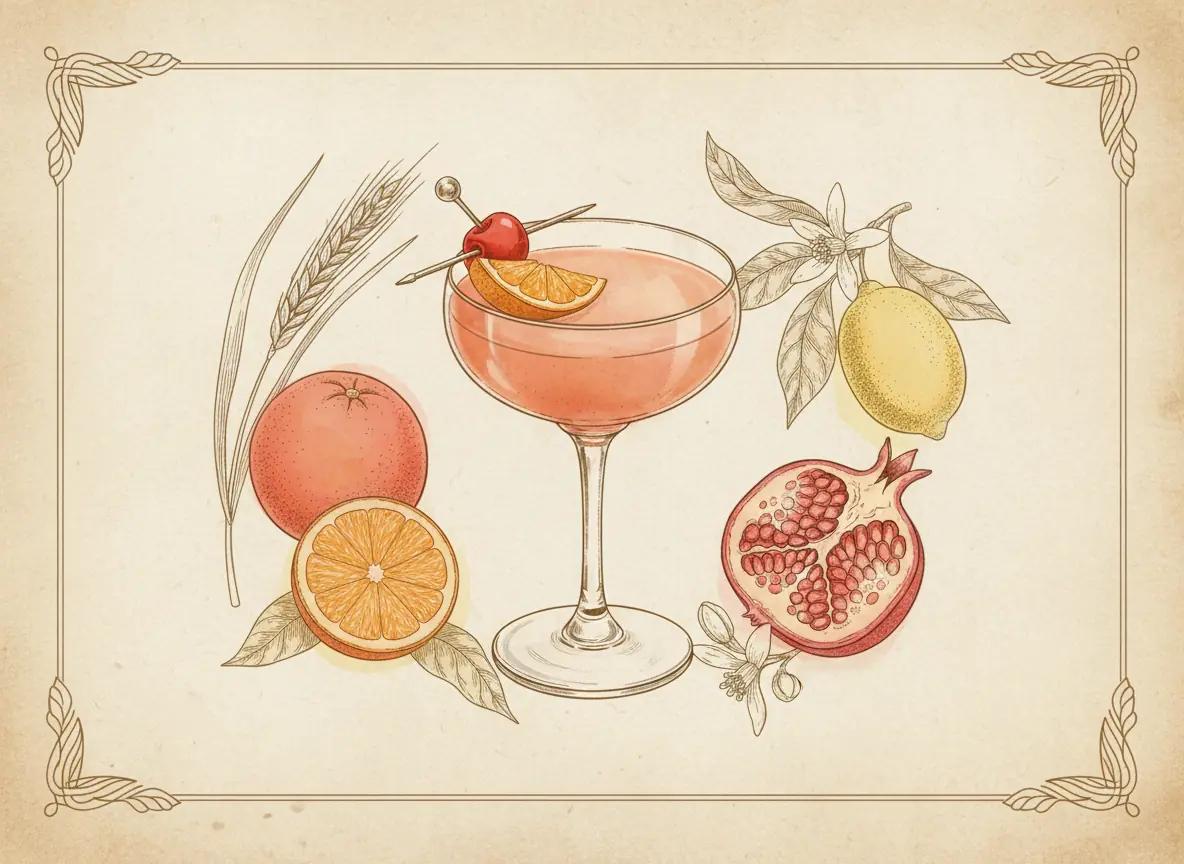
The Ward Eight was created at Locke-Ober Café in Boston in 1898, named after the eighth ward of the city, whose Democratic machine was celebrating the anticipated election victory of Martin Lomasney on the night it was first served. Lomasney won as expected, and the drink outlasted both his career and the ward system by over a century. The structure sits in the whiskey sour family with one element that separates it from the standard sour: rye with fresh lemon juice, fresh orange juice and grenadine. The orange alongside the lemon softens and rounds the citrus, while the grenadine provides the sweetening and a colour that makes this one of the more visually striking drinks in the sour canon. Rye is the historically correct and most interesting choice. Its spice and dryness sit against the combined citrus and grenadine in a way that bourbon's rounder character does not replicate, keeping the whiskey present and the balance dynamic.

Welsh Gold

The Welsh Gold is a house Old Fashioned written for St David’s Day: Penderyn Madeira Finish on a large cube with Welsh honey syrup, two dashes of Angostura and expressed orange. The frame is the oldest one in the book, and the ingredients are the point. Penderyn’s signature expression carries honey sweetness and dried fruit from its Madeira wine casks, and the syrup meets it rather than fighting it, honey answering honey with the bitters holding the seam between them. The measure of the drink is its restraint. Fifteen millilitres of syrup is all the sweetening it takes, because the cask has already done half the work. Add more and the whisky drowns; hold the line and it stays spirit-forward, which is where an Old Fashioned belongs. It suits the first of March, poured slowly while the cawl simmers, but it is not a costume drink: made properly it stands up in any month, and the honey belongs to the whisky rather than to the occasion.

Whiskey Collins

The Whiskey Collins is the Collins template on bourbon: spirit, fresh lemon and sugar shaken together, strained over ice and lengthened with soda. It is the same build as a Tom Collins with the gin swapped out, and the swap changes rather more than it looks like it should. Bourbon's vanilla and oak survive carbonation better than juniper does. Where a gin Collins stays crisp and botanical, this one reads rounder and warmer, closer to sparkling lemonade with a barrel education. Rye instead of bourbon sharpens the same frame for anyone who wants it drier. There is a naming muddle worth knowing about. Mid-century American menus often called this a John Collins, a name that properly belongs to the genever original from Limmer's Hotel in London. The confusion is genuine and old, and it is easier to give the whiskey version its own name than to argue about it every time it comes up.
Whiskey Highball

Whiskey Highball

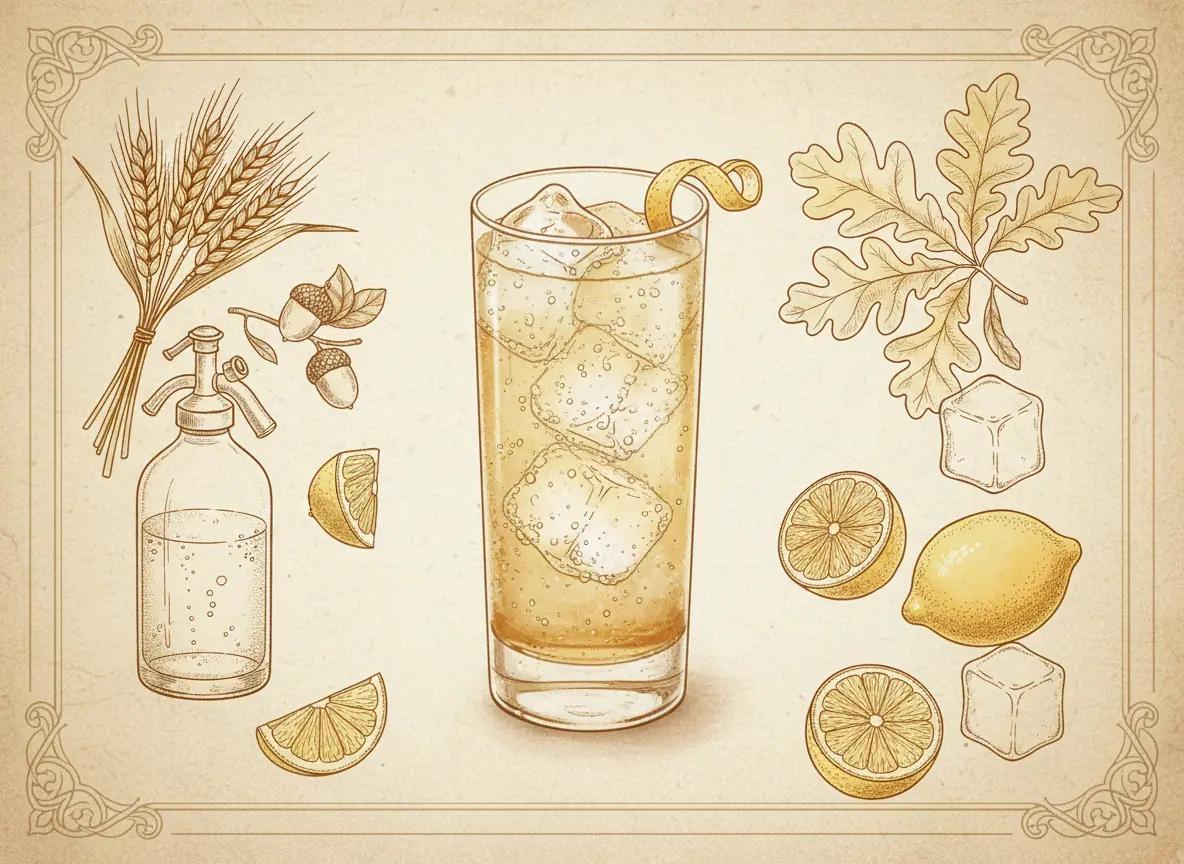
The Highball is one of the oldest and most debated drink formats in the canon, with origin stories placing it variously in American railroad culture, British officers’ messes, and the bars of late nineteenth century New York. The name most likely derives from the railway signal ball that indicated a clear track ahead, fitting for a drink fast to build and faster to consume. The format arrived in Japan in the early twentieth century and was adopted with a seriousness that turned a simple two-ingredient serve into a craft discipline. The Japanese Highball, whisky and soda water over ice in a tall glass, became one of the defining drinks of Japanese bar culture, and the attention given to ice temperature, glass preparation, carbonation preservation, and the ratio of whisky to soda made it the benchmark for the format. The version documented here applies those standards to a Scotch or Irish whiskey base. Two ingredients. The quality of each determines everything. A whiskey with genuine character and a well-chilled, high-carbonation soda, poured correctly over properly prepared ice, produce a drink greater than the sum of its parts; the format has nowhere to hide a characterless whiskey or a flat soda.

Whiskey Smash

The Whiskey Smash is the smash family’s famous face. Jerry Thomas printed the format in 1862 and described it as a julep on a small plan; Dale DeGroff made this reading his calling card at the Rainbow Room in the 1990s and poured it at whiskey sceptics by the thousand until the drink was back in the repertoire for good. Bourbon over lemon wedges muddled skin and all, mint pressed in afterwards, shaken and strained over fresh crushed ice. The whole lemon is what separates this from a julep: muddling the wedges rather than juicing them puts the peel oils into the drink alongside the acid, and that is where a smash gets its particular brightness. Few formats owe their second century so clearly to one bartender. It remains the most reliable answer to anybody who says they do not like whiskey, and it takes about three minutes to make the case.